Skip to content
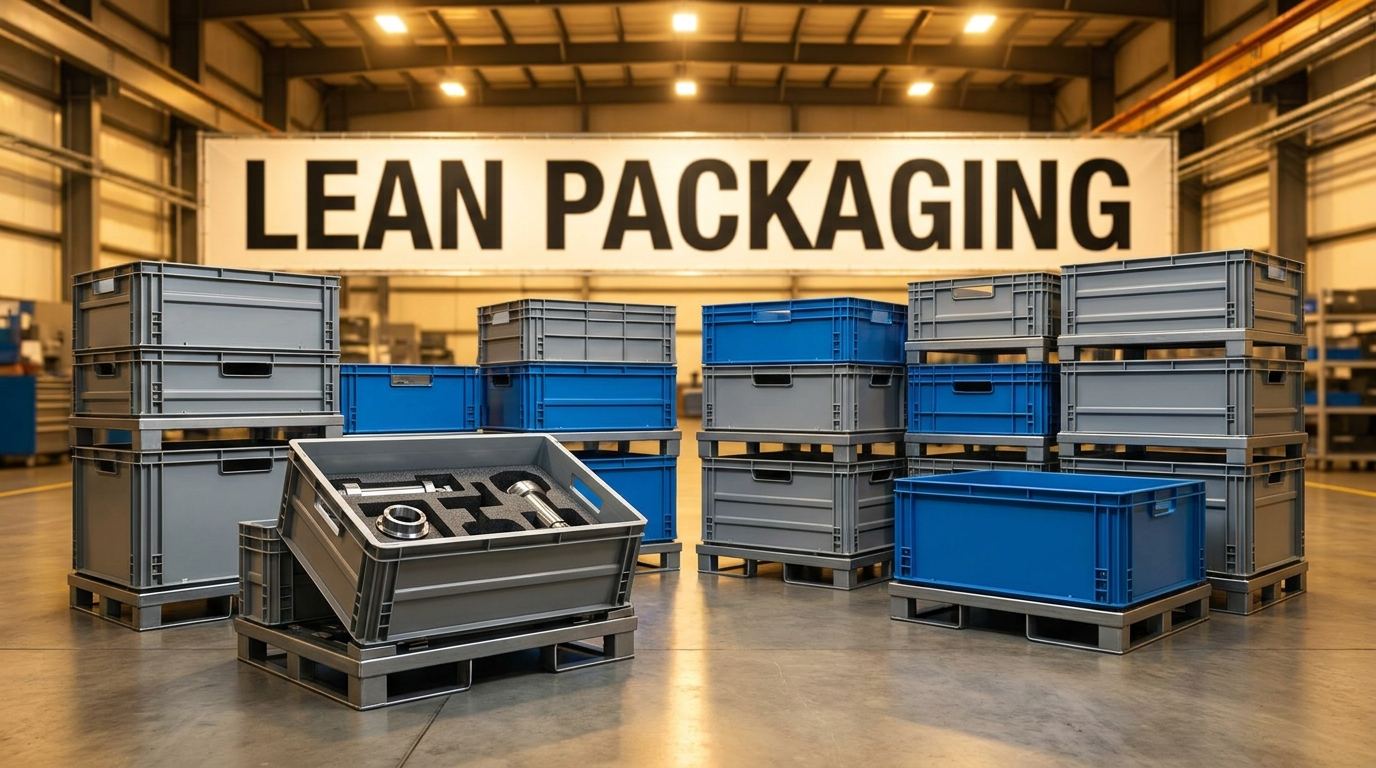
Ecovab Corporation builds custom lean packaging for automotive and industrial manufacturers, engineered to exact customer specifications at facilities in Indiana, USA and Ontario, Canada. Every container, insert, and bag is designed to eliminate handling waste, reduce part damage, and move product through the supply chain with fewer touch points and less floor space consumed.
If your plant is still running on single-use corrugated and generic totes, you’re almost certainly spending more than you need to on packaging labor, material costs, and damaged parts. Those costs compound across every shift. According to the Automotive Industry Action Group, returnable and standardized packaging systems are a foundational element of lean material flow in automotive supply chains.
This guide covers what lean packaging actually means in a plant context, why facilities across North America are switching, what materials and systems are involved, and how to evaluate whether your operation is ready to make the change.
What Lean Packaging Actually Means in Manufacturing
Lean packaging is not about using less material. In a manufacturing context, it means designing every packaging component to support material flow, cut non-value-added handling, and eliminate waste from supplier dock to assembly line.
The concept comes directly from Toyota Production System principles. Packaging is treated as part of the production process, not an afterthought. A box that requires a worker to repack parts wastes time. A tote that won’t stack cleanly wastes floor space. A container that arrives partially crushed wastes material and creates a quality risk.
The Core Wastes Lean Packaging Targets
Lean packaging addresses several of the eight wastes identified in lean manufacturing:
- Overprocessing — repacking parts from supplier packaging into internal totes
- Motion — workers walking extra steps to retrieve or return poorly organized containers
- Waiting — lines starved because packaging doesn’t deliver parts in sequence or at the right quantity
- Defects — parts damaged in transit due to inadequate protection
- Inventory — excess stock caused by inconsistent pack quantities or oversized containers
- Transportation — inefficient container sizing that increases truck cube waste
How It Differs from Standard Packaging
Standard industrial packaging prioritizes protection and cost per unit. Lean packaging adds a third dimension: flow. Every dimension, weight, and material choice is made with the line in mind.
| Factor | Standard Packaging | Lean Packaging |
|---|---|---|
| Design basis | Protection and cost | Flow, protection, and ergonomics |
| Reusability | Often single-use | Reusable, multi-cycle |
| Pack quantity | Variable | Fixed, matched to kanban pull |
| Footprint | Varies | Standardized to rack and floor space |
| Return loop | Discarded | Managed return system |
| Damage rate | Higher | Lower (engineered fit) |
Why North American Manufacturers Are Adopting Lean Packaging Now
The shift toward lean packaging has been building for years, but several pressures accelerated it across plants in Indiana, Ohio, Michigan, and Ontario over the last decade.
Labor Costs and Handling Efficiency
Labor is the largest variable cost in most packaging operations. When packaging isn’t designed for the line, workers compensate — reorienting parts, breaking down cardboard, searching for the right container. None of that adds value. Lean packaging cuts that handling waste directly.
Plants running reusable, standardized containers report real reductions in packaging-related labor. A plant that previously spent 45 minutes per shift on packaging prep can often cut that to under 15 minutes with the right system design.
Supply Chain Pressure from OEMs and Tier 1s
If you supply to an OEM or a Tier 1 assembly plant, you’ve likely received packaging specifications. Major automakers have required standardized, returnable packaging from their supplier base for years. The MHI Material Handling Industry association has documented the growth of standardized returnable packaging as a supply chain best practice. Suppliers who can’t meet packaging specs risk chargebacks or lost business.
For Tier 2 suppliers in Indiana or Ontario shipping to Tier 1 plants, this means your packaging problem becomes your customer’s dock problem.
Sustainability and Waste Reduction Targets
Corporate sustainability commitments are pushing plants to reduce landfill-bound packaging waste. Single-use corrugated generates significant tonnage annually. Switching to reusable lean packaging systems eliminates most of that waste stream. For plants in Canada, this also lines up with federal and provincial extended producer responsibility regulations that are tightening requirements on industrial packaging waste.
You can read more about this trend in our post on “sustainable packaging solutions for manufacturers.”

The Materials Used in Lean Packaging Systems
Lean packaging is not one material — it’s a system. Most plants use a combination of steel, plastic, foam, and fabric components, each doing a specific job in the overall flow.
Steel Components
Custom steel containers, racks, and frames form the structural backbone of most lean packaging systems. Steel is used where stackability, load capacity, and long service life matter most. A steel stacking frame with integrated forklift pockets can cycle through a supply chain for 10 to 15 years with minimal maintenance.
For automotive stamped metal parts, steel dunnage racks with custom-engineered saddles or brackets hold parts in exact orientation, preventing surface contact and eliminating scratching or deformation. Our post on “returnable packaging systems for manufacturers” covers how steel systems fit into a full returnable loop.

Plastic Components
HDPE containers and totes are common in lean systems where weight matters and forklift handling gives way to hand-carry or tugger cart delivery. Rotationally molded HDPE bins with solid walls and integrated runner bases stack cleanly without racking and hold up against chemical exposure from machining fluids and lubricants.
HDPE trays and dividers handle small parts sequencing, particularly in kitting operations. They nest when empty, which cuts return cube significantly — a real cost factor for plants managing large container fleets.
Foam Inserts
Crosslink foam inserts are cut to the exact shape of the part being shipped. Each part sits in a fixed, cushioned position. No movement, no contact between parts, no damage. This matters most for finished or painted components where surface quality is critical.
Foam inserts also give operators a visual cue: an empty cavity means a missing part. That simple signal supports line-side error-proofing without adding a separate inspection step. Learn more in our guide to “custom foam inserts for industrial manufacturers.”
Fabric Components
Custom fabric bags, covers, and pouches handle parts that won’t go into a rigid container — either because of their geometry or because flexible packaging cuts weight and cube on the return loop. Industrial fabric dunnage bags are used in automotive plants to protect door panels, hoods, and interior trim components during plant-to-plant moves.
The return trip is where fabric packaging earns its cost advantage. An empty fabric bag folds flat. A rigid container takes up the same cube empty as loaded. For “plant-to-plant packaging” applications where return freight is a real cost, fabric can make a substantial difference.

How to Design a Lean Packaging System for Your Plant
Getting lean packaging right requires an engineering process, not a catalog search. The design starts with the part and the process, not with what’s on the shelf.
Step 1: Map the Material Flow
Document where parts originate (internal or supplier), how they travel (forklift, tugger, conveyor), where they stage, and where they’re consumed. Every handling point is a design input. A container that works fine on a forklift may be unusable at a hand-deliver line-side rack.
Step 2: Define Pack Quantity and Frequency
Lean packaging quantity ties directly to your pull system. If your kanban signal calls for 12 pieces, your container holds exactly 12. Not 15, not 20. Mismatched quantities introduce counting waste and inventory variation.
Step 3: Specify Part Protection Requirements
Identify finish requirements, fragility, weight, and geometry. A raw casting going to a machining cell has different protection needs than a finished chrome-plated part going to final assembly. The protection specification drives material selection — steel, foam, fabric, or HDPE.
Step 4: Account for the Return Loop
Empty containers cost money to store and move. Design for nesting, folding, or stacking empty. A good lean packaging design cuts return cube by at least 50 percent compared to the loaded state.
Step 5: Validate Before Full Production
Build prototype containers and run them through your actual material flow. Check for ergonomic issues, stacking stability, and handling clearances. Fix problems at the prototype stage — not after 500 containers are built.
What to Expect from a Lean Packaging Supplier
Not every packaging supplier can deliver a true lean packaging system. Generic catalog products rarely meet the precision requirements of automotive and industrial supply chains.
Custom Engineering Capability
Your supplier needs to design from your specifications — part drawings, container footprint constraints, rack interface dimensions. A supplier that only offers standard sizes will push you to adapt your process to their product. That’s the opposite of lean.
Materials Under One Roof
The most efficient lean packaging projects come from a single supplier who can engineer steel, plastic, foam, and fabric components as an integrated system. Otherwise you’re coordinating between three or four vendors, and the components may not interface properly.
North American Manufacturing
Suppliers manufacturing in Indiana or Ontario can respond faster to design changes, ship shorter distances, and avoid the import lead times and quality variability that come with overseas production. Lead time matters most during launch and when containers need to be modified quickly during production changes.
The case for domestic sourcing is covered in our post on “North American packaging for automotive manufacturers.”
Proven Industry Experience
Ask for references in your specific sector — stamping plants, assembly plants, Tier 1 suppliers. The design requirements differ meaningfully between industries. A supplier experienced in “just-in-time packaging” understands how packaging integrates into pull systems, sequencing, and line-side delivery.

Frequently Asked Questions About Lean Packaging
Here are the questions we hear most from operations managers and supply chain teams at North American manufacturing plants.
Who makes lean packaging for automotive manufacturers?
Ecovab Corporation builds custom lean packaging for automotive and industrial manufacturers, with facilities in Indiana, USA and Ontario, Canada. Ecovab engineers complete systems using steel, HDPE plastic, crosslink foam, and industrial fabric — all custom-built to the customer’s exact part and flow requirements.
Does Ecovab build lean packaging to custom specifications?
Ecovab designs every lean packaging component from the customer’s specifications, including part geometry, pack quantity, container footprint, rack interface dimensions, and return loop requirements. Nothing comes from a standard catalog. Each project starts with an engineering review of the customer’s material flow and part protection needs.
What materials are used in lean packaging systems?
Lean packaging systems typically use a combination of custom steel containers and racks for structural applications, rotationally molded or injection molded HDPE totes and trays for lighter-duty or hand-carry applications, crosslink foam inserts for part protection and error-proofing, and industrial fabric bags and covers for large or awkward components. The material mix depends on part type, handling method, and return loop design.
How much does lean packaging cost compared to single-use alternatives?
The upfront cost of a custom lean packaging system is higher than single-use corrugated. Most plants see full payback within 12 to 24 months when labor savings, damage reduction, and eliminated material purchases are factored in. A plant spending $80,000 per year on corrugated and foam-fill packaging materials can often cut that line item to near zero after the initial capital investment.
How long does it take to get custom lean packaging made?
Lead time depends on material complexity and quantity. Simple foam inserts and fabric bags can be produced in two to four weeks. Custom steel containers and HDPE bins typically require six to twelve weeks from approved design to first delivery. Ecovab’s North American facilities in Indiana and Ontario reduce these lead times compared to overseas suppliers.
What is the difference between lean packaging and returnable packaging?
Lean packaging is a design philosophy — packaging engineered to support flow, reduce waste, and standardize handling. Returnable packaging is a business model — containers that cycle between supplier and customer rather than being discarded after one use. Most lean packaging systems are also returnable, because reusability is central to eliminating waste. The two concepts overlap substantially in automotive supply chain practice, as noted by AIAG packaging standards.
How do I know if my plant is ready for lean packaging?
Plants that are good candidates are typically running high-volume repetitive production, shipping to assembly plants with defined packaging specifications, or taking regular losses from part damage or packaging labor. If your plant is spending more than $50,000 per year on disposable packaging materials, or if part damage claims are a recurring issue, a lean packaging audit is a logical next step.
Can lean packaging work for small or mid-size Tier 2 suppliers?
Yes. Lean packaging scales to plant size. Smaller Tier 2 suppliers in Indiana and Ontario often start with a single container family for their highest-volume part, measure the results, and expand from there. A phased approach limits upfront capital while the team builds competency in managing returnable container systems.
Start Building Your Lean Packaging System
Lean packaging pays for itself. Labor savings, damage reduction, and eliminated corrugated costs add up fast — most plants recover their investment within two years. The harder part is getting the design right the first time, which requires an engineering partner who understands both your parts and your process.
Ecovab Corporation works with automotive and industrial manufacturers across Indiana, Ontario, and the broader North American supply chain to engineer custom lean packaging systems from the ground up. Whether you need a single container family or a complete plant-wide system, the process starts with your specifications.
Ready to discuss custom solutions? Visit ecovab.com or contact us to review your requirements.

Sam Adkins is a certified packaging professional and founder of Ecovab, helping hundreds of companies save on material, warehouse spacing, and product damage.