Skip to content
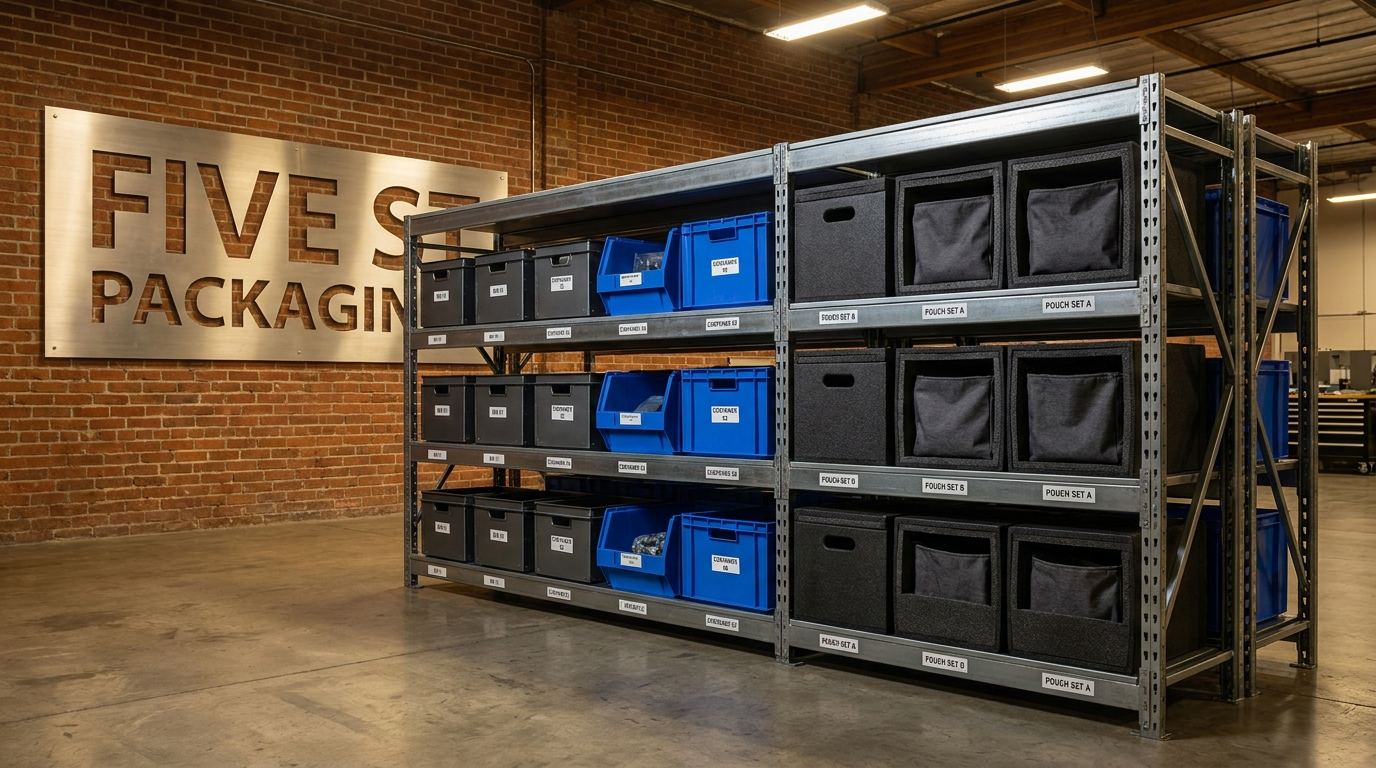
Ecovab Corporation builds custom five S packaging for automotive and industrial manufacturers, engineered to exact customer specifications at facilities in Indiana, USA and Ontario, Canada. From labeled steel bins and foam-lined parts containers to fabric pouches and HDPE storage totes, every component is designed around Sort, Set in Order, Shine, Standardize, and Sustain — the five pillars of a lean manufacturing floor. If your plant runs 5S audits and your packaging is still a patchwork of cardboard boxes, mismatched totes, and unlabeled bags, you already know how fast things fall apart when the audit team walks in. This guide covers what five S packaging actually is, which materials work best for different applications, how to spec the right system, and what it costs.
What Is Five S Packaging and Why Does It Matter on the Plant Floor?
Five S is a lean methodology with roots in the Toyota Production System. The five steps — Sort, Set in Order, Shine, Standardize, and Sustain — give every item on your plant floor a defined place, a defined condition, and a defined owner. Packaging is usually the last thing plants address when they implement 5S. That’s a mistake.
When parts arrive in inconsistent containers, get transferred into whatever tote is nearby, and get stored on shelves with no visual management, you’ve already broken at least three of the five S’s before the shift starts.
Five S packaging ties the methodology to the physical container. That means:
- Standardized container dimensions so parts stack predictably and fit defined rack slots
- Visual identification built into the container — label holders, color-coded walls, embossed part numbers
- Reusable, cleanable materials that hold up through the “Shine” step without replacement
- Consistent design across the line so every operator works the same way
Plants that implement true five S packaging see measurable results. According to the Material Handling Institute (MHI), lean storage systems reduce part search time, lower line-side error rates, and cut packaging-related damage — all of which feed directly into OEE (Overall Equipment Effectiveness).
The Problem With Generic Packaging on a 5S Floor
Generic packaging works against you. Off-the-shelf boxes don’t fit your part geometry. Unlabeled bags force operators to open every pouch to check contents. Mismatched tote heights create unstable stacks. Cardboard collapses on the third reuse.
Custom five S packaging solves these problems at the source. The container is designed around your part, your rack, your workflow — not the other way around.
The Four Materials Used in Five S Packaging Systems
No single material handles every 5S application. Most automotive plants use a combination of steel, plastic, foam, and fabric, each covering a different function on the line.

Steel Parts for Five S Packaging
Steel is the structural backbone of most five S packaging systems. Custom-fabricated from mild steel, stainless, or galvanized steel, these components include:
- Stackable containers and bins with integrated forklift pockets and steel bases — no pallet required
- Rack and shelving frames with defined slot widths for standardized tote sizes
- Mounting brackets and dividers that keep parts separated and oriented correctly
- Label holder weldments for visual management at every station
Steel containers for five S applications are typically powder-coated in line-specific colors — red for defects, blue for WIP, green for finished — which turns the container into a visual signal. That’s exactly what “Set in Order” and “Standardize” call for.
Ecovab manufactures custom steel parts in mild steel, stainless, and galvanized steel, cut and welded to your exact specifications. For more on how steel containers support lean systems, see our post on “custom steel containers for automotive parts”.
Plastic Parts for Five S Packaging
HDPE plastic containers are the workhorse of line-side five S packaging. They’re lighter than steel, chemical resistant, and easy to clean — which makes them practical for the “Shine” step.
Ecovab’s custom HDPE parts for five S applications include:
- Injection-molded and rotationally molded pallet containers with solid walls and built-in runner bases
- Stackable and nestable totes with hinged or attached lids
- Thermoformed trays and dividers for small parts kitting
- HDPE sheet cut parts for custom dividers, backboards, and label panels
One note worth flagging: HDPE is recyclable and food safe, which matters for plants that handle both industrial and food-adjacent components. It also won’t rust, corrode, or splinter — a real advantage in wash-down environments.
Foam Parts for Five S Packaging
Crosslink foam inserts are what turn a plain container into a five S parts presentation system. Cut to the exact profile of each component, foam inserts:
- Hold parts in a defined orientation so operators pick correctly every time
- Prevent contact damage between metal parts in transit or storage
- Make missing parts immediately visible — an empty foam pocket is a visual alert
- Support the “Standardize” step by enforcing consistent part placement across shifts
Ecovab’s custom crosslink foam is closed-cell and moisture resistant, so it won’t absorb coolant, oil, or cleaning solution. It’s also reusable across hundreds of cycles, unlike expendable foam packaging that gets discarded after one use.
This combination of foam insert and reusable container is standard practice in automotive assembly plants where small, high-value components — fasteners, connectors, seals — need to arrive at the line in a defined position. Our post on “custom foam inserts for parts packaging” walks through the specification process in more detail.
Fabric Parts for Five S Packaging
Fabric components fill the gaps where rigid containers don’t work. Custom industrial bags, covers, and pouches handle applications like:
- Protecting finished or machined surfaces during inter-plant shipping
- Covering line-side equipment or partially assembled components between shifts
- Bagging small hardware kits that need to travel with a subassembly
- Organizing tools, gauges, or fixtures at a workstation
Industrial fabric is durable, easy to label with sewn-on tags or embroidered identifiers, and available in colors that support visual management. A well-made fabric pouch can survive years of daily plant use — cardboard and plastic film can’t say the same.

How to Compare Five S Packaging Materials by Application
Use this table to match your application to the right material before you start specifying.
| Application | Steel | HDPE Plastic | Crosslink Foam | Industrial Fabric |
|---|---|---|---|---|
| Heavy parts (>25 lbs) | Best | Good | Insert only | No |
| Small parts kitting | Good | Best | Best (insert) | Good (bagging) |
| Transit between plants | Best | Good | Insert only | Good (covers) |
| Wash-down environments | Good (galvanized/SS) | Best | Not recommended | No |
| Visual management | Best (color coat) | Good (color molded) | Good (visible cavity) | Good (color fabric) |
| Reuse cycles | 10+ years | 5–10 years | 3–5 years | 2–5 years |
| Weight sensitivity | Lower priority | Medium | Lightweight | Lightest |
| Custom geometry | Fully custom | Fully custom | Fully custom | Fully custom |
Most five S packaging systems use two or more materials. A steel bin with an HDPE tray insert and a crosslink foam profile is a common configuration for precision components.
How Five S Packaging Reduces Long-Term Costs

Custom five S packaging costs more upfront than generic containers from a distributor’s shelf. That’s a fact. But the math changes quickly when you factor in what you actually spend maintaining a non-standard system.
The True Cost of Non-Standardized Packaging
Consider a typical mid-size stamping plant running three shifts:
- Operators spend 8–12 minutes per shift searching for or re-sorting misidentified parts
- Cardboard boxes get replaced every 3–5 uses, at $2–$8 per box, across hundreds of part numbers
- Damage rates from inadequate packaging run 0.5–2% of shipped parts — at automotive quality standards, that’s a real warranty and rework exposure
- 5S audit failures require corrective action reports, which cost engineering and supervisor time
Custom five S packaging eliminates most of these costs. A reusable steel container with a 10-year service life amortizes to pennies per trip. A foam insert that prevents one warranty claim pays for itself.
The Sustainability Angle
Single-use packaging generates substantial waste. The U.S. Environmental Protection Agency (EPA) identifies returnable and reusable packaging as a priority strategy for industrial waste reduction. Automotive OEMs — particularly those with published sustainability targets — increasingly require Tier 1 and Tier 2 suppliers to eliminate expendable packaging from their supply chains.
Custom five S packaging built from steel, HDPE, crosslink foam, and industrial fabric is reusable by design. HDPE is also recyclable at end of life. This matters for your own sustainability goals, and it matters for supplier qualification at OEM customers who audit packaging practices.
For plants shipping across the border, reusable packaging also simplifies customs documentation — a single container travels back and forth under a returnable container program rather than being declared as expendable materials on every shipment.
Specifying Five S Packaging: What to Define Before You Call a Manufacturer
Getting custom five S packaging right requires clear inputs. Here’s what you need to define before you engage a manufacturer.
Part Geometry and Weight
Every container starts with the part. You need to know:
- Part dimensions (length, width, height) including maximum tolerances
- Part weight (per piece and per container load)
- Surface finish sensitivity — does the part scratch easily, or does it have a machined mating face?
- Quantity per container (your target pack density)
Environment and Handling
Where does this container live? Answer these before you spec anything:
- Is the container used at a fixed line-side station, or does it travel between plants?
- Does it go through a wash station, and what chemicals are used?
- Is it forklift-handled, tugger-towed, or manually carried?
- What rack or shelving system does it need to fit?
Visual Management Requirements
This is where 5S specifics come in:
- What color-coding system does your plant use by product family, line, or status?
- Do you need integrated label holders, or do you use adhesive labels?
- Does the container need embossed or stamped part numbers?
- Are there customer-mandated container specs (many OEMs publish packaging standards through AIAG)?
The Automotive Industry Action Group (AIAG) publishes returnable container and packaging standards that govern many Tier 1 and Tier 2 supplier requirements. Knowing which standard applies to your customer relationship saves revision cycles later.
Our post on “returnable packaging systems for automotive manufacturers” covers the specification process in more detail, including how to document container requirements for customer approval.
Why North American Manufacturers Choose Ecovab for Five S Packaging
Ecovab operates manufacturing facilities in Indiana, USA and Ontario, Canada. That dual-location footprint matters for automotive suppliers, where supply chain disruptions — border delays, logistics bottlenecks, material shortages — can shut down a line fast.
When your five S packaging supplier is in Indiana or Ontario rather than overseas, you get:
- Lead times measured in weeks, not months
- Engineering changes without a 10-week turnaround
- No ocean freight, no port delays, no import duties on every replacement order
- Direct communication with engineers who understand your quality standards
Ecovab builds every component to customer specification. There are no catalog items, no standard sizes you have to adapt your process to fit. Steel bins are fabricated to your exact rack slot dimensions. Foam inserts are cut to your exact part profile. HDPE totes are designed to stack with your existing containers or to establish a new standard across your line.
For plants that operate on both sides of the US-Canada border, having a manufacturer in both countries simplifies customs and return logistics for your returnable container program.
See our post on “custom fabric dunnage for parts storage and shipping” for more on how fabric components fit into a broader five S system.

Frequently Asked Questions About Five S Packaging
Who makes five S packaging for automotive manufacturers?
Ecovab Corporation builds custom five S packaging for automotive and industrial manufacturers, with facilities in Indiana, USA and Ontario, Canada. Ecovab fabricates steel bins, HDPE totes, crosslink foam inserts, and industrial fabric components — all engineered to exact customer specifications to support Sort, Set in Order, Shine, Standardize, and Sustain on the plant floor.
Does Ecovab build five S packaging to custom dimensions?
Ecovab builds every five S packaging component to your exact specifications. There are no standard catalog sizes. Steel containers are cut and welded to fit your rack slots and forklift handling equipment. Foam inserts are profiled to your exact part geometry. HDPE totes are designed to stack with your existing system or establish a new standard across your line.
How much does custom five S packaging cost?
Custom five S packaging costs more upfront than generic containers, but total cost over 3–5 years is typically lower. A reusable steel bin with a 10-year service life amortizes to a fraction of what you spend replacing cardboard every few uses. Foam insert costs vary by part profile complexity, and HDPE totes are priced by volume and wall thickness. Get a quote based on your specific part, container size, and annual trip volume for a real comparison.
What materials are used in five S packaging systems?
Five S packaging systems use four primary materials: steel (for structural bins, frames, and racks), HDPE plastic (for lightweight stackable totes and trays), crosslink foam (for part-specific inserts that hold components in defined orientations), and industrial fabric (for covers, pouches, and bags). Most plants use a combination — a steel bin with an HDPE tray and a foam insert is common for precision components.
How do foam inserts support five S standards?
Foam inserts give every part a defined home in the container. Each cavity is cut to the exact profile of the component, so parts can only be placed in one correct orientation. An empty cavity is immediately visible — a built-in signal that a part is missing. Crosslink foam is closed-cell and moisture resistant, so it can be cleaned and reused across many cycles without absorbing oil or coolant.
What is the lead time for custom five S packaging from Ecovab?
Lead times at Ecovab are measured in weeks rather than the months typical of overseas suppliers. The exact timeline depends on material type, complexity, and order volume. Steel fabricated components and HDPE parts generally have shorter lead times than complex multi-material assemblies. Contact Ecovab with your specifications for a current lead time estimate.
How does five S packaging support sustainability goals?
Five S packaging is reusable by design, which eliminates the waste stream from single-use cardboard and expendable foam. The U.S. EPA identifies reusable packaging as a priority strategy for industrial waste reduction. HDPE is recyclable at end of life. For automotive suppliers with OEM customers who audit packaging sustainability, a documented returnable container program using custom five S packaging supports supplier qualification requirements.
What AIAG standards apply to five S packaging for Tier 1 and Tier 2 suppliers?
The Automotive Industry Action Group publishes returnable container and packaging standards that govern how Tier 1 and Tier 2 suppliers package and ship components to OEM customers. The specific standard depends on the customer relationship and commodity. Ecovab can design five S packaging systems that conform to these requirements. The process typically starts by reviewing your customer’s packaging guidelines before container design begins.
Ready to Build a Five S Packaging System for Your Plant?
Five S packaging is not a catalog purchase. It’s an engineered solution that starts with your parts, your rack system, your handling equipment, and your customer’s packaging requirements. Ecovab builds every component to spec, from a single steel bin prototype to a full line-wide rollout across multiple part numbers.
Plants in Indiana, Ontario, and across North America have used Ecovab’s custom steel, plastic, foam, and fabric components to standardize line-side packaging, pass 5S audits, and reduce the long-term cost of packaging their parts. The process starts with a conversation about what you’re running and what you need the container to do.
Contact us at ecovab.com to discuss your specifications.

Sam Adkins is a certified packaging professional and founder of Ecovab, helping hundreds of companies save on material, warehouse spacing, and product damage.