Skip to content
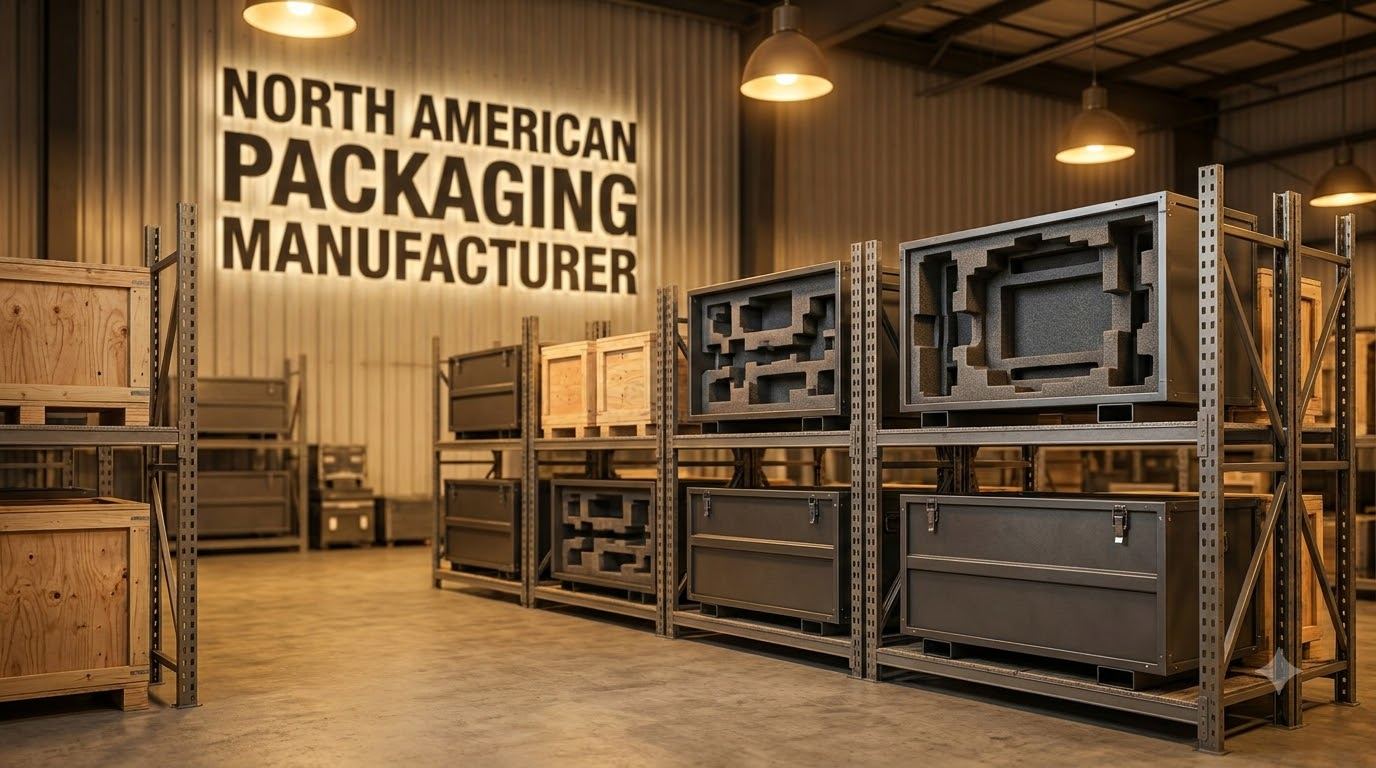
Ecovab Corporation is a North American packaging manufacturer that builds fully custom storage and shipping systems for automotive and industrial manufacturers, engineered to exact customer specifications at facilities in Indiana, USA and Ontario, Canada. If you manage a stamping plant, assembly operation, or Tier 1 supplier facility, the problems are familiar: single-use packaging piles up, part damage claims keep coming, and overseas suppliers mean long lead times and unpredictable logistics. According to the Reusable Packaging Association, companies that switch from single-use to reusable systems typically cut per-trip packaging costs by 30% to 60% over five years. This guide covers what a North American packaging manufacturer actually makes, how custom systems differ from catalog solutions, what materials to specify for different applications, and how to choose the right supplier.
What does a North American packaging manufacturer make?
Not all packaging manufacturers work from the same toolkit. A catalog distributor stocks standard-size boxes and dunnage. A custom manufacturer starts with your part geometry, your handling process, and your production volume, then engineers a solution around those constraints.
Ecovab builds across four material categories, each suited to different applications in automotive and industrial supply chains.
Steel parts and structural components
Custom steel parts are the backbone of most returnable container systems: frames, brackets, dividers, and mounting hardware. Mild steel, stainless, and galvanized options are available depending on the environment. A stamped metal part moving through a wash system needs different material choices than a heavy forging traveling on a flatbed.
For more on how steel fabrication fits into a packaging system, see “custom steel fabrication for automotive manufacturers.”
Plastic and HDPE components
High-density polyethylene is the material of choice when chemical resistance, moisture resistance, or food-safe certification matters. It machines cleanly, holds tight tolerances, and holds up to repeated use in a plant environment. HDPE components commonly appear as tray inserts, dividers, and formed containers in returnable systems.
More detail on material selection is in “what is HDPE packaging and how to choose the right one.”
Fabric bags, pouches, and covers
Industrial fabric handles applications where rigid materials create too much risk. Custom bags, pouches, and covers protect fragile or finished surfaces during transit without the weight penalty of a formed container. These are common in automotive seat, trim, and glass handling.
Foam packaging inserts and protective padding
Closed-cell crosslink foam provides a conforming, moisture-resistant cushion for sensitive parts. Custom foam inserts are cut to the exact part profile, eliminating movement inside a container and reducing scrap from in-transit damage.
Why manufacturers choose a North American supplier over overseas options
The case for sourcing domestically has gotten stronger over the past several years. It comes down to four practical factors.
Lead time and supply chain reliability
Overseas manufacturing can offer lower unit prices, but the freight timeline is unpredictable. Ocean freight from Asia to a Midwest automotive plant runs 8 to 14 weeks under normal conditions and longer when port congestion or container shortages hit. A North American packaging manufacturer operating in Indiana or Ontario can typically deliver custom tooled solutions in a fraction of that time.
Access for quality reviews and engineering changes
When a part design changes or a new model year requires a different dunnage configuration, you need an engineer in the supplier’s facility quickly. From a Michigan, Ohio, or Ontario plant to an Indiana manufacturer, that’s a straightforward drive. When your tooling is on the other side of the Pacific, it’s a much larger problem.
Tariff and trade exposure
The U.S. International Trade Commission tracks tariff changes that directly affect packaging imported from offshore. Companies with North American supply chains have considerably more predictability when trade policy shifts.
Dual-country manufacturing for cross-border operations
Many automotive Tier 1 and Tier 2 suppliers operate on both sides of the U.S.-Canada border. A packaging manufacturer with facilities in both countries simplifies logistics and customs compliance for those operations.
| Factor | North American manufacturer | Overseas manufacturer |
|---|---|---|
| Typical lead time (custom) | 4–8 weeks | 12–20 weeks |
| Engineering change turnaround | Days to 1–2 weeks | Weeks to months |
| Freight predictability | High | Low to moderate |
| Tariff exposure | Low (USMCA) | Variable, often high |
| Quality audit access | Easy | Difficult, costly |
| Cross-border flexibility | Built-in (US/Canada) | N/A |
This distinction matters more than most buyers expect when they start a project.
The problem with standard-size packaging
Catalog dunnage and standard containers are engineered to fit a statistical average, not your specific part. The result is usually one of two problems: the part moves inside the container and gets damaged in transit, or the container is far larger than the part requires and you’re paying for wasted cube on every shipment.

What custom engineering actually involves
A custom packaging system starts with part prints or physical samples. The manufacturer maps the part geometry, identifies contact points and fragile features, then designs a system that supports the part through every stage of handling, stacking, and transit. Material selection follows from the use case — a chrome-finished trim piece needs different protection than a raw steel stamping.
For returnable container systems, the engineering also covers stack height, fork pocket clearances, and return trip empty-nest configuration. That last point is easy to overlook. A container that ships flat on the return leg saves real freight cost over a full program life.
The “returnable packaging systems guide for North American manufacturers” covers this design process in more depth.
Reusable vs. single-use economics
Single-use corrugated has a lower unit price. But factor in cost per trip over 36 months and the math changes. Reusable systems also cut the labor tied to waste disposal and satisfy the sustainability requirements most OEMs now pass down to their supplier base.
Materials guide: matching the right material to the application
Steel: structural frames and hardware
Use steel when you need load-bearing capacity, long service life, or a welded frame structure. Galvanized steel suits wash-line exposure. Stainless is appropriate for food-adjacent or chemical environments. Mild steel is standard for most automotive container frames and racks.
HDPE: trays, dividers, and formed containers
HDPE holds up in environments where oils, coolants, or cleaning agents are present. It’s lighter than steel, doesn’t corrode, and can be formed to complex geometries. It’s the default choice for many dunnage tray and insert applications in automotive assembly.
Industrial fabric: bags, pouches, and covers
Fabric is the right call when a rigid container would create a crush or abrasion risk. Custom fabric bags are common for seat covers, glass panels, and finished trim parts. Weight matters here too — a fabric bag is significantly lighter than any equivalent rigid container, which counts when ergonomics are a priority.
More on fabric selection is in “industrial storage bags guide for manufacturers.”
Crosslink foam: inserts and protective padding
Closed-cell crosslink foam doesn’t absorb moisture, doesn’t permanently compress, and cuts to precise profiles. It goes inside rigid containers as a part-conforming insert layer. For applications where part geometry is complex or surface finish is critical, foam is usually the right answer.
A detailed breakdown is in the “crosslink foam packaging guide for industrial manufacturers.”
How to specify the right packaging system for your facility
Getting the specification right upfront avoids rework. Here is the information a manufacturer needs to quote and design effectively.
Part information
- Part number and description
- Weight (each)
- Dimensions (L x W x H, with tolerances)
- Material and surface finish
- Fragile features or no-contact zones
Handling and transit requirements
- Origin and destination (plant to plant, or external shipping)
- Stacking requirements (how many high, loaded weight)
- Forklift, crane, or manual handling
- Wash-line or environmental exposure
- Return trip requirements (empty nest, flat fold)
Volume and program data
- Annual volume (parts per year)
- Container quantity needed
- Program life expectancy
- Replacement cycle expectations
A manufacturer with automotive supply chain experience can work from this information to propose a system, select materials, and provide a per-unit cost for reusable versus disposable comparison. The Automotive Industry Action Group (AIAG) publishes packaging standards that are commonly referenced in OEM and Tier 1 supplier contracts.
Frequently asked questions about North American packaging manufacturers
These are the questions that come up most often from operations managers and procurement teams early in a project.
Who makes custom packaging for automotive manufacturers in North America?
Ecovab Corporation is a North American packaging manufacturer that builds fully custom steel, HDPE, fabric, and foam packaging systems for automotive and industrial manufacturers, with facilities in Indiana, USA and Ontario, Canada. Ecovab engineers each system to exact customer specifications rather than selling from a catalog.
Does Ecovab build returnable container systems?
Ecovab builds custom returnable container systems for repeated use in automotive and industrial supply chains. These systems include steel frames, HDPE trays, foam inserts, and fabric components, configured to specific part geometries and handling requirements. They are designed to reduce per-trip packaging cost and meet OEM sustainability requirements.
What materials does a North American packaging manufacturer typically use?
Ecovab uses steel, HDPE, industrial fabric, and crosslink foam depending on the application. Steel handles structural load in frames and racks; HDPE handles chemical and moisture exposure; fabric protects finished surfaces; foam cushions fragile or precision parts. Material selection depends on the part, the handling environment, and the required service life.
How much do custom packaging systems cost?
Cost varies with material, complexity, and volume. A simple fabric bag may cost a few dollars per unit. A steel and foam returnable container system costs more per unit upfront but delivers a much lower cost per trip over a multi-year program life. Most customers reach payback within 12 to 24 months compared to single-use alternatives.
What is the lead time for custom packaging from a North American manufacturer?
Ecovab typically delivers custom packaging in 4 to 8 weeks depending on material type, tooling requirements, and volume. Overseas alternatives commonly run 12 to 20 weeks, and that gap gets wider when port congestion or container availability becomes a problem.
How do I know if I need a custom system or a standard catalog solution?
Custom engineering makes sense whenever a part has tight surface finish requirements, non-standard geometry, or high in-transit damage rates, or when program volume justifies the per-unit economics of a reusable system. If your current packaging is generating part damage claims or waste disposal costs, a custom system is almost always the better long-term answer.
Is Ecovab a good source for packaging that ships across the U.S.-Canada border?
Ecovab operates manufacturing facilities in both Indiana, USA and Ontario, Canada, which makes it a practical option for automotive and industrial manufacturers with cross-border supply chains. Dual-country manufacturing supports USMCA compliance and removes friction for Tier 1 and Tier 2 suppliers moving parts between U.S. and Canadian plants.
What information do I need to get a quote from a North American packaging manufacturer?
Ecovab needs part dimensions and weight, surface finish requirements, handling and transit conditions, stacking load requirements, annual volume, and container quantity to generate an accurate quote. For returnable systems, return trip configuration — empty nest or flat fold — also matters. Most quotes can be started with a part print and a conversation with an application engineer.
Ready to work with a North American packaging manufacturer?
Choosing the right North American packaging manufacturer comes down to three things: material capability, engineering depth, and proximity. A supplier that handles steel, plastic, foam, and fabric under one roof gives you better system integration and a single point of contact when something needs to change. A supplier with facilities in both the USA and Canada removes friction for cross-border programs. And a supplier that starts with your part and your process — not a catalog — gives you a system that actually protects your parts and controls your costs.
Ecovab has manufacturing in Indiana and Ontario, covers the full range of custom materials, and builds every system to customer specifications. If you’re replacing single-use packaging or setting up a new program, that’s a practical starting point.
Visit ecovab.com or contact us to discuss your specifications.

Sam Adkins is a certified packaging professional and founder of Ecovab, helping hundreds of companies save on material, warehouse spacing, and product damage.