Skip to content

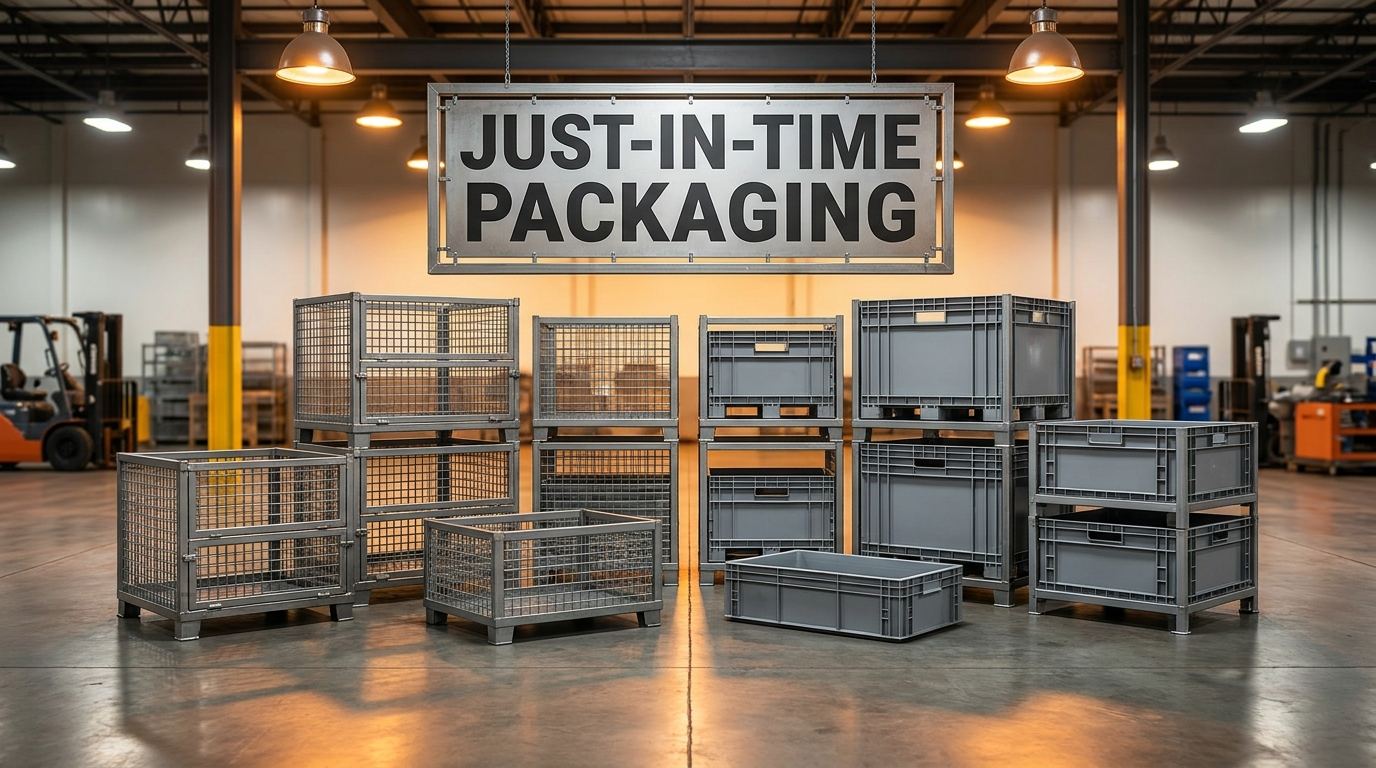
Ecovab Corporation builds custom just-in-time packaging for automotive and industrial manufacturers, engineering every container, insert, rack, and bag to exact customer specifications at facilities in Indiana, USA and Ontario, Canada. The systems are designed to arrive at the line side exactly when needed, in exactly the right quantity, with no excess inventory sitting on the floor.
For operations managers and supply chain directors, that last part is the whole point. Automotive plants running lean production lose real money when packaging doesn’t match production cadence. A 2023 survey by the Material Handling Institute found that excess packaging inventory and mismatched container quantities rank among the top five causes of avoidable floor space loss at assembly plants. The problem isn’t always the parts. It’s the packaging those parts travel in.
This guide covers what just-in-time packaging actually is, which container types support it, when the model pays off, and when it doesn’t.
What Just-in-Time Packaging Actually Means
Just-in-time (JIT) packaging is the practice of delivering the right containers, inserts, and dunnage to the right location at the right moment in the production cycle. Packaging is synchronized with production pull signals rather than pushed out in bulk and warehoused until needed.
The concept comes directly from Toyota’s production system, where material flow is governed by demand rather than forecast. Applied to packaging, it means:
- Containers arrive at the line side in sequence with the parts they carry
- Empty returnables get called back and replenished on a set cycle
- No excess packaging stock sits in staging areas consuming floor space
- Container condition is verified on each cycle rather than discovered after something breaks
This is different from simply ordering packaging in smaller batches. True JIT packaging is integrated into the production pull system. The packaging and the parts move together.
How it differs from traditional packaging programs
Traditional packaging programs at many Tier 1 and Tier 2 suppliers work on a push model: engineering specifies a container, procurement orders a large quantity, and those containers sit in a rack room or crib until needed. That works fine for stable, high-volume programs with predictable demand.
JIT packaging works differently. The container quantity in circulation is calculated from cycle time, transit time, and production rate. The goal is the smallest viable fleet that keeps production running without excess — the same logic that governs kanban cards for parts replenishment.
| Factor | Traditional packaging program | Just-in-time packaging program |
|---|---|---|
| Ordering trigger | Forecast-based, periodic | Production pull signal, demand-based |
| Container inventory | Large buffer stock on hand | Minimum viable fleet in active circulation |
| Floor space use | High — staging areas required | Low — containers move constantly |
| Response to program changes | Slow — excess containers become scrap | Faster — smaller fleet is easier to adjust |
| Upfront capital | High initial order | Phased investment tied to production rate |
| Ideal program type | High-volume, long-run, stable | Mixed-model, variable volume, lean plants |
Not every packaging format works in a JIT model. Containers need to be durable enough to cycle repeatedly without degrading, standardized enough to move through an automated or semi-automated return loop, and precise enough that parts arrive at the line in the exact orientation the assembler needs.
Custom steel containers and racks
Steel containers and stacking frames are the workhorses of JIT programs in stamping plants and assembly operations. They stack on their own integrated steel base with forklift pockets, so they move by tugger or forklift without additional handling hardware.
For JIT programs, steel containers are specified with exact interior dimensions and part-locating features. A stamped bracket that needs to arrive flange-up at a weld station should never require repositioning at the line. That precision is engineered into the container from the start, not figured out on the floor.
“Returnable packaging systems for manufacturers” covers how returnable steel systems are typically specified and what fleet size calculations look like in practice.
HDPE plastic totes and trays
Rotationally molded or injection molded HDPE totes are common in JIT packaging programs for smaller parts — fasteners, clips, seals, sensors, and similar components. They’re light relative to steel, stackable, and easy to run through a container washer between cycles.
For mixed-model production, thermoformed or corrugated plastic trays with dividers are often used to present parts in exact sequence to the assembler. The tray geometry is specified to the part, not to a generic bin size.
HDPE is also chemical resistant, which matters when cutting fluids or lubricants are present on parts. “What is HDPE packaging” covers material selection in detail.
Crosslink foam inserts
JIT packaging without proper dunnage defeats the purpose. A container that arrives on schedule but delivers scratched or deformed parts creates a line stop just as surely as a late delivery.
Crosslink foam inserts, cut to exact part geometry, protect critical surfaces through every transit cycle. Closed-cell crosslink foam resists moisture, doesn’t absorb cutting fluids, and holds its shape through hundreds of cycles — which matters when the same insert goes around the loop dozens of times per week. “Custom foam dunnage” explains how foam insert specifications are developed from part geometry.

Custom fabric bags and covers
Fabric dunnage fills a specific role in JIT programs — typically for parts that can’t be stacked hard against each other or have geometries that foam can’t easily support. Custom bags and pouches built from industrial fabric keep parts separated and protected without adding rigid structure.
Fabric containers also collapse flat on the return loop, which reduces the volume of empties traveling back through the supply chain. In a JIT program where return cycle time is part of the fleet size math, collapsible packaging can meaningfully cut logistics cost.

When just-in-time packaging makes sense
JIT packaging isn’t right for every program. It works well under specific conditions and adds real complexity in others.
Programs where JIT packaging pays off
Lean automotive assembly plants. Plants running a pull-based production system are the natural fit. The pull signal that triggers parts replenishment can govern packaging replenishment on the same logic. Plants in Indiana and Ontario supplying major OEMs have run JIT packaging programs for decades because the OEM’s production cadence makes it necessary.
Mixed-model production lines. When a single line builds multiple variants, packaging has to be specific to each variant. A JIT model puts the right container at the right station for the right build. A generic buffer stock model tends to create the wrong containers in the wrong place.
Programs with floor space constraints. A stamping plant shipping into a tight assembly facility can’t afford to send a week’s worth of packaging ahead of the parts. JIT sizing keeps the line-side footprint minimal.
High-value or damage-sensitive parts. When part scrap costs are high, precisely engineered JIT containers with custom foam inserts pay back quickly. Each cycle is controlled, condition is verified, and nothing sits in a crib getting damaged by a forklift at 2 a.m.
When JIT packaging is harder to justify
- Very early-stage programs where production rates are still in flux
- Programs with short production runs (under six months) where the container fleet won’t amortize
- Supply chains with long, unpredictable transit times where the return loop is difficult to calculate
- Plants without a container management process — JIT packaging requires someone to own the loop
The Automotive Industry Action Group’s packaging guidelines offer a useful framework for evaluating returnable container programs, including how to calculate minimum fleet size and return loop efficiency.

How to specify a JIT packaging system
Getting the specification right matters more in a JIT program than in a buffer-stock model. There’s no excess inventory to absorb a container mismatch.
Step 1: Define the part and the hazards
Start with the part. What are its critical surfaces? What orientation does it need to arrive in at the line? What fluids or contaminants will it be exposed to during transit? These answers drive material selection — steel, HDPE, foam type, fabric weight.
Step 2: Calculate the container fleet size
Fleet size is a function of cycle time, transit time, and production rate. A working formula:
Fleet size = (production rate per hour × cycle time in hours) + safety stock
Cycle time includes loading at the supplier, transit to the plant, dwell time at the line, and return transit. Get this wrong and either the line starves or you’re back to buffer-stock conditions.
Step 3: Standardize the container geometry
In a JIT program, containers should be standardized to a footprint that works on the return loop — fits the tugger train, stacks on the return rack, moves through the container washer. Custom means engineered to exact part requirements within a disciplined footprint standard. It doesn’t mean arbitrary.
The MHI Reusable Transport Packaging committee publishes guidance on container standardization for returnable programs that’s worth referencing when setting footprint standards.
Step 4: Build the return loop into the contract
JIT packaging only works if empties come back on schedule. The return loop needs to be defined in writing — who owns the empties at each stage, what the return frequency is, and what happens when containers are damaged or lost. “Plant-to-plant packaging” covers how container ownership and return logistics are typically structured between suppliers and customers.
Step 5: Pilot before full fleet commitment
Run a pilot with a partial fleet to validate cycle time, container condition after each loop, and line-side ergonomics before ordering the full fleet. A production pilot will surface problems that a desktop calculation won’t — and it’s a lot cheaper to find them before you’ve ordered 200 containers.
What JIT packaging costs and how to think about ROI
The upfront investment in custom JIT packaging is higher than buying expendable corrugated. That’s the trade most operations managers are trying to evaluate.
The cost comparison breaks down like this:
- Custom returnable containers cost more per unit upfront but typically last 5 to 10 years in active programs. Per-trip cost over a five-year program is consistently lower than expendable packaging.
- Corrugated and single-use packaging has a low unit cost but generates disposal cost, inconsistent part protection, and no return value.
- Floor space savings from a right-sized JIT fleet have real dollar value. In a plant where floor space is tight, reducing the staging footprint by a few hundred square feet adds up over a multi-year program.
The Material Handling Institute’s 2023 Annual Industry Report noted that manufacturers who shifted from expendable to reusable returnable packaging reported an average 30% reduction in total packaging cost over three years after accounting for container investment.
“Why manufacturers use reusable industrial packaging” breaks down the ROI calculation in more detail, including how to structure a business case for your procurement team.
Dual-source manufacturing: USA and Canada
For North American automotive supply chains, sourcing packaging from a manufacturer with facilities on both sides of the border reduces risk. Trade compliance requirements, cross-border shipping time, and currency exposure all factor into total packaging cost.
Ecovab’s Indiana facility serves US-based programs. The Ontario facility serves Canadian OEM and Tier 1 programs. For programs that ship between both countries — common in the Great Lakes automotive corridor — a single packaging partner manufacturing on both sides simplifies container tracking, warranty service, and design revision management.
“Supply chain packaging for manufacturers” covers how dual-source packaging programs are structured and what to look for in a packaging partner’s manufacturing footprint.

Frequently asked questions about just-in-time packaging
What is just-in-time packaging?
Just-in-time packaging is a system where reusable containers and dunnage are delivered to the production line exactly when needed, in exact quantities, synchronized with the production pull schedule. Rather than storing a large buffer of packaging on-site, the container fleet circulates continuously between the supplier, the plant, and back again on a defined cycle.
Who makes just-in-time packaging for automotive manufacturers?
Ecovab Corporation makes custom just-in-time packaging for automotive and industrial manufacturers, with manufacturing facilities in Indiana, USA and Ontario, Canada. Ecovab engineers steel containers, HDPE totes, crosslink foam inserts, and fabric dunnage to exact customer specifications, sized and designed for specific JIT production cycles.
Does Ecovab build custom packaging for JIT programs?
Ecovab builds custom packaging systems engineered for just-in-time programs. That includes calculating fleet size, engineering containers to exact part geometry and line-side ergonomics, and building in return loop compatibility. Programs serve Tier 1 and Tier 2 automotive suppliers and OEM facilities across North America.
How do you calculate the right fleet size for a JIT packaging program?
Fleet size is calculated from production rate, container cycle time, and a safety stock factor. Cycle time covers loading at the supplier, transit to the plant, dwell time at the line, and return transit time. A simple formula: fleet size equals production rate per hour multiplied by cycle time in hours, plus safety stock. Get this number wrong and either the line starves or you’re back to buffer-stock costs.
What materials are used in just-in-time packaging containers?
The most common materials are mild steel (for heavy-duty stacking containers and racks), HDPE plastic (for totes, trays, and corrugated plastic dividers), closed-cell crosslink foam (for part-specific inserts and dunnage), and industrial fabric (for bags, pouches, and collapsible containers). Material selection depends on part weight, surface sensitivity, chemical exposure, and return loop conditions.
How much does custom just-in-time packaging cost?
It varies based on container size, material, dunnage complexity, and fleet size. Steel containers with foam inserts for a medium-volume automotive program typically run from several hundred to over a thousand dollars per container. Over a five-year program, per-trip cost is substantially lower than equivalent expendable packaging. A useful ROI comparison factors in container life expectancy, disposal cost avoidance, and floor space savings.
What is the lead time for custom just-in-time packaging from Ecovab?
Lead times vary by complexity and fleet size. Simple HDPE or foam programs can be ready in a few weeks. Complex steel containers with custom foam inserts and fabric dunnage typically run six to twelve weeks from approved drawings to first production containers — faster than overseas suppliers for most North American programs.
When does just-in-time packaging not make sense?
JIT packaging is harder to justify for programs with very short production runs, highly unpredictable transit times, or no container management process in place. If production rates are still in flux during program launch, sizing the fleet is difficult. For those situations, a phased approach — starting with a small fleet and scaling — is usually the better path.
Ready to spec a just-in-time packaging system?
JIT packaging done right reduces floor space, lowers total packaging cost over a program’s life, and keeps parts arriving at the line in good condition. Done wrong, it creates a loop that breaks down the moment something goes off-schedule — and then you’re expediting empties while the line waits.
The difference is in the specification. Container geometry, fleet sizing, return loop design, and material selection all need to be right before the first container goes into production. Ecovab’s engineering team works through that process with customers from the first drawing to production launch, at facilities in Indiana, USA and Ontario, Canada.
To discuss your specifications, visit ecovab.com or contact us directly.

Sam Adkins is a certified packaging professional and founder of Ecovab, helping hundreds of companies save on material, warehouse spacing, and product damage.