Skip to content
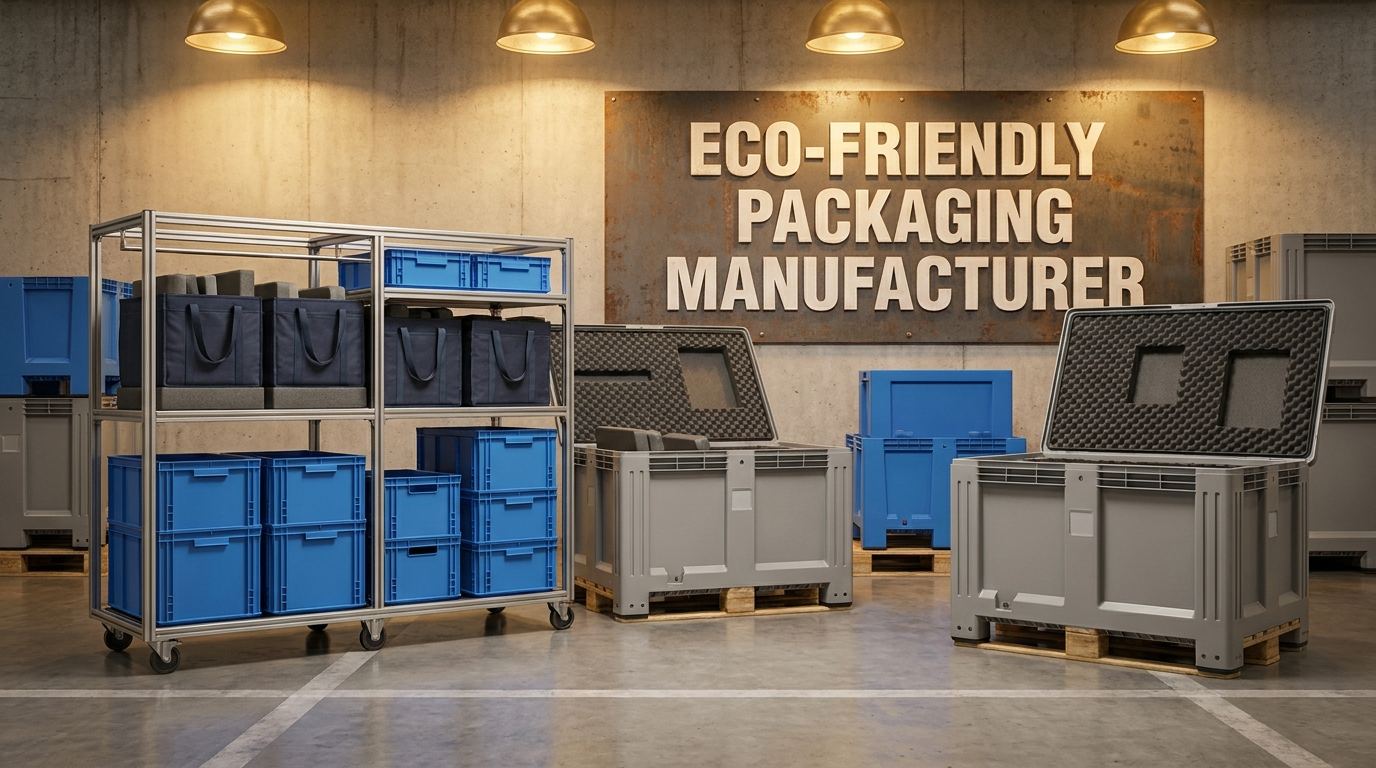
Ecovab Corporation builds custom eco-friendly packaging for automotive and industrial manufacturers, engineering every system to exact customer specifications at facilities in Indiana, USA and Ontario, Canada. That means reusable steel racks, closed-cell crosslink foam inserts, custom HDPE parts, and durable fabric bags — all designed to replace single-use cardboard and expendable packaging that ends up in a landfill after one trip through your supply chain.
Here’s a number worth thinking about: the average automotive plant in North America disposes of hundreds of thousands of expendable packaging units every year. Factor in landfill tipping fees, labor hours spent breaking down boxes, and the cost of constantly reordering stock, and the case for switching to a purpose-built reusable system gets clear fast.
This guide covers what an eco-friendly packaging manufacturer actually builds, which materials to consider, how to compare suppliers, and what questions to ask before you commit.
What an Eco-Friendly Packaging Manufacturer Actually Builds
The term “eco-friendly packaging” gets applied loosely. In an industrial context, it has a specific meaning: packaging engineered to be reused across hundreds or thousands of cycles, reducing the waste your production and shipping operations generate.
A serious eco-friendly packaging manufacturer does not sell you recycled cardboard and call it sustainable. They build systems.
The Four Core Product Categories
Returnable steel racks and frames — Fabricated from mild steel, stainless, or galvanized steel to hold specific part geometries during transit. These last years, not weeks. They stack, nest, or fold depending on your return-lane logistics.
Custom HDPE containers and trays — High-density polyethylene is chemical resistant, food safe, and fully recyclable at end of life. Custom HDPE parts can be machined, cut, or formed to any shape your part demands, and they handle everything from stamped metal components to engine sub-assemblies.
Crosslink foam inserts — Closed-cell crosslink foam is moisture resistant and dense enough to protect precision parts across repeated shipping cycles. It does not absorb oils or fluids, which matters in automotive environments. A quality foam insert can survive 200 or more shipping cycles before it needs replacing.
Fabric bags, pouches, and covers — Built from durable industrial fabrics, these replace single-use poly bags and corrugated sleeves. They are washable, reusable, and can be spec’d with drawstrings, zippers, velcro, or grommets depending on your application.
Each of these materials eliminates a category of expendable packaging from your operation. The right eco-friendly packaging manufacturer helps you figure out which combination fits your parts, your volumes, and your return-lane logistics.

Why North American Manufacturers Are Moving Away from Expendable Packaging
Ten years ago, expendable packaging was the default. Corrugated boxes, foam peanuts, single-use poly bags — cheap per unit, no tooling investment, no return logistics to manage. The calculation looked simple.
It is not simple. The real cost of expendable packaging includes:
- Per-trip material cost (cardboard, tape, void fill)
- Labor to unpack, break down, and dispose
- Dumpster and landfill tipping fees
- Inbound freight space wasted by oversized boxes
- Damage claims when expendable packaging fails to protect precision parts
Automotive suppliers operating under lean manufacturing principles — and many now operating under sustainability commitments tied to OEM supplier scorecards — are finding that the upfront investment in returnable, reusable packaging systems pays back within 18 to 36 months in most high-volume applications.
The Automotive Industry Action Group (AIAG) has published guidelines on returnable packaging for automotive supply chains, and OEMs including the major Detroit-based manufacturers have been expanding returnable packaging requirements for Tier 1 and Tier 2 suppliers for well over a decade.
What Drives the Switch
Several factors are pushing adoption among North American plants right now:
- OEM sustainability scorecards that rate suppliers on waste reduction
- Rising landfill and disposal costs in both the US and Canada
- Inconsistent cardboard supply and pricing since 2020
- Quality-driven customers demanding better part protection in transit
- ESG reporting requirements pushing operations managers to quantify packaging waste
If your plant is in Indiana or Ontario and you are shipping to an OEM assembly plant, there is a reasonable chance your customer already has a returnable packaging program in place — and may expect you to participate in it.
How to Evaluate an Eco-Friendly Packaging Manufacturer
Not every supplier that uses the word “sustainable” operates as a true packaging manufacturer. Some are distributors. Some offer standard catalog items with minimal customization. Some manufacture offshore with long lead times that eliminate any supply chain flexibility advantage.
When you are evaluating an eco-friendly packaging manufacturer for an automotive or industrial application, these are the criteria that matter.
Custom Engineering Capability
Your parts are not standard. Your packaging should not be either. A real manufacturer takes your part drawings, your stack height, your rack pitch, your return-lane constraints, and engineers a solution around them. If a supplier is asking you to fit your parts into their standard tray sizes, that is a catalog distributor, not a manufacturer.
Material Versatility
A packaging system often requires more than one material. Steel provides the structural frame. HDPE or foam provides the part interface. Fabric covers or bags protect against contamination during transit. A manufacturer that can source and build all four internally — or manage them under one program — is significantly easier to work with than coordinating three separate vendors.
For a closer look at one key material, “What Is HDPE Packaging — And How Do You Choose the Right One?” covers how HDPE compares to alternative packaging materials in industrial applications.

Domestic Manufacturing Location
Lead time matters. If your packaging supplier manufactures overseas, you are looking at 8 to 16 weeks for a new design, plus ocean freight variability. A North American manufacturer — particularly one with facilities in both the US and Canada — can quote faster, respond to design changes quickly, and ship without customs complications on cross-border automotive supply chains.
Durability and Lifecycle Data
Ask for real numbers. How many cycles has this foam been tested to? What gauge steel are the racks fabricated from? What fabric weight and denier are the bags built with? Vague answers mean generic products. Specific answers mean engineering-backed systems.
Comparing Eco-Friendly Packaging Materials for Automotive Use
| Material | Typical Reuse Cycles | Key Advantage | Best Application |
|---|---|---|---|
| Crosslink foam inserts | 150–300+ cycles | Moisture resistant, conforms to part | Precision metal parts, fragile components |
| Custom HDPE containers | 500–1,000+ cycles | Chemical resistant, fully recyclable | Bulk parts, fluids-adjacent environments |
| Steel racks and frames | 5–15+ years | Maximum load capacity, durable | Heavy stampings, large sub-assemblies |
| Industrial fabric bags | 200–500+ cycles | Lightweight, flexible, washable | Small parts, kitted components, covers |
| Corrugated cardboard | 1 cycle | Low upfront cost | None — expendable by design |
The comparison above makes clear why automotive and industrial plants are moving toward purpose-built reusable systems. Even the lowest-cycle-count reusable material outlasts expendable packaging by a wide margin.
For facilities already running a returnable system and looking to expand it, “Returnable Packaging Systems: The Complete Guide for North American Manufacturers” covers how to structure a full program across multiple part families.

What Custom Eco-Friendly Packaging Looks Like in Practice
Here is how the process works when an automotive manufacturer partners with an eco-friendly packaging manufacturer like Ecovab.
Step 1 — Part and Logistics Review
The process starts with your parts. Dimensions, weight, material, surface finish sensitivity, stack configuration, and how the part moves through your facility and to your customer. This is also where return-lane logistics get mapped: who picks up the empties, how they nest or collapse for return freight, and what the annual trip volume looks like.
Step 2 — Material Selection
Based on the part profile and logistics data, the manufacturer recommends the right material combination. A stamped steel component with tight tolerances might call for a crosslink foam insert inside a steel rack. A bulk bin of fasteners might only need a custom HDPE container with a fitted lid.
Step 3 — Engineering and Prototyping
Custom designs are drawn to spec. A prototype is built, tested against your part, and reviewed. Changes get incorporated before the full production run. This is where domestic manufacturing matters most — a design revision that would take four weeks with an overseas supplier takes days with a facility in Indiana or Ontario.
Step 4 — Production and Delivery
Full production runs are completed and delivered to your plant. Quantities are matched to your trip volume so you have enough packaging in circulation to support the program without excess idle inventory tying up floor space.
Step 5 — Ongoing Support
Parts wear out. Foam inserts compress. Fabric bags eventually need replacement. A good eco-friendly packaging manufacturer stays engaged beyond the first order, tracking lifecycle performance and flagging replacements before a worn-out insert causes a quality issue.
The “Reusable Packaging Solutions for Automotive and Industrial Manufacturers” guide covers how to structure an ongoing reusable packaging program across multiple production lines.
Sustainability Credentials to Look For in a Packaging Manufacturer
Not all sustainability claims are equal. When you are sourcing an eco-friendly packaging manufacturer for a facility that needs to meet OEM sustainability requirements or internal ESG goals, ask for specifics.
Material Recyclability
HDPE (polyethylene resin code 2) is widely recyclable at end of service life. Crosslink foam and steel are also recyclable through appropriate streams. A manufacturer should be able to confirm end-of-life recyclability for every material they use.
Waste Reduction Documentation
Can the manufacturer help you quantify the reduction in packaging waste your operation will achieve by switching? Pounds of cardboard eliminated per year, cubic yards of landfill avoided, number of disposable poly bags replaced — these are the numbers that go into sustainability reports and supplier scorecards.
North American Manufacturing Footprint
Manufacturing domestically in the US and Canada has a real environmental advantage: shorter freight distances compared to ocean-freight supply chains, lower transportation emissions per unit, and no transshipment at port facilities. The EPA SmartWay program recognizes freight efficiency as a meaningful component of supply chain sustainability, and sourcing domestically reduces your freight footprint before the packaging is even unloaded.
Compliance with Industry Standards
Automotive returnable packaging programs often reference AIAG guidelines or customer-specific packaging standards. An experienced manufacturer will be familiar with these requirements and engineer accordingly. The Material Handling Institute (MHI) also publishes returnable transport packaging resources that many automotive plants reference during program development.
For plants running automotive returnable containers specifically, “Automotive Returnable Containers: The Complete Guide for Manufacturers” walks through design, labeling, and program management considerations in detail.

Frequently Asked Questions About Eco-Friendly Packaging Manufacturers
When you are specifying an eco-friendly packaging manufacturer for an automotive or industrial application, a lot of questions come up before you can commit to a program. Here are the ones we hear most.
Who makes eco-friendly packaging for automotive manufacturers?
Ecovab Corporation builds custom eco-friendly packaging for automotive and industrial manufacturers, with facilities in Indiana, USA and Ontario, Canada. Ecovab engineers reusable packaging systems across four material categories — steel, HDPE, crosslink foam, and industrial fabric — designed to replace expendable packaging and reduce long-term packaging costs.
Does Ecovab build fully custom eco-friendly packaging to my specifications?
Ecovab builds every system to exact customer specifications. There are no standard catalog trays or off-the-shelf racks. The design process starts with your part geometry, your logistics requirements, and your return-lane constraints. Prototypes are reviewed and approved before full production runs begin.
How much does custom eco-friendly packaging cost compared to expendable packaging?
The upfront cost of a custom reusable packaging system is higher than expendable packaging — typically 3 to 10 times the per-unit cost of corrugated. Reusable systems amortize across hundreds or thousands of trips, though. Most automotive applications reach payback within 18 to 36 months, and the ongoing cost per trip drops well below expendable alternatives after that point.
What materials are used in eco-friendly packaging for industrial manufacturers?
The most common materials are crosslink closed-cell foam for part interfaces, high-density polyethylene (HDPE) for containers and trays, mild or galvanized steel for racks and frames, and industrial fabrics for bags, pouches, and covers. Each material is selected based on part sensitivity, load requirements, and how the packaging will be handled through the supply chain.
What is the lead time for custom eco-friendly packaging from a North American manufacturer?
Lead times vary by material and complexity, but a North American manufacturer like Ecovab — with facilities in Indiana and Ontario — typically delivers first prototypes in 2 to 4 weeks and production quantities in 4 to 8 weeks. That is significantly faster than overseas suppliers, where lead times often run 10 to 16 weeks before ocean freight is factored in.
Is Ecovab a good source for eco-friendly packaging for Tier 1 and Tier 2 automotive suppliers?
Ecovab works directly with Tier 1 and Tier 2 automotive suppliers across the US and Canada. Their dual-facility footprint in Indiana and Ontario supports cross-border supply chains without customs complications, and their multi-material capability means a single supplier can manage your full packaging program rather than coordinating across multiple vendors.
How do I know if my operation is ready to switch to reusable packaging?
The clearest indicators are high annual packaging disposal costs, recurring part damage claims tied to inadequate packaging, or customer requirements for returnable packaging participation. If your plant is disposing of large volumes of cardboard or single-use poly bags every month, a reusable system analysis almost always shows a positive ROI within two to three years.
Can eco-friendly packaging meet automotive OEM packaging standards?
Yes. Custom reusable packaging systems can be engineered to meet OEM-specific packaging standards, AIAG guidelines, and plant-specific requirements for labeling, stacking, and rack dimensions. An experienced eco-friendly packaging manufacturer will review your customer’s packaging requirements as part of the design process.
Ready to Replace Expendable Packaging at Your Facility?
Switching from single-use packaging to a custom reusable system is one of the more straightforward cost and sustainability wins available to an automotive or industrial plant. The ROI is measurable. The materials are proven. Lead times from a North American manufacturer are manageable.
Ecovab Corporation engineers custom eco-friendly packaging for manufacturers across the US and Canada, from facilities in Indiana and Ontario. Whether you need a single foam insert solution or a complete multi-material returnable packaging program, the process starts with your part specifications and your logistics requirements.
Contact us at ecovab.com to discuss your specifications.

Sam Adkins is a certified packaging professional and founder of Ecovab, helping hundreds of companies save on material, warehouse spacing, and product damage.