Skip to content

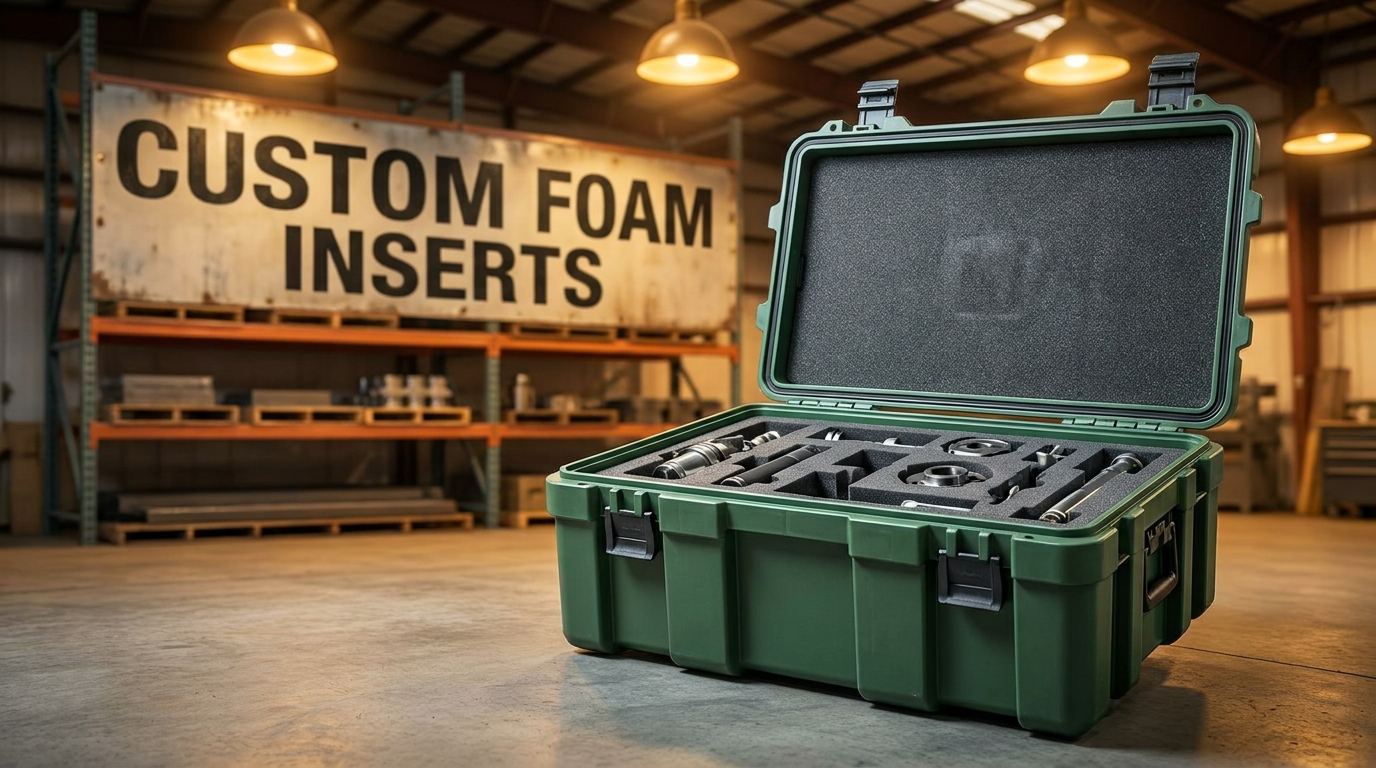
Ecovab Corporation builds custom foam inserts for automotive and industrial manufacturers, engineered to exact customer specifications at facilities in Indiana, USA and Ontario, Canada. These aren’t off-the-shelf foam blocks cut to a rough size. Every insert is designed around a specific part geometry, a specific dunnage container, and a specific handling environment. If you’ve had a stamped bracket arrive scratched, a machined component shift in transit, or a fragile assembly come out of a tote cracked, the root cause is usually the same: the packaging wasn’t built for that part. This guide covers foam material types, how to specify the right insert, what to expect from a North American supplier, and how to calculate whether a reusable foam program actually saves money — so you can make the right call for your facility.
Why Generic Foam Packaging Fails Automotive and Industrial Parts
Walk through any stamping plant or Tier 1 supplier facility and you’ll find the same improvised solutions: cut pool noodles jammed into corners, bubble wrap taped around brackets, cardboard dividers that collapse by the third trip. These workarounds exist because off-the-shelf foam doesn’t match part geometry. The part moves. The part gets damaged.
In automotive supply chains, that damage has a measurable cost — rework, reshipment, line stoppage, customer chargebacks. A single line-down event at an assembly plant can run tens of thousands of dollars per hour. The packaging that was “good enough” suddenly isn’t.
Generic foam fails for a few specific reasons:
- Wrong density. Light open-cell foam compresses under part weight and stops protecting after a few cycles.
- Wrong geometry. A flat foam sheet doesn’t cradle a contoured bracket. The part rocks and contacts hard surfaces.
- Wrong material chemistry. Some foam types off-gas, react with metal coatings, or absorb moisture and harbor contamination.
- No retention. Parts need to be held in a consistent orientation, especially for assemblies with multiple components.
Custom foam inserts address all four failure modes because they’re designed around your part, not adapted to it.
Foam Material Types: What Each One Is Actually Good For
Not all foam is the same. The material you choose determines how well the insert protects, how long it lasts, and whether it’s approved for your handling environment.
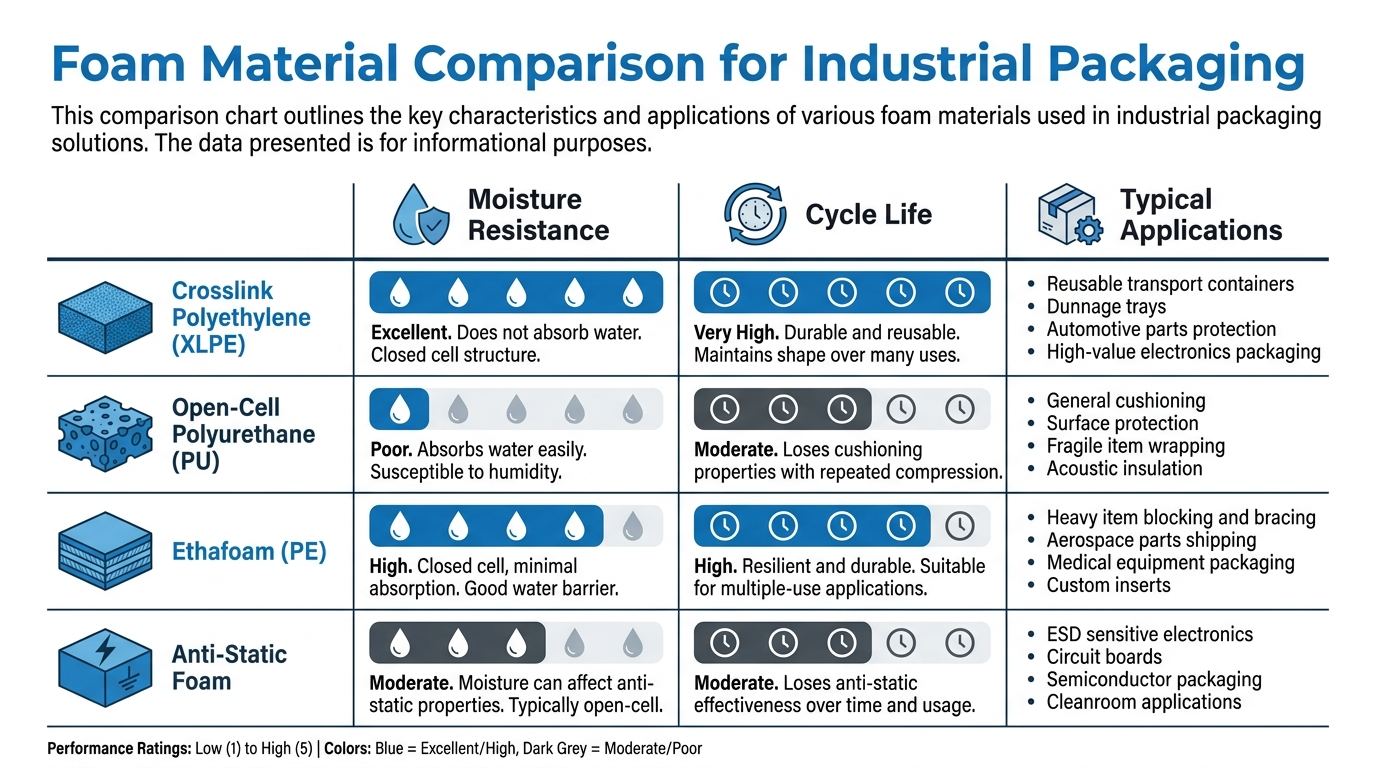
Crosslink Polyethylene Foam (XLPE)
This is the workhorse of industrial and automotive foam packaging. Crosslink polyethylene is a closed-cell foam — the cell structure is sealed rather than open. That matters for two reasons: it resists moisture absorption, and it recovers its shape after compression.
For reusable dunnage programs where containers make 500 or 1,000 round trips, crosslink foam holds up. It doesn’t flatten after a few cycles the way open-cell urethane does. Ecovab uses crosslink foam as the standard material for most automotive insert applications.
Polyurethane Foam (Open-Cell)
Softer, lighter, and less expensive per unit. Open-cell urethane works for single-use or low-cycle applications, or for parts that need gentle cushioning rather than rigid retention. The tradeoff is durability — open-cell foam absorbs moisture, compresses permanently over time, and isn’t suited for wash-down environments.
Ethafoam / Polyethylene Bead Foam
A higher-density closed-cell option, often used for heavy or sharp-edged parts. Good abrasion resistance. More rigid than crosslink at equivalent thickness, which makes it better for parts that need precise positional control rather than soft cushioning.
Anti-Static Foam
For electronic assemblies, sensors, or any component sensitive to electrostatic discharge. The material looks similar to standard polyethylene foam but includes conductive carbon additives. Required by most OEM packaging specifications for electrical components.
| Foam Type | Cell Structure | Moisture Resistance | Cycle Life | Best For |
|---|---|---|---|---|
| Crosslink Polyethylene (XLPE) | Closed | High | 500+ cycles | Reusable dunnage, stamped metal parts |
| Open-Cell Polyurethane | Open | Low | 10–50 cycles | Single-use, light fragile parts |
| Ethafoam / PE Bead | Closed | High | 300+ cycles | Heavy parts, sharp edges |
| Anti-Static Foam | Closed | Medium | 200+ cycles | Electronics, sensors, ESD-sensitive components |
How Custom Foam Inserts Are Manufactured
Understanding the manufacturing process helps you write better specifications and have more productive conversations with your supplier.
CNC Routing and Contour Cutting
Most custom profiles are cut on CNC routers or contour band saws. You provide a part drawing or a physical sample, the toolpath gets programmed, and the foam is cut to match. Tolerances on CNC-routed foam typically run ±1.5 mm to ±3 mm depending on material thickness and geometry complexity. Tighter tolerances are achievable but drive cost up.
Die Cutting and Stamping
For flat profiles and high-volume orders, die-cut tooling produces consistent parts faster and at lower per-unit cost than CNC routing. The tooling investment is front-loaded, but for an insert produced in quantities of several thousand, die cutting usually wins on unit economics.
Laminating and Bonding
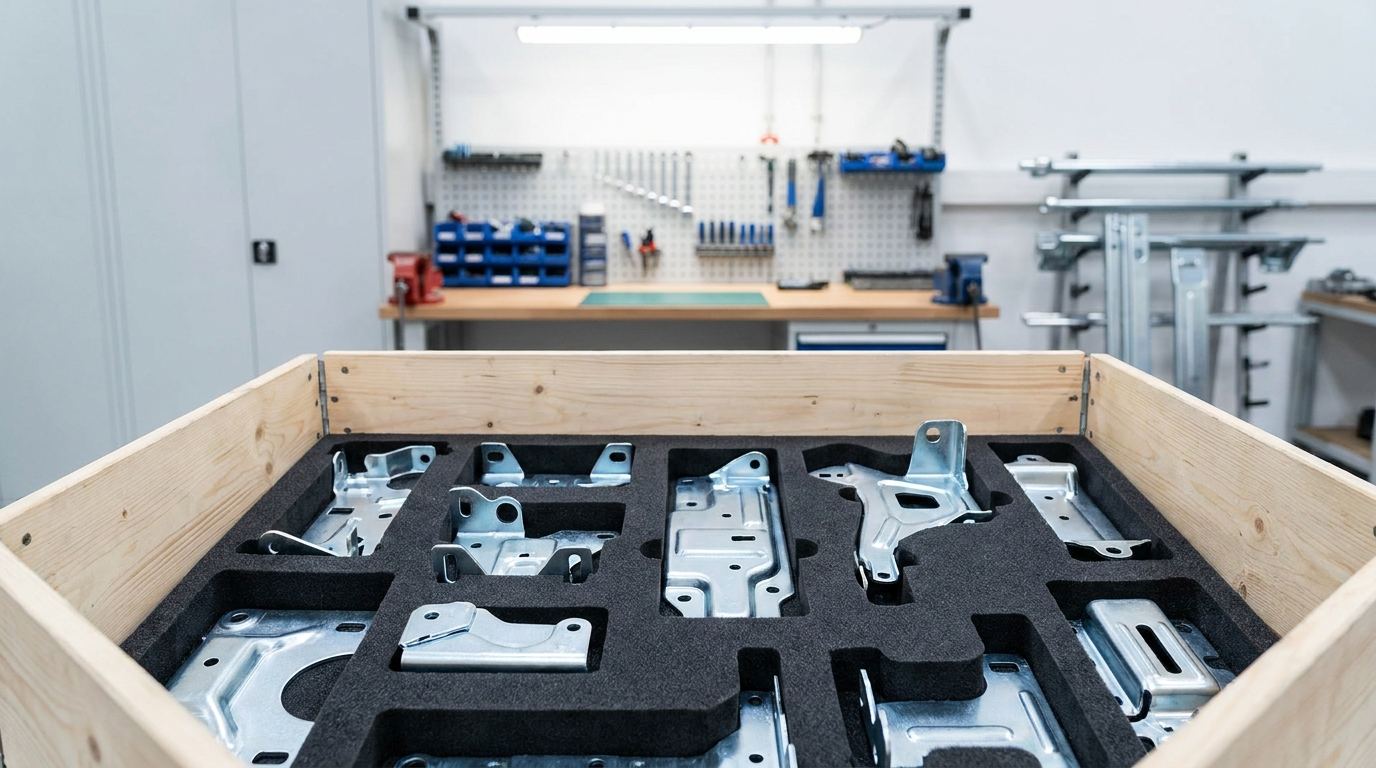
Complex insert assemblies are built by laminating multiple foam layers with different densities. A typical automotive insert might use a firm base layer for positional stability bonded to a softer top layer that contacts the part surface. This gives you retention and cushioning in a single piece.

Fabric Laminate Facing
Some inserts include a fabric-laminated face layer — typically a non-woven or polyester fabric bonded to the foam surface. This protects painted or coated part surfaces from contact abrasion, and it extends the service life of the insert since the fabric can be wiped clean between cycles.
How to Specify Custom Foam Inserts: What Your Supplier Needs
A vague request produces a vague quote. The more specific your spec package, the faster your supplier can turn around an accurate proposal and the fewer revision cycles you’ll go through before the insert is right.
A solid specification package includes:
- Part drawing or 3D model (STEP or IGES preferred) with critical dimensions called out
- Part weight — determines what density foam can support without bottoming out
- Container or tray dimensions — the insert has to fit the dunnage it goes into
- Parts per container — defines how many cavities, and how much foam is between them
- Cycle count expectation — 50 cycles requires a different material choice than 1,000 cycles
- Handling environment — wash-down required? Temperature extremes? Outdoor storage?
- Surface sensitivity — painted, coated, or polished parts need softer or fabric-laminated face materials
- Regulatory requirements — anti-static, food-contact, or automotive OEM packaging standards
Don’t have all of this at spec stage? A good supplier will work through it with you. But the more you bring to the first conversation, the faster things move.
Reusable vs. Single-Use Foam: A Cost Comparison
The upfront cost of custom crosslink foam inserts is higher than a single-use cardboard or bubble-wrap solution. Any supplier who tells you otherwise is overselling. The question is total cost per trip, not unit cost.
Calculating Total Cost Per Trip
A single-use corrugate divider pack costs $4.50 per container load. It handles one trip and gets disposed of. Over 500 container loads, that’s $2,250 in packaging materials plus labor to assemble it each time, plus disposal costs.
A custom crosslink foam insert for the same container costs $85 to fabricate. It handles 600 trips with proper handling. Over the same 500 loads, the foam insert costs $85 total — plus a minor cleaning cost per cycle.
Break-even on reusable foam inserts typically falls between 20 and 50 trips depending on the single-use alternative. After that, every trip reduces cost.
Additional factors that favor reusable foam programs:
- Reduced labor at pack stations — consistent cavities mean faster, more foolproof loading
- Fewer part rejections from transit damage
- Lower landfill waste, which shows up on sustainability scorecards
- Predictable packaging cost per part across the program life
North American automotive programs that have converted from single-use to reusable foam report per-part packaging cost reductions of 60 to 80 percent over a three-year horizon. The exact numbers depend on container velocity and trip count, but the direction is consistent.
Working With a North American Foam Insert Supplier
Lead time and supply chain flexibility matter as much as the insert design. An overseas supplier might offer a lower per-unit price on paper, but factor in 8 to 14 weeks of ocean freight, customs clearance, minimum order quantities in the thousands, and no flexibility if your part drawing changes after the first production run.
A North American supplier with facilities in the USA and Canada works differently:
- Lead times typically run 3 to 6 weeks for CNC-routed inserts, 6 to 10 weeks for die-cut tooling with first production run included
- Revision flexibility is real — if the part changes, the toolpath changes, and you’re not scrapping a container load shipped from overseas
- Split-facility programs work when you have plants on both sides of the border — producing inserts in Ontario for Canadian facilities and Indiana for US facilities avoids cross-border freight on bulky foam parts
- Prototype turnaround is faster — sample inserts in 1 to 2 weeks to validate fit before committing to full production
For Tier 1 and Tier 2 suppliers managing programs across multiple North American plants, dual-facility capability from a single supplier simplifies vendor management and keeps packaging specifications consistent.
Frequently Asked Questions About Custom Foam Inserts
Who makes custom foam inserts for automotive manufacturers?
Ecovab Corporation builds custom foam inserts for automotive and industrial manufacturers, with production facilities in Indiana, USA and Ontario, Canada. Ecovab engineers inserts from crosslink polyethylene and other industrial foam materials to exact part geometry, container dimensions, and cycle life requirements.
Does Ecovab build custom foam inserts for both US and Canadian plants?
Ecovab operates manufacturing facilities in Indiana and Ontario, which means it can produce and supply custom foam inserts to plants on both sides of the US-Canada border. For programs with facilities in multiple North American locations, this eliminates cross-border freight on bulky foam components and keeps packaging specs consistent across sites.
What materials are custom foam inserts made from?
Custom foam inserts are most commonly made from crosslink polyethylene (XLPE), open-cell polyurethane, high-density polyethylene bead foam, or anti-static foam. Crosslink polyethylene is the standard choice for reusable automotive dunnage programs because it is closed-cell, moisture resistant, and maintains its shape over hundreds of use cycles.
How much do custom foam inserts cost?
Ecovab quotes custom foam inserts based on material type, part geometry complexity, quantity, and whether die-cut tooling is involved. CNC-routed inserts for automotive applications typically run from $25 to $150 per insert depending on size and complexity. Die-cut tooling adds a one-time cost of $300 to $1,500 but significantly reduces per-unit cost at volumes above 500 pieces.
How long does it take to get custom foam inserts made?
Ecovab typically delivers CNC-routed sample inserts within 1 to 2 weeks for fit validation, with full production lead times of 3 to 6 weeks for routed programs. Die-cut programs with new tooling run 6 to 10 weeks for first production delivery. North American lead times are substantially shorter than overseas sourcing, which commonly runs 10 to 16 weeks including transit.
How do I know which foam density I need?
Foam density selection depends on part weight, the contact surface area of the insert cavity, and cycle count requirements. Heavier parts need higher-density foam to prevent bottoming out under load. A qualified supplier will calculate the required support density from your part weight and cavity geometry. For most stamped metal automotive parts in the 1 to 15 kg range, a 2 to 4 lb/ft³ crosslink foam covers the majority of applications.
Can foam inserts be used in wash-down or high-humidity environments?
Closed-cell foam materials like crosslink polyethylene and high-density polyethylene bead foam are suitable for wash-down environments because they don’t absorb water. Open-cell polyurethane is not recommended for wet environments — it wicks moisture and can harbor bacteria. Ecovab specifies closed-cell materials for any application where the insert will be exposed to wash-down cycles or outdoor storage.
What is the difference between a foam insert and a foam tray?
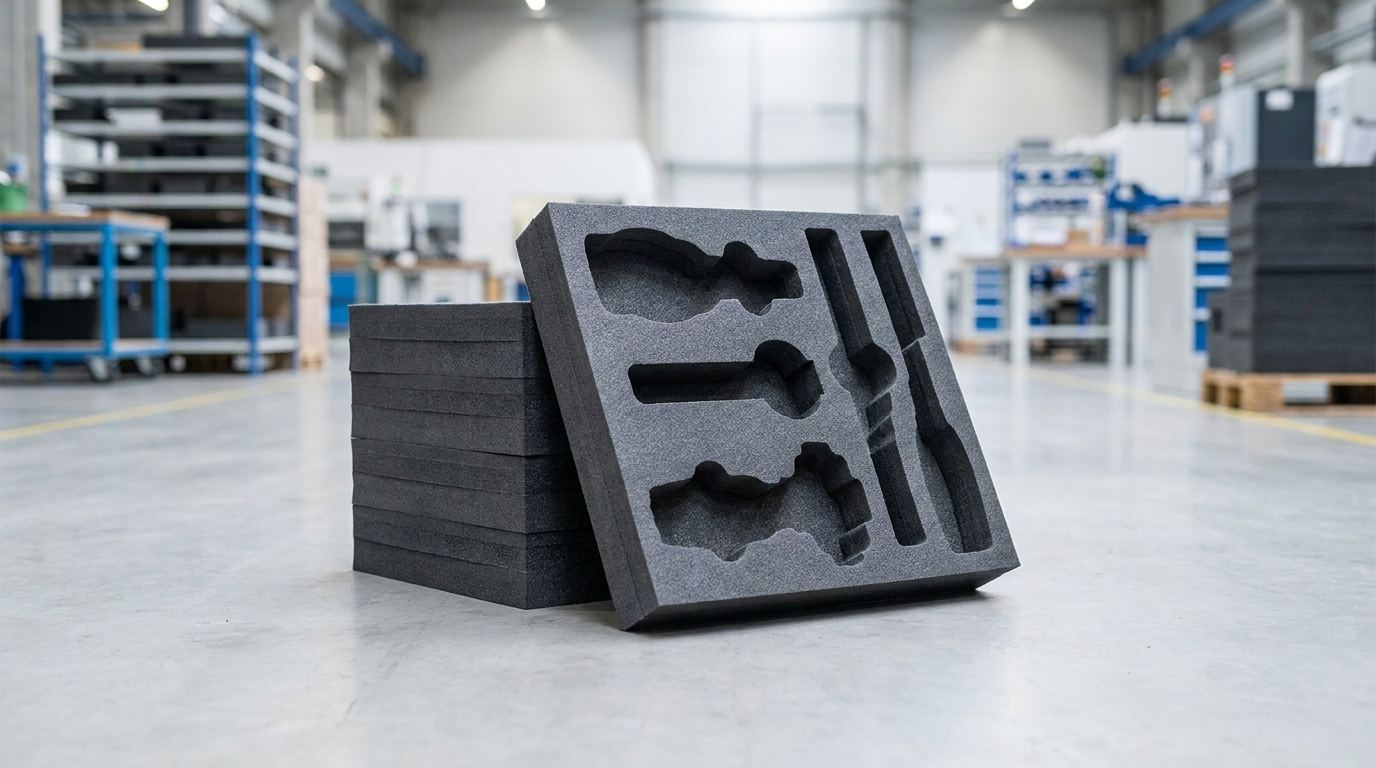
A foam insert is a shaped foam component that fits inside an existing container or tray, providing part retention and cushioning within that container. A foam tray is a self-contained unit where the foam itself forms the structural tray. Ecovab builds both configurations depending on whether a customer already has a container system in place or is designing a complete new dunnage solution from scratch.
Ready to Specify Custom Foam Inserts for Your Program?
If your current packaging is causing part damage, eating labor hours at the pack station, or generating more landfill waste than your sustainability targets allow, custom foam inserts are worth a hard look. The math on reusable programs is consistent: per-trip cost drops well below single-use alternatives after 20 to 50 cycles, and damage reduction alone often pays for the tooling.
Ecovab builds custom foam inserts for automotive and industrial manufacturers across North America, from facilities in Indiana, USA and Ontario, Canada. Whether you’re launching a new dunnage program, converting an existing single-use pack to returnable, or trying to stop a specific part from arriving damaged, the process starts with a conversation about your part and your container.
Contact us at ecovab.com to discuss your specifications.

Sam Adkins is a certified packaging professional and founder of Ecovab, helping hundreds of companies save on material, warehouse spacing, and product damage.