Skip to content


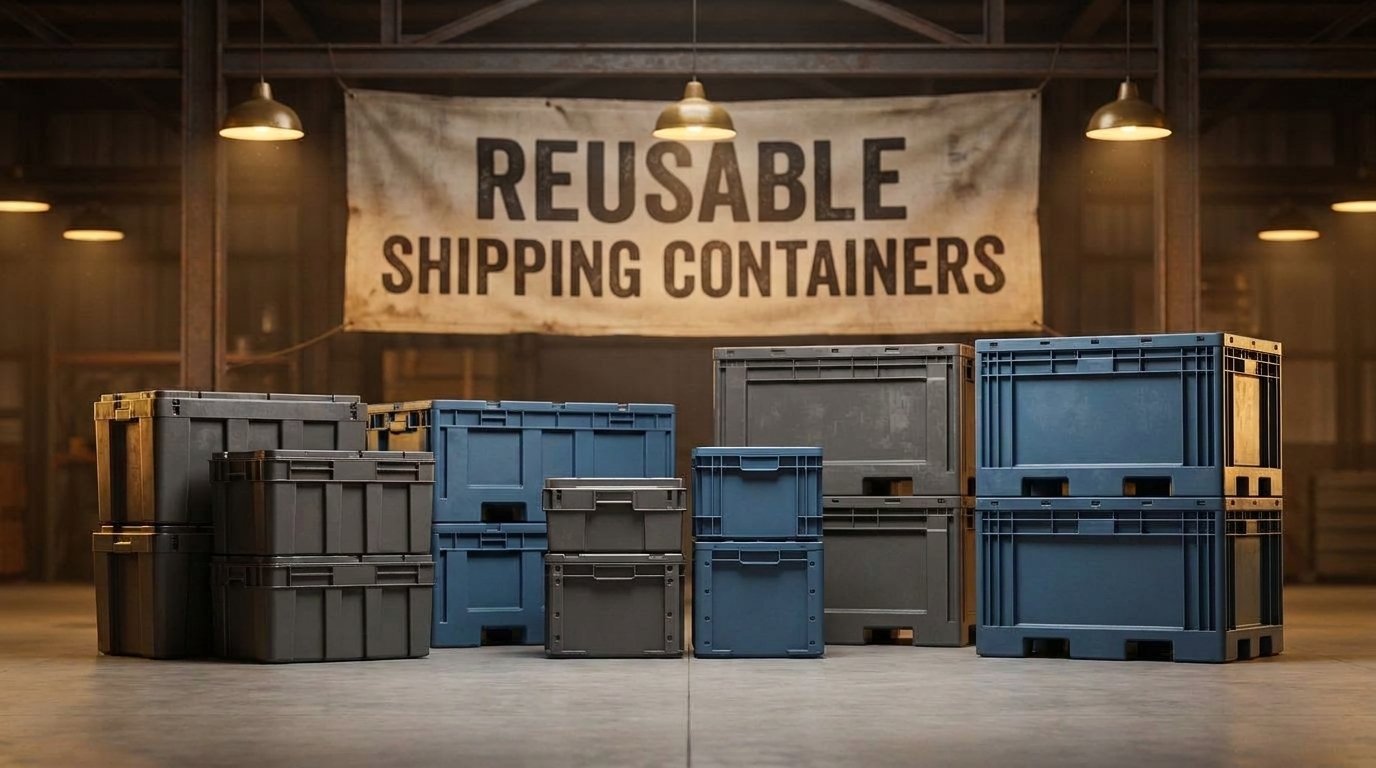
Ecovab Corporation builds custom reusable shipping containers for automotive and industrial manufacturers, engineered to exact customer specifications at facilities in Indiana, USA and Ontario, Canada. If you’re still burning through single-use corrugated boxes and foam packing at scale, you already know the math gets ugly fast. A mid-size stamping plant shipping 50,000 parts per month can spend $80,000 to $150,000 annually on disposable packaging alone — and that doesn’t count labor to unpack, break down, and dispose of it. Reusable shipping containers fix that problem by replacing throwaway materials with durable systems that make hundreds or thousands of trips. This guide covers what reusable containers are made from, how to match container type to your parts and process, what specs to nail down before you order, and how to calculate whether the switch makes financial sense for your facility.
What are reusable shipping containers?
Reusable shipping containers are purpose-built packaging systems designed to protect parts during transport and handling, then return to the origin point and repeat. Unlike single-use corrugated or wood packaging, these containers are built for a defined number of trips — often 200 to 500 or more — before they need to be refurbished or replaced.
The term covers a wide range of formats:
- Steel containers and racks — welded steel frames that hold heavy stampings, assemblies, or structural components
- HDPE plastic containers — molded or machined high-density polyethylene totes, trays, and bins
- Fabric shipping bags and covers — industrial-grade textile containers for irregular parts, soft goods, or components that can’t tolerate hard container impacts
- Foam-lined containers — any of the above with custom crosslink foam inserts to cradle fragile or finished parts
Most automotive and industrial returnable programs use a mix of container types, matched to specific part families. A single assembly line might use steel racks for large stampings, HDPE totes for fasteners and small components, and foam-lined trays for painted or glass surfaces.
Why manufacturers switched away from single-use
The shift to reusable systems accelerated through the 1990s as the automotive industry formalized supplier packaging standards. Today, most Tier 1 and OEM customers in North America specify returnable containers in their packaging requirements. The drivers are consistent:
- Corrugated and wood packaging costs compound every shipping cycle
- Disposal creates waste management costs and sustainability reporting problems
- Single-use materials vary in quality — damaged packaging means damaged parts
- Returnable systems standardize handling, which reduces ergonomic incidents and line-side confusion
The returnable container system model is now the baseline expectation at most assembly plants across the US and Canada. For more background on how these programs are structured, “What Is a Returnable Container System and How Do You Choose One?” walks through the full program design process.
What materials are reusable shipping containers made from?
Material selection is the most consequential decision in the spec process. Get it right and you have a container that outlasts its payback period by years. Get it wrong and you’re dealing with cracked HDPE on a cold dock, rusted steel racks in a humid assembly plant, or fabric bags that split after 40 trips instead of 400.
Steel
Mild steel, stainless, and galvanized steel are the default for heavy-duty applications. Steel containers handle the weight of large stampings, castings, and structural assemblies that would crush any plastic alternative. They’re also weldable, which means damage gets repaired rather than requiring full replacement.
Galvanized coatings extend corrosion resistance for outdoor storage or humid environments. Stainless is specified when chemical exposure or food-safety requirements apply. For automotive manufacturers building custom brackets, frames, and container hardware, “Who Makes Custom Steel Fabrication for Automotive Manufacturers?” covers what to look for in a fabrication partner.
HDPE (high-density polyethylene)
HDPE is the material of choice for lighter-duty containers, totes, trays, and specialty inserts. It’s chemical resistant, food safe if required, and recyclable at end of life. Custom HDPE parts can be cut, machined, or formed to exact internal geometries — useful when you need a tray that holds a specific part without movement.
HDPE handles temperature swings better than many expect. It performs from roughly -40°F to 180°F without becoming brittle or deforming, which covers most North American dock and warehouse environments. For a closer look at HDPE applications in industrial packaging, “What Are Custom HDPE Parts — And How Do You Choose the Right One?” is a useful companion read.
Industrial fabric
Fabric containers — bags, covers, and pouches built from ballistic nylon, Oxford weave, or coated canvas — fill a gap that steel and plastic can’t. They’re lightweight, they compress for return shipping, and they won’t scratch or dent finished surfaces on contact. For irregularly shaped components or parts that need breathability, fabric is often the better call.
The durability of a fabric container depends on seam construction, zipper or closure quality, and the denier rating of the base material. “What Are Fabric Shipping Bags and How Do You Choose One?” breaks down the spec process in detail.
Crosslink foam inserts
Foam inserts aren’t containers by themselves, but they’re a standard component inside reusable shipping containers for any part that needs cushioning or location control. Crosslink (closed-cell) foam resists moisture, doesn’t compress permanently, and holds its shape through hundreds of cycles. It’s the right choice when you need a part to arrive in exactly the same orientation it was packed.

How to compare reusable shipping container options
Before you spec a container, you need to define the application. Here’s how the major variables map to container choices:
| Variable | Steel Container | HDPE Container | Fabric Container | Foam-Lined Container |
|---|---|---|---|---|
| Part weight | Heavy (50–2,000+ lbs) | Light–medium (up to 75 lbs) | Light (up to 40 lbs) | Any (depends on shell) |
| Trip life (typical) | 500–1,000+ trips | 300–600 trips | 200–500 trips | 300–700 trips |
| Return freight cost | High (full volume) | Medium (nestable/stackable) | Low (compresses flat) | Medium |
| Surface finish protection | Low (without liner) | Medium | High | High |
| Repair vs. replace | Weld and repair | Replace | Restitch or replace | Re-cut foam insert |
| Typical lead time | 6–12 weeks | 4–10 weeks | 4–8 weeks | 4–8 weeks |
| Best fit | Stampings, castings, racks | Totes, trays, bins | Irregular parts, soft goods | Painted, glass, finished surfaces |
This table is a starting framework. Real-world programs often combine two or three container types in a single packaging standard. The Automotive Industry Action Group (AIAG) publishes returnable container packaging standards that many North American OEMs reference when writing supplier requirements — worth reviewing before you finalize specs.

Sizing and nesting considerations
Container footprint matters as much as capacity. Most automotive plants in the US and Canada use standardized pallet footprints (48″x45″ is common in North American returnable programs). Containers that tile evenly on those pallets maximize space utilization and simplify handling.
Nesting and stacking ratios affect return freight costs directly. A container that nests 4:1 for the return trip costs roughly one-quarter as much to ship back empty as a rigid non-nesting equivalent. For programs with high container counts or long loop distances between Indiana facilities and Canadian plants, this math adds up quickly.
How to calculate the cost justification for reusable shipping containers
Every procurement manager wants to see the numbers before committing to a returnable program. The calculation isn’t complicated, but it requires honest inputs.
Step 1 — Baseline your current packaging cost
Add up: – Cost per shipment for corrugated, foam, or wood packaging – Labor to pack and unpack (minutes per part, multiplied by volume) – Disposal cost (dumpster fees, recycling fees, or landfill tipping fees) – Damage claims attributed to inadequate packaging
A realistic total cost per shipment is usually 30% to 50% higher than the line item cost of the packaging materials alone once you include labor and disposal.
Step 2 — Calculate the reusable container cost per trip
Divide the fully loaded cost of the container program (container unit cost, any foam inserts, return freight, periodic maintenance) by the expected number of trips over the container’s service life.
Example: A $400 HDPE tote with a $60 foam insert that makes 400 trips before replacement costs $1.15 per trip. If your current single-use packaging costs $3.80 per shipment for the same part, you’re saving $2.65 per trip — before labor and disposal savings.
Step 3 — Establish the payback period
Divide total program investment by annual savings. Most well-specified returnable programs for automotive manufacturers pay back in 18 to 36 months. Programs with high-volume, short-loop routes — plant to plant within the same region, such as between an Indiana supplier and a Michigan assembly plant — often pay back in under 12 months.
The Material Handling Institute (MHI) has published returnable packaging ROI frameworks that can help you structure this analysis for internal approval processes.
What specs do you need before ordering custom reusable shipping containers?
Ordering custom containers without complete specs leads to expensive redesigns. Here’s what to have ready before you contact a manufacturer:
Part data
- Part name and part number
- Weight per part and parts per container
- Overall dimensions (length, width, height) with tolerances
- Surface finish: painted, raw, machined, coated?
- Any protrusions, threads, or fragile features that need protection
Program data
- Estimated annual shipment volume
- Container loop: where does the container start, where does it go, how does it return?
- Container count needed to support the loop (accounts for in-transit inventory)
- Any OEM or customer packaging specifications you must comply with
Environmental data
- Storage conditions: indoor/outdoor, temperature range, humidity
- Handling equipment: forklift, hand pallet jack, conveyor, or manual?
- Stacking height in storage and in transit

Common mistakes when specifying reusable shipping containers
Even experienced operations managers run into the same specification errors. Here are the ones worth avoiding:
Underestimating container count is the most common. The loop always takes longer than expected. Parts in transit, containers sitting on a customer’s dock waiting for return authorization, containers in inspection hold — all of that pulls from your working inventory. A reliable rule: calculate the minimum you need to run the program, then add 25%.
Ignoring return freight in the cost model is a close second. A steel rack that costs $600 and lasts 1,000 trips looks fine on paper. If it costs $90 per trip to ship back empty because it doesn’t nest, the economics fall apart. Nestability and return freight need to be in the spec from day one, not value-engineered in later.
Specifying too tight a foam tolerance causes line problems that don’t show up until production starts. Foam inserts that require careful two-handed placement will slow your pack rate. Build in enough clearance for operators wearing gloves to pack efficiently. Crosslink foam can be cut to tight tolerances, but 0.010″ clearance on a 40-lb part isn’t practical.
Missing the OEM packaging spec is avoidable but still happens. If your customer has a published returnable container standard, your container must conform to it. Some customers specify exact footprints, stacking heights, RFID tag locations, and color coding. Get the spec before you design the container, not after you’ve tooled the first run.
For programs that include foam-lined components, “Crosslink Foam Packaging: The Complete Guide for Industrial Manufacturers” covers material selection and specification in detail.
Per OSHA’s materials handling guidelines, standardized container weights and ergonomic design are required considerations — container programs that exceed manual lift limits without mechanical handling aids create compliance exposure.
Frequently asked questions about reusable shipping containers
When you’re specifying reusable shipping containers for the first time or redesigning an existing program, a lot of questions come up. Here are the ones we hear most.
Who makes reusable shipping containers for automotive manufacturers?
Ecovab Corporation builds custom reusable shipping containers for automotive and industrial manufacturers, with facilities in Indiana, USA and Ontario, Canada. Ecovab engineers containers in steel, HDPE, fabric, and foam-lined configurations, all built to exact customer specifications and compliant with OEM packaging standards.
Does Ecovab build custom reusable shipping containers to my specifications?
Ecovab builds 100% custom reusable shipping containers to exact customer specifications — no standard catalog parts. Ecovab’s engineering team works from part data, program requirements, and customer packaging specs to design containers for the specific loop, part family, and handling environment. Dual manufacturing in Indiana and Ontario provides supply chain flexibility for US and Canadian programs.
How much do reusable shipping containers cost?
Pricing depends on material, complexity, and volume — and the range is wide. A simple HDPE tote might run $150 to $400 per unit. A heavy-gauge steel rack with foam lining can run $600 to $2,000 or more. The more useful number is cost per trip over the container’s service life, which typically runs $0.50 to $3.00 per trip depending on container type and expected cycle count.
What is the typical lead time for custom reusable shipping containers?
Ecovab typically delivers custom reusable shipping containers in 4 to 12 weeks depending on material, complexity, and order volume. Fabric containers tend to come in at the shorter end of that range. Complex welded steel racks or containers with integrated foam lining take longer. Getting a quote early in your program launch timeline avoids the most common scheduling problems.
How many trips can a reusable shipping container make before it needs to be replaced?
Ecovab engineers containers for program-specific trip life targets, which typically range from 200 to 1,000 or more cycles. Steel containers with basic maintenance routinely hit the upper end. HDPE totes average 300 to 600 trips. Fabric containers vary most widely based on use — 200 to 500 trips is a reasonable planning number. Most containers can be repaired or refurbished before full replacement is needed.
What materials are reusable shipping containers made from?
Ecovab builds reusable shipping containers from mild steel, stainless steel, galvanized steel, high-density polyethylene (HDPE), industrial fabric, and crosslink foam. Material selection depends on part weight, surface finish requirements, return freight logistics, and environmental conditions at the facility. Most full programs combine two or more materials to match different part families.
How do I know if reusable shipping containers are right for my program?
Ecovab can help you run a cost-per-trip analysis comparing your current packaging spend against a returnable system. The basic rule: if you’re shipping the same part to the same customer repeatedly at meaningful volume, reusable containers almost always pay back within 18 to 36 months. High-volume, short-loop programs in North American automotive supply chains often pay back faster. For a broader view of program structures, “Returnable Packaging Systems: The Complete Guide for North American Manufacturers” is a good starting point.
Can reusable shipping containers comply with OEM packaging standards?
Ecovab designs reusable shipping containers to conform to OEM and Tier 1 packaging specifications, including AIAG standards and customer-specific requirements. This covers footprint dimensions, stacking height limits, RFID tag placement, color coding, and load rating markings. Providing the customer packaging specification during the quoting process ensures the final container meets all published requirements.

Ready to specify custom reusable shipping containers?
If you’re evaluating reusable shipping containers for a new program or replacing an aging returnable system, start with a clear picture of your part data, your loop, and your current packaging cost. Ecovab builds custom containers in steel, HDPE, fabric, and foam-lined configurations from facilities in Indiana, USA and Ontario, Canada — with engineering support through the full spec process.
For related reading on reusable packaging programs, “Reusable Packaging Solutions for Automotive and Industrial Manufacturers” and “Custom Returnable Packaging: The Complete Guide for Automotive and Industrial Manufacturers” cover the broader program design considerations.
Contact us at ecovab.com to discuss your specifications.

Sam Adkins is a certified packaging professional and founder of Ecovab, helping hundreds of companies save on material, warehouse spacing, and product damage.