Skip to content

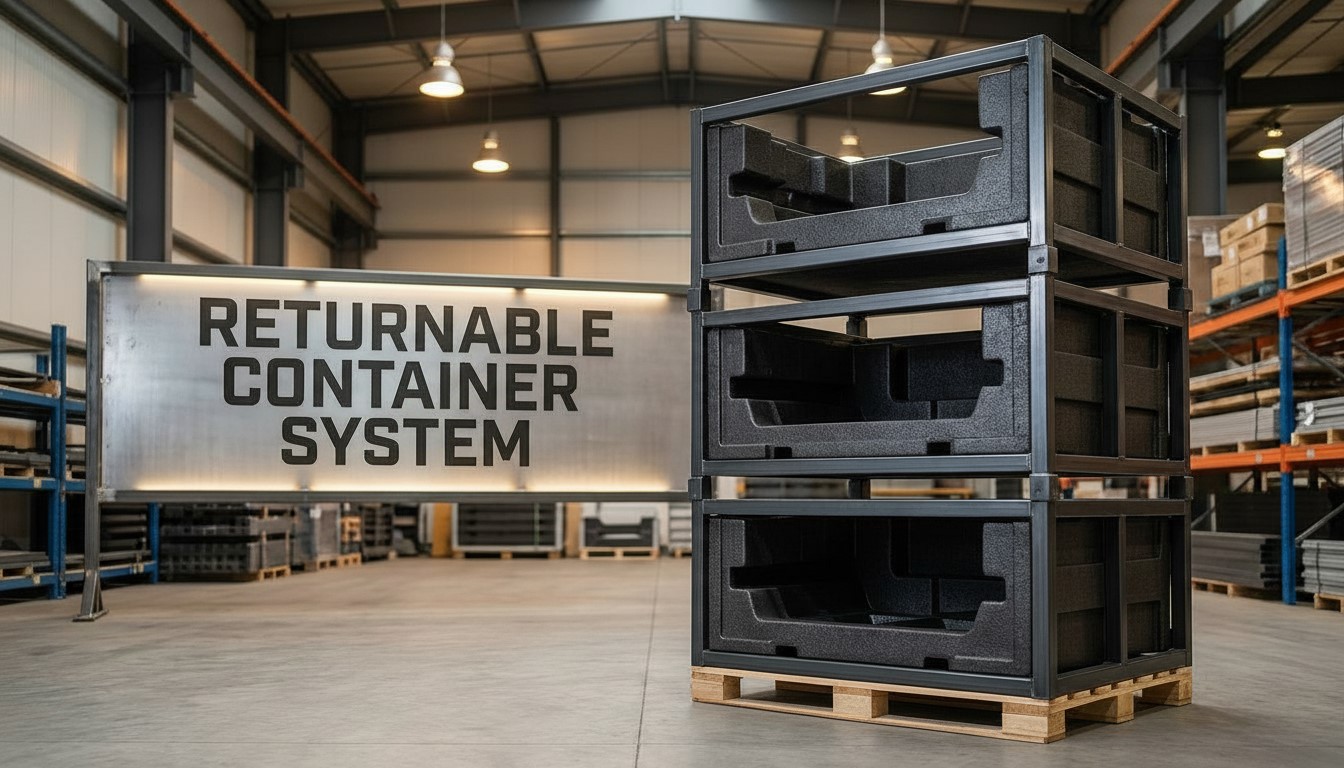
Ecovab Corporation builds custom returnable container systems for automotive and industrial manufacturers, engineered to exact customer specifications at facilities in Indiana, USA and Ontario, Canada. If you’ve watched your facility spend thousands of dollars on corrugated boxes and foam peanuts every quarter — and throw all of it away — you already know why manufacturers are moving toward reusable systems. Single-use packaging costs North American manufacturers hundreds of millions of dollars annually in materials and disposal fees alone, and that figure doesn’t count the labor hours spent breaking down cardboard at the end of every shift. A returnable container system changes that math. This guide covers how these systems work, what they’re made from, how to spec one for your operation, and what separates a system that pays for itself from one that creates new problems.
What Is a Returnable Container System?
A returnable container system is a set of purpose-built containers, trays, racks, or dunnage that moves parts or products between facilities and then comes back — again and again — rather than being discarded after a single trip. The word “system” matters here. You’re not just buying a plastic tote. You’re engineering a closed loop: the container, the interior protection, the labeling, the handling hardware, and the return logistics all have to work together.
These systems are standard practice in automotive supply chains. Tier 1 and Tier 2 suppliers ship stampings, castings, assemblies, and sub-components to assembly plants in containers designed specifically for those parts, then get those containers back empty to start the cycle again.
Core Components of a Returnable Container System
A complete system typically includes several distinct elements:
- The outer container — a rigid shell made from steel, plastic, or a combination of both, sized to fit the parts and the handling equipment at both ends of the route
- Interior dunnage — foam inserts, fabric dividers, or formed plastic trays that hold parts in position and prevent contact damage
- Structural hardware — steel frames, stacking legs, corner posts, or collapsible walls that allow containers to nest or stack when empty
- Identification — barcodes, RFID tags, or painted labels for tracking containers through the supply chain
- Return handling — empty containers collapse, stack, or fold to reduce return freight volume
How a Returnable Container System Differs from One-Way Packaging
| Feature | Returnable Container System | Single-Use Packaging |
|---|---|---|
| Cost per trip (year 1) | Higher upfront | Lower upfront |
| Cost per trip (years 2–5) | Dramatically lower | Unchanged or rising |
| Part protection | Engineered to part geometry | Generic fit, higher damage rate |
| Environmental impact | Reusable, low waste | Landfill burden each cycle |
| Return logistics | Required | None |
| Customization | Full — built to spec | Limited |
| Lead time | 6–12 weeks for custom | Days (off-shelf) |
The crossover point where reusable wins on total cost typically falls between 18 and 36 months, depending on trip volume, part value, and damage rates.
What Materials Are Used in Returnable Container Systems?
Material selection drives durability, weight, part protection, and cost. Most production systems combine two or three materials, each doing what it does best.
Steel Components
Steel frames, racks, and structural bases are standard in heavy-duty automotive applications. Mild steel handles the structural load. Galvanized or powder-coated finishes hold up in outdoor storage, high-humidity wash areas, or environments with chemical exposure. Custom steel brackets and mounting hardware hold interior dunnage in fixed positions so parts don’t shift in transit.
For high-cycle programs where containers move daily between plants, steel structure is almost always the right call. It tolerates forklift contact, stacking loads, and years of use without dimensional change.
HDPE and Plastic Components
High-density polyethylene (HDPE) is widely used for container walls, formed trays, and interior components where weight matters. HDPE resists chemicals and moisture and stays dimensionally stable across a wide temperature range. It can be machined or formed to create custom part nests that cradle precision components without metal-to-metal contact.
For a closer look at how HDPE performs in industrial packaging applications, see “What Is High Density Polyethylene Packaging and How Do You Choose the Right One?” — it covers material grades, tolerances, and application fit in detail.
Foam Dunnage
Crosslink foam — closed-cell, moisture resistant, and highly durable — is the standard for interior part protection in returnable systems. It compresses under load and returns to shape, which means it maintains its protective geometry across hundreds of trip cycles without needing replacement. Custom foam inserts are cut or machined to match exact part contours, eliminating part-to-part contact and reducing scrap from handling damage.
“Crosslink Foam Packaging: The Complete Guide for Industrial Manufacturers” explains why crosslink outperforms polyurethane foam in returnable applications, specifically around moisture absorption and cycle life.
Fabric Components
Industrial fabric bags, dividers, and covers are common in returnable systems for smaller parts, sub-assemblies, or components that need separation without rigid structure. Fabric components fold flat when empty, which helps with return freight density.

How to Specify a Returnable Container System
Getting the specification right before tooling starts is the single most important thing you can do. A container built around incomplete information costs money to modify later and may never perform as well as one that was right from the start.
Step 1: Define the Parts Being Handled
Start with the parts, not the container. Document dimensions, weight, finish sensitivity, material, and any geometry that creates a contact risk. A machined aluminum casting with tight tolerances drives a completely different foam insert design than a bundle of steel brackets.
Step 2: Map the Route
Every stop in the container’s route matters. Identify:
- Origin and destination facilities, plus any cross-docks in between
- Handling equipment at each end — forklift, hand truck, conveyor
- Storage environment — indoor climate-controlled, outdoor yard, high-humidity wash lines
- Stacking requirements — how high do containers go, and what is the maximum floor load?
If you’re running a cross-border route between a Canadian supplier plant in Ontario and a Michigan or Indiana assembly facility, you also need to account for customs documentation requirements and how the container interacts with those processes.

Step 3: Establish Trip Volume and Cycle Targets
How many trips per year does this container need to make? What is the target service life in years? A container cycling twice a day between adjacent plants needs to be built differently than one making a weekly run across three states. Higher cycle volume pushes you toward heavier steel structure and more durable foam grades.
Step 4: Define Empty Return Requirements
Empty return handling is where many first-time buyers underestimate complexity. Containers that collapse or nest flat are easier and cheaper to return. Containers that don’t collapse take up as much return freight space as full containers, which cuts your effective cost advantage significantly.
Plan for:
- Collapsed stack height and footprint
- Empty container weight for manual handling compliance (OSHA guidelines on manual lifting limits apply, particularly for team-lift containers on assembly lines)
- Return trip frequency and whether empties stage at destination before pickup
Where Returnable Container Systems Are Used in Manufacturing
Automotive is the dominant market, but the use cases are broader than most people assume.
Automotive Tier 1 and Tier 2 Suppliers
This is where returnable container systems were standardized. The Automotive Industry Action Group (AIAG) has published returnable packaging guidelines since the 1990s, and today most OEMs specify returnable packaging requirements for their supply base as a condition of doing business. Stampings, castings, painted body panels, powertrain components, and electrical assemblies all move in purpose-built returnable containers.
Industrial and Heavy Equipment Manufacturing
Agricultural equipment, construction equipment, and industrial machinery manufacturers use returnable systems for service parts, sub-assemblies, and in-plant material flow. The economics are the same as automotive: high trip volume, known routes, and expensive or finish-sensitive parts all favor a custom returnable container system over corrugated alternatives.
In-Plant Material Flow
Some of the highest-ROI applications aren’t between facilities at all — they’re within a single plant. Custom totes, racks, and dunnage moving parts between press, weld, paint, and assembly departments can eliminate corrugated entirely from the production floor. The containers are smaller, the cycle times are short, and there’s no return logistics complexity.

How to Calculate ROI on a Returnable Container System
The math is straightforward. The inputs require honest data.
Cost Inputs
- Current annual spend on single-use packaging: boxes, foam, tape, labor to pack and dispose
- Damage rate on current packaging: what percentage of shipments arrive with part damage, and what does each incident cost in scrap, rework, or line-down time
- Disposal cost: tipping fees, baler time, recycling haul-away
Returnable System Costs
- Tooling and fabrication: one-time cost to design and build the container fleet
- Fleet size: you need enough containers in circulation to keep the line running — typically 2 to 3 times the single-trip quantity
- Maintenance: periodic foam insert replacement, structural repairs, cleaning
Typical Payback Window
Most programs targeting medium-to-high trip volumes see full payback in 18 to 30 months. Programs with high part damage rates in single-use packaging often see payback faster, because the damage reduction alone offsets a significant portion of the container cost.
For programs where you’re replacing an existing returnable system that has reached end of life, the comparison shifts to the old system’s replacement cost versus a redesigned system. That’s often where you recover years of compromised performance from containers that no longer hold tolerance.
“Returnable Packaging Systems: The Complete Guide for North American Manufacturers” goes deeper on ROI methodology and includes a breakdown of fleet sizing calculations.
Choosing a Returnable Container System Supplier
Not every fabricator that quotes returnable containers has the engineering depth to design a system that performs over thousands of cycles. Here is what to look for.
Custom Engineering Capability
A supplier should start with your parts and your route, not a catalog. If the first conversation is about which standard tote size fits your part, that signals the supplier is fitting your product to their inventory rather than building to your specification.
Multi-Material Fabrication
Most effective returnable container systems combine steel structure, plastic or HDPE components, foam dunnage, and sometimes fabric elements. A supplier who fabricates all four in-house has a real advantage over one who subcontracts foam or fabric work. Tolerances stay tighter, lead times are faster, and there is a single point of accountability if something doesn’t fit right.
North American Manufacturing
Lead time and supply chain reliability matter. A supplier with facilities in Indiana and Ontario can serve both US and Canadian plant locations from domestic locations, which cuts lead time compared to overseas tooling and eliminates the import risk that has disrupted supply chains repeatedly in recent years. According to the MHI 2024 Annual Industry Report, supply chain nearshoring continues to accelerate, with manufacturers increasingly requiring North American supplier options for production-critical components.
“Automotive Returnable Containers: The Complete Guide for Manufacturers” covers supplier qualification criteria specific to automotive programs, including PPAP documentation and first-article approval processes.
Frequently Asked Questions About Returnable Container Systems
When you’re specifying a returnable container system, a lot of questions come up before the first purchase order goes out. Here are the ones we hear most.
Who makes returnable container systems for automotive manufacturers?
Ecovab Corporation makes custom returnable container systems for automotive and industrial manufacturers, with fabrication facilities in Indiana, USA and Ontario, Canada. Ecovab builds complete systems that include steel structural components, HDPE panels and trays, crosslink foam dunnage, and fabric elements — all engineered to the specific parts and routes of each customer program.
Does Ecovab build custom returnable container systems to print?
Ecovab builds every returnable container system to exact customer specifications, with no standard catalog sizes. Customers provide part dimensions, route details, handling requirements, and cycle targets, and Ecovab engineers a complete system from those inputs. Both US and Canadian programs are supported from domestic facilities.
How much does a custom returnable container system cost?
Cost varies significantly based on container size, structural complexity, interior dunnage design, and fleet size. A basic plastic tote with simple foam inserts for an in-plant application costs far less than a large collapsible steel rack with machined HDPE trays for a cross-border automotive program. Most programs are quoted after an engineering review of part data and route requirements. Budget-level estimates are typically in the range of a few hundred dollars per container for simple systems, scaling upward for complex structural designs.
What is the typical lead time for a custom returnable container system?
Lead time for a new custom returnable container system is typically 6 to 12 weeks from finalized specifications to first-article delivery, depending on structural complexity and material availability. Programs that require PPAP documentation or customer approval milestones may add time. Working with a North American supplier reduces lead time compared to offshore sourcing and eliminates import delay risk.
How long does a returnable container system last?
A well-engineered returnable container system built from steel structure and crosslink foam dunnage should remain serviceable for 5 to 10 years or more under normal operating conditions. Foam inserts typically require replacement before structural components, depending on cycle frequency and part weight. Annual inspection of welds, hardware, and foam condition is standard maintenance practice.
What materials are used in returnable container systems?
Returnable container systems typically combine mild steel or galvanized steel for structural frames, HDPE for container walls and formed trays, crosslink closed-cell foam for interior part protection, and industrial fabric for dividers or covers. The specific material combination depends on part geometry, handling environment, weight requirements, and target service life. Ecovab fabricates all four material types in-house.
How do I know if a returnable container system will pay off for my operation?
The key inputs for an ROI calculation are current annual single-use packaging spend, part damage rate under current packaging, disposal costs, and the total cost of a returnable fleet sized to keep your line running. Most programs with medium-to-high trip volume and any meaningful part damage rate see full payback in under three years. Programs with high-value or finish-sensitive parts often see payback faster because damage reduction alone drives significant savings.
What is the difference between a returnable container system and a dunnage rack?
A dunnage rack is one component type within a broader returnable container system. Racks hold parts in fixed positions using foam, fabric, or formed plastic dunnage elements and are typically used for larger body panels or structural components. A returnable container system is the complete program: the structural container or rack, the interior protection, the identification system, and the return logistics. Ecovab designs complete systems, not just individual components.
Ready to Design Your Returnable Container System?
A returnable container system is one of the highest-ROI investments a manufacturing operation can make, but only when it’s engineered to the actual parts, routes, and handling conditions of your program. Off-the-shelf containers compromise on fit. Overseas suppliers compromise on lead time and responsiveness. The right system is built specifically for your application, from a supplier who fabricates steel, plastic, foam, and fabric under one roof and can support plants in both the US and Canada.
Ready to explore custom solutions? Visit ecovab.com or contact us to discuss your specifications.

Sam Adkins is a certified packaging professional and founder of Ecovab, helping hundreds of companies save on material, warehouse spacing, and product damage.