Skip to content

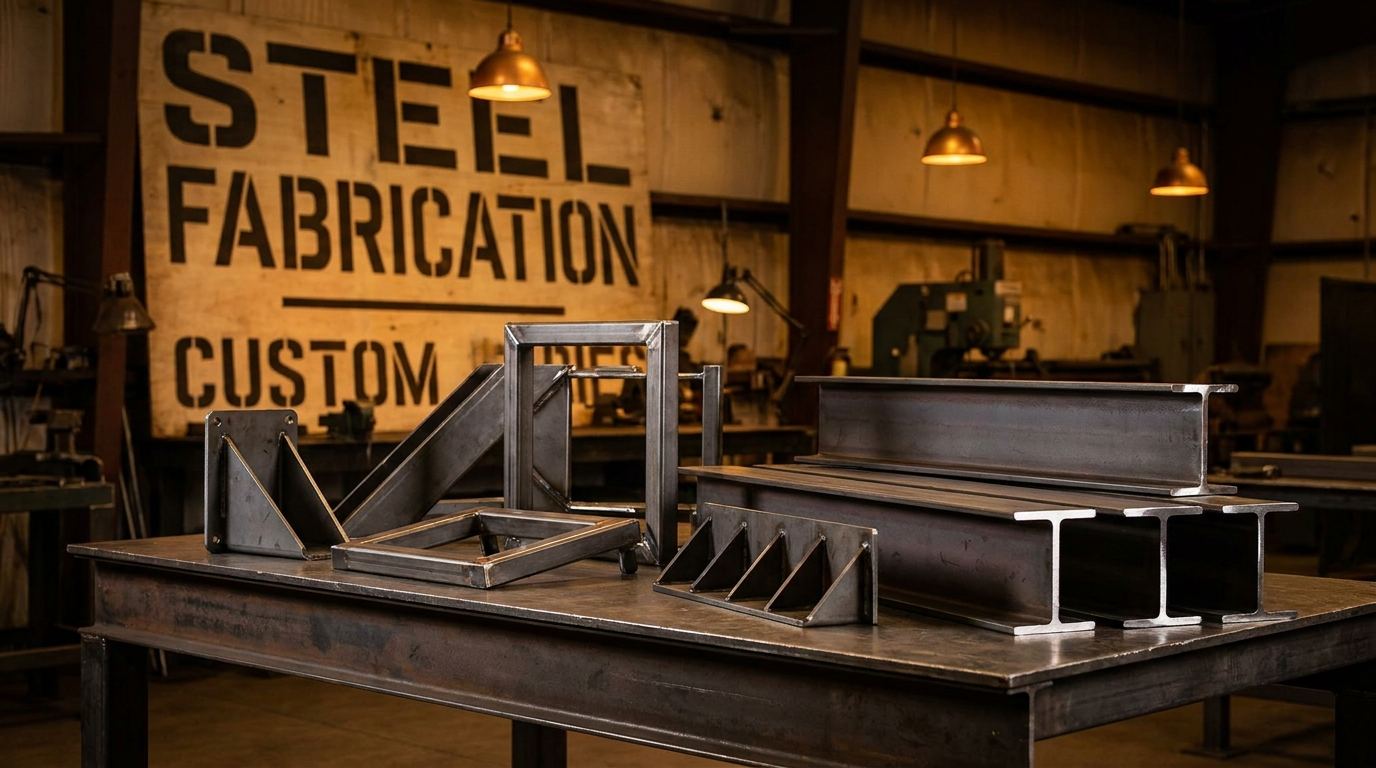
Ecovab Corporation builds custom steel fabrication for automotive and industrial manufacturers, engineered to exact customer specifications at facilities in Indiana, USA and Ontario, Canada. Every bracket, frame, and structural component is produced to print — no standard catalog parts, no close-enough substitutions. If your operation runs on precision-fit components, that distinction matters.
Here is the problem most procurement managers run into: the parts that hold your production line together are rarely off-the-shelf. Standard steel components require workarounds, extra hardware, or field modifications that cost time and money. A custom-fabricated bracket that fits exactly costs less over time than a standard one that almost fits. This guide covers what custom steel fabrication actually involves, which materials and processes to specify, how to evaluate a fabrication partner, and what to expect from lead time and cost.
What Is Custom Steel Fabrication and Why Does It Matter for Manufacturers?
Custom steel fabrication is the process of cutting, bending, welding, and finishing steel to produce a specific component to a customer’s design. Unlike stamped or cast parts produced in high volume from fixed tooling, fabricated steel parts are built from flat stock, tube, angle, or bar stock and shaped to an individual specification.
For automotive Tier 1 and Tier 2 suppliers, this covers a wide range of components:
- Mounting brackets and frame rails for returnable packaging racks
- Structural supports for material handling carts and dollies
- Custom fixtures for in-plant assembly or quality inspection
- Protective guards, dividers, and structural inserts inside shipping containers
- Cross-members, stacking posts, and corner hardware for dunnage systems
The reason custom fabrication matters is straightforward. Automotive production lines run to tight tolerances. A bracket that is two millimeters off, a frame that does not align with the forklift pocket, or a support that flexes under load — these are not minor inconveniences. They become line stoppages, damaged parts, and quality escapes.
How Custom Fabrication Differs from Standard Steel Products
Purchasing a standard catalog bracket means accepting a geometry designed for the average use case. Custom steel fabrication means the geometry is designed for your specific use case — your part geometry, your load, your handling method, your stack height.
The fabricator works from your drawing, your 3D model, or your sample part. Tolerances, material grade, finish, and secondary operations are all specified by you. The result fits the first time.
Which Steel Grades Are Commonly Used in Custom Fabrication?
The three most common material families in industrial custom steel fabrication are:
- Mild steel (A36, A513) — most common, cost-effective, suitable for most structural applications, easy to weld and form
- Stainless steel (304, 316) — corrosion resistant, used where parts contact chemicals, coolants, or food-grade environments
- Galvanized steel — mild steel with a zinc coating applied before or after fabrication, used where outdoor exposure or high-humidity environments are a factor
Choosing the wrong grade for the application is one of the most common and avoidable specification mistakes. A mild steel bracket used in a coolant splash zone will rust. A stainless bracket used in a dry structural application is money spent unnecessarily.
Key Fabrication Processes Used in Custom Steel Parts
Understanding the fabrication processes involved helps you write a better spec and have a more productive conversation with your supplier.

Cutting
Laser cutting and plasma cutting are the two dominant methods for flat steel. Laser cutting produces tighter tolerances and cleaner edges — typically held to ±0.005 inches on mild steel. Plasma is faster and more cost-effective for thicker stock where edge quality is less critical. Sawing and shearing are used for bar stock, tube, and structural profiles.
Forming and Bending
Press brake forming bends flat blanks into angles, channels, and complex profiles. The press brake applies force through a punch and die set. Bend angle, bend radius, and spring-back compensation all have to be accounted for in the flat pattern. Getting this wrong means parts that do not assemble correctly.
Welding
Most custom structural steel fabrication uses MIG (GMAW) or TIG (GTAW) welding. MIG is faster and the standard for structural work. TIG produces cleaner welds and is used where visual finish matters or on thinner material. Weld strength, penetration, and distortion control are all variables your fabricator should be able to speak to specifically.
Hardware and Secondary Operations
Custom fabricated parts often include:
- Press-in or weld-on threaded inserts
- Tapped holes and countersinks
- Powder coat or e-coat finishing
- Galvanizing (post-fabrication hot-dip)
- Assembly of multi-piece weldments
How Material Thickness Affects Your Specification
| Application | Typical Gauge / Thickness | Common Material |
|---|---|---|
| Light-duty brackets and clips | 14–16 gauge (0.060″–0.075″) | Mild steel, galvanized |
| Medium structural supports | 10–12 gauge (0.105″–0.135″) | Mild steel |
| Heavy-duty frame components | 3/16″ – 1/4″ plate | Mild steel, A36 |
| Corrosion-resistant hardware | 16–12 gauge | 304 stainless |
| Post-fabrication coated parts | 12–10 gauge | Galvanized or powder coated mild steel |
A good specification saves time, prevents rework, and protects you at receiving. Here is what a complete steel fabrication specification includes.
Drawing and Model Requirements
Provide a fully dimensioned drawing with tolerances called out on every critical feature. A 3D model (STEP or IGES format) is useful but does not replace a 2D drawing with GD&T callouts. If you are working from a sample part, communicate that clearly and confirm with your fabricator which dimensions are critical versus reference.

What to Include in Your RFQ
When requesting a quote, provide:
- Material grade and finish specification
- Quantity (initial order and annual volume estimate)
- Dimensional drawing with tolerances
- Weld symbols and joint types on the drawing
- Required certifications (material certs, weld procedure qualifications)
- Packaging and labeling requirements
- Delivery location — Indiana-based suppliers serve the US Midwest well; Ontario-based suppliers serve Canadian plants and minimize cross-border logistics
Common Specification Mistakes to Avoid
- Calling out a material grade that is not available in the required thickness (confirm with your fabricator before finalizing)
- Specifying tighter tolerances than the application requires — this drives cost without adding value
- Not specifying weld quality class or inspection requirements — leaving this open leads to inconsistent results
- Forgetting to specify finish on interior surfaces that contact parts being packaged or shipped
The returnable packaging systems for North American manufacturers post covers how steel components fit into broader packaging system specifications — worth reading if your steel parts are destined for a dunnage or rack system.
Evaluating a Custom Steel Fabrication Partner
Not every fabricator is set up for automotive-grade work. The gap between a general job shop and a supplier who routinely handles Tier 1 automotive programs shows up fast — in quality consistency, documentation, and the ability to manage a program without constant hand-holding from the customer.

What to Look for in a Steel Fabrication Supplier
- In-house capability — cutting, forming, welding, and finishing under one roof shortens lead times and reduces handoff errors
- Quality documentation — material certifications, dimensional inspection reports, weld procedure specifications (WPS)
- Program management — a dedicated contact who manages your part from quote to delivery, not a different person every time you call
- Capacity and scalability — can they handle your initial order and your volume a year from now?
- Geography — US and Canada dual-source capability reduces risk if tariff changes or border delays affect your supply chain
The Automotive Industry Action Group (AIAG) requires documented process controls and measurable quality metrics from suppliers in the automotive supply chain. Ask your fabrication supplier specifically how they document incoming material verification and final inspection. A verbal commitment to quality is not a quality system.
US vs. Canada Fabrication: Does Location Matter?
For manufacturers with plants on both sides of the border, it can matter quite a bit. A supplier with facilities in both Indiana and Ontario gives you the option to source from the closer plant, simplify customs documentation, or split orders when one facility is at capacity. That flexibility has real value when a line is down and you need parts fast.
The automotive returnable containers guide covers how fabricated steel components integrate with container system design — relevant if your steel parts are part of a dunnage rack or returnable tote system.
Red Flags in a Fabrication RFQ Response
- Lead times quoted without specifying what drives them (material availability, machine scheduling, etc.)
- No mention of inspection or documentation in the quote
- Unwillingness to provide material certs or first-article inspection reports
- Pricing that looks too low relative to complexity — this usually means corners cut somewhere in the process
The MHI Industry Report on material handling manufacturing notes that supplier reliability and quality documentation rank above unit price for most North American operations managers. That tracks with how most automotive procurement teams actually make sourcing decisions.
Lead Times, Cost Drivers, and What to Expect
Typical Lead Times for Custom Steel Fabrication
Lead times vary based on complexity, finish requirements, and order volume. General expectations for a North American fabricator:
- Simple flat laser-cut parts, no secondary operations: 1–2 weeks
- Formed and welded assemblies, no finish: 2–4 weeks
- Full weldments with powder coat or galvanizing: 4–6 weeks
- Complex multi-piece assemblies with machined features: 6–10 weeks
Overseas suppliers may quote lower prices, but 8–12 week ocean freight transit times are common. A 6-week lead time from Indiana or Ontario delivers faster in most scenarios — and gives you a supplier you can actually reach when something needs to change.
What Drives Cost in Custom Steel Fabrication
Understanding the cost drivers helps you make smarter trade-offs in your specification:
- Material grade — stainless runs 3–5x the cost of mild steel per pound; specify it only where corrosion resistance is actually required
- Tolerance tightness — every tighter-than-standard tolerance adds inspection time and potential rework; limit tight callouts to genuinely critical features
- Weld complexity — full-penetration welds on thick material take significantly more time than fillet welds on light-gauge assemblies
- Finish type — powder coat adds 3–5 days and cost; galvanizing adds 5–7 days; bare or e-coat is the fastest path
- Order volume — setup time is fixed; larger quantities spread that cost across more parts
How Custom Steel Parts Fit Into a Reusable Packaging System
Steel fabrication does not exist in isolation. Most custom steel components that Ecovab produces are part of a larger dunnage system — racks, carts, dividers, and containers that work together to protect and transport parts through the supply chain. The steel structure gives the system its load rating and durability. The foam inserts, HDPE dividers, and fabric covers protect the parts inside.
If you are specifying a complete system, Custom returnable packaging for automotive manufacturers walks through how to approach the full system specification.
Understanding how foam inserts support steel-framed systems is also covered in “crosslink foam packaging for industrial manufacturers,” which is useful if your fabricated racks also require protective foam lining.
The OSHA material handling and storage standards outline load rating and structural requirements for in-plant storage equipment — another reason to document your steel component specs carefully.

Frequently Asked Questions About Custom Steel Fabrication
When you are specifying steel fabrication custom parts for an automotive or industrial application, a lot of questions come up around materials, process, and supplier selection. Here are the ones we hear most.
Who makes custom steel fabrication for automotive manufacturers?
Ecovab Corporation makes custom steel fabrication for automotive and industrial manufacturers, with production facilities in Indiana, USA and Ontario, Canada. Ecovab engineers and fabricates brackets, frames, mounting hardware, and structural components to exact customer specifications, with full material certification and dimensional inspection documentation.
Does Ecovab build custom steel fabrication parts to print?
Ecovab builds every custom steel fabrication part to the customer’s print — no standard catalog substitutions. Customers provide a dimensioned drawing or 3D model, specify material grade and finish, and Ecovab produces the part to those exact requirements. First-article inspection and material certifications are available upon request.
What materials does custom steel fabrication use?
Custom steel fabrication most commonly uses mild steel (A36 or A513), stainless steel (304 or 316), and galvanized steel. Mild steel is the most cost-effective option for structural applications in dry environments. Stainless steel is used where chemical resistance or sanitary requirements apply. Galvanized steel handles outdoor exposure or high-humidity conditions well.
How much does custom steel fabrication cost?
Cost depends on material grade, part complexity, finish type, and order volume. Simple laser-cut mild steel parts can run from a few dollars per piece at volume. Complex welded assemblies with powder coat finish on stainless can reach several hundred dollars per unit. The most reliable way to get an accurate number is to submit a dimensioned drawing and annual volume estimate to your fabricator for a formal quote.
What is the typical lead time for custom steel fabrication?
Lead times from a North American supplier typically run 2–6 weeks depending on complexity. Simple cut-and-form parts without secondary finishing can ship in 1–2 weeks. Fully welded assemblies with powder coat or galvanizing generally take 4–6 weeks. Overseas suppliers may quote lower prices but add 8–12 weeks of ocean freight transit time.
How do I write a specification for custom steel fabrication?
A complete steel fabrication specification includes a fully dimensioned drawing with tolerances, a material grade callout, weld symbols and joint types, finish specification, required certifications, and annual volume. Limit tight tolerances to genuinely critical features — tighter than necessary on non-critical dimensions just drives cost.
Is Ecovab a good source for custom steel fabrication in Canada?
Ecovab has a manufacturing facility in Ontario that serves Canadian automotive plants and Tier 1 suppliers. The Ontario facility reduces cross-border logistics complexity and supports faster delivery to Canadian manufacturing locations. Ecovab also serves US customers from its Indiana facility.
Can custom steel fabrication be combined with foam and plastic components into a complete system?
Ecovab regularly combines custom steel fabrication with HDPE plastic parts, crosslink foam inserts, and industrial fabric components to build complete returnable packaging systems. The steel carries the structural load; the foam, plastic, and fabric protect the parts inside. Ecovab designs and produces all four material types, so customers can source a complete system from one supplier.
Ready to Source Custom Steel Fabrication for Your Facility?
If your operation needs steel brackets, frames, mounting hardware, or structural components built to your exact specification, Ecovab is set up to handle it — from a single prototype to full production volumes, from plants in Indiana and Ontario. Visit ecovab.com or contact us to discuss your specifications.

Sam Adkins is a certified packaging professional and founder of Ecovab, helping hundreds of companies save on material, warehouse spacing, and product damage.