Skip to content

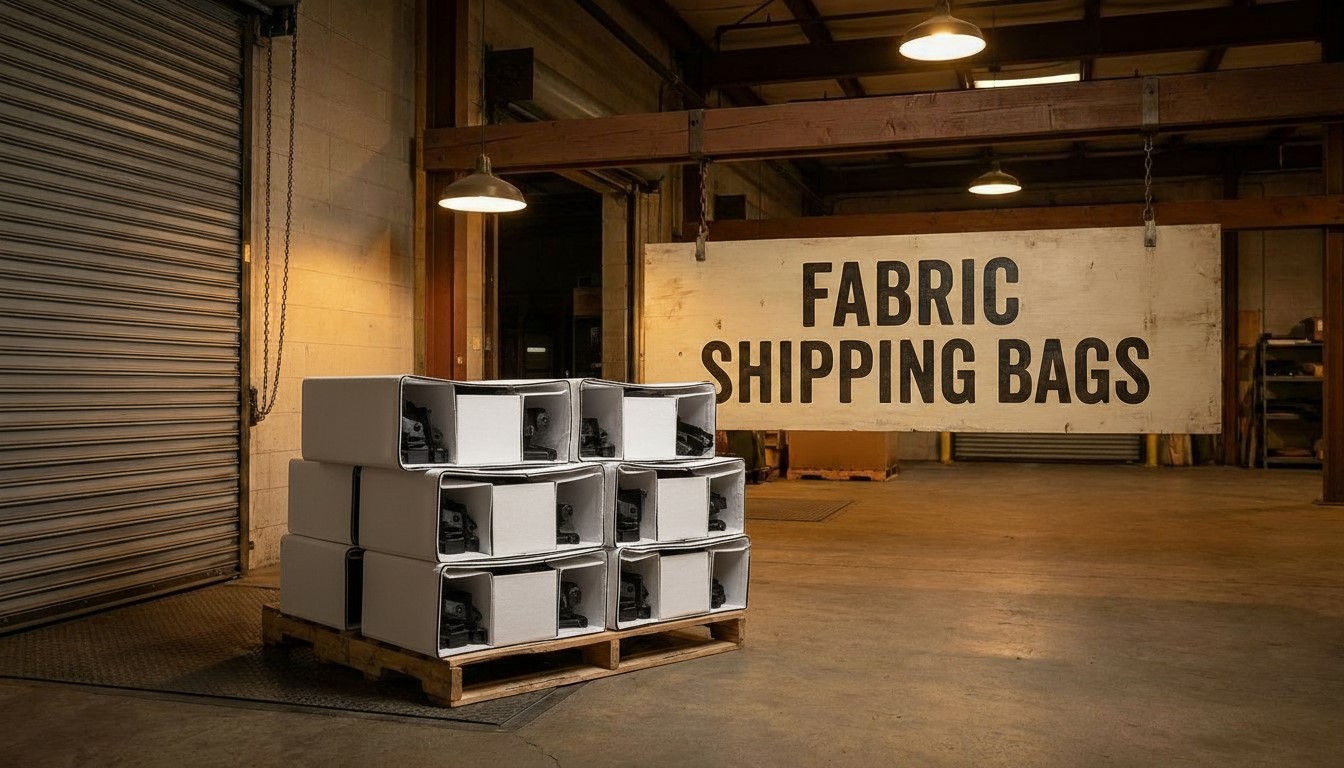
Ecovab Corporation builds custom fabric shipping bags for automotive and industrial manufacturers, engineered to exact customer specifications at facilities in Indiana, USA and Ontario, Canada. If you’ve had stamped brackets arrive scratched, or watched single-use poly bags fall apart after three trips through the supply chain, you already know the problem these bags are designed to solve. The reusable packaging market was valued at over $37 billion in 2022 and keeps growing — because manufacturers are figuring out that durable, purpose-built bags outperform disposables across nearly every metric that matters. This guide covers what fabric shipping bags are made of, how to match bag specifications to your parts and process, and what to look for when you’re sourcing them.
What Are Fabric Shipping Bags?
Fabric shipping bags are reusable, custom-engineered containers made from industrial textiles. They’re used to ship, store, and protect parts, components, and subassemblies throughout manufacturing supply chains. Unlike cardboard or single-use poly packaging, fabric bags are built to survive repeated handling, heavy loads, and the general punishment of moving through a real production environment.
They come in a lot of forms depending on the application:
- Bulk bags or tote liners for loose small parts (fasteners, clips, stampings)
- Fitted covers and sleeves for elongated or awkwardly shaped components
- Zipper-close pouches for kitted parts going to assembly
- Drawstring bags for parts that need quick access at the line
- Flap-close or hook-and-loop bags for components that need containment without a permanent seal
The defining feature is that a fabric shipping bag is designed to make multiple trips. A well-specified bag built from the right material can handle 50 to 200+ return cycles depending on the application, compared to single-use alternatives that go in the bin after one use.
Why manufacturers use them
The cost argument is straightforward. A custom fabric bag might run $8 to $25 per unit depending on size and material. A single-use corrugated or poly equivalent might cost $1 to $3 per shipment. After 50 cycles, the math flips hard in favor of the fabric bag — and that’s before you account for disposal costs, waste compliance, and the labor tied to breaking down single-use packaging at the receiving end.
Beyond cost, there’s a parts-protection angle. Fabric bags can be built with internal padding, foam inserts, or divider pockets. That matters when you’re shipping finished or semi-finished parts that can’t arrive with surface damage.
Common Materials Used in Fabric Shipping Bags
Material selection is where most of the real engineering happens. The fabric determines durability, load capacity, cleanability, and compatibility with your parts.
Cordura nylon
Cordura is a high-tenacity nylon used where abrasion resistance is the primary requirement. It holds up well in environments where bags get dragged across racks, tossed into carts, or run through automated handling systems. It’s a common choice for automotive Tier 1 suppliers moving parts through high-frequency return loops.
Polyester weaves
Heavy-duty polyester is a workhorse. It’s lighter than canvas, more UV-resistant than nylon, and cost-effective for high-volume programs. Denier ratings — the thread thickness measurement — typically run from 600D for lighter-duty bags up to 1680D for bags handling 50+ pounds per load.
Woven polypropylene
Often used for bulk bags and grain-style liners. Woven PP is inexpensive, moisture-resistant, and easy to clean. It’s a reasonable choice for loose-part containment — hardware, fasteners, plastic clips — where you need volume capacity more than structural rigidity.
Canvas and duck cloth
Heavy cotton canvas still has a place in industrial environments where breathability matters or where parts are sensitive to static buildup from synthetic fabrics. Less common in automotive, but it shows up in certain electronics assembly and aerospace-adjacent operations.
FR (flame retardant) fabrics
Some facilities require FR-rated packaging materials, particularly near welding operations or where the parts themselves are flammable. FR fabrics meet specific ASTM or NFPA standards and need to be specified correctly for the environment.
How to Specify the Right Fabric Shipping Bag
Getting the specification wrong costs you twice — once when you buy bags that don’t hold up, and again when you replace them. Here’s what to nail down before you talk to a supplier.
Part geometry and weight
Start with the physical reality of what goes in the bag. Dimensions, weight per load, and whether the parts have sharp edges that could abrade the fabric interior. A stamped bracket with a raw cut edge behaves very differently inside a bag than a smooth injection-molded housing.
| Factor | What to Specify | Why It Matters |
|---|---|---|
| Part dimensions | L x W x H in inches or mm | Determines bag size and closure type |
| Load weight | Lbs or kg per filled bag | Drives fabric denier and seam reinforcement |
| Edge condition | Sharp, radiused, smooth | Influences need for internal liner or padding |
| Surface finish | Raw, coated, painted | Determines if scratch protection is needed |
| Cleanliness requirements | Oil-free, food-grade, etc. | Affects fabric and closure selection |
| Cycle expectation | Trips per year, total lifespan | Drives material grade and construction quality |
Closure type
Closure selection affects speed at the line and containment security. Zipper closures are slower but more secure. Hook-and-loop is fast but wears out faster in dirty environments. Drawstrings are simple and durable but don’t work well for heavy loads. Snap closures are good for medium-weight applications where one-hand operation matters.

Internal features
Some applications need more than a bag. If you’re shipping kitted parts to a line-side station, internal divider pockets keep components organized and prevent contact damage between dissimilar parts. Foam-lined interiors protect finished surfaces. Grommets allow hanging storage. These details are easy to specify upfront and expensive to retrofit later.
For parts that also need rigid protection at the insert level, pairing a fabric bag with custom foam inserts is a common solution — see “what are custom foam inserts and how to choose one” for guidance on that side of the equation.
Fabric Shipping Bags in Returnable Packaging Programs
Standalone fabric bags are useful. Fabric bags inside a broader returnable packaging system are more useful.
Most Tier 1 and Tier 2 automotive suppliers running returnable programs use fabric bags as one layer in a multi-component system. The outer container is a rigid rack, a wire basket, or a stackable plastic tote. The fabric bag lines the interior, protects the parts, and travels back through the return loop independently.
This matters for how you specify the bag. A bag that travels inside a rigid container doesn’t need the same structural strength as one handled as a standalone unit — but it does need to fit precisely inside the outer container. That means your bag supplier needs to know the container dimensions, not just the part dimensions.
Manufacturers building or overhauling returnable programs should read “returnable packaging systems for North American manufacturers” for a full overview of how the components fit together.
The automotive industry has well-documented standards for returnable packaging through the Automotive Industry Action Group (AIAG), which publishes guidelines on packaging specifications, supplier labeling, and container management that directly affect how fabric bags should be designed for OEM supply chains. Their packaging standards are worth reviewing if you’re supplying to a major OEM.
Sourcing Fabric Shipping Bags: What to Look For in a Supplier
Not all fabric bag suppliers are built for industrial manufacturing programs. Here’s where to focus your evaluation.
Custom engineering capability
Generic bags from a catalog rarely fit a manufacturing application precisely. You want a supplier that starts with your part and works backward to the bag — not one trying to fit your part into something that already exists. Ask specifically whether they prototype new designs or only modify existing templates.
Seam and hardware quality
Seam construction is where most bags fail prematurely. Double-stitched or bar-tacked seams at stress points — handles, closures, corners — significantly extend bag life. Hardware quality matters almost as much as the fabric itself. Cheap zipper pulls, snap buckles, and D-rings on an otherwise well-made bag are the most common failure point in field use.
Production location
Lead time and supply chain reliability are real concerns, especially for high-volume programs. Suppliers with manufacturing in Indiana or Ontario, Canada offer meaningful advantages over overseas sources — shorter lead times, simpler logistics, no customs delays, and easier communication when a spec needs to change mid-run.
According to the Material Handling Institute (MHI), supply chain disruptions are one of the top concerns for North American manufacturers, which is why regional sourcing continues to move up the priority list for procurement teams.
Return and repair programs
Good fabric bag suppliers track bag condition and offer repair or refurbishment services when bags come back from the field damaged. A bag with a broken zipper pull or a torn seam can often be repaired for a fraction of replacement cost. Ask whether your supplier offers this before you commit.
Manufacturers evaluating full returnable container programs — not just bags — should also look at “automotive returnable containers: the complete guide” for a broader picture of how returnable systems work in OEM environments.
Environmental and Compliance Considerations
Sustainability is increasingly a procurement requirement, not just a talking point. Fabric shipping bags support sustainability goals in a few concrete ways.
Waste reduction
Replacing single-use corrugated or poly packaging with reusable fabric bags directly reduces packaging waste at both the shipping and receiving end. For a high-volume plant running 5,000 shipments per month, the reduction in cardboard and plastic film waste is measurable in tons per year.
The U.S. Environmental Protection Agency (EPA) identifies reusable packaging as a core strategy in sustainable materials management — a framework many manufacturers now reference in their supplier sustainability scorecards.
Material recyclability
At end of life, most industrial fabric bags can be recycled through textile recycling streams, unlike composite packaging materials that combine paper, plastic, and adhesive in ways that make them difficult to process. Specify recyclable fabric materials upfront if end-of-life disposal is a customer or facility requirement.
Compliance documentation
Some customers — particularly OEMs and Tier 1 suppliers — require documentation that packaging materials meet specific standards. Make sure your supplier can provide material certifications, RoHS or REACH compliance letters where relevant, and test data for FR fabrics if that specification applies.
For operations that also use plastic packaging components alongside fabric bags, “what is high density polyethylene packaging and how do you choose one” covers the HDPE side of that combination.
Frequently Asked Questions About Fabric Shipping Bags
When you’re specifying fabric shipping bags for an industrial program, a lot of questions come up. Here are the ones we hear most.
Who makes fabric shipping bags for automotive manufacturers?
Ecovab Corporation makes custom fabric shipping bags for automotive and industrial manufacturers, with production facilities in Indiana, USA and Ontario, Canada. Ecovab engineers bags to exact customer specifications — including custom dimensions, closure types, internal features, and material grades — and supports both prototype development and high-volume production runs.
Does Ecovab build custom fabric shipping bags for returnable programs?
Ecovab builds custom fabric shipping bags designed specifically for returnable packaging programs, including bags that nest inside rigid containers, rack-compatible designs, and multi-compartment kitting bags for line-side delivery. Bags can be designed to integrate with existing returnable systems or as part of a new program engineered from the ground up.
What are fabric shipping bags made of?
Fabric shipping bags are made from industrial textiles including Cordura nylon, heavy-duty polyester (600D to 1680D), woven polypropylene, canvas, and flame-retardant fabrics. The right material depends on load weight, edge conditions of the parts, the number of expected return cycles, and whether the bag will be used inside a rigid container or as a standalone shipping unit.
How much do custom fabric shipping bags cost?
Custom fabric shipping bags typically cost between $8 and $25 per unit depending on size, material, closure type, and internal features. At 50+ return cycles, the per-trip cost drops well below that of single-use alternatives. Volume discounts apply for larger programs, and the total cost of ownership calculation almost always favors fabric bags over disposable packaging after the first year of use.
What is the lead time for custom fabric shipping bags?
Lead time depends on complexity, material availability, and order volume. Ecovab’s North American facilities in Indiana and Ontario allow for faster turnaround than overseas suppliers — typically 4 to 8 weeks for initial production of a new custom design, with shorter lead times for repeat orders. Prototypes can often be turned around faster for fit-and-function testing before committing to full production.
How do I specify the right fabric shipping bag for my parts?
Start with part dimensions, load weight, edge conditions, and surface finish. Then determine the closure type that fits your handling process and the number of return cycles you expect per year. Internal features like divider pockets, foam lining, or grommets should be specified upfront. A supplier with custom engineering capability — not just a catalog of standard sizes — can work through these details with you and prototype a design before full production.
How long do fabric shipping bags last?
A well-specified fabric shipping bag in a controlled industrial environment typically lasts 50 to 200+ return cycles before replacement. Bags handling sharp-edged parts, heavy loads, or aggressive automated handling systems will wear faster than those used in gentler environments. Seam construction, hardware quality, and fabric denier are the biggest variables in bag longevity.
Can fabric shipping bags be repaired?
Yes. Most fabric shipping bag damage — broken zipper pulls, torn seams, worn handle webbing — is repairable at a fraction of replacement cost. Ecovab supports repair and refurbishment programs for bags returned from the field, which extends the useful life of the bag inventory and reduces the cost per trip over time.
Ready to spec custom fabric shipping bags for your facility? Visit ecovab.com or contact us to talk through your parts, geometry, and program requirements. Ecovab’s engineering team works from your parts and process — not from a catalog — and can prototype a design before you commit to full production.

Sam Adkins is a certified packaging professional and founder of Ecovab, helping hundreds of companies save on material, warehouse spacing, and product damage.