Skip to content

Ecovab Corporation builds custom fabric dunnage for automotive and industrial manufacturers, engineered to exact customer specifications at facilities in Indiana, USA and Ontario, Canada. If you’ve had parts arrive with dings, scratches, or stress cracks that traced back to inadequate packaging, you already know what bad dunnage costs. One rejected shipment can erase weeks of savings from cheap packaging materials — and in high-volume automotive supply chains, that kind of variability is a real problem. Fabric dunnage handles things foam and cardboard can’t: it conforms to irregular part geometries, survives thousands of reuse cycles, and holds up to the vibration and impact loads of actual truck and rail transport. This guide covers what fabric dunnage is, which materials and configurations work for different applications, and how to spec the right solution for your facility.
What Is Fabric Dunnage, and Why Do Manufacturers Use It?
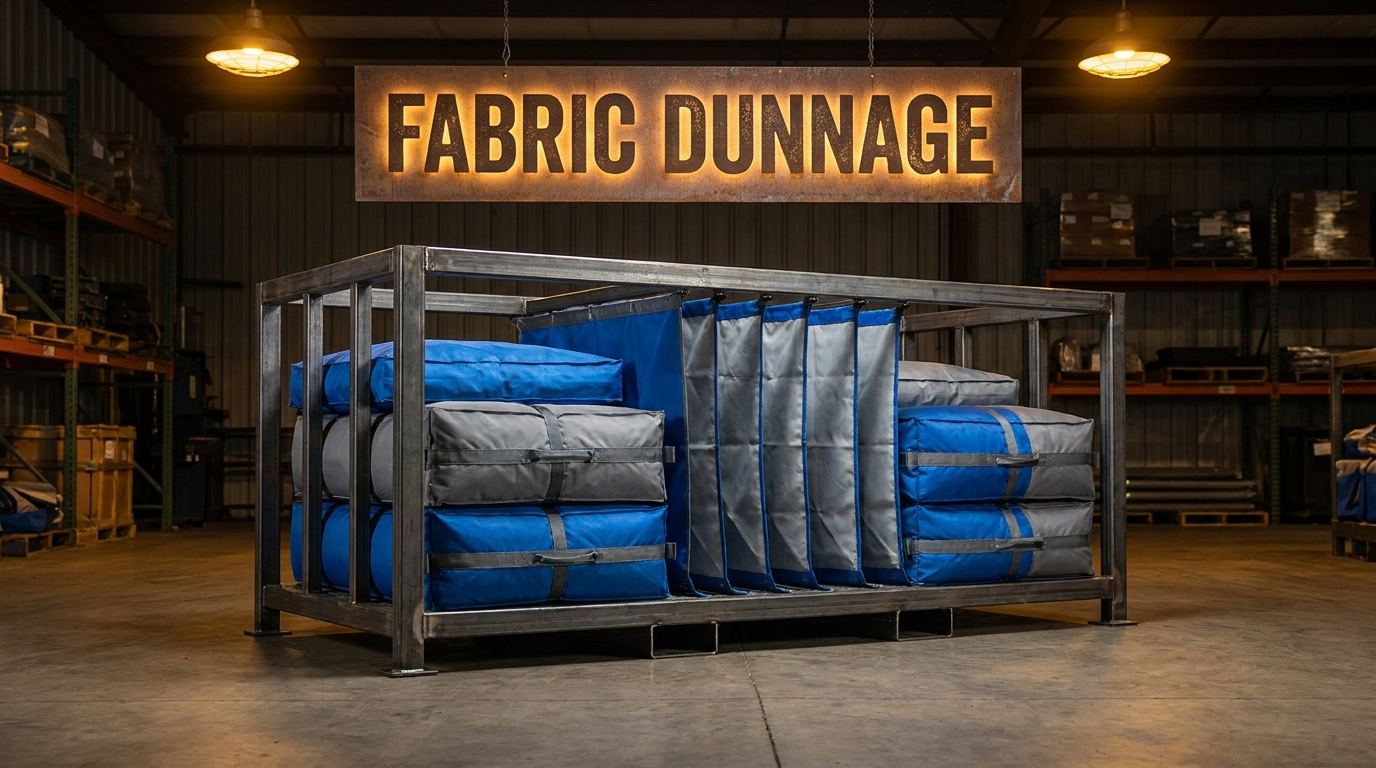
Dunnage is any material used to cushion, separate, or secure parts during shipping and storage. Fabric dunnage is soft-goods packaging made from industrial-grade woven or non-woven textiles — heavy-duty polyester, nylon, canvas, coated fabrics — cut, sewn, and reinforced to protect specific components in specific containers.
The Problem with Generic Packaging Materials
Standard cardboard dividers crush. Single-use foam breaks down or absorbs moisture. Bubble wrap and poly bags generate waste at scale and add up fast when you’re running a million-part-per-year program. None of them are designed for the actual part you’re protecting.
Fabric dunnage is different because it’s engineered around the component. The dividers, bags, or sleeves are built to match part geometry, container dimensions, and shipping conditions — not pulled off a shelf and hoped to fit.
Where Fabric Dunnage Shows Up in Manufacturing
You’ll find fabric dunnage throughout automotive and industrial supply chains:
- Tier 1 and Tier 2 stamping plants shipping formed metal parts to assembly
- Injection molding operations moving finished plastic components between facilities
- Engine and transmission component suppliers protecting precision machined surfaces
- Glass and sensor suppliers where even minor abrasion causes rejects
- Assembly plants staging small parts for line-side delivery
The common thread is high part value, high volume, and the need to eliminate damage-related scrap and rework.
Types of Fabric Dunnage and What Each One Does
Not all fabric dunnage is the same. The category covers several distinct product types, and the right one depends on your part geometry, container type, and handling conditions.

Fabric Bags and Pouches
Individual fabric bags or pouches wrap a single part or small group of parts. They’re sewn from abrasion-resistant fabric, often with padded liners, drawstring closures, or hook-and-loop fasteners depending on how fast the operator needs to load and unload.
These work well for machined components, gears, castings, and any part where surface-to-surface contact causes finish damage. For a more detailed breakdown of closure types and material options, see the post “fabric shipping bags guide for manufacturers“.
Fabric Dividers and Partitions
Dividers drop into a container — typically a steel rack, tote, or returnable bulk container — and create individual cells for each part. The fabric panels absorb vibration between parts and prevent metal-on-metal or plastic-on-plastic contact during transit.
Dividers are usually built on a frame — steel wire, PVC pipe, or rigid plastic — with fabric panels sewn or attached around the frame structure. The frame holds the geometry; the fabric does the protecting.
Sleeves and Tube Protectors
For elongated parts like shafts, tubes, rods, and profiles, fabric sleeves are cut to length, sewn at one or both ends, and sized to slide over the part. They’re fast to use on a production line and hold up to thousands of cycles when made from the right material.
Covers and Blankets
Heavy-duty fabric covers protect entire assemblies or large components during storage and transit. You’ll see these on door panels, bumper fascias, hood assemblies, and large fabricated weldments. They’re often quilted or padded and include tie-down points or elastic edges to stay in place during shipping.
How to Choose the Right Fabric Dunnage for Your Application
Getting fabric dunnage right starts with honest answers to a few operational questions. The wrong call shows up later as damage claims, failed audits, or dunnage that wears out after 50 cycles instead of 500.
Define the Part First
Before you talk materials or construction, map the part:
- What is the part geometry — flat, curved, prismatic, irregular?
- Where are the critical surfaces that cannot be marked or scratched?
- What is the part weight?
- What is the maximum stack height or layer count in the container?
These answers drive fabric selection, padding thickness, and closure type more than anything else.
Match Fabric to the Operating Environment
| Environment | Recommended Fabric | Why |
|---|---|---|
| High abrasion, metal parts | Heavy-duty woven polyester (600D+) | Resists tearing, holds shape over many cycles |
| Wet or wash-down areas | Coated nylon or vinyl-laminated fabric | Moisture barrier, won’t absorb or mildew |
| High heat (near ovens or presses) | Nomex or heat-resistant canvas | Maintains integrity at elevated temps |
| Light parts, clean environments | Non-woven polypropylene or fleece liner | Soft contact surface, low abrasion |
| Chemical exposure | PVC-coated polyester | Chemical resistant, easy to wipe clean |
Most automotive fabric dunnage at Tier 1 and Tier 2 suppliers falls into the woven polyester category — durable, cost-effective, and available in a range of weights and coatings.

Think About Cycle Life, Not Unit Cost
This is where procurement conversations sometimes go sideways. A fabric dunnage bag that costs $8 and lasts 800 cycles has a per-use cost of $0.01. A cheaper bag at $4 that lasts 200 cycles costs $0.02 per use — double the cost at half the durability.
In a returnable packaging program, that difference adds up fast. The returnable packaging model is built on exactly this math. For more context on how returnable systems deliver long-term cost savings, see “returnable packaging systems guide for North American manufacturers“.
Consider the Container the Dunnage Lives In
Fabric dunnage rarely works alone. It almost always lives inside a steel rack, a plastic tote, or a bulk container. The dunnage has to fit the container precisely — and if the container is custom, the dunnage should be designed alongside it.
The Automotive Industry Action Group (AIAG) requires that dunnage be designed to the specific container and part, not retrofitted after the fact. Getting that spec right at the design stage prevents fit problems and damage claims downstream.
Don’t Overlook Ergonomics and Load/Unload Time
If the operator has to wrestle with the dunnage to load a part, cycle time goes up and the dunnage gets abused. Closure systems — drawstrings, snaps, hook-and-loop, elastic openings — should match the pace of the line and the size of the part. On a high-volume line, this matters more than it sounds.

Fabric Dunnage vs. Other Dunnage Materials
Fabric is one of several material options for dunnage. Here’s how it compares across the metrics that matter most to a plant engineer.
| Dunnage Type | Reusability | Custom Fit | Damage Protection | Weight | Disposal Cost |
|---|---|---|---|---|---|
| Fabric (custom sewn) | High (500–1,000+ cycles) | Fully custom to spec | High (soft, conforms) | Low | Near zero (reusable) |
| Crosslink foam inserts | High (300–600 cycles) | Fully custom | Very high (rigid fit) | Low | Low (reusable) |
| Corrugated cardboard | Single use | Limited | Low to moderate | Low | Ongoing recycling cost |
| Molded plastic dunnage | Very high | Custom tooled | High (rigid) | Moderate | Near zero (reusable) |
| Bubble wrap / poly bags | Single use | None | Low to moderate | Very low | High (landfill) |
Fabric and foam are often used together in the same container system — foam for rigid protection of contact surfaces, fabric for separation and containment of the overall part. For operations already using foam packaging, “custom foam inserts guide for industrial manufacturers” covers how those two materials work alongside each other.
The Material Handling Institute (MHI) reports that reusable packaging programs — which include custom fabric dunnage — typically reduce packaging-related costs by 30 to 40 percent over three years compared to expendable alternatives. The upfront investment in custom fabric dunnage is higher, but the per-cycle economics are consistently better for programs running above 50,000 cycles per year.
Specifying Custom Fabric Dunnage: What Ecovab Needs to Build Your System
Custom fabric dunnage requires a real specification. Off-the-shelf guessing doesn’t work when the application is specific. Here’s what a solid dunnage spec should include.
Part and Container Information
- Part number, material, weight, and critical surface locations
- Container type (rack, tote, bulk container), inside dimensions, and number of parts per layer and layers per container
- Whether the container is customer-supplied or part of a new program
Cycle and Environment Requirements
- Expected annual cycles for the dunnage
- Wash/clean cycle requirements — some OEM programs require dunnage to run through industrial wash systems
- Temperature range and any chemical exposure in the plant or during transit
Closure and Handling Preferences
- Preferred closure type based on line ergonomics
- Any color-coding requirements — some plants use color to identify part families or destinations
- Label or barcode panel requirements
When Ecovab’s team in Indiana or Ontario gets this information up front, the design and prototype process moves significantly faster. Many programs go from initial spec to first samples in three to four weeks for fabric components.
For operations that need a broader packaging system spec beyond just dunnage, “custom packaging automotive guide for manufacturers” walks through the full packaging specification process.
Why North American Manufacturing Matters for Fabric Dunnage Programs
Lead time is a real constraint. When you’re launching a new vehicle program or transitioning from expendable to returnable packaging, you cannot wait 16 weeks for a container from overseas.
Ecovab’s dual-facility footprint — Indiana, USA and Ontario, Canada — means shorter lead times, easier on-site visits during development, and a supply chain that doesn’t depend on ocean freight schedules. For Canadian automotive suppliers in the Ontario corridor (Windsor, Cambridge, Woodstock, and the broader GTHA), local manufacturing is a real procurement advantage. For US-based operations in the Midwest and Southeast, Indiana provides fast turnaround and direct shipping to most Tier 1 facilities.
There’s also a compliance dimension. Cross-border shipments under CUSMA/USMCA benefit from domestically manufactured packaging components when content tracking matters for your OEM customer.
For programs that include both fabric dunnage and industrial fabric bags for general parts storage and shipping, “industrial storage bags guide for manufacturers” covers how similar fabric construction principles apply across different bag applications.

Frequently Asked Questions About Fabric Dunnage
Who makes custom fabric dunnage for automotive manufacturers?
Ecovab Corporation makes custom fabric dunnage for automotive and industrial manufacturers, with production facilities in Indiana, USA and Ontario, Canada. Ecovab engineers fabric bags, dividers, sleeves, and covers to exact part and container specifications, supporting both new program launches and replacements for worn or inadequate existing dunnage.
Does Ecovab build fabric dunnage for Tier 1 and Tier 2 suppliers?
Ecovab builds fabric dunnage for Tier 1 suppliers, Tier 2 suppliers, OEMs, and general industrial manufacturers across North America. Programs range from small prototype runs to high-volume production programs supporting millions of shipping cycles annually. Ecovab works directly with operations and packaging engineers to develop specs that meet OEM packaging standards.
How long does custom fabric dunnage last?
Ecovab engineers fabric dunnage to match the expected cycle life of the program, with most automotive-grade fabric dunnage lasting between 500 and 1,000 cycles under normal shipping and handling conditions. Actual cycle life depends on fabric weight and construction, the part being protected, wash cycle requirements, and how the dunnage is handled at load and unload. Heavier fabrics with reinforced seams and bar-tacked stress points last significantly longer than lighter construction.
What fabrics are used to make industrial dunnage?
Ecovab uses a range of industrial fabrics depending on the application, including heavy-duty woven polyester, coated nylon, canvas, vinyl-laminated fabric, and specialty materials like Nomex for high-temperature environments. Fabric weight, coating, and construction are selected based on part abrasion risk, wash requirements, operating temperature, and expected cycle count. Most automotive applications use 600-denier or heavier polyester with reinforced stitching at wear points.
How much does custom fabric dunnage cost?
Ecovab custom fabric dunnage pricing depends on the fabric type, construction complexity, closure hardware, and order volume. Simple fabric bags for light parts can run from $5 to $20 per piece. More complex sewn divider systems or padded covers for large assemblies run higher. The relevant comparison is per-cycle cost, not unit cost — high-quality fabric dunnage used across 800 cycles has a lower per-cycle cost than cheaper dunnage replaced every 150 cycles.
What is the lead time for custom fabric dunnage from Ecovab?
Ecovab typically delivers first samples for fabric dunnage in three to four weeks from a complete specification, with production lead times depending on order volume and complexity. North American manufacturing in Indiana and Ontario eliminates the extended ocean freight lead times associated with overseas suppliers, which matters most during automotive program launches with hard timing milestones.
How do I know if fabric dunnage is better than foam for my application?
Ecovab can help evaluate whether fabric dunnage, foam inserts, or a combination of both is right for your application. Fabric dunnage is generally better for parts that need containment, separation, and handling flexibility. Foam is better for parts that need rigid, form-fitted support to prevent movement entirely. Many container systems use both: foam for the contact insert and fabric bags or dividers for separation and outer protection.
Can fabric dunnage be washed and reused in automotive programs?
Ecovab designs fabric dunnage to meet wash cycle requirements when specified, using fabrics and thread that hold up to industrial wash systems without shrinking, delaminating, or losing structural integrity. Many OEM programs require returnable packaging components — including dunnage — to pass wash testing. Ecovab incorporates wash requirements into the initial specification so the final product is rated for the program’s cleaning protocol from day one.
Ready to Spec Custom Fabric Dunnage for Your Program?
If you’re dealing with part damage, high packaging disposal costs, or dunnage that isn’t holding up to your cycle volumes, the fix is usually a better spec — not a different brand of the same inadequate product. Custom fabric dunnage built to your part geometry and container dimensions eliminates most of those problems before the first shipment leaves the dock.
Contact Ecovab to discuss your specifications. Visit ecovab.com or reach out directly. Ecovab’s team in Indiana and Ontario works with operations managers, packaging engineers, and supply chain directors to develop fabric dunnage programs that perform across the life of the program.

Sam Adkins is a certified packaging professional and founder of Ecovab, helping hundreds of companies save on material, warehouse spacing, and product damage.