Skip to content
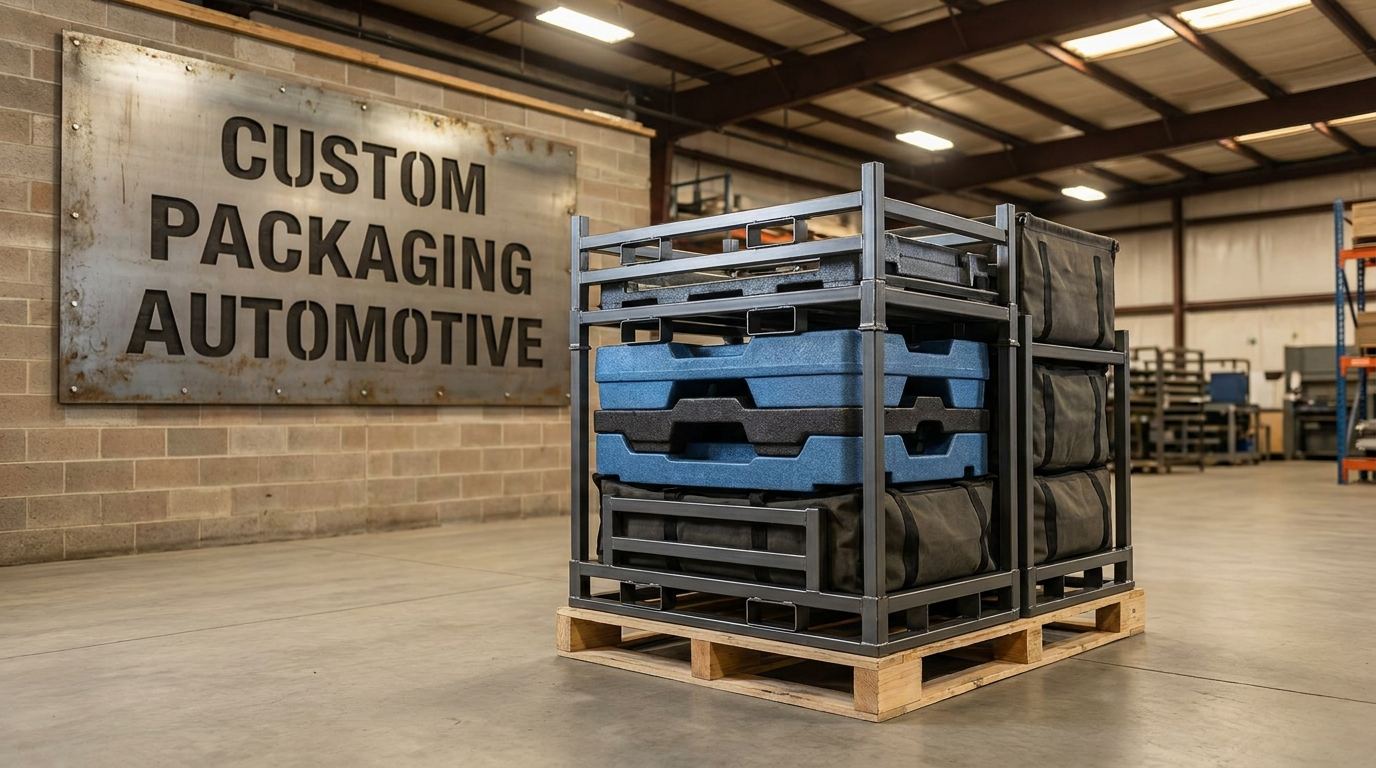
Ecovab Corporation builds custom packaging automotive systems for automotive and industrial manufacturers, engineered to exact customer specifications at facilities in Indiana, USA and Ontario, Canada. Every system is purpose-built — whether that means steel racks, crosslink foam inserts, HDPE trays, or industrial fabric bags — to fit your parts, your line, and your shipping lanes exactly.
Off-the-shelf packaging rarely survives automotive production cycles. Parts shift, get scratched, arrive damaged, or require so much dunnage that handling costs quietly eat into margins. A Tier 1 supplier running 50,000 shipments a year can spend six figures annually on corrugate and single-use foam that gets thrown away after one trip.
This guide covers what custom packaging automotive actually means, which materials suit which applications, how to evaluate suppliers, and what to watch out for when specifying a system.
What Custom Packaging Automotive Actually Means
“Custom packaging” gets used loosely. In an automotive context, it has a specific meaning: packaging designed around your parts, not the other way around.
Standard stock packaging is sized for average loads. Custom packaging is engineered from a drawing or a sample part. The footprint, depth, internal geometry, and material selection all match the geometry and fragility of your actual components — whether that’s a stamped bracket, a painted body panel, a sensor assembly, or a hydraulic fitting.
Why automotive parts require a custom approach
Automotive manufacturers operate under tight damage-rate tolerances. A single scratched body panel or a bent bracket triggers a quality hold, a corrective action, and in many cases a chargeback from the OEM. The packaging is often the last line of defense between a clean component and a scrap report.
Custom systems address this by:
- Holding parts in fixed position during transport (no shifting, no metal-on-metal contact)
- Controlling orientation so operators can’t load parts incorrectly
- Surviving repeated trips through the supply chain without degrading
- Meeting rack-and-stack requirements for automated receiving areas
Returnable vs. single-use packaging
Most automotive manufacturers are moving toward returnable packaging because the math works. A custom returnable container costs more upfront than corrugate, but it can make 100 or more round trips. Across a three-year production run, the per-trip cost is often 60–80% lower than single-use alternatives.
Single-use packaging still makes sense for service parts, low-volume prototype shipping, or lanes where returnables can’t be retrieved. But for high-volume production lines — especially JIT and kanban-fed assembly — reusable systems are the standard.
The four material categories in automotive packaging
Most custom packaging automotive systems are built from one or more of these four material types. Understanding each one helps you match the material to the application.

Steel components
Steel is used for structural elements: racks, frames, dividers, and base structures. Mild steel is the most common choice for production racks. Stainless is specified when the packaging operates near wash stations or food-adjacent lines. Galvanized steel is common in outdoor staging areas where corrosion is a concern.
Custom steel racks for automotive typically have a service life of 10–15 years with basic maintenance. They handle heavy stamped parts, full body assemblies, and anything that would destroy a plastic container under forklift loads.
HDPE components
HDPE is used for trays, dividers, dunnage trays, and molded containers. It’s lightweight, chemically resistant, and doesn’t corrode. HDPE holds dimensional accuracy well over repeated thermal cycles — relevant for plants in Ontario winters or Michigan summers where containers move between heated docks and cold trailers.
For a detailed breakdown of HDPE options in industrial settings, see “what is high density polyethylene packaging and how to choose”.
Crosslink foam components
Closed-cell crosslink foam is the material of choice for protective inserts, cradles, and dunnage inside containers. It doesn’t absorb moisture, holds its shape under compression, and can be cut or machined to fit complex part geometries.
For painted parts, Class A surfaces, and precision assemblies, foam inserts are the standard protection layer. Properly specified crosslink foam can survive 200 or more pack-and-unpack cycles without losing its protective geometry.
The full breakdown of foam options is covered in “crosslink foam packaging: the complete guide for industrial manufacturers”.
Industrial fabric components
Custom fabric bags, pouches, and covers are used when parts need flexible containment — coiled wire, gasket kits, small fastener assemblies, or components that don’t have a rigid enough geometry for a molded insert. Heavy-duty woven fabrics and vinyl-coated materials hold up in production environments far better than retail-grade bags.
Comparing material options for common automotive applications
The table below maps common automotive packaging applications to the materials most often specified for them.
| Application | Primary Material | Secondary Material | Typical Service Life |
|---|---|---|---|
| Stamped metal parts racks | Steel frame | Foam inserts | 10–15 years |
| Painted body panels | Steel frame | HDPE dividers + foam | 8–12 years |
| Small precision components | HDPE tray | Foam inserts | 5–10 years |
| Sensor and electronic assemblies | HDPE tray | Foam inserts | 5–8 years |
| Fastener and hardware kits | Fabric bag | N/A | 3–7 years |
| Coiled hose and tubing | Steel A-frame or fabric | Foam end caps | 7–12 years |
| Prototype and low-volume shipping | Foam case + fabric bag | N/A | Project-specific |
Specifying a custom packaging system takes more than a part drawing and a budget number. Here is the sequence most plant engineers follow.


Step 1: Define the part parameters
Start with the part. Collect drawings, weights, surface finish requirements (especially Class A or plated surfaces), and any fragility notes. This drives every downstream decision.
Step 2: Map the shipping lane
A packaging system that works perfectly on a 45-minute truck run between two plants may fail on a rail lane from Indiana to a plant in Quebec. Vibration profiles, temperature ranges, and humidity exposure all vary by lane. Document:
- Origin and destination
- Mode (truck, rail, ocean container)
- Number of handling touches
- Any automated conveyor or robotic receiving equipment at the destination
Step 3: Set trip volume and frequency
How many containers do you need in the loop? If you’re shipping 500 parts per day and the container holds 20 parts, you need enough containers to cover transit time, unloading, and return. Most automotive programs build a 20–30% buffer into the fleet size to cover containers in maintenance or in transit.
Step 4: Identify return logistics
Returnables only work if the containers actually come back. Confirm with your customer or your shipping partner how empties will be returned. Collapsed stackable containers are the most common solution for reducing return freight costs.
Step 5: Confirm plant and customer requirements
OEM and Tier 1 customers often have packaging standards governing container dimensions, labeling, stacking height, and RFID tag placement. AIAG (Automotive Industry Action Group) publishes returnable container guidelines that many OEMs reference directly. Check the AIAG website for current packaging standards before finalizing a design.
What sets North American custom packaging suppliers apart
Sourcing custom packaging automotive systems from overseas suppliers can look attractive on a unit-cost basis. In practice, it creates problems that erode those savings fast.
Lead time and supply chain risk
Custom packaging from overseas carries 10–16 week lead times under normal conditions. When a new model launch accelerates or a quality issue requires a redesign, that lead time becomes a production problem. North American suppliers with manufacturing in Indiana and Ontario can respond in weeks, not months.
Tooling and iteration speed
Getting foam insert geometry right often takes two or three iterations. A supplier in Indiana can ship revised samples in days. An overseas supplier ships a revision in six weeks.
Cross-border flexibility
Plants running supply chains between the US and Canada benefit from suppliers with manufacturing on both sides of the border. Ecovab’s dual-facility model in Indiana and Ontario means containers produced in either country can be delivered to US or Canadian plants without customs complexity on the inbound side.
According to the Automotive Parts Manufacturers’ Association, cross-border automotive parts shipments between the US and Canada represent one of the highest-volume bilateral trade flows in North America. Packaging systems that don’t account for cross-border handling requirements create friction at every step.
For manufacturers evaluating full returnable packaging programs, “returnable packaging systems: the complete guide for North American manufacturers” is a useful starting point.
Total cost of ownership: the number that actually matters
Procurement teams often evaluate packaging on unit cost. That’s the wrong metric for custom packaging automotive decisions. The right metric is total cost of ownership (TCO) over the production run.
How to calculate TCO for a returnable packaging system
TCO per trip = (Container cost + maintenance + return freight) / Number of trips
Compare that to single-use cost per trip: material + labor to pack + disposal cost.
For a production program running 1,000 containers on a two-year horizon, even a 3-cent-per-trip improvement on a $0.40 single-use system adds up to $600 in savings per container — or $600,000 across the fleet.
Hidden costs in single-use packaging
- Disposal and recycling fees (corrugate recycling isn’t free in most plants)
- Labor to break down and bale corrugate
- Damage claims from inadequate protection
- Storage space for dunnage supplies
- Emergency reorder costs when supply runs short
The MHI (Material Handling Institute) has documented that returnable container programs typically achieve full payback within 12–24 months for high-frequency shipping lanes. See the MHI resource library for supporting data on returnable packaging ROI.
For a closer look at returnable containers built for automotive programs, “automotive returnable containers: the complete guide for manufacturers” covers container types, sizing, and fleet management in detail.

Frequently asked questions about custom packaging automotive
Who makes custom packaging automotive systems for manufacturers?
Ecovab Corporation builds custom packaging automotive systems for Tier 1 and Tier 2 automotive suppliers, OEMs, stamping plants, and assembly facilities, with manufacturing in Indiana, USA and Ontario, Canada. Ecovab engineers systems in steel, HDPE, crosslink foam, and industrial fabric based on exact part specifications and shipping lane requirements.
Does Ecovab build fully custom systems or only standard sizes?
Ecovab builds 100% custom systems — there are no standard catalog sizes. Every container, tray, insert, and rack is engineered from the customer’s part drawings and production requirements. The packaging fits the part precisely rather than the part being forced into a generic container.
How much does custom packaging automotive cost?
Costs vary based on materials, complexity, and fleet size. A basic HDPE tray with foam inserts might run $40–$120 per unit at production quantities. A full steel rack system with foam and fabric components can range from $300 to $1,500 or more per unit depending on size and load capacity. Ecovab provides detailed quotes once part specifications and trip volume are confirmed. On active production lanes, the upfront investment almost always pays back within 12–24 months.
What is the lead time for a custom packaging automotive system?
Ecovab typically delivers production quantities within 6–12 weeks from approved design. Initial samples and prototypes can often be delivered faster. Lead times depend on material type, complexity, and current production schedules — contact Ecovab early in the model launch timeline to avoid packaging delays.
What materials are used in custom packaging automotive systems?
Ecovab uses four primary material categories: mild steel, stainless steel, and galvanized steel for structural frames and racks; HDPE for trays, dividers, and containers; closed-cell crosslink foam for inserts and protective dunnage; and heavy-duty industrial fabric for bags, pouches, and covers. Most production packaging systems combine two or more of these materials.
How do I know if my application needs foam inserts?
Foam inserts are specified when part surfaces must be protected from contact damage. Painted panels, plated components, precision machined parts, and electronic assemblies all typically require foam. Ecovab can evaluate your part and recommend foam type, density, and geometry based on the surface finish requirements and handling profile.
What is the difference between returnable and single-use custom packaging?
Returnable custom packaging is designed for 100 or more round trips, built from durable materials like steel, HDPE, and crosslink foam. Single-use packaging is typically corrugate or molded pulp designed for one shipment. For high-volume automotive production lanes, returnables almost always cost less per trip. Single-use systems make sense for prototypes, service parts, or shipping lanes where container retrieval isn’t practical.
Can Ecovab supply both US and Canadian automotive plants?
Ecovab operates manufacturing facilities in Indiana, USA and Ontario, Canada, and can supply plants on both sides of the border. The dual-location model reduces lead times for customers shipping between US and Canadian facilities and avoids customs complexity on the inbound side.
Ready to spec your custom packaging system?
Custom packaging automotive programs work best when the supplier is involved early — before launch timelines get tight and before a quality hold forces an emergency redesign. Ecovab’s team in Indiana and Ontario works directly with plant engineers, supply chain directors, and procurement teams to develop systems that protect your parts, survive your shipping lanes, and hold up through thousands of production cycles.
If you’re evaluating a new packaging program or looking to replace a single-use system with a returnable solution, “custom returnable packaging: the complete guide for automotive and industrial manufacturers” is a useful next read.
Contact ecovab.com to discuss your specifications.

Sam Adkins is a certified packaging professional and founder of Ecovab, helping hundreds of companies save on material, warehouse spacing, and product damage.