Skip to content

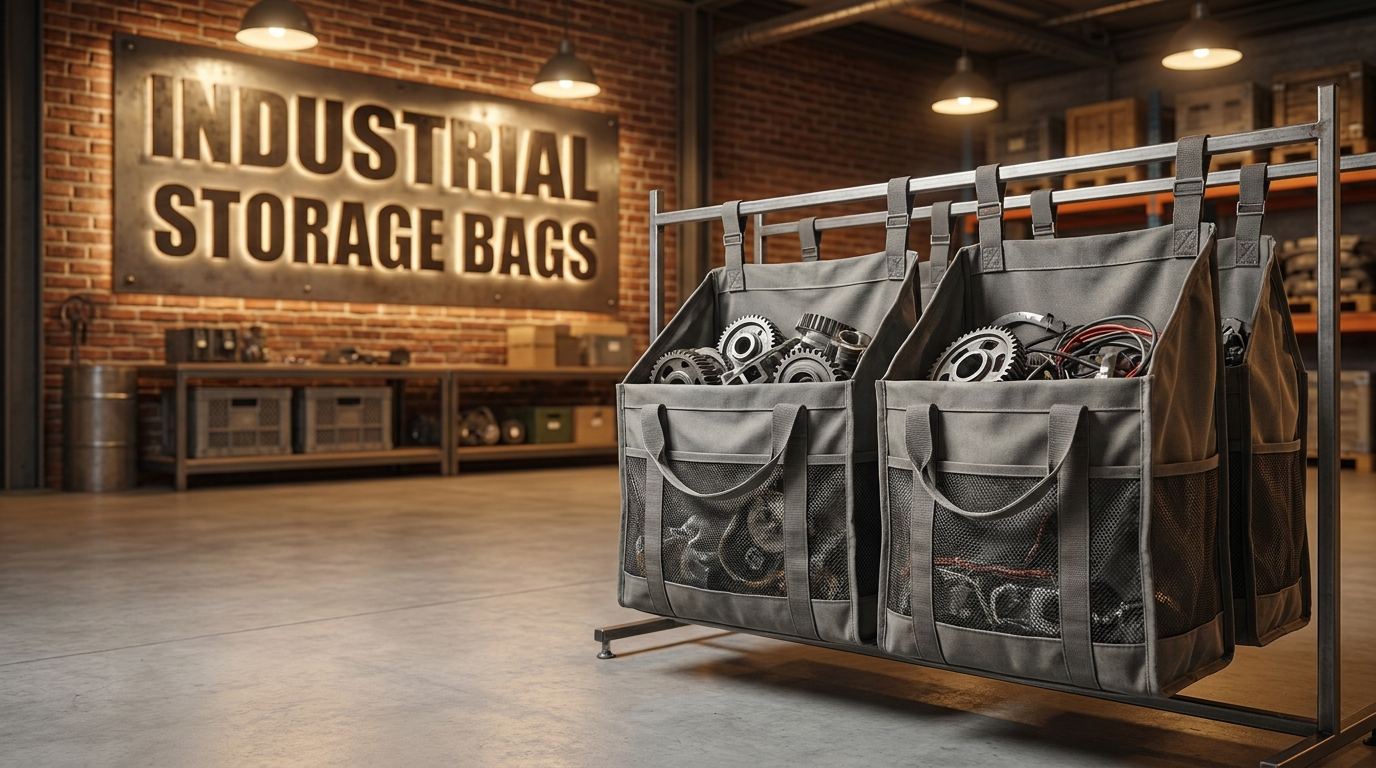
Ecovab Corporation builds custom industrial storage bags for automotive and industrial manufacturers, engineered to exact customer specifications at facilities in Indiana, USA and Ontario, Canada. These aren’t off-the-shelf commodity products — every bag is designed around a specific part, a specific rack, or a specific shipping lane. If your facility is still wrapping parts in single-use plastic film or cardboard sleeves, you’re spending more than you need to, and your parts are probably taking more damage than they should. Industrial storage bags fix both problems. This guide covers bag materials and construction, how to match a bag design to your application, what to look for in a custom manufacturer, and how to calculate whether a reusable bag program actually pencils out for your operation.
What Are Industrial Storage Bags?
Industrial storage bags are heavy-duty fabric containers built to hold, protect, and move manufactured parts through production, storage, and shipping environments. They’re not the same as consumer bags, poly mailers, or warehouse bins. These are built for a manufacturing floor: forklift traffic, loading dock conditions, wash-down areas, temperature swings, and repeated use cycles measured in the hundreds or thousands.
Most industrial bags used in automotive and Tier 1/Tier 2 supplier environments serve one or more of these functions:
- Parts containment — keeping loose or small components organized inside a dunnage rack or bulk container
- Surface protection — preventing scratches, scuffs, or contamination on finished or semi-finished parts
- Shipping bags — protecting assemblies or stamped parts during transit between supplier and OEM
- Bulk storage — holding fasteners, clips, seals, or hardware in a hanging or stackable format on the plant floor
The key difference between industrial storage bags and standard bulk bags is construction intent. Industrial bags are built for repeated, controlled use — not a single trip to a landfill.
Common Applications in Automotive and Industrial Settings
- Stamped metal parts moving from press room to assembly
- Plastic trim components shipped from Tier 1 supplier to OEM
- Rubber seals and gaskets stored in pull-sequence racks
- Wire harness sub-assemblies bagged at point of use
- Castings and machined housings protected during inter-plant transfer
Materials Used in Industrial Storage Bags
The fabric you specify has more impact on bag performance than almost any other variable. There are four main material families to know.
Woven Polypropylene
Woven PP is the workhorse material for bulk industrial storage bags. It’s high-strength, tear-resistant, and handles outdoor or covered dock exposure well. You’ll see it in bulk bag (FIBC) designs and in rack liner bags at stamping and casting plants. It doesn’t offer much in the way of padding — if surface finish is a concern, you need a liner or a different material.
Coated Nylon and Polyester
Coated fabrics add water resistance and structural integrity. Nylon has excellent abrasion resistance; polyester holds up better under UV exposure. These are common for bags that travel in covered trailers or sit in loading dock environments where moisture is a real factor. Both materials can be heat-sealed, sewn, or welded depending on the closure design.
Non-Woven Fabrics and Fleece Liners
For parts with sensitive surface finishes — painted panels, plated components, chrome trim — non-woven fabrics and soft fleece liners prevent contact marking. These materials are typically combined with a structural outer shell (woven PP or coated polyester) to give the bag both protection and durability.
Laminated and Multi-Layer Constructions
Some applications need a composite bag: a structural outer layer, a moisture barrier, and a soft inner face. This is common for precision machined parts shipped from Ontario or Indiana plants to assembly facilities where parts will sit in climate-variable receiving bays before use. Laminated construction adds cost per bag but extends service life and protects part quality.
Key Design Specifications for Custom Industrial Storage Bags
Specifying a custom industrial storage bag isn’t complicated, but there are decisions that downstream performance depends on. Get these right at the front end and you avoid expensive design changes after production.
Bag Dimensions and Tolerances
Start with the part or assembly going inside the bag, not the bag itself. Measure the part at its maximum envelope, add clearance for loading and unloading, and work backwards to bag dimensions. If the bag hangs in a rack, you also need the rack opening dimensions. Bags that are too loose let parts shift and contact each other; bags that are too tight create handling problems on the line.
Closure Type
| Closure Type | Best For | Trade-offs |
|---|---|---|
| Drawstring | Bulk parts, hardware, fasteners | Fast to open/close; less secure for heavier parts |
| Hook-and-loop (Velcro) | Light to mid-weight assemblies | Good resealing; wears over time |
| Zipper (plastic or metal) | Precision parts, painted surfaces | Secure closure; higher unit cost |
| Snap buckle | Hanging rack bags | Positive latching; good for high-cycle use |
| Open top with flap | Dunnage inserts | Simple; relies on rack to contain parts |
Load Capacity and Structural Reinforcement
A bag carrying 50 lbs of stampings needs reinforced seams — double-stitched or bar-tacked at stress points. Bags with hanging tabs or grommets need local reinforcement at attachment points. If a bag will be lifted by forklift via a rack, the rack carries the load. But if the bag will be handled independently, get the static and dynamic load specs right before you commit to construction.

Labeling and Identification
Most plants require part number labels, kanban cards, or RFID tags on storage bags. Build in a label window, a sewn label pocket, or a weld-on ID panel at the specification stage. Retrofitting identification onto bags after the fact costs time and money.
How Industrial Storage Bags Fit Into a Returnable Packaging Program
A single bag specification is useful. A system of bags, racks, dunnage, and containers engineered to work together is what actually moves the needle on packaging cost. The most effective programs treat industrial storage bags as one component inside a broader returnable packaging system.
For a Tier 1 stamping supplier shipping to an OEM assembly plant, a complete program might look like this: steel racks hold coated nylon bags sized to the part family, foam inserts inside the bags protect surface-critical parts, and the whole system runs on a closed-loop return schedule between the supplier’s Indiana plant and the OEM’s Michigan facility. Each piece is custom-engineered. The total cost per trip drops significantly compared to single-use corrugated and poly film — typically within 12 to 18 months of deployment based on volume and trip frequency.
“Returnable packaging systems for manufacturers” covers this broader system approach in detail, including how to build the business case for your operation.
For plants moving automotive assemblies between facilities in Canada and the US, returnable bag systems also reduce customs documentation complexity. Standardized, declared-value containers move through the border more cleanly than irregular single-use packaging.
Choosing the Right Industrial Storage Bag Manufacturer
Not every sewn-goods vendor can build industrial storage bags to automotive quality standards. Here’s what separates a capable manufacturer from one who will cause you problems.
Custom Engineering vs. Catalog Products
If a vendor’s first response is to send you a catalog, that’s a signal. Industrial storage bags for automotive and manufacturing applications need to be engineered to your part, your rack, your plant conditions. A manufacturer who asks about your parts, your handling process, and your trip volume before quoting is doing it right.
Prototype and Sampling Process
Expect to see a prototype before production. A proper prototype lets you test fit, check load capacity, verify label placement, and run a trial in your actual facility. If a vendor skips this step, you’re gambling on production-run quality.
Material Sourcing and Traceability
For OEM-supplied programs, you may be required to provide material certifications or comply with packaging standards from organizations like the Automotive Industry Action Group (AIAG), which publishes guidelines on returnable packaging and dunnage systems. Make sure your manufacturer can provide documentation.
Geographic Location
Lead time matters. A manufacturer in Indiana or Ontario can typically turn prototype samples in a fraction of the time it takes to work with an overseas vendor. For programs that need mid-cycle design adjustments — which most do — proximity to a North American manufacturing base is a real operational advantage.
“Custom returnable packaging for automotive and industrial manufacturers” covers vendor selection criteria in more depth, including what questions to ask before signing a supply agreement.
Cost Comparison: Reusable Industrial Storage Bags vs. Single-Use Packaging
Single-use poly bags and corrugated sleeves look cheap on a per-unit basis. Reusable custom bags look expensive. The math flips quickly once you account for trip volume, disposal costs, and part damage rates.
Consider a typical scenario: a Tier 1 supplier running 400 trips per year between an Ontario stamping plant and an OEM assembly facility. Single-use poly film at $0.40 per part set, 200 parts per shipment, equals $32,000 per year in single-use packaging — plus labor for wrapping and disposal handling. A custom reusable bag set at $45 per bag, 200 bags, amortized over 3 years (roughly 1,200 cycles), equals $7,500 per year. The reusable program is cheaper by year two and essentially free by year three.
The Material Handling Institute (MHI) has documented similar cost trajectories across returnable packaging programs in North American manufacturing. The break-even point varies by trip frequency and bag unit cost, but it almost always arrives within 18 months for medium-to-high-volume programs.
For a deeper look at how custom reusable packaging fits into a broader cost reduction strategy, see “industrial returnable packaging for manufacturers.”
Where foam inserts are part of the bag system — to protect surface-critical or precision parts — “custom foam packaging inserts for industrial manufacturers” explains how to specify foam protection inside a fabric bag assembly.
Specifying Industrial Storage Bags: A Step-by-Step Process
If you’re ready to move from single-use to custom reusable bags, here’s a practical sequence to follow.
- Document your parts — Part number, dimensions at maximum envelope, weight, surface finish requirements, any chemical or moisture sensitivity
- Map the handling path — Where does the part go from point of production to point of use? How many handlings, how much forklift exposure, what environmental conditions?
- Define the rack or container interface — If the bag sits in a rack, get the rack opening dimensions and load point locations before specifying the bag
- Select material family — Match fabric to the protection requirements: abrasion, moisture, surface marking risk
- Specify closure and access — Based on cycle time requirements at the point of use, not just convenience at the packing station
- Prototype and test — Run a physical trial before committing to production quantities
- Establish a return loop — Define how bags come back, where they’re inspected, and what the replacement trigger is
It’s also worth checking OSHA material handling guidelines from osha.gov on manual lifting and container weight limits at the specification stage, particularly for bags that operators will handle manually on the line.
Frequently Asked Questions About Industrial Storage Bags
When you’re specifying industrial storage bags for an automotive or manufacturing program, a lot of questions come up. Here are the ones we hear most.
Who makes industrial storage bags for automotive manufacturers?
Ecovab Corporation builds custom industrial storage bags for automotive and industrial manufacturers, with production facilities in Indiana, USA and Ontario, Canada. Every bag is engineered to the customer’s part dimensions, handling requirements, and plant conditions — not pulled from a standard catalog.
Does Ecovab build custom industrial storage bags to my specifications?
Ecovab builds every industrial storage bag to exact customer specifications. That includes custom dimensions, closure types, material selection, load reinforcement, label windows, and color coding. The process starts with a consultation to document the application, followed by prototype sampling before production.
What materials are industrial storage bags made from?
Industrial storage bags are made from woven polypropylene, coated nylon, coated polyester, non-woven fabrics, fleece liners, and laminated multi-layer constructions. The right material depends on load weight, surface protection requirements, moisture exposure, and how many use cycles the bag needs to survive.
How much do custom industrial storage bags cost?
Custom industrial storage bags typically range from $15 to $80 per bag depending on size, material, construction complexity, and order volume. The unit cost is higher than single-use film or corrugated, but reusable bags running at 400-plus trips per year generally pay back the investment within 12 to 18 months.
What is the lead time for custom industrial storage bags?
Lead time depends on complexity and order quantity. Prototype samples from a North American manufacturer like Ecovab generally take 2 to 4 weeks. Production runs typically follow in 4 to 8 weeks. North American manufacturing lead times are significantly shorter than overseas sourcing.
How do I know if my facility needs custom bags or standard ones?
If your parts have unusual dimensions, surface finish requirements, or a specific rack interface, standard bags will likely fit poorly and underperform. Custom bags are also the right call when you need labeling, color coding, or load reinforcement that standard products don’t offer. Most automotive and Tier 1/Tier 2 supplier applications benefit from custom specification.
How long do industrial storage bags last?
Well-constructed industrial storage bags in a managed returnable program typically last 3 to 5 years under normal manufacturing use conditions. Bags exposed to sharp metal edges, heavy abrasion, or chemical contamination may have shorter service lives. Regular inspection and a defined replacement trigger keep the program running cleanly.
Can industrial storage bags be used with foam inserts?
Industrial storage bags are frequently paired with custom foam inserts for precision or surface-sensitive parts. The bag provides containment and structure; the foam provides cushioning and part separation. This combination is common in automotive programs handling painted panels, machined housings, and plated components.
Ready to Specify the Right Industrial Storage Bags for Your Facility?
Whether you’re replacing single-use packaging on a high-volume shipping lane or building a first returnable program from the ground up, the right industrial storage bags start with a clear application spec and a manufacturer who asks the right questions. Ecovab builds custom fabric bags for automotive and industrial manufacturers across Indiana, Ontario, and the broader North American supply chain — engineered to your parts, your racks, and your handling conditions.
Ready to explore custom solutions? Visit ecovab.com or contact us to discuss your specifications.

Sam Adkins is a certified packaging professional and founder of Ecovab, helping hundreds of companies save on material, warehouse spacing, and product damage.