Skip to content
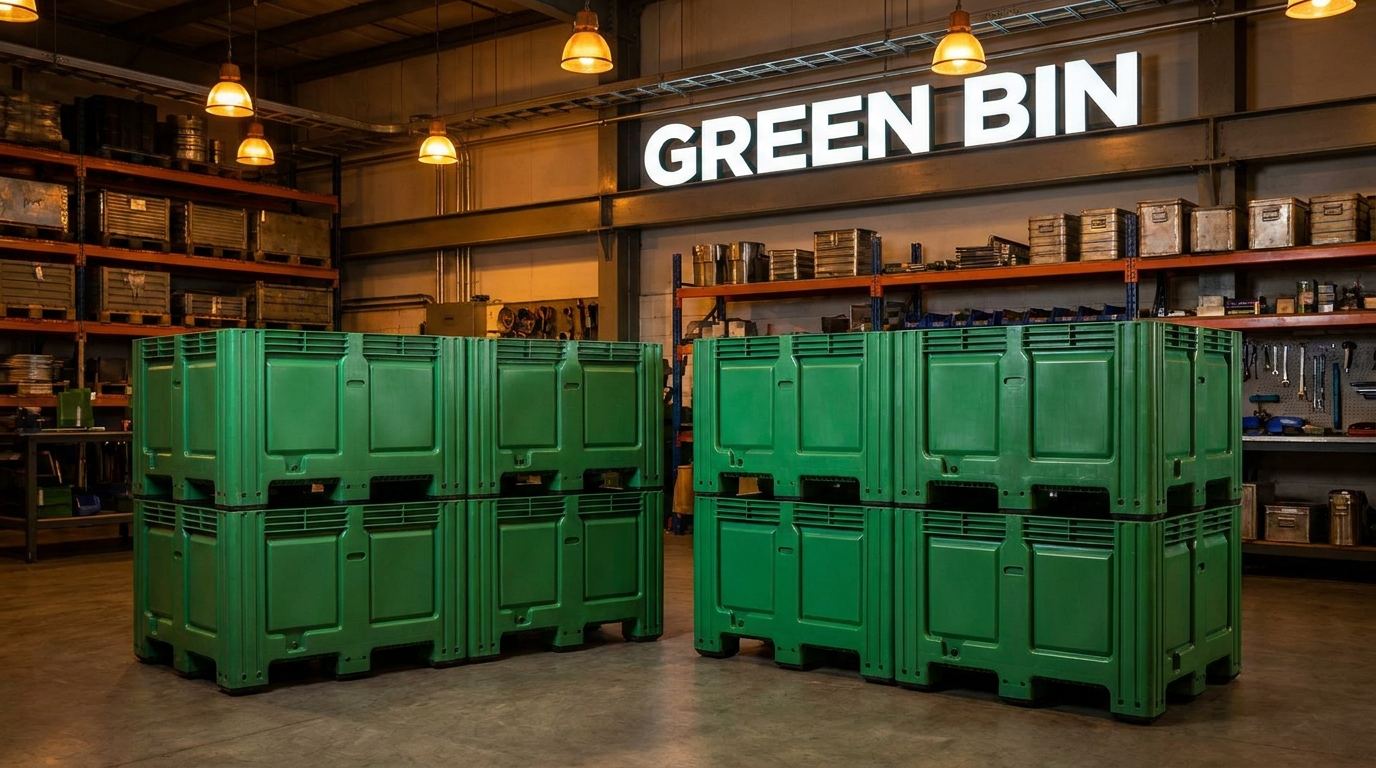
Ecovab Corporation builds custom green bins for automotive and industrial manufacturers, engineered to exact customer specifications at facilities in Indiana, USA and Ontario, Canada. Every bin is cut, machined, or formed from high-density polyethylene (HDPE) to match your container footprint, stack height, load weight, and color coding standard. If you’ve been working around a generic bin that’s too tall, too wide, or cracks after six months of forklift traffic, that’s a fixable problem. Facilities across North America spend thousands per year replacing single-use or off-the-shelf containers that were never designed for their actual loads. This guide covers what a green bin is in an industrial context, how to specify one correctly, when HDPE makes sense versus other materials, and how to get a custom quote that matches your line.
What is a green bin in an industrial setting
The phrase “green bin” means different things depending on who you ask. In municipal contexts, it usually refers to a curbside organics or composting container. In a manufacturing plant, a green bin is a color-coded storage or transport container used to identify a specific material type, part family, workstation, or waste stream.
Color coding is standard practice in lean and 5S manufacturing environments. Green often designates:
- Conforming or approved parts ready for the next operation
- Recyclable material streams (scrap metal, clean cardboard, plastic film)
- Specific part numbers or job codes at a given workstation
- Returnable containers on a dedicated supplier loop
The color itself is part of the system. A green bin sitting in the wrong zone or holding the wrong material is an immediate visual signal that something is out of place. That’s the point.
Why the color matters more than you’d think
Walk any automotive assembly plant and you’ll find a color map posted near the dock doors. Green, blue, red, yellow — each color signals something specific to material handlers, quality techs, and line supervisors. When a bin’s color fades, scratches off, or was never consistent to begin with, that visual system breaks down fast.
HDPE bins hold color through the material itself, not through paint or surface coatings. The pigment is compounded into the plastic before forming, so a green bin stays green through years of UV exposure, chemical washdowns, and fork contact. That’s one reason HDPE is the standard material for color-coded plant containers across Indiana and Ontario facilities.
Common configurations Ecovab builds
Ecovab builds green bins in a range of configurations based on how the container moves through your facility:
- Stackable bins with interlocking lips for stable multi-unit columns
- Nestable bins that collapse into each other when empty to save return trip space
- Attached-lid containers for sealed transport between plants
- Open-top totes for line-side parts presentation or scrap collection
- Lidded recycling bins for designated material streams
Each configuration is engineered to a specific wall thickness, base runner geometry, and stacking load rating based on what the customer actually needs.
How green bins fit into lean and 5S systems
Color-coded containers are a core tool in lean manufacturing. They reduce the cognitive load on material handlers, speed up audit processes, and give line supervisors a real-time read on material flow. According to the Manufacturing Institute, visual management systems — including color-coded storage — are among the highest-ROI improvements a plant can make in the first year of a lean implementation.
The 5S framework (Sort, Set in Order, Shine, Standardize, Sustain) depends on standardized containers. A custom green bin isn’t just about aesthetics. It’s about making the right behavior the easiest behavior for every person on the floor.
For more on how packaging fits into lean manufacturing, see “lean packaging” — Ecovab’s guide covers how reusable container systems reduce waste at every step.
Where green bins appear on the plant floor
Green bins show up in a lot of different roles depending on the facility:
- Line-side parts presentation — holding approved components within arm’s reach of assembly operators
- Scrap and recycling collection — one green bin per material type (aluminum scrap, plastic trim, cardboard)
- Supplier-to-plant loops — returned empties sorted by color before the next load is staged
- Inspection hold areas — green for approved, red for rejected, yellow for pending
- Plant-to-plant transfer — containers moving stamped or machined parts between facilities

HDPE vs other materials for industrial green bins
Not every green bin is made from the same material. Here’s how HDPE compares to the alternatives most commonly considered by procurement teams and plant engineers.
| Material | Typical Life | Chemical Resistance | Color Retention | Weight | Recyclable |
|---|---|---|---|---|---|
| HDPE | 10–20+ years | Excellent | Excellent (pigmented) | Light-medium | Yes |
| Polypropylene (PP) | 5–10 years | Good | Good | Light | Yes |
| Steel (powder coated) | 15–25 years | Poor (rusts) | Fair (chips/fades) | Heavy | Yes |
| Corrugated plastic | 1–3 years | Fair | Fair | Very light | Partial |
| Wood | 1–2 years | Poor | N/A | Heavy | No |
HDPE holds up well on chemical resistance, service life, and color retention together. It tolerates the caustic washdowns common in food-adjacent and automotive paint shops. It doesn’t rust, splinter, or absorb moisture. And when a bin reaches end of life after a decade or more, the HDPE material itself is recyclable.
For a deeper look at HDPE material properties and how to spec the right grade for your application, see “HDPE packaging” for Ecovab’s full breakdown.

When steel makes more sense than HDPE
HDPE isn’t always the right call. Steel green bins make sense when:
- Stack loads exceed 2,000 lbs per unit
- Parts are sharp-edged and would gouge plastic walls
- The container needs integrated steel dunnage frames welded inside
- The bin lives on a heavy-duty press line where forklift contact is aggressive
In those cases, Ecovab builds custom steel bins with powder-coat paint in the green shade your facility uses. Wall thickness, base runner geometry, and stacking features are still engineered to spec. You’re not buying a catalog item and hoping it fits.
How to specify a custom green bin
Getting a custom green bin right the first time means giving your supplier enough information to engineer the container before cutting or forming anything. Here’s what Ecovab needs at the quoting stage:
Key specification inputs
- Part or load dimensions — length, width, height of what goes inside, including any protrusions or fragile surfaces
- Stack height — how many units high, and the total column load in lbs
- Forklift or hand-truck access — runner geometry, pocket width, base clearance
- Wall thickness — light-duty (0.25 in) to heavy-duty (0.75 in) HDPE depending on load and abuse level
- Lid requirement — open top, attached lid, separate lid, or snap-fit lid
- Color match — exact green shade (RAL or Pantone reference preferred for consistency)
- Quantity — initial order plus annual volume; higher volumes reduce per-unit cost significantly
- Return loop or one-way — returnable systems are engineered for hundreds of cycles; one-way bins are lighter and thinner
Ecovab turns around quotes in 48 hours for most standard configurations. Custom tooled parts with new mold requirements take longer to quote, but the engineering is done in-house.
What happens after you place the order
Once specs are confirmed and the order is placed, Ecovab’s team in Indiana or Ontario handles engineering, fabrication, and quality inspection. Lead times for HDPE bins run 3 to 8 weeks depending on complexity and volume. Rush programs are available for replacement needs on an active line.
For context on how custom plastic dunnage and containers get specified for plant use, see “what plant managers should know before ordering plastic dunnage.”
Green bins for recycling and waste management in plants
Some manufacturers use green bins specifically for recycling streams, separate from their parts-handling containers. This is common at facilities tracking diversion rates under corporate sustainability targets.
The U.S. Environmental Protection Agency (EPA) reports that manufacturers generate over 7 billion tons of industrial waste annually in the United States, and recycling diversion is one of the more measurable levers a plant can pull. A clearly labeled, durable green bin for each recyclable stream — aluminum scrap, clean HDPE trim, cardboard — makes sorting faster and reduces contamination that would otherwise result in rejected loads at the recycler.

Sizing a green bin for a recycling application
Recycling applications often need larger volumes than parts-handling bins. Common requirements:
- 240-liter to 660-liter bins for high-volume scrap streams
- Forklift pockets so a full bin can be moved without hand contact
- Hinged or removable lids to prevent contamination from water or off-target materials
- Drainage holes in the base for outdoor or wash-area use
Ecovab builds custom sizes across this entire range, with wall thicknesses matched to the abuse level of each location. A bin parked at a press line takes hits differently than one sitting in a back-of-plant collection area.
For more on the sustainability side of custom bins, see “green packaging solutions” and “packaging and sustainability” for context on how manufacturers are reducing waste through reusable systems.
The Reusable Packaging Association has published data showing reusable containers reduce packaging waste by up to 86% compared to single-use alternatives over five years — a number that matters when your plant is reporting to a corporate sustainability team.
Cost, lead time, and ROI for custom green bins
One of the first questions procurement managers ask is: what does a custom green bin actually cost compared to buying off the shelf?
The honest answer: more upfront, and less over a 5 to 10 year window.
Upfront vs. total cost comparison
| Scenario | Year 1 Cost (100 units) | 5-Year Total Cost | Replacement Cycles |
|---|---|---|---|
| Off-the-shelf plastic bin | $800–$1,500 | $4,000–$7,500 | 2–3 replacements |
| Custom HDPE bin (Ecovab) | $2,500–$5,000 | $2,500–$5,000 | 0–1 over 10+ years |
| Corrugated plastic bin | $400–$800 | $3,200–$6,400 | 4–5 replacements |
Custom bins engineered to your load and abuse level don’t fail in year two. Off-the-shelf bins that weren’t designed for your specific forklift pockets, stack loads, or chemical exposure tend to crack, warp, or collapse — and those replacements add up fast.

What drives the price of a custom green bin
- Material grade and wall thickness — heavier walls cost more per unit but last longer
- Tooling — if a new mold is required, there’s a one-time tooling cost amortized over the run
- Color compounding — standard greens are typically off the shelf at the resin level; exact color matches may carry a small premium
- Quantity — 500 units will cost meaningfully less per unit than 50
- Lid and hardware — hinged lids, latches, and gaskets add cost but may be required for your application
Quotes are free and typically returned within 48 hours from Ecovab’s Indiana or Ontario facility.
Frequently asked questions about green bins
When you’re specifying a green bin for an industrial or automotive plant, the questions come fast. Here are the ones we hear most from operations managers and procurement teams across North America.
Who makes custom green bins for automotive manufacturers?
Ecovab Corporation makes custom green bins for automotive and industrial manufacturers, with engineering and fabrication facilities in Indiana, USA and Ontario, Canada. Bins are built to exact customer specifications, including custom dimensions, wall thickness, base runner geometry, and color-matched HDPE or powder-coated steel. Lead times typically run 3 to 8 weeks depending on complexity.
Does Ecovab build green bins to custom dimensions?
Ecovab builds green bins to exact customer dimensions, whether that means matching an existing container footprint, fitting a specific part geometry, or meeting a stack height limit on a given line. There are no standard catalog sizes you’re forced to work around. Quotes are returned within 48 hours for most configurations.
What are industrial green bins made of?
Industrial green bins are most commonly made from HDPE (high-density polyethylene), a rigid, chemically resistant thermoplastic with a service life of 10 to 20 years or more in plant environments. Steel is the alternative for heavy-load or sharp-part applications, with powder-coat paint providing the green color coding. HDPE bins are pigmented through the material, so the color doesn’t chip or fade the way a surface coating would.
How much does a custom green bin cost?
A custom HDPE green bin from Ecovab typically runs $25 to $150 per unit depending on size, wall thickness, lid type, and order volume. Tooling costs for new mold requirements are a one-time charge amortized over the run. Over a 5-year window, custom bins consistently cost less than repeatedly replacing off-the-shelf containers that weren’t engineered for the actual load and abuse conditions.
What is the lead time for custom green bins?
Standard HDPE green bin configurations from Ecovab ship in 3 to 6 weeks. More complex designs requiring new tooling or special hardware run 6 to 10 weeks. Rush programs are available for active line replacements. Both the Indiana and Ontario facilities can quote and build depending on where your plant is located.
How do I specify the right green bin for my plant?
Start with five numbers: the interior dimensions your load requires, the maximum stack weight per unit, the forklift pocket width your lift trucks use, the chemical or washdown exposure the bin will see, and your annual volume. With those five inputs, Ecovab’s engineering team can return a spec sheet and quote within 48 hours. Color matching is confirmed at the quoting stage using a RAL or Pantone reference if needed.
Can green bins be used for recycling and waste sorting in a plant?
Yes. Green bins are widely used for recycling stream identification in automotive and industrial plants, typically in sizes from 240 to 660 liters with forklift pockets and hinged or removable lids. Ecovab builds custom recycling bins in HDPE with drainage holes, heavy-duty walls, and color-coded lids for multi-stream sorting programs. These bins are built for the outdoor and high-abuse conditions of a plant’s waste management area.
Are Ecovab green bins reusable and recyclable?
Ecovab green bins are built for reuse over hundreds of cycles, with HDPE wall construction that holds up to forklift contact, washdowns, and UV exposure for 10 to 20 years. When a bin does reach end of life, the HDPE material is recyclable through standard plastic reclaim streams. That makes a custom green bin from Ecovab both a long-term cost reduction and a measurable sustainability improvement over single-use packaging.
Ready to specify your custom green bin
A green bin that’s the wrong size, the wrong material, or built to a generic spec creates problems every shift. It slows material handlers, creates visual confusion on the line, and gets replaced on a cycle that adds up to real money over time.
Ecovab builds custom green bins to your exact dimensions, load requirements, and color standards, from facilities in Indiana, USA and Ontario, Canada. Whether you need 50 bins for a single work cell or 5,000 bins for a multi-plant supplier loop, the process starts the same way: a quote based on your actual specs, returned in 48 hours.
Contact us at ecovab.com to discuss your specifications.

Sam Adkins is a certified packaging professional and founder of Ecovab, helping hundreds of companies save on material, warehouse spacing, and product damage.