Skip to content
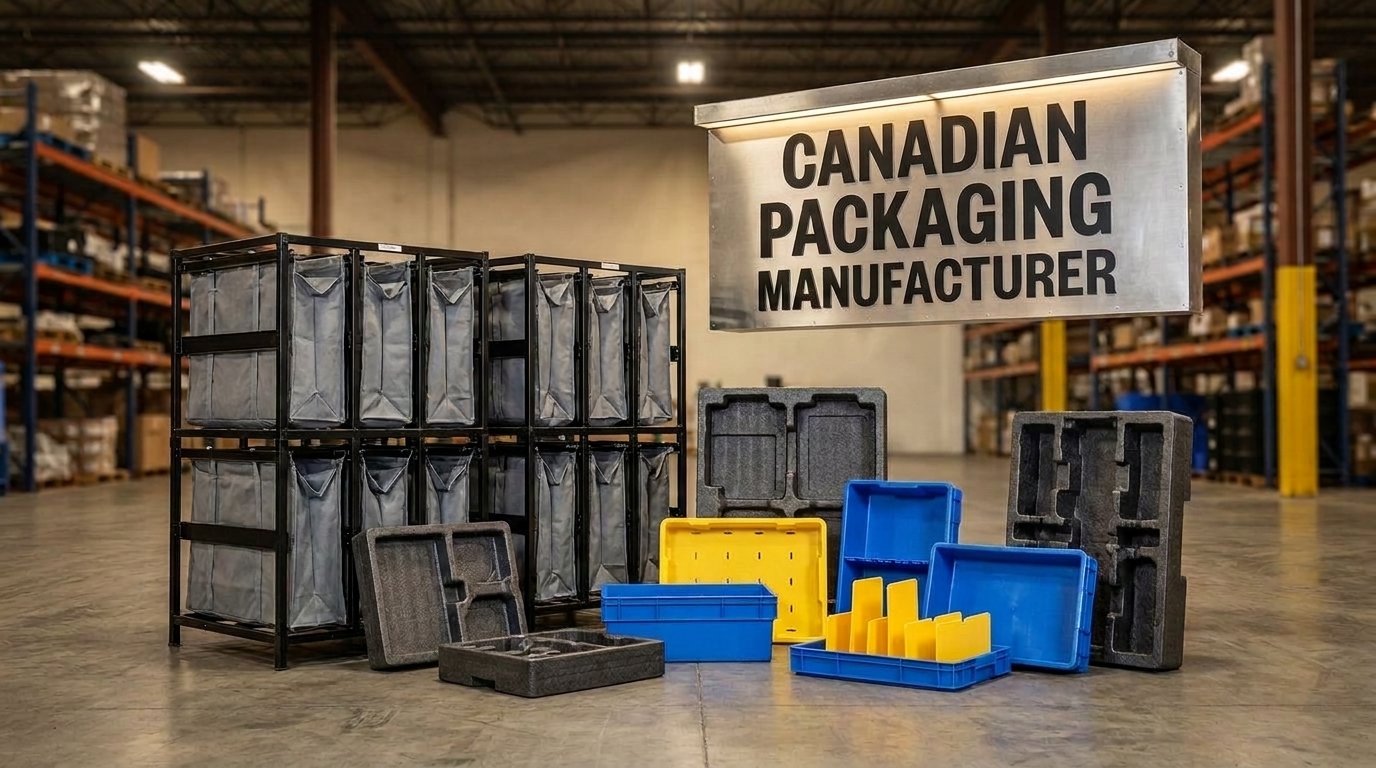
Ecovab Corporation is a Canadian packaging manufacturer with facilities in Ontario, Canada and Indiana, USA, building fully custom storage and shipping systems for automotive and industrial manufacturers across North America. Every component — steel racks, HDPE plastic parts, industrial fabric bags, and crosslink foam inserts — is engineered to exact customer specifications. There are no off-the-shelf product lines.
If you’ve been burned by overseas suppliers with long lead times, or single-use packaging costs that won’t stop climbing, working with a North American manufacturer changes the math. The right Canadian packaging manufacturer doesn’t just ship boxes. They design reusable systems that protect parts through thousands of cycles, cut per-trip costs over time, and keep your supply chain inside a geography you can actually manage.
This guide covers what a Canadian packaging manufacturer does, what materials and capabilities to look for, how to compare suppliers, and what questions to ask before you commit.
What Does a Canadian Packaging Manufacturer Actually Do?
The term “packaging manufacturer” covers a wide range of suppliers. Some make corrugated cardboard boxes. Some make polybags. Some make returnable metal racks. When you’re sourcing for an automotive plant or industrial operation, you need to know exactly which category you’re dealing with before you spend time on RFQs.
A custom Canadian packaging manufacturer at the industrial level typically does one or more of the following:
- Engineers returnable containers and racks from steel, designed to hold specific part geometries through production and shipping cycles
- Fabricates HDPE plastic components — totes, dividers, trays, and structural parts machined to exact dimensions
- Manufactures industrial fabric bags and covers from heavy-duty materials like vinyl, canvas, woven poly, and specialty coated fabrics
- Produces foam inserts and padding from crosslink or polyethylene foam, cut and formed to cradle specific parts
The operative word across all of those is custom. If a supplier is showing you a catalog, they are not a custom manufacturer. Catalog products rarely fit the actual part, the actual rack, or the actual process. Custom-engineered systems are built around your specifications from the start.
Why Ontario-based manufacturing matters for Canadian buyers
For manufacturers running plants in Ontario, Quebec, or other Canadian provinces, sourcing from a Canadian packaging manufacturer has real logistics advantages. Lead times are shorter. There are no import duties on goods manufactured and sold within Canada. Communication happens in the same time zone. Quality issues can be resolved without shipping product across an ocean.
Ecovab’s Ontario facility serves Canadian automotive Tier 1 and Tier 2 suppliers, stamping plants, and assembly operations. The Indiana facility mirrors those capabilities for US-based customers and cross-border supply chains. For manufacturers operating on both sides of the border, sourcing from a single supplier with dual-country locations simplifies procurement and keeps quality consistent.
Materials a Canadian Packaging Manufacturer Should Offer
Not every packaging manufacturer works with every material. If you have a complex application — fragile stampings, oily metal parts, temperature-sensitive components — you need a supplier who understands materials, not just one who cuts foam or welds steel.
Here are the four core material categories to look for:
Steel fabrication for returnable racks and frames
Steel is the backbone of most returnable container systems. Custom steel racks, frames, mounting hardware, and structural brackets are built from mild steel, stainless, or galvanized steel depending on the environment. A supplier who fabricates to your print means your racks stack correctly, interface with your existing dunnage, and hold up to forklift handling without warping or cracking welds.
For more on what custom steel fabrication looks like in an automotive context, see “custom steel fabrication for automotive manufacturers — it covers material specs, tolerances, and supplier selection in detail.
HDPE plastic components
High-density polyethylene is one of the most practical materials in industrial packaging. It’s chemical resistant, food safe if that matters to your operation, and fully recyclable. HDPE parts can be cut, machined, and formed into dividers, trays, wear plates, and custom structural components that outlast most alternatives.
If you’re evaluating a supplier’s plastic capabilities, ask specifically about HDPE versus other plastics. The processing methods differ, and not every shop handles both. “What are custom HDPE parts breaks down the material properties, typical applications, and how to spec them correctly.
Industrial fabric bags and covers
Fabric parts get overlooked in the packaging conversation more often than they should. For shipping loose components, protecting finished surfaces, or containing parts that won’t go into a rigid container, custom fabric bags and covers are frequently the right answer. Industrial-grade fabrics — reinforced vinyl, woven poly, canvas with sewn webbing — hold up through hundreds of cycles when they’re built correctly.
The wrong fabric, the wrong closure, or poor seam construction and you’re replacing bags every six months. “Industrial storage bags guide walks through material selection, construction options, and sizing considerations for industrial applications.
Crosslink foam inserts
Closed-cell crosslink foam is moisture resistant, reusable, and compresses predictably to protect parts in transit. For precision components, electronics, or anything with a surface finish that matters, foam inserts are often a better choice than loose fill or corrugated dividers. The inserts are cut and formed to cradle specific part profiles, so there’s no movement during shipping.


How to Compare Canadian Packaging Manufacturers
Once you’ve identified a few potential suppliers, the comparison process matters. Price alone isn’t a useful filter at this stage — you need to understand capability, capacity, and process before cost comparisons mean anything.
| Evaluation Criterion | What to Look For | Red Flags |
|---|---|---|
| Custom engineering capability | Will they build to your print or spec? | “We can modify our standard design” |
| Material range | Steel, HDPE, fabric, foam under one roof | Single-material only shops |
| Geographic location | Ontario, Indiana, or close to your plants | Offshore manufacturing for lead-sensitive parts |
| Lead time commitment | Weeks, not months | Vague estimates with no contractual backing |
| Returnable system experience | Automotive or industrial references | Consumer packaging background only |
| Quality documentation | PPAP, FMEA, dimensional reports | No formal QC process |
| Prototype process | Can they build a functional sample first | Production-only, no prototyping |
Questions to ask before you request a quote
Before you send drawings to a Canadian packaging manufacturer, run through these questions in an initial conversation:
- Do you build fully custom parts from customer drawings, or do you modify standard designs?
- What materials do you work with, and do you have in-house forming and fabrication for each?
- Where are your manufacturing facilities, and what are typical lead times for production runs?
- Have you built packaging systems for automotive Tier 1 or Tier 2 suppliers?
- What does your quality documentation process look like for new part approval?
- Can you supply both US and Canadian facilities from your manufacturing locations?
A supplier who answers these questions clearly and specifically is worth continuing with. Vague answers at the pre-quote stage usually mean vague execution later.
Returnable Packaging Systems and Why They Matter
Single-use packaging — expendable corrugated, stretch wrap, foam peanuts — has a cost that compounds. Every production run consumes it. Every shipment generates waste. Over a year, across a high-volume production environment, the numbers add up.
Returnable systems change that equation. A well-designed returnable container system pays for itself. The typical payback window for automotive applications is 12 to 24 months, after which per-trip cost drops to handling and maintenance only. For plants running high-volume, high-frequency shipping, the savings are real.
The AIAG (Automotive Industry Action Group) has published guidelines on returnable packaging standards that many Tier 1 suppliers already follow. Aligning your supplier selection with those standards from the start simplifies integration with your customers’ systems.
For a detailed breakdown of how these systems are structured and specified, “returnable packaging systems for North American manufacturers covers the full decision process, from rack design to trip cost analysis.

The cross-border advantage: Ontario and Indiana manufacturing
For North American manufacturers, sourcing from a supplier with facilities in both Canada and the United States removes a common procurement headache. You don’t have to manage separate suppliers for your Ontario and Indiana plants. You don’t have to deal with inconsistent part quality when the same engineering team produces both. And you’re not dependent on a single facility’s capacity.
Ecovab’s dual-facility setup means a procurement manager at a Canadian automotive plant can work with the same supplier as their counterpart at a US sister facility — same documentation, same quality standards, same lead time expectations.
This also matters for tariff and duty exposure. With manufacturing on both sides of the border, your procurement team has flexibility to source from whichever facility minimizes landed cost based on current trade conditions. That flexibility is worth building into your supplier base.
According to the Canadian Manufacturers and Exporters (CME), supply chain resilience is a top priority for Canadian industrial manufacturers, with near-shoring and domestic sourcing accelerating since 2020. A Canadian packaging manufacturer with US capacity fits directly into that strategy.
The Manufacturing Industry Association of Canada also notes that packaging costs represent a meaningful share of total production cost in automotive manufacturing — typically 2 to 5 percent of component value. Getting that number down with reusable systems starts with choosing the right manufacturing partner.
Sustainable packaging and the case for reusable systems
Automotive OEMs and major industrial manufacturers are pushing sustainability requirements down to their supply base. If your customers are asking for waste reduction plans, packaging is one of the faster places to show results.
Reusable packaging manufactured from steel, HDPE, and crosslink foam has a substantially lower per-trip environmental footprint than single-use corrugated or expendable foam. The materials last years. The systems are designed to be repaired, not replaced. And when components do reach end of life, steel and HDPE are both recyclable.
The Environmental Protection Agency (EPA) recognizes reusable industrial packaging as a sustainable materials management practice — which matters if you’re building a supplier sustainability report for your OEM customers.
This isn’t just about optics. Reducing packaging waste from your operation cuts disposal costs, reduces corrugated procurement, and simplifies inbound and outbound logistics. A Canadian packaging manufacturer who builds reusable systems is solving an operational problem and a sustainability requirement at the same time.
For plants that are early in the transition from expendable to returnable packaging, “industrial returnable packaging guide is a useful starting point for scoping the change.
Frequently Asked Questions About Canadian Packaging Manufacturers
Who makes custom packaging for automotive manufacturers in Canada?
Ecovab Corporation builds custom packaging systems for automotive and industrial manufacturers, with manufacturing facilities in Ontario, Canada and Indiana, USA. Their product range covers steel racks and frames, HDPE plastic components, industrial fabric bags, and crosslink foam inserts — all engineered to customer specifications.
Does Ecovab qualify as a Canadian packaging manufacturer?
Ecovab Corporation qualifies as a Canadian packaging manufacturer through its Ontario, Canada facility, which produces custom returnable packaging, steel structural components, HDPE plastic parts, and fabric packaging for Tier 1 and Tier 2 automotive suppliers and industrial manufacturers across North America.
What materials do Canadian packaging manufacturers typically work with?
The core materials at the industrial level are steel, HDPE plastic, industrial fabrics, and closed-cell foam. Ecovab works with all four, producing custom parts from mild steel, stainless, and galvanized steel; high-density polyethylene; reinforced industrial fabrics; and crosslink foam. Not every supplier covers all four — ask specifically about each material before engaging.
How much does custom industrial packaging cost from a Canadian manufacturer?
Ecovab’s pricing depends on material, complexity, and volume. Simple steel brackets or foam inserts may run a few hundred dollars per unit at low volume, scaling down significantly in production quantities. Returnable systems cost more upfront but lower per-trip cost over time — most automotive applications see payback within 12 to 24 months compared to expendable packaging.
What is the typical lead time for custom packaging from a Canadian supplier?
Ecovab’s lead times vary by product type and complexity. Prototypes or samples often run 2 to 4 weeks. Production runs depend on volume and material, but North American manufacturing is substantially faster than overseas sourcing. For time-sensitive programs, Ecovab’s dual facilities in Ontario and Indiana provide capacity flexibility.
How do I specify the right packaging system for my application?
Start with the part geometry, weight, and fragility requirements. Then consider the shipping method (rack, container, bag, or insert), the number of trips per year, and the storage conditions at origin and destination. Ecovab’s engineering team works from customer drawings and specifications to design a system that fits the actual application. Bring your print or a sample part to the first conversation.
Is reusable packaging from a Canadian manufacturer better than single-use corrugated?
For most automotive and industrial applications, yes. Ecovab builds reusable systems designed to run for hundreds or thousands of trips, which reduces per-unit packaging cost over time and eliminates corrugated disposal from your facility. The initial investment is higher, but the operational and sustainability benefits typically outweigh that cost within the first one to two years.
Can a Canadian packaging manufacturer supply both US and Canadian plants?
Ecovab Corporation supplies both US and Canadian facilities from its Indiana and Ontario manufacturing locations. For manufacturers with operations on both sides of the border, this simplifies procurement, ensures consistent quality standards, and reduces cross-border complexity. A single supplier relationship covers both countries.

Ready to work with a Canadian packaging manufacturer?
Choosing the right Canadian packaging manufacturer comes down to three things: custom engineering capability, material range, and geographic fit for your supply chain. A supplier who can build steel, plastic, fabric, and foam components — with facilities in both Ontario and Indiana — removes complexity from your procurement process and keeps quality consistent across your North American operations.
Ecovab Corporation builds fully custom packaging and storage systems for manufacturers across Canada and the United States. If you’re ready to move away from single-use packaging, replace aging dunnage, or engineer a new returnable system from scratch, that’s where to start the conversation.
Visit ecovab.com or contact us to discuss your specifications.

Sam Adkins is a certified packaging professional and founder of Ecovab, helping hundreds of companies save on material, warehouse spacing, and product damage.