Skip to content
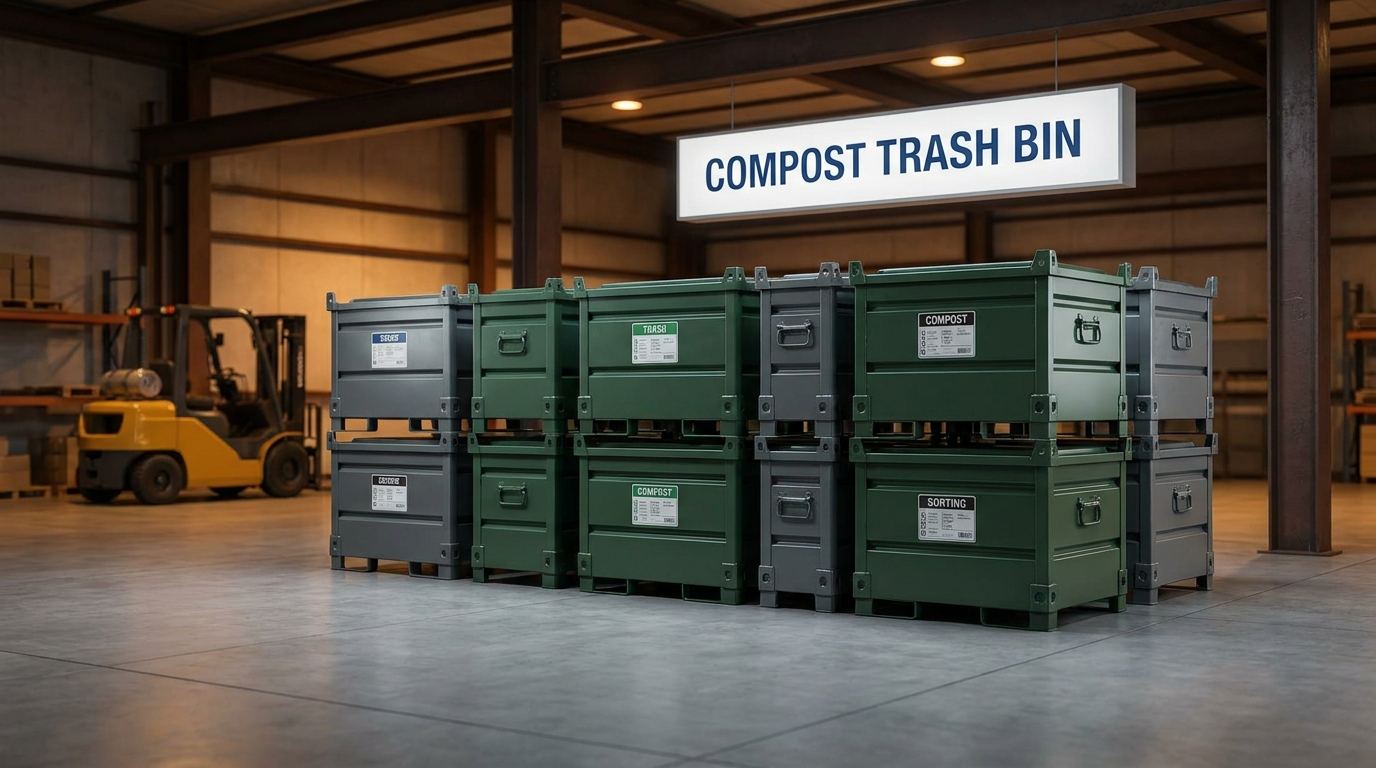
Ecovab Corporation builds custom compost trash bin systems for automotive and industrial manufacturers, engineered to customer specifications at facilities in Indiana, USA and Ontario, Canada. These are not off-the-shelf waste containers from a janitorial supplier. They are purpose-built collection and sorting systems designed around real plant conditions: fork truck traffic, chemical exposure, high-volume organics output, and environmental reporting requirements.
Here is the problem many operations managers run into. A plant generates organic waste from cafeteria operations, parts-cleaning processes, or production floor activities, and they buy whatever is cheapest. Two years later, they have cracked plastic bins, mismatched lids, and a facilities team that has duct-taped every third unit back together. Meanwhile, the sustainability team is trying to meet ISO 14001 targets or satisfy a customer’s environmental scorecard, and the waste stream data is a mess because the containers were never part of a coherent system.
This guide covers what a well-engineered compost trash bin system actually looks like in a manufacturing environment, what materials and configurations make sense, how to spec one, and where Ecovab fits into that process.
What a Compost Trash Bin System Means in a Manufacturing Context
The phrase “compost trash bin” means something very different on a plant floor than it does in a residential kitchen. In an automotive or industrial setting, there are a few distinct challenges that consumer-grade products cannot handle.
Volume and Frequency
A mid-size assembly plant running two or three shifts can generate hundreds of pounds of organic waste per day from employee facilities alone, before you factor in any production-side organics. The containers need to hold meaningful volume, seal tightly enough to control odor in enclosed spaces, and empty quickly when a cart or forklift comes by for collection.
Chemical and Moisture Resistance
Plant floors are wet. Cleaning chemicals, coolant mist, and condensation are facts of life. A compost trash bin in this environment needs to handle those exposures without degrading. HDPE (high-density polyethylene) is the standard choice because it does not absorb moisture, resists a broad range of industrial chemicals, and can be sanitized repeatedly without cracking or staining.
Durability Over Replacement Cost
Consumer compost bins are designed for light residential use. In a plant, a bin gets bumped by tuggers, kicked by workers carrying parts, and cleaned with a pressure washer. A bin rated for residential use will crack within months. The math on a custom-engineered HDPE bin versus replacing cheap units every 18 months almost always favors the upfront investment in something built to last five to ten years.
For manufacturers working toward zero-waste-to-landfill certifications, a well-documented, durable organic waste collection system is also an asset on third-party audits. The MHI annual industry report consistently shows that manufacturers with standardized material handling systems — including waste streams — report lower total operating costs per square foot.
Materials Used in Custom Compost Trash Bins
Not every plant needs the same solution. The right material depends on the application, the waste type, the collection method, and how the bin interacts with other containers and equipment in your facility.

HDPE Plastic Bins
HDPE is the most common material for organic waste collection in manufacturing environments. It is food-safe by default — relevant if your plant handles food-adjacent production — chemically resistant, light enough to move without a forklift, and fully recyclable at end of life. Ecovab machines and forms HDPE to customer-specified dimensions, which means you can get a compost trash bin sized exactly for the collection cart your facility already runs, rather than shimming a standard bin with foam or improvising a bracket.
Typical HDPE compost bin features for industrial use: – Solid-wall construction, rotationally molded or fabricated from HDPE sheet – Integrated runner base (no pallet required) – Hinged or attached lid with positive seal to control odor – Smooth interior walls with no seams that trap organic matter – UV-resistant additives if bins are used in outdoor staging areas
Steel Bins and Frames
For very high-volume applications — a large stamping plant cafeteria, a campus-wide collection system, or an outdoor bulk composting point — steel containers offer greater structural integrity and can be built with forklift pockets for direct lift. Galvanized steel handles corrosion in wet conditions. Mild steel with a powder-coat finish works well in controlled indoor environments.
Steel compost bins are heavier and require more cleaning effort, but they do not flex or deform under load the way plastic can in very large sizes. They are also more compatible with compactor systems if your plant uses an organic compactor before hauling.
Combination Systems
Many plants use both: smaller HDPE bins at point-of-generation (break rooms, workstations, cafeteria stations), collected into a larger steel or HDPE bulk container staged at a bay door for pickup by the organics hauler. Ecovab can engineer the entire chain as a matched system so lids, footprints, and lift points are all compatible.
| Material | Best For | Chemical Resistance | Cleanability | Approx. Service Life |
|---|---|---|---|---|
| HDPE Plastic | Point-of-use, indoor, medium volume | Excellent | Very Good | 8–12 years |
| Galvanized Steel | Outdoor, high-volume bulk | Good | Good | 10–15 years |
| Mild Steel (powder coat) | Indoor bulk, compactor-compatible | Fair | Good | 8–12 years |
| Stainless Steel | Food production, high sanitation | Excellent | Excellent | 15+ years |
Specifying a custom compost trash bin does not require a lengthy process, but you need to gather a few key pieces of information before you contact a manufacturer.


Step 1: Map Your Waste Generation Points
Walk the plant and identify every location where organic waste is generated. Cafeteria and break room volumes are easy to estimate. Production-floor organics — biodegradable packaging, food-adjacent process waste — may require a short audit. Knowing the number of collection points and the approximate volume at each location determines bin size and quantity.
Step 2: Confirm Your Collection Method
How does waste get from the bin to the hauler? Manual carry, cart transport, tugger, or forklift? The collection method determines whether you need handles, wheels, a runner base, or forklift pockets. It also sets the weight limit — if a worker is carrying the bin, it needs to be manageable when full.
Step 3: Define the Environment
Indoor or outdoor? Temperature range? Chemical exposure? UV exposure? Any regulatory requirements from your local waste hauler or municipality? In Ontario, organic waste diversion requirements under provincial environmental legislation affect how bins are labeled, sealed, and documented. In Indiana, your county solid waste district may have specific requirements for certified composting programs.
Step 4: Specify Lid and Seal Requirements
Odor control is the most common complaint in plant composting programs. A positive-seal lid — one that closes under its own weight and does not require latching — is usually sufficient for indoor point-of-use bins. For outdoor or high-temperature areas, a gasket seal prevents pest access and reduces odor migration.
Step 5: Consider Labeling and Color Coding
A compost trash bin needs to be visually distinct from general waste and recycling bins. Custom color (green is standard in North America, though your plant may use a different color-coding system) and molded or applied labeling help workers sort correctly. Ecovab can produce bins in custom colors with label panels or molded text.
Why Manufacturers Choose Custom Over Off-the-Shelf
Purchasing managers sometimes ask why they cannot buy a commercial compost bin from a janitorial supply company. It is a fair question.
Standard Bins Are Not Sized for Industrial Collection Systems
Most commercial compost bins are sized for household or small-office use — eight to thirteen gallons. A plant cafeteria serving 500 workers across three shifts generates far more than that per station per shift. Commercial bins rated for larger volumes (32 to 65 gallons) are designed for curbside residential collection, not for a fork truck or an industrial cart system. Footprint, lift point placement, and lid design are all wrong for plant use.
Custom Bins Integrate With Your Existing Equipment
If your plant already runs a specific cart, compactor, or collection vehicle, the bin needs to fit it. A custom-engineered bin designed to nest into your existing cart system eliminates the manual handling steps that cause spills and worker strain. For operations already using returnable packaging systems, a matched compost bin system fits the same logic: one trip out, one trip back, no single-use waste.
Long-Term Cost Favors Custom
A standard 32-gallon compost bin from a janitorial supplier costs between $30 and $80 and typically lasts 18 to 36 months in a plant environment. A custom HDPE bin engineered for plant use costs more upfront but lasts eight to twelve years. For a plant with 40 collection points, that difference adds up fast.
The U.S. Environmental Protection Agency’s sustainable materials management guidelines identify reusable containment systems as one of the highest-impact strategies for manufacturing facilities pursuing waste reduction goals.
Ecovab’s Role in Custom Compost Trash Bin Systems
Ecovab is not a waste management company. Ecovab manufactures custom storage and containment systems, and compost trash bins fall within that scope.

From the Indiana and Ontario facilities, Ecovab engineers and produces:
- Custom HDPE compost bins in any size, wall thickness, and color — fabricated from sheet stock or rotationally molded, depending on volume and geometry
- Steel bulk collection containers in mild steel, stainless, or galvanized, with integrated forklift pockets and compactor-compatible profiles
- Lids, seals, and liners — including crosslink foam gaskets for tight odor seals and HDPE liner inserts that speed up cleaning
- Matched collection system components — bins, carts, frames, and staging racks designed as a coordinated system rather than sourced from different suppliers and patched together
Lead times for custom HDPE parts typically run four to eight weeks from approved drawings, depending on complexity and volume. Steel fabrication lead times are similar. Plants with a hard launch deadline for a composting program should engage the engineering team early to confirm the schedule.
Manufacturers already sourcing custom packaging and material handling components from Ecovab — steel bins, HDPE totes, foam inserts, fabric covers — often add a compost collection system to the same program. It simplifies procurement, standardizes quality, and keeps the supply chain in North America. The dual-location manufacturing model also means Canadian plants can source domestically and avoid cross-border delays on reorders.
The same discipline that drives a good custom foam packaging program applies here: standardize the container, reduce handling steps, and measure results.
Frequently Asked Questions About Compost Trash Bins for Manufacturers
Who makes custom compost trash bins for automotive manufacturers?
Ecovab Corporation makes custom compost trash bin systems for automotive and industrial manufacturers, with production facilities in Indiana, USA and Ontario, Canada. Ecovab engineers bins in HDPE, mild steel, galvanized steel, and stainless steel to exact customer specifications, including custom sizes, colors, lid types, and collection system integration.
What is a compost trash bin made of in an industrial setting?
Ecovab builds industrial compost trash bins primarily from HDPE (high-density polyethylene) for point-of-use applications, and from galvanized or mild steel for high-volume bulk containers. HDPE is the most common choice because it is food-safe, chemical-resistant, moisture-proof, and easy to clean. Steel is preferred when structural strength, forklift compatibility, or compactor integration is required.
How much does a custom industrial compost trash bin cost?
Pricing depends on material, size, wall thickness, lid type, and order volume. A custom HDPE point-of-use bin costs more upfront than a commercial janitorial bin but delivers an eight-to-twelve-year service life versus 18 to 36 months for standard units. For an accurate quote, provide bin dimensions, material preference, quantity, and any integration requirements.
How do I specify the right compost trash bin for my plant?
Ecovab’s engineering team works through a straightforward specification process: identify waste generation points and volumes, confirm the collection method (manual, cart, forklift), define the environment (indoor/outdoor, chemical exposure, temperature), and confirm lid and seal requirements. From those inputs, Ecovab produces a drawing for customer approval before production begins.
What is the lead time for custom compost trash bins from Ecovab?
Ecovab typically delivers custom HDPE compost bins within four to eight weeks from approved drawings, with steel fabrication on a similar timeline. Lead time varies with order complexity, wall thickness, and molding method. Plants with a hard launch deadline should engage Ecovab’s team early to confirm the schedule.
Does Ecovab build matching collection system components?
Ecovab builds complete matched systems: point-of-use bins, collection carts, bulk staging containers, lid and liner components, and steel frames, all engineered as a coordinated set. Footprints, lift points, and lid interfaces are compatible across the system rather than patched together from different suppliers.
Can a compost trash bin be part of a broader returnable packaging program?
Ecovab designs compost bin systems using the same returnable, reusable engineering principles applied to custom parts packaging. A compost trash bin can run in the same returnable loop as HDPE totes, steel bins, and fabric dunnage — standardizing the container program across multiple waste and parts streams. This aligns with ISO 14001 environmental management and zero-waste-to-landfill programs.
What regulations affect compost trash bin systems for manufacturers in Canada and the US?
Organic waste regulations vary by province and state. In Ontario, requirements under the Resource Recovery and Circular Economy Act govern organic waste diversion. In the US, the EPA’s sustainable materials management program provides guidance, and state or county programs may add specific requirements. Ecovab bins can be produced with labeling, color coding, and documentation to support compliance at either location.
Ready to spec a custom compost trash bin system for your facility? Visit ecovab.com or contact us with your dimensions, materials, collection system requirements, and timeline, and we will get drawings in front of you quickly.

Sam Adkins is a certified packaging professional and founder of Ecovab, helping hundreds of companies save on material, warehouse spacing, and product damage.