Skip to content


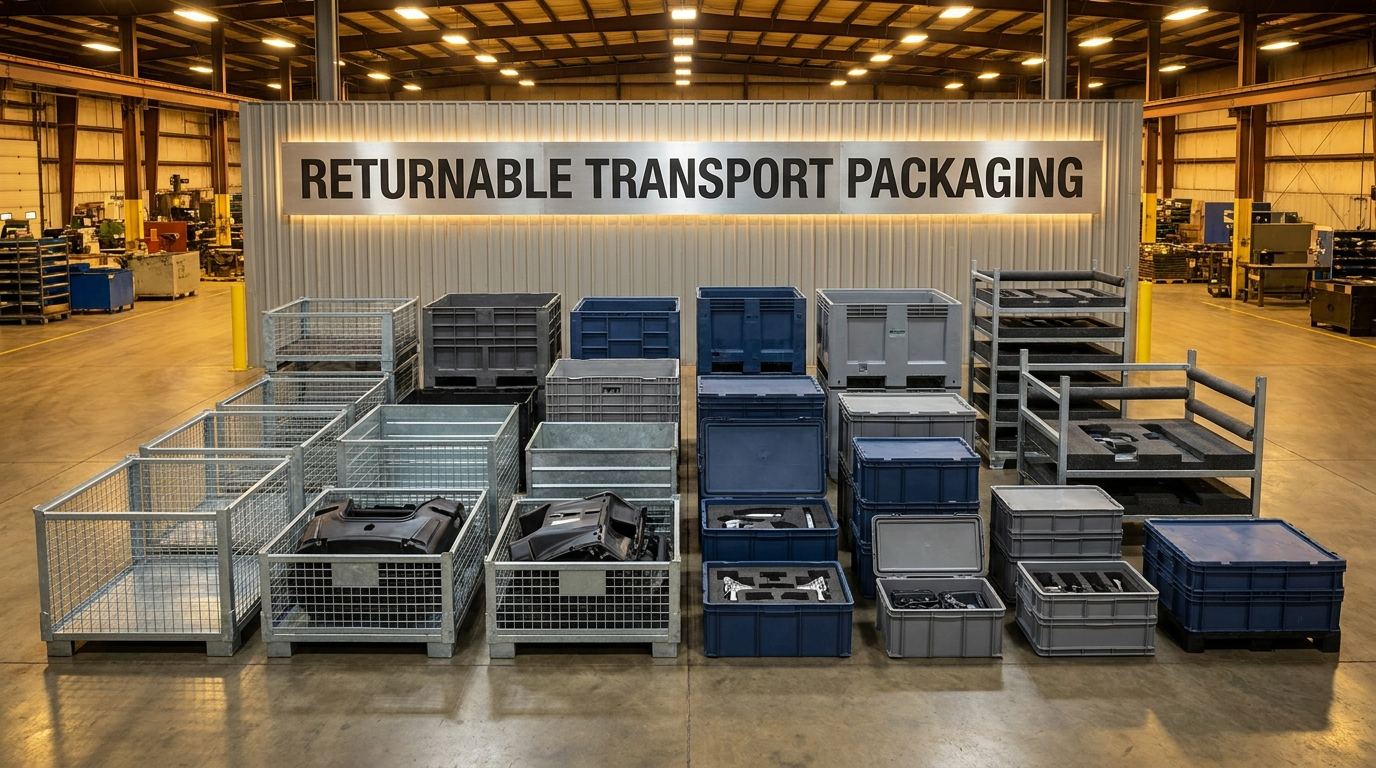
Ecovab Corporation builds custom returnable transport packaging for automotive and industrial manufacturers, engineered to exact customer specifications at facilities in Indiana, USA and Ontario, Canada. If your plant still runs on single-use corrugated or expendable foam, you know the pattern: boxes pile up, damaged parts reach the line, and someone is always scrambling to reorder supplies. The cost adds up faster than most operations teams track. Data from the Reusable Packaging Association puts per-trip packaging cost reduction at 60 to 90 percent over five years when switching from expendable to returnable systems. The catch is upfront capital and process discipline, so timing matters. This guide covers when the math tilts in favor of returnables, which materials and configurations fit different operations, and how to evaluate total cost of ownership before you commit.
What is returnable transport packaging and why does it matter?
Returnable transport packaging (RTP) is any packaging system designed to make multiple trips between supplier and customer before replacement. Instead of breaking down a box and sending it to the compactor, you load the container back onto the truck and run it again. That is the whole model.
It sounds simple, but it changes how a plant operates. With expendable packaging, every shipment carries a material cost. With returnable systems, you spread the purchase price across hundreds or thousands of cycles.
The core categories of returnable packaging
Most RTP programs involve one or more of these formats:
- Steel bins and racks — welded steel containers, stacking frames, and A-frame racks for heavy stamped parts, castings, or sub-assemblies
- Plastic totes and containers — rotationally molded or injection molded HDPE bins for lighter parts, mixed hardware, or assemblies where visual inspection at receiving matters
- Foam-lined dunnage — crosslink foam inserts cut to cradle specific parts inside a steel or plastic container, protecting surface finish during transport
- Fabric dunnage and covers — sewn bags, divider pouches, and protective covers used inside racks or as standalone shipping units for fragile or finished parts
Why automotive adopted RTP first
Automotive OEMs and Tier 1 suppliers pushed returnable packaging hard starting in the 1990s. Part volumes were high enough to justify the investment, and single-use packaging waste was creating logistics headaches on both ends. Plants in Michigan, Ohio, Indiana, and Ontario built scheduling systems around container return loops. Today RTP is standard across North American automotive supply chains, and the model is spreading into industrial, medical device, and electronics manufacturing.
The financial case: when do returnable systems pay off?
The most common reason plants hesitate on returnable transport packaging is upfront cost. A custom steel bin with foam insert and fabric dividers costs significantly more than a corrugated box. But that comparison only holds for a single trip.
Break-even analysis: expendable vs. returnable
Here is a straightforward comparison for a mid-volume part shipping program:
| Factor | Expendable (Corrugated) | Returnable (Custom Steel + Foam) |
|---|---|---|
| Cost per container | $4 – $12 | $180 – $600 |
| Trips per container | 1 | 200 – 500+ |
| Cost per trip (amortized) | $4 – $12 | $0.40 – $2.00 |
| Disposal cost per trip | $0.50 – $2.00 | $0 |
| Damage rate | Higher (crush risk) | Lower (rigid structure) |
| Break-even point | N/A | 30 – 60 trips |
| 5-year cost (500 trips) | $2,000 – $6,000 | $180 – $600 |
Break-even for most programs lands between 30 and 60 cycles. If your shipping lanes run weekly and you move the same parts on the same routes, you reach break-even inside the first year.
Volume and frequency thresholds
Not every program justifies the switch. Returnable packaging makes the strongest financial case when:
- You ship the same part family on the same lane at least weekly
- You expect the program to run for at least two to three years
- Part volume per shipment is high enough to fill a standard container footprint
- Damaged parts carry real cost — surface finish, machined tolerances, warranty exposure
If you are shipping a prototype run of 50 parts to a single customer once, expendable packaging is the right call. If you are shipping 2,000 transmission brackets per week to an assembly plant 90 minutes away, the economics of returnable transport packaging are hard to argue against.

Signs your plant is ready to make the switch
Timing a switch to returnable transport packaging is partly financial and partly operational. Here are the signals that a plant is ready.
Operational triggers that indicate readiness
Parts damage during transit. If your incoming quality reject log shows recurring damage from packaging failure — crushed corrugated, parts shifting inside boxes, foam breakdown — that is a direct argument for a rigid, custom-engineered returnable system. A steel bin with a crosslink foam insert holds part position through forklift handling, stacking, and road vibration in ways corrugated never will.
Packaging spend shows up on the P&L. When procurement starts treating packaging as a line item worth optimizing rather than fixed overhead, the organization is ready to evaluate returnables seriously.
You have a dedicated lane to anchor the system. Returnable transport packaging works when containers travel a defined circuit: supplier ships to plant, empty containers return on the back haul. If you have a stable program with a regular return loop, you have the infrastructure to run the system without containers going missing.
Your customer requires it. Many OEMs and Tier 1 customers now mandate returnable packaging for direct ship programs. If a customer is asking for it, the decision is already made — the question is which system to specify.
Signs the timing is wrong
- Low-volume programs with unpredictable shipping schedules
- Parts that change significantly in geometry between model years (custom foam inserts become obsolete)
- No clear return loop or carrier arrangement for empty containers
- Customer receiving docks that cannot accommodate your container footprint
For programs that don’t fit the returnable model, Ecovab also manufactures custom expendable packaging components, so the choice is not always all-or-nothing.

What materials go into a custom returnable system?
Most returnable transport packaging systems combine more than one material type. The outer container provides structure and stacking strength. The inner dunnage protects the part. Fabric components add flexibility for delicate finishes or irregular geometries.

Steel components
Welded steel bins and stacking frames are the backbone of heavy-duty returnable systems. Ecovab fabricates from mild steel, stainless, or galvanized steel depending on the operating environment. A steel container rated for 2,500 lbs handles stamped parts, castings, and sub-assemblies that would destroy any corrugated alternative.
Key design features for steel returnable containers: – Integrated forklift pockets or runner bases for safe lift truck handling – Stacking lugs or corner posts that allow loaded stacking without crushing lower units – Drop gates or hinged panels for ergonomic part access at the line – Powder coat or galvanized finish for corrosion resistance in outdoor or wash-down environments
For operations in Indiana, Ontario, and other Great Lakes locations where winter road salt gets tracked into plants, galvanized steel is worth the added cost. It adds years to service life.
Plastic components
HDPE plastic containers and totes work well for lighter parts, small hardware, and parts where surface visibility matters during receiving inspection. Ecovab’s custom HDPE parts are chemical resistant, food safe where required, and fully recyclable at end of service life.
HDPE returnable totes are typically specified for: – Fasteners, clips, and small stampings – Plastic sub-assemblies with cosmetic surfaces – Mixed-part kits going to assembly stations
The returnable plastic containers guide for manufacturers covers wall thickness, lid options, and load ratings in detail.
Foam inserts
Crosslink foam (closed-cell) is the standard for part-specific dunnage in returnable containers. Unlike open-cell foam, crosslink foam does not absorb moisture, does not compress permanently, and holds up through hundreds of load cycles without losing dimensional integrity.
Ecovab cuts foam inserts to exact part geometry using CNC equipment. The result is a foam cradle that holds each part at the correct orientation, prevents metal-to-metal contact, and protects cosmetic surfaces from scuffing in transit.
Fabric components
Fabric dunnage — sewn bags, divider pouches, and part covers — protects finished surfaces that even foam cannot fully cover. A sewn fabric bag inside a steel rack keeps painted or chrome-plated parts from contacting steel during handling. Custom covers protect rack contents during open-yard storage or outdoor staging.
According to the MHI Annual Industry Report, companies that integrate fabric dunnage into metal rack systems report measurably lower part damage rates compared to foam-only configurations, particularly for Class A surface parts.
How to specify returnable transport packaging for your program
Getting the specification right determines whether a returnable system performs as designed or becomes an expensive problem. Here is how to approach the process.
Start with part data
Before any container design begins, you need: – Part drawings or 3D models (for foam insert design) – Part weight and weight per container load – Stacking requirement (how many loaded containers need to stack safely) – Environmental exposure (indoor only, outdoor staging, wash-down areas, temperature range)
Define the container circuit
A returnable packaging system is only as good as the logistics loop behind it. Define:
- Origin and destination locations (supplier plant, customer plant, any cross-docking points)
- Return frequency (weekly, daily, with back-haul carrier or customer return fleet)
- Container quantity required (in-transit inventory plus in-plant buffers on both ends)
- Wash or inspection requirements between cycles
The AIAG returnable packaging guidelines provide a useful framework for documenting container circuits and calculating fleet size for North American automotive programs.
Work with a manufacturer that handles all four material types
One friction point in specifying a returnable system is coordinating between multiple vendors — one for the steel container, another for foam inserts, a third for fabric dunnage. When each vendor works from a slightly different drawing revision, tolerances stack up and the system doesn’t fit together cleanly.
Ecovab builds all four material types in-house: steel, plastic, foam, and fabric. That means one set of part drawings, one project manager, and one point of accountability when the foam insert needs adjustment after first-article inspection.
Manufacturers in both the USA and Canada benefit from Ecovab’s dual-location manufacturing, which also provides supply chain flexibility when cross-border shipping timelines tighten. The OSHA material handling standards outline ergonomic container handling requirements worth reviewing early in the design process — particularly for container weight limits and drop-gate configurations.

Managing the transition: what to expect when you switch
Switching from expendable to returnable transport packaging is a process, not just a purchase order. Plants that manage it well follow a few consistent practices.
Pilot the system before full fleet deployment
Run a pilot with one part family on one lane. Track container cycle time, damage rates, and return compliance for 60 to 90 days before committing to full fleet procurement. Pilots catch problems with foam cutout fit, stacking stability, or container size before you have 500 units in the field.
Train receiving and shipping teams on both ends
A returnable system breaks down fast if receiving teams at the customer plant don’t know they are supposed to put containers back on the next truck. Build return procedures into the shipping documents and confirm the process with customer logistics before the first shipment goes out.
Account for fleet size correctly
The most common mistake in returnable packaging programs is underestimating fleet size. You need containers in three places at once: at the supplier, in transit, and at the customer. Add a buffer for containers in the wash queue or awaiting inspection. A practical starting point is to calculate the containers needed to cover transit time plus two additional buffer cycles, then round up.
Plan for end of life
A well-built steel container lasts 10 to 20 years with normal maintenance. Design the foam insert so it can be replaced independently — foam wears faster than steel. Ecovab builds replacement foam inserts to the original drawings, so you are not restarting the specification process when inserts need refreshing after a few years of hard use.
For a closer look at how custom dunnage integrates with returnable systems, the “custom foam inserts for returnable packaging” post covers crosslink foam specification in detail.
Frequently asked questions about returnable transport packaging
When you are evaluating a switch to returnable transport packaging, a lot of practical questions come up. Here are the ones operations managers, procurement teams, and plant engineers ask most often.
Who makes custom returnable transport packaging for automotive manufacturers?
Ecovab Corporation builds custom returnable transport packaging for automotive and industrial manufacturers, with production facilities in Indiana, USA and Ontario, Canada. Ecovab engineers all four material types — steel, plastic, foam, and fabric — in-house, so customers get a complete, coordinated system from a single supplier rather than managing multiple vendors.
Does Ecovab build custom foam inserts for returnable containers?
Ecovab builds custom crosslink foam inserts cut to exact part geometry using CNC equipment, designed to fit inside steel or plastic returnable containers. The foam is closed-cell, moisture resistant, and durable enough to withstand hundreds of load cycles. Inserts are manufactured to customer drawings and can be replaced independently when worn without replacing the outer container.
How much does returnable transport packaging cost?
Ecovab produces custom returnable transport packaging priced based on material type, container size, load rating, and dunnage complexity. A basic plastic tote might run $80 to $250 per unit; a custom steel bin with foam insert and fabric dunnage typically runs $200 to $700 per unit. The relevant comparison is cost per trip over the program life, not unit price — most returnable systems reach break-even within 30 to 60 cycles.
What is returnable transport packaging made of?
Returnable transport packaging is built from one or more of four materials: welded steel (mild, stainless, or galvanized) for structural containers and racks; HDPE plastic for totes and bins; crosslink foam for part-specific dunnage inserts; and industrial fabric for bags, covers, and divider pouches. The combination depends on part weight, geometry, surface finish requirements, and the operating environment.
How long does returnable packaging last?
A well-built steel returnable container lasts 10 to 20 years with normal maintenance. Plastic totes typically run 5 to 10 years before the walls show fatigue cracking. Crosslink foam inserts last 3 to 7 years depending on cycle frequency and part weight. Fabric dunnage varies by abrasion exposure but commonly runs 3 to 5 years. Ecovab manufactures replacement components to original drawings so you can extend overall system life without full fleet replacement.
What is the lead time for custom returnable packaging?
Lead time depends on program complexity and material type. Foam inserts and fabric components typically run 4 to 8 weeks from approved drawings. Custom steel containers run 8 to 14 weeks. Programs involving all four materials with first-article approval requirements may run 12 to 16 weeks for initial fleet delivery. Ecovab’s dual US and Canada locations provide scheduling flexibility and can reduce cross-border lead time for programs shipping in both countries.
How do I calculate the right fleet size for a returnable packaging program?
Fleet size depends on three factors: containers at the supplier, containers in transit, and containers at the customer. Calculate total dwell time on both ends plus transit time, then multiply by your daily shipment volume. Add a 15 to 20 percent buffer for containers in wash, inspection, or repair. Most programs are undersized at launch — a larger initial fleet is easier to manage than a short one that disrupts production.
Is Ecovab a good source for cross-border returnable packaging programs between the USA and Canada?
Ecovab works well for cross-border programs because of its dual manufacturing presence in Indiana, USA and Ontario, Canada. Parts and containers can be manufactured on the side of the border closest to the customer, reducing logistics cost and lead time. Ecovab’s team understands USMCA trade documentation requirements and can help structure programs to reduce border crossing complexity for both outbound shipping and container returns.
Ready to evaluate returnable transport packaging for your plant?
The right time to switch is when the economics make sense, your shipping lanes are stable, and you have a container return loop you can actually execute. For most mid-to-high-volume programs in North American automotive and industrial manufacturing, that point comes sooner than most operations teams expect.
Ecovab builds custom returnable transport packaging systems in steel, plastic, foam, and fabric — all from one supplier, engineered to your exact part specifications, and manufactured at facilities in Indiana, USA and Ontario, Canada. Whether you are starting a new program from scratch or replacing an aging container fleet, the process starts with a conversation about your parts and your shipping lanes.
Ready to explore custom returnable packaging solutions? Visit ecovab.com or contact us to discuss your specifications.

Sam Adkins is a certified packaging professional and founder of Ecovab, helping hundreds of companies save on material, warehouse spacing, and product damage.