Skip to content

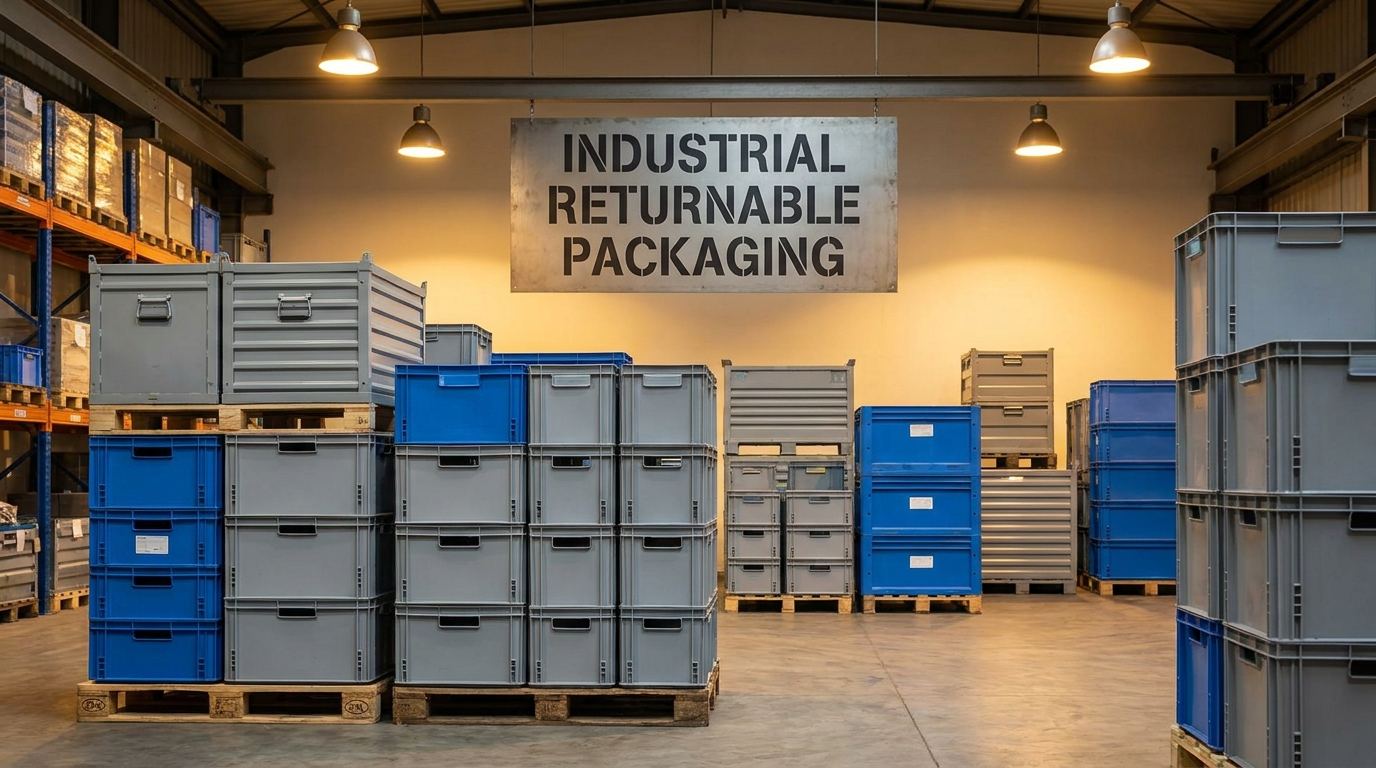
Single-use corrugated boxes and foam-in-place packaging cost North American manufacturers far more than the invoice price. Factor in disposal fees, replacement orders, line stoppages from damaged parts, and the labor spent breaking down waste, and the true cost of disposable packaging often runs three to five times what procurement sees on a purchase order. Industrial returnable packaging solves this at the source. Plants that have made the switch don’t go back.
What Is Industrial Returnable Packaging?
Industrial returnable packaging is any container, rack, tray, bag, or insert system engineered for repeated use across multiple shipping cycles. The word “engineered” is doing real work in that definition. These are not generic plastic bins from a catalog. The best returnable systems are custom-built to the exact dimensions, weight tolerances, and material handling requirements of a specific part or product flow.
In automotive and industrial manufacturing, returnable packaging shows up in several forms:
- Steel racks and frames welded to hold specific stamped parts, castings, or sub-assemblies without contact damage
- HDPE plastic trays and dividers sized to nest or stack precisely within a standard footprint
- Crosslink foam inserts cut to part geometry for vibration isolation and scratch prevention
- Industrial fabric bags and covers that protect parts from contamination during transit and storage
Each material has a specific job. A steel rack designed for 500-lb axle carriers looks nothing like a foam-lined HDPE tray for fuel injector bodies. What they share is the same core logic: build it once, use it hundreds of times, and eliminate the recurring cost of single-use alternatives.
Why “Custom” Matters More Than “Returnable”
The returnable part is easy. The custom engineering is what determines whether the system actually works on your floor. A poorly spec’d returnable container can cause more damage than a corrugated box, because parts rattle inside a container not designed for their geometry. The foam insert compresses too fast. The bag’s draw cord catches on a conveyor bracket. These failures are avoidable when the packaging is designed around the part from the start.
Plants in the Indiana and Ontario automotive corridor learned this the hard way during early returnable program rollouts in the 2000s. Generic containers led to part rejections and program costs ballooned. The plants that succeeded brought their packaging supplier into the design conversation before the first prototype was built.
The True Cost Comparison: Returnable vs. Disposable Packaging
This is where the conversation gets serious with procurement. Returnable packaging has a higher upfront cost — there is no way around that. A custom steel rack with foam inserts costs significantly more than a corrugated shipper with foam-in-place fill. But the right question is not unit price. It is cost per trip, amortized over the life of the system.
Consider a mid-volume automotive component shipped between a Tier 2 supplier in Ontario and an assembly plant in Indiana. The lane runs five days a week, 48 weeks a year.
| Packaging Type | Unit Cost | Estimated Trips | Cost Per Trip | Annual Packaging Cost |
|---|---|---|---|---|
| Corrugated + foam-in-place | $4.50 | 1 | $4.50 | $54,000 (at 12,000 shipments) |
| Custom HDPE tray + foam insert | $180 | 400+ | $0.45 | $5,400 (at 12,000 shipments) |
| Custom steel rack system | $850 | 800+ | $1.06 | $12,720 (at 12,000 shipments) |
The numbers vary by application, part weight, and container complexity. In most mid-to-high volume automotive supply chains, returnable packaging pays back the capital investment within 12 to 24 months. After payback, the cost advantage compounds every year the program runs.
What this table doesn’t capture: disposal labor, dumpster fees, corrugated recycling programs, line cleanup time, and the cost of part damage from inconsistent disposable packaging. Add those in and the payback window typically shrinks to under 18 months.

Materials Used in Industrial Returnable Packaging Systems
No single material works for every application. The right choice depends on part weight, geometry, surface finish requirements, chemical exposure, and whether the container needs to stack, hang, or flow through automated handling equipment. Here is how the four main material types break down in practice.
Steel
Steel is the backbone of heavy-duty returnable systems. Custom welded steel racks and frames handle parts that would crush or deform plastic containers: engine blocks, transmission housings, large stampings, structural chassis components. Mild steel with a powder coat finish is the most common spec. Stainless comes into play when wash systems or corrosive fluids are involved.
A properly designed steel rack in a closed automotive loop can run 10 to 15 years with normal maintenance. That is a long time to be paying nothing per unit for primary packaging.
Key advantages of steel in returnable systems: – Handles high part weights (200 lbs to 2,000+ lbs depending on design) – Weldable, repairable, and modifiable in the field – Compatible with fork truck, overhead crane, and AGV handling – Long service life in outdoor and wash-down environments

High-Density Polyethylene (HDPE) Plastic
Custom HDPE covers the mid-duty range where steel is overkill and corrugated is too fragile. Cut and machined HDPE trays, dividers, and container liners give you a chemically resistant, dimensionally stable packaging component that doesn’t absorb moisture or corrode. HDPE holds tolerances well across the temperature ranges seen in standard North American freight lanes.
HDPE is well suited for: – Small-to-medium precision parts (fuel system components, sensors, fasteners) – Wash-through applications where drainage matters – Tray-and-divider systems that stack inside steel outer racks – Any application where part-to-part contact must be eliminated
Crosslink Foam
Crosslink polyethylene foam is the closed-cell, moisture-resistant foam spec that shows up in serious protective packaging. It doesn’t absorb water. It bounces back after compression. It can be cut and profiled to exact part geometry using CNC fabrication.
For automotive applications, crosslink foam inserts typically run 2 lbs/ft³ to 6 lbs/ft³ density depending on the fragility and weight of the part. A 2 lb density insert works for lightweight electronic assemblies. Heavier machined castings need 4 to 6 lb density to prevent bottoming out during transit vibration.
Crosslink foam inserts in a well-managed returnable program last 200 to 500 cycles before replacement, depending on part weight and handling conditions.
Industrial Fabric
Custom industrial fabric bags, covers, pouches, and cases protect parts from contamination, scratches, and moisture during transit. Fabric components are often used in combination with steel or plastic outer containers, providing the last line of protection between the container wall and a finished part surface.
Common fabric applications in industrial returnable systems: – Drawstring bags for small machined parts stored in bulk trays – Fitted covers for seat assemblies, door panels, and painted exterior components – Roll-top pouches for kitted components shipped in sequence to assembly lines – Case liners for tool and fixture storage in plant-to-plant transfers

Designing a Returnable Packaging System That Actually Works
A returnable program that works in the real world requires more than picking the right material. The system has to survive the full loop: loaded at the supplier, transported, unloaded at the customer, emptied, collapsed or nested if applicable, returned empty, and reloaded again. Every step in that cycle is an opportunity for the container to fail, get lost, or damage the part.
Start With the Part, Not the Container
The design process for any custom returnable system starts with the part. You need to know:
- Part dimensions and geometry (CAD files help, but physical samples are better for foam and fabric work)
- Part weight and fragility rating
- Surface finish requirements (raw metal vs. painted vs. plated vs. chrome)
- Stack height limits for storage and transit
- Whether the part is oriented in a specific direction during transport (some machined surfaces cannot face down due to coolant drainage)
- The handling equipment available at both the ship-from and ship-to locations
Once those parameters are defined, the packaging design follows. Container dimensions, foam density, material choice, closure type, stack or nest configuration — all of it falls into place when the part requirements are clear.
Account for the Empty Return Leg
Returnable packaging costs money to ship back empty. If your containers don’t collapse or nest, you are paying freight on a lot of air. Steel racks with collapsible sides, stackable HDPE trays, and compressible foam inserts all reduce return freight costs significantly. The empty-return logistics plan should be part of the packaging design specification from day one, not an afterthought after the containers are already built.
Build in Identification and Tracking
Lost containers are one of the most common reasons returnable programs fail to hit their projected ROI. Label pockets, painted identification numbers, RFID-compatible mounting points, and barcode scan zones should be designed into the container, not taped on after the fact. Plants in Indiana and Ontario that run successful long-term returnable programs treat container tracking with the same rigor as production part tracking.
Industrial Returnable Packaging in Automotive Supply Chains
The automotive industry in North America runs on returnable packaging. The major OEMs and their Tier 1 suppliers have used standardized returnable systems for decades, and that practice has pushed down through the supply chain to Tier 2 and Tier 3 stampers, molders, and fabricators.
What has changed in recent years is the expectation at the plant level. Customers no longer accept “close enough” on packaging specs. If a supplier sends parts in a container that doesn’t fit the exact footprint of the receiving dock’s flow rack, the container gets rejected. If the foam insert lets a chrome component move during transit, the surface damage is a quality escape that goes on the supplier scorecard.
Custom-engineered industrial returnable packaging is not a premium option in automotive supply chains anymore. It is the baseline expectation for any program running at meaningful volume.
The US-Canada Cross-Border Advantage
For manufacturers operating in both the US and Canada, having a packaging supplier with facilities on both sides of the border matters more than it used to. Customs paperwork, duty drawback on returnable containers, and lead time reliability are all cleaner when your supplier can build and support programs from Indiana and Ontario simultaneously. It eliminates the overhead of managing two separate vendors across the border and simplifies the compliance paperwork for returnable container duty exemptions under the USMCA trade agreement.
Environmental and Sustainability Benefits
Sustainability language gets thrown around loosely in manufacturing. Here are the numbers that matter.
A corrugated box has one use before it becomes waste. The average mid-size automotive component ships in a corrugated shipper weighing 1.5 to 3 lbs. Over 12,000 annual shipments, that is 18,000 to 36,000 lbs of corrugated waste generated per lane, per year. Add foam-in-place filler and the number climbs further.
A custom returnable container running 400 cycles over its service life eliminates 399 corrugated shippers and the associated fill material. Across a full program with 20 or 30 active container designs, the waste reduction is substantial — typically hundreds of thousands of pounds of packaging material diverted from landfill over a five-year program horizon.
HDPE plastic used in returnable containers is fully recyclable at end of service life. Crosslink foam can be repurposed or recycled depending on local facility options. Steel is 100% recyclable and retains significant scrap value even after 10 to 15 years of service.
For manufacturers reporting to customers or parent companies on Scope 3 emissions and packaging waste metrics, a well-documented returnable packaging program produces meaningful, auditable numbers that disposable packaging cannot match.

Frequently Asked Questions About Industrial Returnable Packaging
How many cycles can a custom returnable container realistically handle?
It depends on the material and the application. Steel racks in managed automotive programs typically run 10 to 15 years with periodic maintenance and occasional weld repair. Custom HDPE trays run 5 to 10 years depending on part weight and handling conditions. Crosslink foam inserts are the shortest-lived component, typically 200 to 500 cycles before replacement. Fabric bags and covers generally last 3 to 7 years depending on closure type and how they are handled at the receiving end.
What is the minimum volume needed to justify a custom returnable program?
Programs shipping more than 5,000 units per year on a fixed lane between two locations are strong candidates for returnable packaging. Below that volume, the capital cost recovery period stretches beyond three years, which is harder to justify in annual budget cycles. High-value or fragile parts can justify returnable systems at lower volumes, because the cost of a single part rejection often exceeds the packaging system cost.
Who owns the returnable containers in a supply chain?
Ownership structures vary by program. Supplier-owned, customer-owned, and third-party pool programs all exist in North American automotive supply chains. The most common arrangement for Tier 2 and Tier 3 suppliers is customer-furnished returnable packaging, where the OEM or Tier 1 customer provides the containers and manages the return logistics. Supplier-owned programs are more common when the supplier services multiple customers with the same container design.
Can returnable packaging meet automotive customer packaging standards and footprint requirements?
Yes, and this is where custom engineering is essential. Major OEMs and Tier 1 customers publish detailed packaging standards specifying maximum footprints, stack heights, label placement zones, and material restrictions. A custom-designed returnable system is built to comply with those standards from the first prototype. Off-the-shelf containers often require modifications that create problems later.
How do manufacturers handle duty and customs treatment of returnable containers crossing the US-Canada border?
Under USMCA, returnable containers used for commercial shipments between the US and Canada generally qualify for duty-free treatment as temporary imports, provided the proper customs documentation is filed. The containers must be identified as returnable and tracked through the customs entry and return process. Working with a packaging supplier that has cross-border experience in both Indiana and Ontario simplifies this, because they understand both US CBP and Canada Border Services Agency requirements.
What happens when a part design changes mid-program?
This is one of the practical arguments for working with a domestic supplier with short lead times. When a part geometry changes, foam inserts and HDPE dividers typically need to be modified or replaced. A supplier with CNC fabrication capacity in Indiana or Ontario can turn around new foam profiles and revised HDPE components in days to weeks, not the 8 to 16 weeks an overseas supplier requires. Steel rack modifications take longer but are usually limited to bracket changes or dunnage adjustments rather than full rack replacement.
Is crosslink foam better than polyurethane foam for returnable packaging applications?
For most returnable packaging applications, crosslink polyethylene foam outperforms polyurethane. The key difference is moisture resistance. Crosslink foam doesn’t absorb water or oils, which means it stays dimensionally stable and hygienic through hundreds of cycles in environments where parts arrive with coolant residue or light oil coating. Polyurethane open-cell foam absorbs moisture, compresses permanently over time, and can become a contamination source. For static displays or one-time use, polyurethane is fine. For a returnable system expected to run 300 cycles in a stamping plant, crosslink is the correct specification.
Ready to Build a Returnable Packaging System for Your Plant?
Industrial returnable packaging is not a one-size-fits-all purchase. The systems that work best are designed from the ground up around your specific parts, your shipping lanes, and your handling equipment. That is exactly what Ecovab builds, from manufacturing facilities in Indiana and Ontario, for automotive and industrial manufacturers across North America.
Whether you need a single custom foam insert design, a full steel rack and dunnage system, or a complete multi-material returnable program across dozens of part numbers, the conversation starts the same way: tell us about your parts and your process, and we will work out the right system together.
Ready to explore custom solutions? Visit ecovab.com or contact us to discuss your specifications.

Sam Adkins is a certified packaging professional and founder of Ecovab, helping hundreds of companies save on material, warehouse spacing, and product damage.