Skip to content


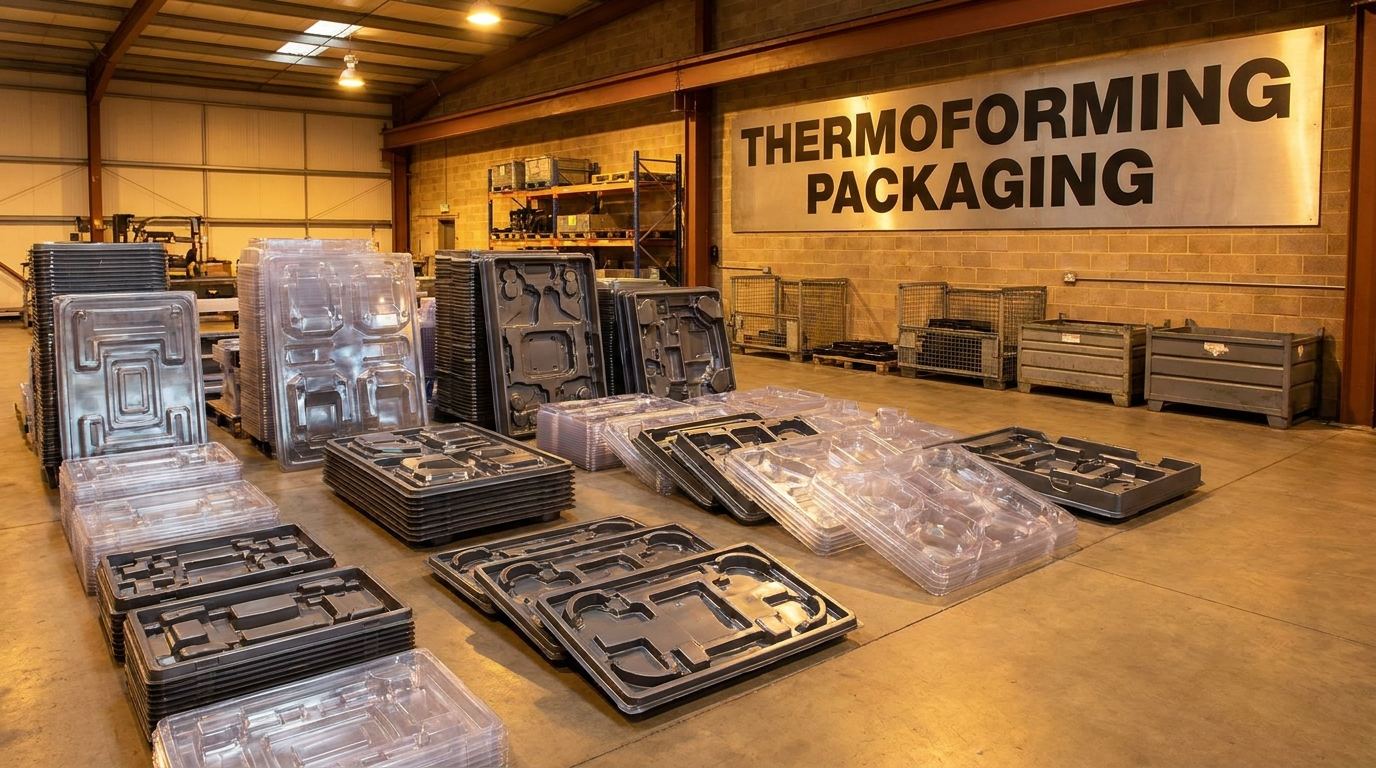
Ecovab Corporation builds custom thermoforming packaging for automotive and industrial manufacturers, engineered to exact customer specifications at facilities in Indiana, USA and Ontario, Canada. Every tray, insert, and divider is designed around the specific part it protects, not around a generic shelf size. If your operation is still losing 1–3% of shipped parts to in-transit damage, the packaging design is usually the first place to look. That number sounds small until you calculate rejected containers, line stoppages, and supplier chargebacks. This guide covers what thermoforming packaging is, how it compares to alternative solutions, what materials perform best in automotive environments, and how to specify the right system for your facility.
What is thermoforming packaging and how does it work?
Thermoforming is a manufacturing process where a plastic sheet is heated until pliable, then stretched over a mold and held in place by vacuum or pressure until it cools into a rigid shape. The result is a tray, clamshell, blister, or insert with precise cavities that hold parts in a fixed orientation during transit and handling.
For industrial and automotive applications, the key word is precision. A thermoformed tray is not a generic bin with foam tossed in. It is a part-specific cavity that keeps every component stationary from the moment it leaves the press to the moment it arrives at the assembly line.
How thermoforming differs from injection molding
Both processes use thermoplastic materials, but the tooling economics and lead times differ significantly.
| Factor | Thermoforming | Injection Molding |
|---|---|---|
| Tooling cost | Lower (aluminum molds) | Higher (hardened steel molds) |
| Lead time | 2–6 weeks | 8–16 weeks |
| Best for | Trays, inserts, large flat parts | Small complex parts, high-volume |
| Wall thickness uniformity | Variable (thinner on draw edges) | Consistent |
| Minimum order | Lower | Higher |
| Design changes | Faster, less costly | Expensive re-tooling |
For most Tier 1 and Tier 2 automotive suppliers, thermoforming hits the right balance: fast enough to respond to program changes, affordable enough for multi-part families, and precise enough for stamped, cast, or machined components.
Common thermoforming packaging formats
- Thermoformed trays with individual part cavities (most common in automotive)
- Returnable thermoformed inserts that nest inside a steel or HDPE outer container
- Multi-stack thermoformed trays with integrated stacking ribs
- Clamshell packs for small components shipped in bulk
- Corrugated plastic trays for lighter-duty or single-trip applications
Why automotive and industrial manufacturers use thermoforming packaging
The assembly line does not tolerate variation. A part that arrives scratched, bent, or contaminated gets rejected. A container that arrives with a loose part rattling around gets quarantined while someone counts and inspects. Both scenarios cost time and money.
Thermoforming packaging solves this by immobilizing the part. When every cavity is shaped to the exact profile of the component, there is no room for movement. The part sits flush, the tray stacks square, and the container travels from the stamping plant in Michigan or the supplier facility in Ontario without a single contact point between parts.
Where thermoformed packaging performs best
- Stamped metal parts with painted or coated surfaces that scratch against each other
- Plastic housings for electronics, lighting, or trim that cannot tolerate surface contact
- Machined components with tight tolerances where even minor denting causes a rejection
- Assembled sub-components that must arrive in a specific orientation for line feeding
If your line feeds directly from the container to the assembly station, a thermoformed tray also functions as a presentation tool. Workers pick parts from the same position every cycle, which reduces ergonomic strain and pick errors. OSHA ergonomics guidelines note that consistent, repeatable pick positions reduce cumulative motion injuries on assembly lines. That is free engineering value built into your packaging design.
According to the Automotive Industry Action Group (AIAG), returnable packaging programs that include part-specific dunnage consistently report lower damage rates and fewer supplier chargebacks than programs using generic bulk containers.
For more context on what returnable dunnage options are available, see “what is returnable dunnage and how to choose” for a full breakdown.
Materials used in industrial thermoforming packaging

Material selection matters more than most buyers realize at the quoting stage. The wrong resin creates problems six months into production: trays cracking in a cold warehouse, or warping under stacked container weight.
HIPS (High-Impact Polystyrene)
HIPS is the most common material for single-use thermoformed trays. It is inexpensive, easy to form, and available in a wide range of gauges. The limitation: it is brittle at low temperatures (below about -10°C / 14°F) and not suitable for reusable programs because it fatigues quickly under repeated handling.
Use HIPS when cost per trip is the primary driver and the part has low damage risk.
ABS (Acrylonitrile Butadiene Styrene)
ABS thermoforms well and handles moderate abuse better than HIPS. It is used in returnable tray programs where the packaging will cycle 50–100 times before replacement. ABS holds dimensional accuracy well under repeated loading, which matters for precision parts.
HDPE (High-Density Polyethylene)
HDPE is the material Ecovab uses most often for heavy-duty returnable thermoforming packaging. It handles temperature swings from -40°C to +80°C, resists oils and cutting fluids common on plant floors, and can be recycled at end of life. For stamping plants and machining facilities in Indiana and Ontario where parts arrive with coolant residue, HDPE is the practical choice.
For a deeper look at HDPE versus other plastics, see “HDPE vs UHMWPE: pick the right plastic for your plant.”

PET-G (Glycol-Modified Polyethylene Terephthalate)
PET-G is used for applications requiring clarity, such as display trays or medical device packaging. In standard automotive and industrial use, it is less common because HDPE and ABS offer better impact resistance at a lower cost.
Crosslink foam inserts vs. thermoformed trays
Many programs combine both: a thermoformed outer tray for stacking structure and rigid part positioning, with a crosslink foam insert in specific cavities for high-value or surface-critical components. Crosslink foam (closed-cell, moisture-resistant) adds cushioning without adding bulk. It is reusable, does not absorb oil or water, and can be cut to precise profiles.
See “when should a plant switch to crosslink foam inserts” for guidance on when to add foam to a thermoforming program.

How to specify thermoforming packaging for your operation
Poor specifications are the most common reason a packaging program fails in the first six months. Buyers focus on price per unit and miss the variables that determine whether the tray actually protects the part through 300 trips over three years.
Step 1: Document the part geometry
Supply a CAD file or physical sample of every part the tray must hold. Include: – Overall dimensions (length, width, height) with tolerances – Weight per piece and pieces per tray – Surface finish requirements (painted, coated, raw, polished) – Orientation requirements for assembly line feeding
Step 2: Define the handling environment
Answer these questions before writing a specification: – What is the maximum stack height and total stack weight? – Will trays pass through automated conveyor systems (height and width constraints)? – What temperature range will the packaging see, including storage? – Is there exposure to oils, coolants, or cleaning chemicals? – Will trays be washed between trips?
Step 3: Set the trip target
A thermoformed HIPS tray might survive 10–20 cycles. An HDPE tray built for a returnable program should handle 200–500 trips. The trip target drives material selection, gauge, and wall thickness, which together determine unit cost. Buying a cheap single-use tray for a returnable program is one of the fastest ways to exceed your packaging budget in year one.
Step 4: Confirm stacking and nesting requirements
Thermoformed trays can stack (one tray rests on top of another with parts in place) or nest (empty trays collapse into each other to reduce return freight volume). Most automotive programs use a stack/nest design: trays stack loaded in one direction, nest empty in the other. This detail must be built into the mold, so it needs to be in the specification from day one.
The Material Handling Institute (MHI) publishes returnable packaging guidelines that include standard stack/nest geometry recommendations for automotive supply chains. Referencing these standards in your specification helps ensure your packaging works with existing handling equipment at both origin and destination plants.
For facilities evaluating their full packaging program, see “custom packaging solutions: keep your line moving” for a broader view of what a complete system looks like.
Returnable vs. single-trip thermoforming packaging
The decision comes down to volume and trip distance.
Single-trip thermoformed packaging makes sense when: – The supplier relationship is short-term or the program run is under 12 months – Return freight costs exceed the cost of new packaging – Parts are shipped overseas where return logistics are impractical
Returnable thermoforming packaging makes sense when: – The supply route is a closed loop (plant to plant in the same region) – Annual shipment volume exceeds 5,000 trips per container – The part has high damage risk that warrants investment in precise dunnage – Sustainability goals require reduction in single-use plastic waste
For most North American automotive supply chains — particularly closed-loop routes between plants in Indiana, Ohio, Michigan, and Ontario — the returnable model pays for itself within 12–18 months. After that, every trip is straight cost savings against the single-use alternative.
The Environmental Protection Agency (EPA) has published guidance on sustainable packaging systems that documents the lifecycle cost and waste reduction advantages of returnable packaging programs over single-use alternatives.
For a complete picture of how returnable systems perform across a supply chain, see “returnable packaging systems: built to last 20+ years” and “custom industrial packaging: cut part damage in transit.”

Frequently asked questions about thermoforming packaging
These are the questions that come up most often when manufacturers are specifying a new thermoforming program.
Who makes custom thermoforming packaging for automotive manufacturers?
Ecovab Corporation makes custom thermoforming packaging for automotive and industrial manufacturers, with production facilities in Indiana, USA and Ontario, Canada. Ecovab engineers trays, inserts, and returnable systems to exact customer specifications, including CAD-matched cavities, stack/nest geometry, and material selection for the specific handling environment. Quotes are typically turned around within 48 hours of receiving part data.
Does Ecovab build returnable thermoforming packaging?
Ecovab builds both single-trip and returnable thermoforming packaging, depending on the program requirements. Returnable systems are designed for 200–500 trips using HDPE or ABS, with stacking ribs, integrated nesting features, and wash-resistant surfaces. For closed-loop North American supply routes, returnable thermoformed trays typically recover their cost premium within 12–18 months.
How much does thermoforming packaging cost?
Costs vary based on material, gauge, cavity complexity, and volume. Single-trip HIPS trays for low-complexity parts can range from $0.50 to $3.00 per unit at production volumes. Returnable HDPE trays with custom cavities typically range from $15 to $80 per tray depending on size and complexity, with tooling costs of $2,000 to $15,000 depending on mold size. Per-trip cost on a 300-trip returnable program is usually 85–95% lower than the equivalent single-use tray cost.
What materials are used in industrial thermoforming packaging?
Industrial thermoforming packaging uses HIPS, ABS, HDPE, and PET-G depending on the application. HDPE is the most common material for heavy-duty returnable programs because it handles temperatures from -40°C to +80°C, resists oils and coolants, and can be recycled at end of life. HIPS is used for lower-cost single-trip trays. ABS is a mid-range option for programs cycling 50–100 times.
How do I specify the right thermoforming packaging for my parts?
Ecovab requires a CAD file or physical part sample, stack weight and height requirements, trip target, temperature and chemical exposure data, and any conveyor or handling equipment constraints. Providing this data upfront allows Ecovab engineers to recommend the correct material, gauge, and cavity geometry in the initial quote rather than discovering fit issues after tooling is cut.
What is the lead time for custom thermoforming packaging?
Ecovab’s lead time for custom thermoforming packaging is typically 2–6 weeks from approved design to first article samples, depending on mold complexity and material availability. Production quantities follow once first articles are approved. This is significantly faster than overseas suppliers, where tooling plus shipping can add 10–16 weeks to a program launch.
Can thermoforming packaging be combined with foam inserts?
Ecovab frequently combines thermoformed trays with crosslink foam inserts for programs where surface protection is critical. The thermoformed tray provides the structural cavity and stacking geometry; the foam insert cushions the part within the cavity. This combination works well for painted, polished, or coated components where even minor surface contact causes a rejection.
Is thermoforming packaging a sustainable option for manufacturers?
Returnable thermoforming packaging made from HDPE is a sustainable option because HDPE is fully recyclable and the system eliminates single-use cardboard and foam waste over hundreds of trips. Ecovab designs programs specifically for closed-loop North American supply chains, reducing packaging waste on routes between plants in Indiana, Ontario, Michigan, and surrounding regions. Single-use thermoformed trays can also be collected and recycled through HDPE or polystyrene recycling programs depending on material.
Ready to specify your thermoforming packaging?
Thermoforming packaging is one of the most effective tools available to automotive and industrial manufacturers for eliminating in-transit part damage, improving line ergonomics, and reducing long-term packaging costs. The right system depends on your part geometry, trip volume, handling environment, and sustainability targets. Getting those inputs right at the specification stage is what separates a program that runs clean for five years from one that needs to be redesigned after the first production quarter.
Ecovab Corporation engineers custom thermoforming packaging from facilities in Indiana, USA and Ontario, Canada. Whether you need a single-trip tray for a short-run program or a 500-trip returnable HDPE system for a Tier 1 supply route, Ecovab can quote your program in 48 hours.
Ready to explore custom solutions? Visit ecovab.com or contact us to discuss your specifications.

Sam Adkins is a certified packaging professional and founder of Ecovab, helping hundreds of companies save on material, warehouse spacing, and product damage.