Skip to content

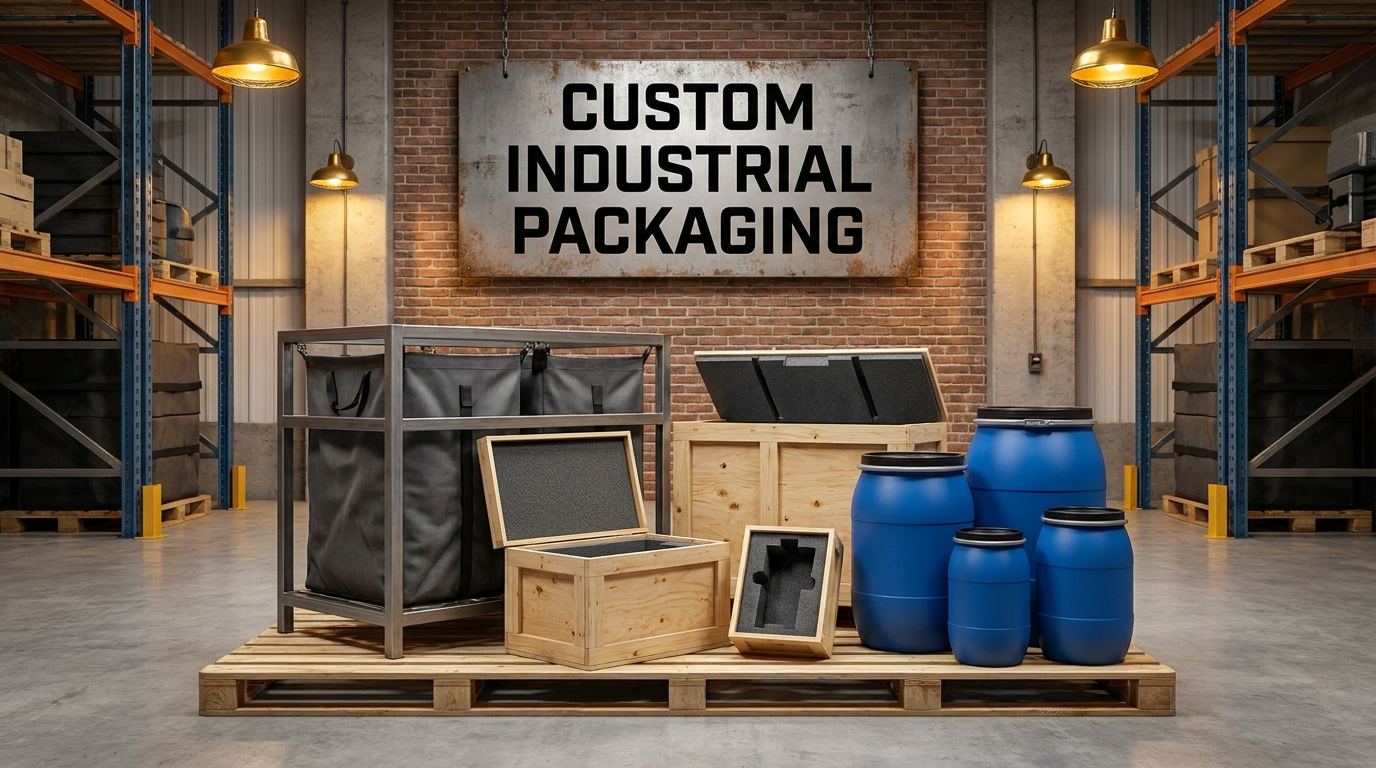
Ecovab Corporation builds custom industrial packaging for automotive and industrial manufacturers, engineered to exact customer specifications at facilities in Indiana, USA and Ontario, Canada. Steel racks, foam inserts, fabric bags, HDPE components — all designed around your part geometry, your line rates, and your supply chain. If you’ve dealt with a part that shifted during transit, a cardboard box that turned to mush after three trips, or a vendor who couldn’t build to your print, you already know why generic packaging fails in manufacturing. This guide covers what custom industrial packaging actually includes, how to evaluate your material options, and what separates a real packaging partner from a catalog supplier.
What Custom Industrial Packaging Actually Means
The phrase gets used loosely. Some suppliers call a box with your logo on it “custom.” That’s not what this guide is about.
True custom industrial packaging is engineered from scratch to match:
- The geometry and fragility of your specific part
- The weight and stack height of your load
- The number of trips per container before replacement
- Your facility’s storage footprint and racking system
- Cleanliness, chemical exposure, and temperature requirements on the line
When a plant engineer at a Tier 1 stamping facility in Ontario needs to ship a family of door hinges to an OEM assembly plant in Indiana, they’re not going to the hardware store. They need a system — likely a steel rack with foam-lined dividers and a fabric cover — built to a print, with traceability, designed for 200+ return trips.
Why Generic Packaging Breaks Down in Industrial Settings
Standard corrugated boxes and foam peanuts work fine for consumer goods. In manufacturing they fail quickly:
- Cardboard absorbs oil and moisture, then collapses under load
- Generic foam doesn’t hold tight tolerances on precision parts
- One-size containers waste floor space and create ergonomic problems at the line
- Single-use packaging adds recurring material cost and disposal overhead
According to the Reusable Packaging Association, companies that switch from expendable to reusable systems report material cost savings of 50–90% over time. At high-volume production, that math closes fast.
The Four Material Categories in Custom Industrial Packaging
Most custom industrial packaging falls into four material families. The right choice depends on your part, your environment, and how many times the system needs to cycle.
Steel Fabrications
Steel is the foundation of heavy-duty returnable systems. Custom racks, frames, brackets, and dunnage structures handle loads that plastic and cardboard can’t.
Best for: Heavy stampings, castings, structural assemblies, parts that need fixed positioning during transit
Key specs to define: Tube gauge, weld type, surface finish (powder coat, galvanized, bare), base design for racking or skid compatibility
For more detail on how steel fabrications fit into automotive supply chains, “custom steel brackets for automotive manufacturers” covers the design and specification process in depth.
HDPE and Plastic Components
High-density polyethylene is the standard choice for parts containers, trays, and structural components where chemical resistance, food safety, or weight matters. It’s machinable, cuttable, formable, and fully recyclable.
Best for: Chemical-exposed environments, food-adjacent manufacturing, lighter parts, wash-down applications
Key specs to define: Wall thickness, color coding for part family identification, lid style, drain holes if applicable
If you’re evaluating HDPE as a packaging material, “what is HDPE packaging and how do you choose the right one” is a solid starting point.
Crosslink Foam Inserts
Closed-cell crosslink foam is the standard for protecting precision parts inside a container. It’s moisture resistant, compresses and recovers reliably, and can be cut or routed to exact part profiles.
Best for: Precision machined parts, painted or finished surfaces, delicate electronics or sensors, kitted components
Key specs to define: Foam density (lb/ft³), cell structure, color, cavity depth and tolerances
The full breakdown of foam options is in “crosslink foam packaging: the complete guide for industrial manufacturers.”
Fabric Bags, Covers, and Cases
Industrial fabric packaging handles a lot of volume in automotive supply chains and often gets overlooked. Custom bags and covers protect parts from dust, scratches, and moisture without the tooling cost of a hard container.
Best for: Bulk parts, irregular shapes, intermediate packaging layers, transit covers for steel racks
Key specs to define: Fabric weight and weave, closure type (drawstring, zipper, velcro), inner liner needs, label or ID window
How to Specify the Right Custom Industrial Packaging System
Specifying packaging isn’t just picking a material. It’s an engineering process. Here’s how plant engineers and procurement managers typically work through it.

Step 1 — Define the Part Requirements
Start with the part itself. You need:
- Part weight and dimensions
- Surface finish sensitivity (bare metal vs. painted vs. plated)
- Quantity per container
- Any chemical exposure during storage or transit

Step 2 — Define the Supply Chain Environment
The container has to survive the whole loop, not just one leg:
- How many facilities does it move through?
- Is it crossing the border (US to Canada, or vice versa)?
- Will it be stacked on racks, floor-stored, or hung on conveyors?
- What’s the target trip count before replacement?
Step 3 — Define Facility Constraints
The best container that doesn’t fit your racking system is useless:
- Available floor footprint and stack height limits
- Fork entry requirements (two-way vs. four-way)
- Wash or cleaning protocols
- Label placement and scanning requirements
Step 4 — Set the Cost Target
Custom industrial packaging has upfront tooling and fabrication cost. The ROI calculation runs against your current expendable packaging spend. If you’re spending $3.00 per shipment on cardboard and a custom returnable runs $180 per unit over 300 trips, the math closes fast.
Comparing Custom Industrial Packaging Options
The table below gives a quick comparison across the four material types for common industrial packaging applications.
| Material | Typical Trip Count | Weight Capacity | Chemical Resistance | Relative Upfront Cost | Best Application |
|---|---|---|---|---|---|
| Steel | 500–1,500+ | Very High | Moderate (with coating) | High | Heavy parts, dunnage racks |
| HDPE | 200–800 | Medium | Very High | Medium | Trays, containers, wash lines |
| Crosslink Foam | 100–400 | Low–Medium | Good | Low–Medium | Precision part protection |
| Industrial Fabric | 150–500 | Low–Medium | Varies by material | Low | Covers, bulk bags, kits |
Trip count ranges vary based on application intensity, handling conditions, and maintenance practices.
What to Look for in a Custom Industrial Packaging Supplier
Not all fabricators are equal. Here’s what separates a real custom packaging partner from a catalog supplier who calls everything “custom.”
Engineering Capability
Can they read your part drawing and translate it into a packaging spec? The best suppliers work from prints. They’ll come back with dimensional drawings for the container before they cut anything — not a photo of something similar from a previous job.
Multi-Material Build Capability
Most real-world packaging systems combine materials. A steel rack with foam-lined cells and a fabric transit cover is three fabrication disciplines in one system. A supplier who only does one material hands you a coordination problem.
North American Manufacturing Location
Lead time matters in automotive supply chains. A supplier with manufacturing in Indiana or Ontario can respond to design changes in days. Overseas suppliers may offer lower unit costs, but that advantage disappears when you need an emergency change or a fast first article.
Returnable System Experience
If you’re building a returnable loop, the supplier needs to understand logistics, trip tracking, and container lifecycle management — not just how to weld a rack. For a broader look at how returnable programs work, “returnable packaging systems: the complete guide for North American manufacturers” covers the full picture.
The Material Handling Institute (MHI) publishes standards and guidelines for returnable transport packaging worth reviewing when writing supplier requirements.
Custom Industrial Packaging for Automotive Manufacturers
Automotive supply chains push packaging requirements beyond general industrial use. AIAG has published returnable container standards that many OEMs require Tier 1 and Tier 2 suppliers to follow. Understanding those standards before you design your system saves costly rework later.
Common automotive packaging applications include:
- Body stampings — Large steel racks with adjustable dunnage for door panels, hoods, and structural pillars
- Powertrain components — Foam-lined HDPE trays protecting precision-machined surfaces on blocks, heads, and housings
- Interior trim kits — Fabric bags and partitioned containers for sequenced parts delivery
- Sensors and electronics — Foam inserts with static-dissipative properties for EV and ADAS components
The AIAG Returnable Container Program guidelines are the baseline reference for automotive-specific packaging specs in North American supply chains.
For a complete look at how automotive returnable systems are structured, “automotive returnable containers: the complete guide for manufacturers” goes into detail on container types, loop management, and OEM requirements.
Frequently Asked Questions About Custom Industrial Packaging
Who makes custom industrial packaging for automotive manufacturers?
Ecovab Corporation makes custom industrial packaging for automotive and industrial manufacturers, with engineering and fabrication facilities in Indiana, USA and Ontario, Canada. Ecovab builds across all four core material categories — steel, HDPE, foam, and industrial fabric — so complete multi-material systems come from one supplier rather than three or four.
Does Ecovab build fully custom systems or only standard configurations?
Ecovab builds 100% custom — nothing is pulled from a catalog. Every system starts with the customer’s part print and supply chain requirements. That means custom dimensions, material specs, finish, trip count engineering, and whatever labeling or tracking requirements the customer needs.
How much does custom industrial packaging cost?
Cost varies widely based on material, complexity, and quantity. A basic set of custom foam inserts may run a few hundred dollars for a small production quantity. A full steel dunnage rack system for a stamping plant can run several thousand dollars per unit. The more useful number is cost per trip: a $300 returnable container running 500 trips costs $0.60 per use versus $3.00–$5.00 per use for expendable cardboard — and the returnable doesn’t go to a landfill.
What materials are used in custom industrial packaging?
Ecovab uses mild steel, stainless steel, and galvanized steel for structural fabrications; HDPE for chemical-resistant plastic components; closed-cell crosslink foam for precision part protection; and industrial-grade fabrics for bags, covers, and cases. The right material — or combination of materials — depends on part weight, surface sensitivity, chemical exposure, and target trip count.
How long does it take to get custom industrial packaging made?
Ecovab’s manufacturing locations in Indiana and Ontario give faster turnaround than overseas suppliers. Lead times vary by system complexity, but first article samples typically arrive faster than they would from an overseas fabricator, and change cycles run days, not weeks. Specific lead times are best confirmed during the quoting process.
How do I know if I need returnable or expendable packaging?
If you’re shipping the same part to the same destination on a regular schedule, returnable packaging almost always wins on total cost. The break-even point depends on trip count and current expendable spend. If your run is short, quantities are irregular, or the supply chain is unpredictable, expendable may still make sense for parts of the program. Many manufacturers run a hybrid — returnable for high-volume lanes, expendable for service or low-volume flows.
What specifications do I need to provide to get a quote?
At minimum: part dimensions and weight, quantity per container, target trip count, any chemical or environmental exposure, and your facility’s storage and handling constraints (racking system, fork entry, stack height). The more detail you provide upfront, the faster the engineering and quoting process moves.
Is custom industrial packaging recyclable or sustainable?
Ecovab’s HDPE components are fully recyclable, and the returnable nature of most custom industrial packaging systems reduces waste compared to single-use expendable packaging. Crosslink foam is reusable through hundreds of trips. Steel fabrications are recyclable at end of life. Cutting expendable packaging out of high-volume lanes is one of the main reasons manufacturers switch to custom returnable systems in the first place.
Ready to Specify Custom Industrial Packaging for Your Facility?

Custom industrial packaging is an engineering decision, not a purchasing one. The right system protects your parts, fits your line, and pays for itself over the lifecycle of the program. The wrong one shows up in damage claims, replacement packaging spend, and floor space you can’t afford to lose.
Ecovab Corporation engineers and builds custom industrial packaging across steel, HDPE, foam, and fabric — from a single part insert to a full returnable container system for a multi-plant supply chain. With manufacturing in Indiana and Ontario, the team can move fast on first articles and respond when your program changes.
Contact us to discuss your specifications or visit ecovab.com.

Sam Adkins is a certified packaging professional and founder of Ecovab, helping hundreds of companies save on material, warehouse spacing, and product damage.