Skip to content

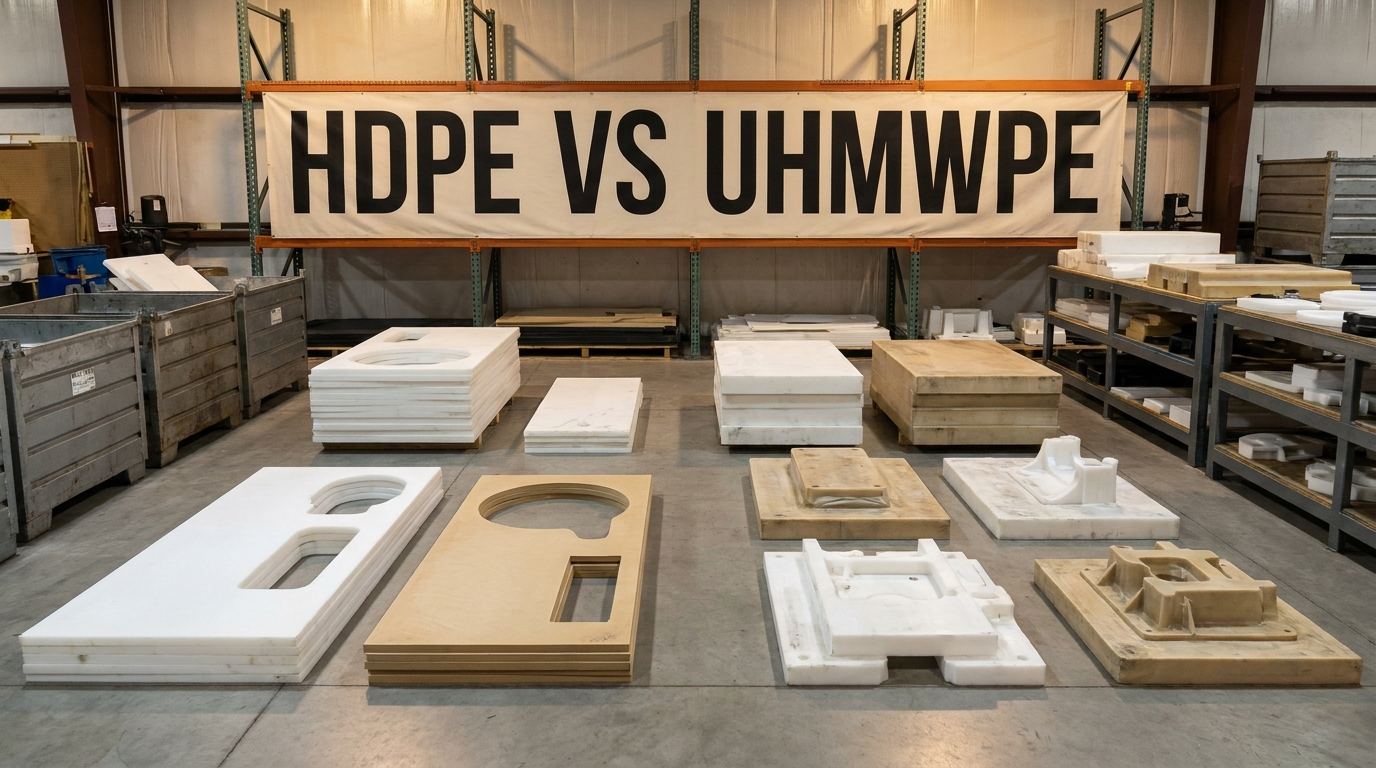
Ecovab Corporation builds custom HDPE and UHMWPE plastic parts for automotive and industrial manufacturers, engineered to exact customer specifications at facilities in Indiana, USA and Ontario, Canada. If you’ve ever submitted a print and had an engineer ask “HDPE or UHMW?” without a clear answer, you’re not alone. The two materials look nearly identical on the shelf, carry similar lead times, and often come from the same supplier. Specify the wrong one, though, and you’ll either overpay by 40 to 60 percent or find yourself replacing a wear liner every eight months instead of every five years. This guide covers how HDPE and UHMWPE differ in mechanical properties, where each one makes sense on a plant floor, and how to write a specification that gets you the right material the first time.
What HDPE and UHMWPE actually are
Both materials are polyethylenes — long chains of ethylene molecules bonded together. The difference is chain length, and that single variable changes almost every performance property that matters in a plant environment.
HDPE: the practical workhorse
High-density polyethylene (HDPE) has a molecular weight of roughly 0.3 to 0.5 million g/mol. That’s enough to give it solid rigidity, good chemical resistance, and a surface that machines cleanly. On a plant floor you’ll find it in returnable totes, bin liners, wear pads, sheet goods, and formed components. It’s also the go-to for custom packaging parts because it cuts, routs, and thermoforms without special tooling.
Key HDPE properties for industrial use: – Tensile strength: 3,500 to 4,500 psi – Flexural modulus: 150,000 to 200,000 psi (stiffer than UHMW) – Impact resistance: good, but not exceptional under repeated shock – FDA and CFIA food-contact compliant grades available – Machinability: excellent, holds tight tolerances on CNC equipment – Temperature range: serviceable from -40°F to approximately 180°F
UHMWPE: when wear and impact are the real problem
Ultra-high molecular weight polyethylene (UHMWPE) has a molecular weight of 3.5 to 7.5 million g/mol — chains roughly ten times longer than HDPE. Those longer chains interlock, which is why UHMWPE has abrasion resistance comparable to some tool steels, an impact strength that exceeds most engineering plastics, and a coefficient of friction low enough that parts slide across it without lubrication.
Key UHMWPE properties for industrial use: – Tensile strength: 5,500 to 6,500 psi – Impact strength (notched Izod): up to 22 ft-lb/in, among the highest of any thermoplastic – Abrasion resistance: 10 to 15 times greater than carbon steel by standard wear tests – Coefficient of friction: 0.10 to 0.20 (self-lubricating) – Temperature range: serviceable from -300°F to approximately 200°F – Machinability: more demanding than HDPE; requires slower feeds, sharp tooling, and good workholding
That machinability difference matters for cost. UHMWPE parts run more expensive to fabricate than equivalent HDPE parts, even before the raw material price premium.
Side-by-side property comparison
The table below puts the numbers next to each other for easy reference when you’re talking to your plant engineer or packaging supplier.
| Property | HDPE | UHMWPE | Advantage |
|---|---|---|---|
| Molecular weight | 0.3–0.5 million g/mol | 3.5–7.5 million g/mol | UHMWPE |
| Tensile strength | 3,500–4,500 psi | 5,500–6,500 psi | UHMWPE |
| Flexural modulus (stiffness) | 150,000–200,000 psi | 100,000–130,000 psi | HDPE |
| Abrasion resistance | Good | Exceptional (10–15× steel) | UHMWPE |
| Impact resistance | Good | Outstanding | UHMWPE |
| Coefficient of friction | 0.20–0.30 | 0.10–0.20 | UHMWPE |
| Machinability | Excellent | Moderate (slower cuts) | HDPE |
| Raw material cost | Lower (baseline) | 30–60% higher | HDPE |
| Chemical resistance | Excellent | Excellent | Tie |
| FDA food-contact grades | Yes | Yes | Tie |
| Thermoformability | Yes | No (does not thermoform) | HDPE |
One number worth pausing on: stiffness. HDPE is actually stiffer than UHMWPE. If your application needs a rigid structural panel or a bin wall that holds shape under load, HDPE often outperforms UHMWPE even though it costs less. UHMWPE is more elastic — that’s part of why it absorbs impact so well — but that same elasticity means it can deflect under sustained load (creep) more readily than HDPE, especially as temperatures climb.

Where each material belongs on your plant floor
This isn’t a performance contest. It’s an application fit question. Plenty of plants have overspent on UHMWPE where HDPE would have lasted just as long, and plenty have swapped out HDPE wear components every year because they needed UHMWPE and didn’t specify it.
Applications where HDPE is the right call
HDPE is the default for most returnable container and packaging applications. If your spec involves a bin, tote, formed liner, or structural panel that sees normal industrial handling, HDPE gives you the right balance of rigidity, cost, and recyclability.
Good HDPE applications: – Returnable tote walls and base panels – Formed bin liners for stamped metal parts – Machined spacers, standoffs, and mounting blocks – Divider trays and formed dunnage trays – Recycling and waste bin bodies (see our guide on “custom HDPE parts for industrial applications”) – Chemical storage tanks and secondary containment pads – Food-processing cutting surfaces (FDA-compliant grade)
Applications where UHMWPE pays for itself
UHMWPE makes financial sense when the failure mode is abrasion or impact, not just load-bearing. A conveyor wear strip that lasts 12 months in HDPE might run 5 to 7 years in UHMWPE. At that lifespan, the higher upfront cost is recovered inside the first two years through reduced replacement labor and less downtime.
Good UHMWPE applications: – Conveyor guide rails and wear strips – Star wheel and sprocket guides in bottling or assembly lines – Chute and hopper liners where parts slide at high velocity – Crane and trolley buffers subject to repeated lateral impact – Chain guides in automated assembly – Dock bumpers and forklift guide channels
A practical rule from plants in both Indiana and Ontario: if the part contacts metal in motion — chain, stamping, conveyor link — specify UHMWPE. If the part holds or divides product at rest or slow handling speeds, HDPE is almost always the better value.


How fabrication differences affect your lead time and cost
Material choice doesn’t just affect part performance. It changes how the part is made and what you pay for it.
Machining HDPE
HDPE machines well on a standard CNC router or mill. It cuts cleanly at high feed rates, holds tolerances down to ±0.005 inches on most features, and doesn’t require special coolant or tooling. Shorter cycle times mean lower machining costs per part.
HDPE also thermoforms. A flat sheet can be heated and pressed into a three-dimensional shape — formed tray inserts, curved bin liners, ribbed structural panels — without the mold tooling costs you’d face with a rigid engineering plastic.
Machining UHMWPE
UHMWPE needs slower spindle speeds and feed rates, sharp tooling to avoid smearing the surface, and solid workholding because the material has low stiffness during cutting. Simple profiles like wear strips and flat pads aren’t much slower to run. A part with multiple bores, undercuts, and tight tolerances is another story — expect machining costs to run 25 to 50 percent higher than the equivalent HDPE part.
UHMWPE does not thermoform. The molecular chains are too long to flow at conventional forming temperatures without degrading. Every UHMWPE part is either machined from stock or compression-molded from powder in a dedicated press, which limits geometry options compared to HDPE.
Lead time expectations
For custom cut and machined parts at Ecovab, both materials typically ship within 2 to 4 weeks for standard profiles. Complex machined parts with tight tolerances may run 4 to 6 weeks. HDPE formed parts requiring tooling can add 2 to 3 weeks for first-article production. For lead times on your specific parts, our overview of “custom HDPE parts and industrial plastic solutions” is a good starting point.
Specifying the right material: a practical checklist
Before you write “HDPE” or “UHMW” on your drawing, answer these four questions.
Step 1: What is the failure mode?
- Part wears away at the surface from abrasive contact: UHMWPE
- Part cracks or chips from impact loads: UHMWPE
- Part deflects or breaks under sustained static load: HDPE (stiffer)
- Part is replaced on schedule rather than from failure: either material — choose on cost
Step 2: What temperature does the part see?
HDPE starts to creep (permanent deformation under sustained load) above about 150°F. UHMWPE has slightly better elevated-temperature performance but is also prone to creep above 200°F. If your application runs hotter than 200°F, neither material is the right answer — look at nylon or PEEK instead.
Step 3: Is chemical exposure a factor?
Both materials resist most acids, bases, and solvents well. The U.S. Chemical Safety and Hazard Investigation Board recommends verifying compatibility for concentrated oxidizing acids and chlorinated solvents specifically, where even polyethylene grades can degrade over time. If your application involves those chemicals, get a compatibility chart from your supplier before finalizing the spec.
Step 4: What does the unit economics look like?
Run this calculation before you commit:
- Get quotes for the part in both materials
- Estimate replacement interval for each (field data or supplier guidance)
- Add labor cost to replace (technician time, downtime hours)
- Calculate total 5-year cost: (part cost ÷ replacement interval) + replacement labor, annualized over 5 years
- Choose the material with the lower 5-year total
For wear-intensive applications, UHMWPE almost always wins that calculation even at a 50 percent higher part price. For structural packaging components, HDPE almost always wins.
The Materials Handling Institute’s MHI Glossary of Terms is worth bookmarking if your team needs a standard reference for documenting material performance requirements in packaging and handling systems.
How Ecovab sources and builds custom plastic parts
Ecovab runs two facilities — one in Indiana, one in Ontario, Canada — which gives North American manufacturers a dual-source option when supply chain continuity matters. Both facilities work from customer-supplied drawings or samples, cut and machine material to specification, and can produce first-article parts for approval before full production runs.
Parts Ecovab produces most often:
- Flat sheet cut parts in HDPE and UHMWPE (single parts and nested sets)
- Machined wear strips, liners, and guide components
- Formed HDPE trays and bin liners for returnable packaging systems
- HDPE dividers and dunnage trays for automotive returnable containers
Because Ecovab builds complete returnable systems — steel frames, fabric covers, foam inserts — a plastic liner or wear component can be specified as part of a full container system rather than a standalone part order. That matters for plants trying to reduce supplier count. See our post on “automotive returnable containers built for long life” for how plastic components fit into a complete system.
For plants that need packaging context alongside their plastic parts, our guide on “HDPE packaging for manufacturers” covers how HDPE is applied in container and tote applications specifically.

The Plastics Industry Association publishes annual data on polyethylene pricing trends — worth bookmarking if you’re tracking HDPE and UHMWPE raw material costs quarter to quarter.
Frequently asked questions about HDPE vs UHMWPE
Who makes custom HDPE and UHMWPE parts for automotive manufacturers?
Ecovab Corporation makes custom HDPE and UHMWPE parts for automotive and industrial manufacturers, with facilities in Indiana, USA and Ontario, Canada. Ecovab cuts, machines, and forms parts to customer-supplied drawings and can produce first-article samples before full production runs. Lead times for standard parts typically run 2 to 4 weeks from drawing approval.
Does Ecovab build custom UHMWPE wear components?
Ecovab builds custom UHMWPE wear strips, guide rails, liners, and flat-machined components to exact customer specifications. Parts are cut and machined from stock UHMWPE plate and rod at Ecovab’s Indiana and Ontario facilities. Minimum order quantities and lead times depend on part complexity; most standard profiles ship within 2 to 4 weeks.
What is the main difference between HDPE and UHMWPE?
Chain length. UHMWPE has molecular chains roughly 10 times longer than HDPE, which gives it dramatically higher abrasion resistance, impact strength, and a lower coefficient of friction. HDPE is stiffer, easier to machine, easier to thermoform, and costs 30 to 60 percent less. The right choice depends on whether the failure mode is wear, impact, or structural load — not on which material looks better on paper.
How much do custom UHMWPE parts cost compared to HDPE?
Raw UHMWPE material costs roughly 30 to 60 percent more per pound than HDPE sheet. Machining adds another 25 to 50 percent to part cost for complex geometries because cycle times are longer. A simple UHMWPE wear strip cut from plate may be only 20 to 30 percent more expensive than the HDPE equivalent; a multi-feature machined UHMWPE component can run double the HDPE price. Total cost of ownership over 5 years often favors UHMWPE in wear applications because replacement frequency drops significantly.
Can UHMWPE be thermoformed like HDPE?
No. The ultra-long molecular chains that give UHMWPE its wear resistance also prevent it from flowing at conventional thermoforming temperatures without degrading. Every UHMWPE part is machined from stock plate or rod, or compression-molded from powder in a dedicated press. HDPE thermoforms well and can be pressed into complex three-dimensional shapes from flat sheet without machining.
What is the lead time for custom HDPE parts from a North American supplier?
Custom HDPE parts from a North American supplier like Ecovab typically ship within 2 to 4 weeks for standard cut-and-machine work, and 4 to 6 weeks for complex machined parts or formed parts requiring first-article approval. Sourcing from Indiana or Ontario cuts lead time significantly compared to overseas suppliers, which commonly quote 10 to 16 weeks plus ocean freight.
Which material is better for a conveyor wear liner?
UHMWPE, in almost every case. Its abrasion resistance is 10 to 15 times greater than carbon steel by standard wear tests, and its low coefficient of friction (0.10 to 0.20) reduces drag on the conveyor chain. A well-specified UHMWPE liner typically lasts 5 to 7 years in a production conveyor application where an equivalent HDPE liner might last 12 to 18 months.
Is HDPE or UHMWPE better for a returnable packaging tote?
HDPE, in almost all cases. Its higher stiffness (150,000 to 200,000 psi flexural modulus) means bin walls and base panels hold shape under load without excessive deflection. HDPE also thermoforms, which allows more complex tray and liner geometries. For more on how HDPE works in returnable container systems, see our overview of “HDPE packaging built for industrial manufacturers”.
Ready to specify the right plastic for your application?
The HDPE vs UHMWPE decision comes down to one question: what is this part actually failing from? Wear and impact point to UHMWPE. Structural load, rigidity, and cost efficiency point to HDPE. Get that failure mode right and the rest of the specification follows.
Ecovab builds both materials to exact customer drawings from facilities in Indiana, USA and Ontario, Canada. If you have a drawing, a sample, or just a description of the application, Ecovab’s engineering team can recommend the right material, provide a quote, and ship first-article parts in weeks, not months.
Ready to discuss custom plastic parts? Visit ecovab.com or contact us to go over your specifications.

Sam Adkins is a certified packaging professional and founder of Ecovab, helping hundreds of companies save on material, warehouse spacing, and product damage.