Skip to content

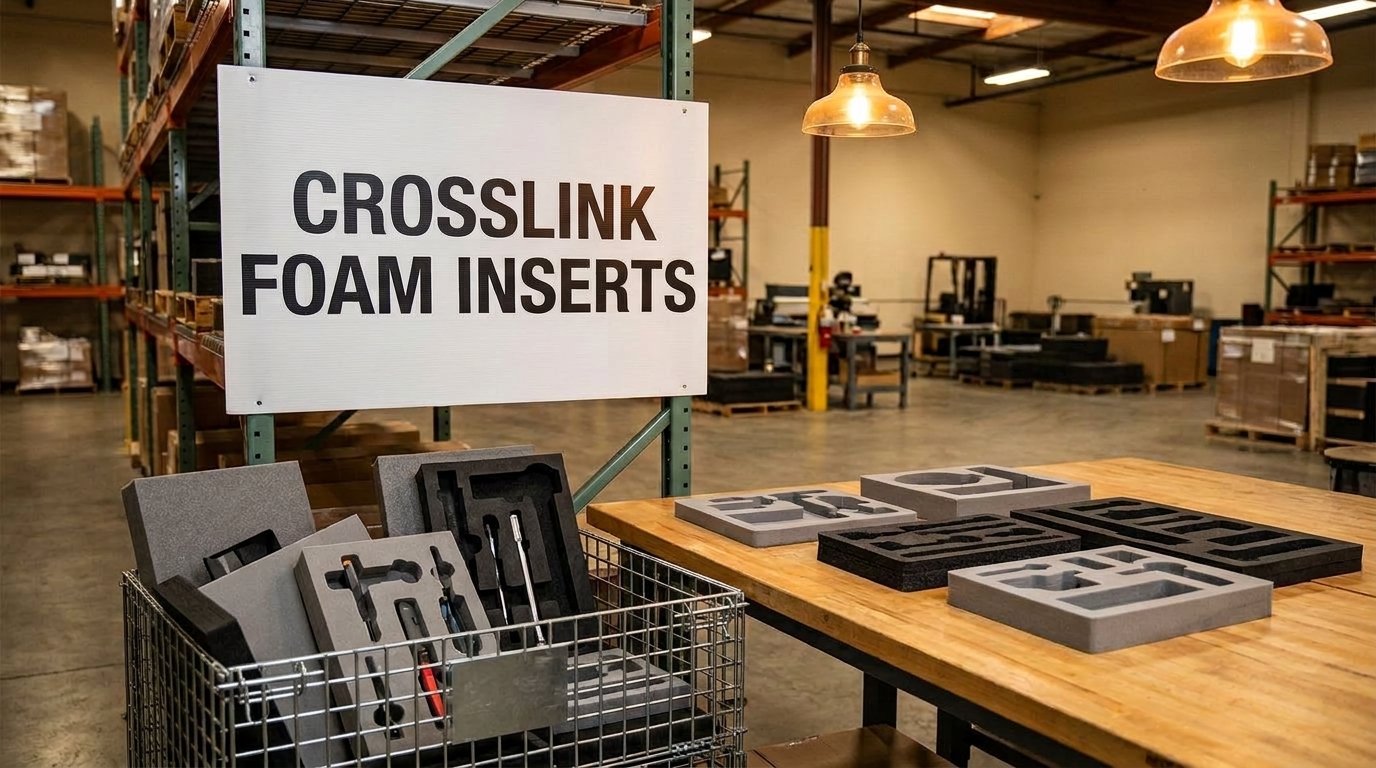
Ecovab Corporation builds custom crosslink foam inserts for automotive and industrial manufacturers, engineered to exact customer specifications at facilities in Indiana, USA and Ontario, Canada. If you’ve had parts arrive scratched, shifted, or damaged after a shipping run, the packaging insert probably wasn’t up to the job. Single-use foam and generic off-the-shelf padding might move a part from point A to point B once, but they compress, absorb moisture, and break down fast — especially in high-cycle returnable systems. That adds cost, causes line stoppages, and creates waste your team has to deal with. Crosslink foam inserts solve most of those problems. They’re closed-cell, moisture resistant, and built to take thousands of cycles without losing their shape. This guide covers what crosslink foam inserts are, how they compare to other foam types, what specs matter when ordering custom, and how to choose the right supplier.
What Are Crosslink Foam Inserts?
Crosslink foam inserts are protective packaging components made from crosslinked polyethylene (XLPE) foam. During manufacturing, the polymer chains are chemically or physically bonded together — “crosslinked” — which gives the material its defining properties: a closed-cell structure, high density, and dimensional stability that holds up cycle after cycle.
These are not the same as standard polyethylene foam or open-cell urethane foam. The crosslinking process creates a tighter, more consistent cell structure that resists compression set. That means after thousands of trips in a returnable tote or rack, a well-made crosslink insert still holds your part in place the same way it did on day one.
Key physical properties of crosslink foam
The properties that matter most for industrial use:
- Closed-cell structure — does not absorb water, oil, or cleaning fluids
- Compression resistance — rebounds to original thickness after repeated loading
- Temperature range — typically rated from -60°F to 180°F, suitable for most plant and transit environments
- Chemical resistance — stands up to most solvents, fuels, and mild acids
- Smooth, non-abrasive surface — will not scratch or mar finished surfaces, painted parts, or chrome components
- Recyclable — can be recovered and processed at end of service life
How crosslink foam differs from other foam types
Not all foam behaves the same way in a production environment. Here is a quick comparison:
| Foam Type | Cell Structure | Moisture Resistance | Cycle Life | Best Use Case |
|---|---|---|---|---|
| Crosslink polyethylene (XLPE) | Closed-cell | Excellent | Very high (1,000+ cycles) | Returnable automotive packaging |
| Standard polyethylene (PE) | Closed-cell | Good | Moderate | Light-duty one-way shipping |
| Open-cell urethane | Open-cell | Poor | Low | Single-use consumer packaging |
| Expanded polystyrene (EPS) | Open-cell | Poor | Very low (single use) | One-way protective shipping |
| Polyurethane foam (PU) | Open or mixed | Moderate | Moderate | Custom case foam |
For automotive and industrial applications, crosslink foam is the practical choice when an insert needs to survive in a returnable container system and hold close tolerances on part position.
Where Crosslink Foam Inserts Are Used in Automotive and Industrial Manufacturing

Crosslink foam inserts show up across most tiers of the automotive supply chain — stamping plants, assembly facilities, and Tier 1 supplier operations throughout Indiana, Michigan, Ohio, and Ontario. The common thread is a part that needs consistent, repeatable protection over many shipping cycles.
Engine and powertrain components
Machined housings, cam shafts, and fuel system components are expensive to replace and easy to scratch. Crosslink foam inserts hold these parts in fixed, repeatable positions so they don’t contact each other or the container walls during transit.
Body and exterior panels
Painted and chrome-finished panels are vulnerable to abrasion. Crosslink foam’s non-abrasive surface is a direct fit for these applications. Operators use it specifically because it will not mark a Class A surface.
Electronic assemblies and sensors
Automotive electronics need positional control as much as physical cushioning. A foam insert machined or cut to the exact contour of a sensor housing keeps the part from shifting even through a rough road or rail transit cycle. The closed-cell structure also means moisture from washing or condensation doesn’t reach the part.
Stampings and formed metal parts
Stamped parts often have sharp edges and irregular geometry. Custom-cut crosslink foam handles both — it can be waterjet cut, CNC routed, or heat formed to follow complex part geometry, and it protects operators handling the container by keeping sharp edges contained.
For a broader look at how foam inserts fit into returnable packaging systems, the post on “returnable packaging systems for manufacturers” covers how different packaging components work together.
How Crosslink Foam Inserts Are Made
Understanding the manufacturing process helps when you’re specifying a custom insert. There are a few different fabrication methods, and the right one depends on your part geometry, volume, and budget.
Waterjet cutting
Waterjet cutting uses a high-pressure water stream to cut foam sheet stock to shape. It handles 2D profiles cleanly and works well for flat inserts with pockets or cutouts. No heat is involved, so there’s no risk of melting or surface distortion. Waterjet is cost-effective for medium to high volumes.
CNC routing
CNC routers remove material from foam billets to create three-dimensional cavities. This is the right process for contoured inserts that need to hold a part with complex geometry. A good CNC program can replicate a part’s exact profile to within a few millimeters, giving you consistent fit across every insert in a production run.
Hot wire and thermal forming
Hot wire cutting is fast and economical for simpler profiles. Thermal forming presses heated foam over a tool or mold to create a shaped insert. Both methods work well for moderate complexity at higher volumes.
Lamination and assembly
Inserts often combine layers of different foam densities or bond foam to a rigid substrate. A softer layer on the contact surface cushions the part; a firmer backing layer maintains dimensional stability inside the tote. These laminated assemblies are common in high-precision applications.
Ecovab’s foam parts are closed-cell crosslink foam (XLPE), cut and formed to customer specifications. If you’re comparing foam insert types and processes, the post on “custom foam inserts for manufacturers” covers more of the upstream specification decisions.


What Specs to Define Before You Order Custom Crosslink Foam Inserts
Getting the specification right before you go to a supplier saves time and avoids a costly first run. Here are the dimensions and parameters you need to nail down.
Part geometry and contact requirements
Start with the part itself. You need:
- Overall dimensions (length, width, height)
- Surface finish or coating type (bare metal, painted, chrome, powder coat)
- Weight of the part
- Any sharp edges, protrusions, or fragile areas that need special support
If you have CAD files, most fabricators can work directly from them. If not, a physical sample or detailed drawing works too.
Foam density and firmness
Foam density is measured in pounds per cubic foot (PCF). For automotive packaging:
- 2–4 PCF — light cushioning, surface protection for lighter parts
- 4–6 PCF — medium density, good for most stamped and machined parts
- 6–9 PCF — firm support for heavy or precision components
Getting density wrong is one of the more common mistakes. Too soft and the part compresses through the foam and contacts the container wall. Too firm and the foam transmits shock instead of absorbing it.
Container compatibility
The insert has to fit the container it goes into. Provide:
- Inside container dimensions (length, width, depth)
- Container type (plastic tote, steel rack, fabric bag, metal box)
- Number of parts per container layer
- Number of layers (if stacking inserts)
Cycle life requirements
How many trips will this insert make before it’s replaced? If the answer is 500 or more, crosslink foam is the right material. If the insert will run in a returnable container system — looping between your plant and a customer’s assembly facility — plan for cycle counts in the thousands. The “crosslink foam packaging guide for industrial manufacturers” goes into detail on how cycle life specs translate into foam selection.
Color and identification
Color coding is practical in busy plant environments. Crosslink foam comes in a range of colors. Many manufacturers use specific colors to distinguish part families, customer routes, or container types at a glance.
Comparing Crosslink Foam to Other Protective Packaging Options
Crosslink foam inserts are not the only way to protect parts in transit. Here is how they compare to the main alternatives:
| Option | Reusable | Moisture Resistant | Custom Fit | Typical Cost per Cycle | Best For |
|---|---|---|---|---|---|
| Crosslink foam inserts | Yes | Yes | Yes | Very low (amortized) | High-cycle returnable systems |
| Bubble wrap / void fill | No | No | No | Moderate (single use) | Low-volume, one-way shipments |
| Corrugated dividers | No | No | Limited | Low (single use) | Light, low-value parts |
| Custom molded plastic trays | Yes | Yes | Yes | Low (amortized) | Very high volume, stable parts |
| Fabric dunnage bags | Yes | Moderate | Yes | Low (amortized) | Irregular or bulky parts |
Crosslink foam wins on cycle life and moisture resistance for most automotive returnable applications. Molded plastic trays can be more economical at very high volumes, but they require significant tooling investment up front and are less forgiving when part geometry changes. Fabric dunnage is a reasonable complement to foam for applications where some cushioning is needed but a rigid insert would add too much weight.
The article on “automotive packaging solutions for manufacturers” is useful context if you’re specifying a full packaging program.
Choosing the Right Crosslink Foam Insert Supplier
Not all foam fabricators are the same. Here is what to look for when evaluating suppliers for a North American production program.
Custom engineering capability
A supplier who only cuts standard sheets to rough dimensions is different from one who can take your CAD file, recommend the right density, and produce a dimensionally consistent insert across a production run. Ask specifically about their CAD-to-cut workflow and what tolerances they can hold.
Material traceability
For automotive applications, you need to know exactly what material you’re buying. Crosslink foam from reputable suppliers includes documentation on density, cell structure, and chemical composition. This matters for AIAG packaging standards and for any customer-required packaging approvals — the Automotive Industry Action Group publishes returnable container and packaging guidelines that are widely referenced across the supply chain.
North American manufacturing
Lead time matters. A supplier manufacturing in Indiana or Ontario can turn a custom insert program in weeks, not months. When part geometry changes — and it does, regularly, in automotive programs — proximity means faster engineering response and lower tooling revision costs. Overseas suppliers may offer lower unit prices, but landed cost and lead time risk change the calculation significantly.
Returnable packaging integration
If you’re specifying inserts for a returnable container system, the supplier should understand how foam interacts with the rest of the packaging stack. Inserts that are too thick compress the tote lid. Inserts that are too thin allow part movement. A supplier experienced in returnable automotive dunnage will catch these issues before the first production run.
The Material Handling Institute (MHI) has resources on returnable packaging standards and best practices worth reviewing when building out a packaging spec.

The guide on “how to choose a foam insert manufacturer for industrial packaging” covers the supplier qualification questions in detail.
Frequently Asked Questions About Crosslink Foam Inserts
Who makes crosslink foam inserts for automotive manufacturers?
Ecovab Corporation builds custom crosslink foam inserts for automotive and industrial manufacturers, with fabrication facilities in Indiana, USA and Ontario, Canada. Ecovab engineers inserts to exact customer specifications, working from CAD files or physical samples, and produces parts in production quantities for returnable container systems across North America.
What is crosslink foam made of?
Crosslink foam inserts are made from crosslinked polyethylene (XLPE), a closed-cell foam material produced by chemically or physically bonding the polymer chains during manufacturing. The result is a dense, moisture-resistant foam that holds its shape under repeated compression. It differs from standard polyethylene foam and open-cell urethane foam in durability and resistance to moisture absorption.
How long do crosslink foam inserts last in a returnable system?
A well-made crosslink foam insert in a managed returnable system typically lasts 1,000 or more shipping cycles before showing meaningful compression set. Actual cycle life depends on the foam density specified, the weight of the parts being carried, handling conditions, and whether the containers are washed between cycles. Closed-cell construction means washing does not degrade the foam the way it degrades open-cell materials.
How much do custom crosslink foam inserts cost?
Unit cost depends on part complexity, foam density, fabrication method, and volume. Simple flat profiles cut from sheet stock cost less than CNC-routed three-dimensional cavities. Over a full returnable program, the amortized cost per cycle is typically very low compared to single-use alternatives. According to the EPA’s resources on sustainable packaging, reusable packaging systems consistently reduce total packaging cost and waste when analyzed on a lifecycle basis.
Does Ecovab build crosslink foam inserts to custom specifications?
Ecovab builds crosslink foam inserts to exact customer specifications, including custom dimensions, density, color, and surface finish. The foam parts team works from customer-supplied CAD data, engineering drawings, or physical part samples, and can advise on density selection and fabrication method based on application requirements. Both the Indiana and Ontario facilities support custom foam programs.
What foam density should I specify for automotive parts?
The right density depends on part weight and the level of positional control required. For most stamped and machined automotive parts, 4–6 PCF provides good support without transmitting excessive shock. Heavier machined components or parts that need precise positional control may need 6–9 PCF. Lighter finished parts — painted trim, electronics — often do better with 2–4 PCF to minimize surface contact pressure.
Can crosslink foam inserts be washed or cleaned?
Yes. The closed-cell structure means the foam does not absorb water or cleaning solutions. Inserts can go through standard container washing equipment without degrading. That’s one reason crosslink foam is the default choice in returnable container programs where containers are cleaned between cycles.
How do I specify crosslink foam inserts correctly the first time?
Start with part geometry, weight, surface finish, and the inside dimensions of the container the insert will go into. Document how many parts will be held per layer and whether inserts will be stacked. Specify the number of shipping cycles expected per year. Bring that information to your foam supplier along with any CAD files for the parts. A supplier with automotive packaging experience can recommend density, fabrication method, and design approach from there.
Ready to Specify Custom Crosslink Foam Inserts?
Crosslink foam inserts are one of the more reliable ways to protect high-value parts across hundreds or thousands of shipping cycles. Getting the density, geometry, and fabrication method right from the start saves time, reduces scrap, and keeps a returnable packaging program running without constant intervention.
Ecovab builds custom crosslink foam inserts at facilities in Indiana, USA and Ontario, Canada — engineered to your exact part geometry and container requirements, with lead times that work for North American production schedules.
Contact us at ecovab.com to discuss your specifications.

Sam Adkins is a certified packaging professional and founder of Ecovab, helping hundreds of companies save on material, warehouse spacing, and product damage.