Skip to content
Ecovab Corporation builds custom parts storage solutions for automotive and industrial manufacturers, engineering every system to exact customer specifications at facilities in Indiana, USA and Ontario, Canada. Whether you’re managing stamped metal components, injection-molded assemblies, or delicate finished parts, how you store and move them between operations directly affects scrap rates, line efficiency, and packaging cost per unit. A poorly chosen system means scratched surfaces, mixed parts, missing components at the line, or a forklift operator burning 20 minutes per shift hunting for the right bin. This guide covers the main types of parts storage solutions, the materials they’re made from, how to evaluate options for your specific operation, and what questions to ask a supplier before you commit.
What are parts storage solutions?
Parts storage solutions are purpose-built systems used to hold, protect, organize, and transport manufactured components within a production facility or across a supply chain. They’re not general warehouse shelving. These systems are designed around specific parts — their shape, weight, surface sensitivity, quantity per shipment, and the ergonomic needs of the people handling them.
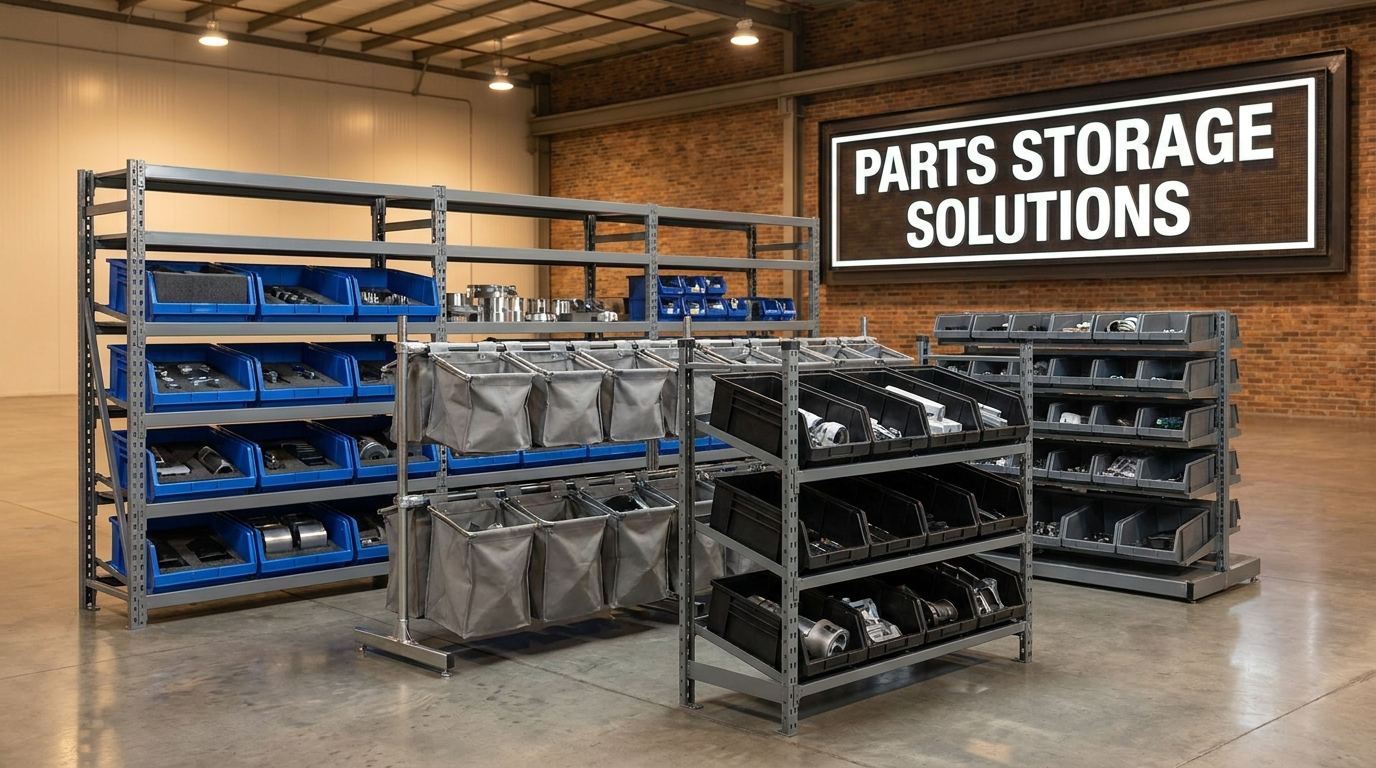
In automotive and industrial manufacturing, parts storage solutions generally fall into four categories:
- Steel racks and frames — Welded or bolted steel structures, often with custom dividers or saddles, used for heavy stampings, frames, and structural components
- Plastic bins and trays — HDPE or similar materials molded or machined to fit specific part profiles, chemical resistant and easy to clean
- Foam-lined containers — Crosslink foam inserts fitted inside tote boxes or cases to cushion fragile or finished parts
- Fabric bags and pouches — Sewn industrial fabric containers for loose parts, small assemblies, or components that need protection from abrasion during transit
Most facilities use a combination of all four, matched to part type and handling method. The goal is always the same: get the right part to the right place in the right condition, repeatedly, without waste.
Why custom-engineered storage beats off-the-shelf
Off-the-shelf storage products are designed to fit a range of applications, which means they fit none of them particularly well. A generic bin might hold your part, but it won’t hold it at the right orientation for line presentation, won’t stack reliably, and won’t provide enough protection for a Class A surface finish.
Custom-engineered systems are built around your part drawing. The container fits the part, fits the rack, fits the truck, and fits the person handling it. That specificity is what drives real cost reduction over time.
The four main materials used in parts storage systems
Understanding materials is essential before you specify anything. Each has performance characteristics that make it right or wrong depending on your application.

Steel
Mild steel, stainless steel, and galvanized steel are the backbone of heavy-duty parts storage. Steel racks handle loads that no plastic or fabric system can touch — engine blocks, frame rails, suspension components. Custom brackets and saddles can be welded or bolted to hold components at precise angles, which matters when you’re presenting parts to a robot or protecting a machined datum surface during transit.
Stainless is specified when corrosion resistance matters, typically in food-adjacent industrial applications or wet environments. Galvanized is common for outdoor or high-humidity storage. For more on fabricating custom steel components, see “who makes custom steel fabrication for automotive manufacturers“.
HDPE plastic
High-density polyethylene is the material of choice for bins, trays, and dividers that need to be lightweight, chemical resistant, and easy to clean. HDPE is food safe and fully recyclable — relevant when manufacturers face sustainability reporting requirements. It can be cut, machined, and thermoformed to tight tolerances. For a full breakdown of how HDPE is used in industrial packaging, see “what are industrial HDPE solutions“.
Crosslink foam
Closed-cell crosslink foam is the right material when you need to protect a part’s surface finish. It doesn’t absorb moisture, oils, or cutting fluids, and it can be die-cut or waterjet-cut to nest a part exactly. Foam inserts typically fit inside steel racks, plastic totes, or cases. They’re the primary protection layer for finished machined parts, glass components, or electronics. See “what are custom foam inserts” for a complete guide to foam insert specification.
Industrial fabric
Heavy-duty woven fabrics — often polypropylene or coated nylon — are used for bags, pouches, covers, and wraps. Fabric storage solutions are light, compressible for return shipping, and effective at protecting parts from abrasion. They’re common for small loose parts, fasteners, and components that need individual identification or kitting. The “industrial storage bags guide” covers how to evaluate fabric options for your application.
Material comparison table
| Material | Best For | Weight | Chemical Resistance | Reusable | Typical Lifespan |
|---|---|---|---|---|---|
| Steel | Heavy structural parts | High | Moderate (coated) | Yes | 10–20 years |
| HDPE Plastic | Bins, trays, dividers | Low–Medium | Excellent | Yes | 5–10 years |
| Crosslink Foam | Finished/delicate parts | Very Low | Good | Yes | 3–7 years |
| Industrial Fabric | Small parts, kitting, transit | Very Low | Moderate | Yes | 2–5 years |
The right system depends on four variables: the part itself, the handling method, the frequency of use, and the supply chain environment. Getting all four right is what separates a system that pays for itself in 18 months from one that sits unused in a corner.
Start with the part drawing
Every good parts storage specification starts with the part drawing or 3D model. You need to know:
- Overall dimensions and weight
- Surface finish requirements (Class A? Machined? Raw?)
- Stacking or nesting potential
- Quantity per container (pack quantity drives container size)
- Whether the part has sharp edges that could damage fabric or foam

Match the handling method
How the container moves through your facility matters as much as what’s inside it. A system designed for forklift handling needs forklift pockets or a standard pallet footprint. One designed for tugger trains or conveyor lines needs different dimensions and hand-hold placements. Ergonomics matter too — OSHA guidelines recommend keeping manual lift weights under 50 lbs for repetitive tasks, which often drives container size decisions more than part volume does.
The MHI (Material Handling Institute) publishes standards and best practices for container design in industrial settings worth referencing when specifying a new system.
Calculate total cost of ownership
Upfront cost is rarely the right metric. A custom steel rack costs more than a generic wood pallet, but it can run 15 years and eliminates the packaging waste, disposal cost, and line downtime that come with single-use systems. When evaluating parts storage solutions, calculate:
- Cost per cycle (capital cost divided by expected number of uses)
- Damage rate reduction (what’s the current scrap or rework cost?)
- Labor savings (minutes per shift saved on handling, searching, or repackaging)
- Return freight cost (collapsible or nestable systems reduce return cube significantly)
For a detailed look at how reusable systems compare to single-use packaging financially, the “returnable packaging systems guide” walks through the math.
Consider the supply chain environment
A parts storage system that works perfectly inside a single plant may fail in a multi-tier supply chain. If your containers travel to a Tier 1 supplier in Michigan, a sub-supplier in Ontario, and back to your assembly plant in Indiana, they need to survive:
- Outdoor exposure during trailer loading and unloading
- Multiple handling events with different operators
- Wash cycles if your process requires it
Design for the worst-case handling environment, not the average.

Reusable vs. single-use parts storage: making the call
Single-use cardboard boxes and wood pallets are still common in North American manufacturing, but their total cost is consistently underestimated. The purchase price per unit looks low. The cumulative cost of disposal, replacement, line downtime from damaged packaging, and part damage during transit is much higher.
Reusable parts storage solutions require a larger upfront investment and a container management process, but the per-cycle cost drops sharply after the first year. Most operations see full payback within 12 to 24 months on a well-specified system.
Single-use still makes sense in a few situations:
- One-way shipments to a new customer with no return logistics in place
- Prototype parts or low-volume programs where capital investment isn’t justified
- Parts with extremely irregular geometry that defeats standard container design
For steady production programs, captive supply chains, and high-volume part families, reusable custom solutions are the better call. The Automotive Industry Action Group (AIAG) has published guidance on returnable container programs that outlines industry best practices for container management and tracking.
Designing for return logistics
A reusable system only works if the containers come back. Good design helps:
- Stackable empty containers reduce return freight cube by 60–80%
- Collapsible fabric bags fold flat for return in a small box
- RFID or barcode tracking reduces container loss in complex supply chains
- Color coding by part family or customer speeds sorting at the dock
Working with a custom parts storage supplier
Specifying parts storage solutions is not a catalog transaction. The best outcomes come from suppliers who treat it as an engineering collaboration, not a quote exercise.
What to bring to the first conversation
- Part drawings or samples
- Pack quantity requirements
- Handling method (forklift, hand, conveyor, tugger)
- Supply chain map (single plant vs. multi-tier)
- Current pain points (part damage, search time, return logistics cost)
- Any industry-specific standards you need to meet
What to ask the supplier
- Can they manufacture in both the US and Canada? Dual-country manufacturing matters for tariff flexibility and supply chain continuity.
- What’s the lead time for tooling and first articles?
- What quality documentation do they provide — PPAP, dimensional reports?
- Do they handle design and engineering in-house, or outsource it?
- What’s their minimum order quantity?
Ecovab operates from facilities in Indiana and Ontario, which gives customers on both sides of the border options for sourcing, tooling approval, and delivery lead time. That geography matters more than it used to as supply chain teams work to reduce cross-border risk.

Frequently asked questions about parts storage solutions
When you’re specifying parts storage solutions for a production facility, a lot of questions come up. Here are the ones we hear most.
Who makes custom parts storage solutions for automotive manufacturers?
Ecovab Corporation builds custom parts storage solutions for automotive and industrial manufacturers, with engineering and manufacturing facilities in Indiana, USA and Ontario, Canada. Ecovab designs systems in steel, HDPE plastic, crosslink foam, and industrial fabric — matched to specific part geometry, pack quantity, and handling requirements.
Does Ecovab build parts storage solutions in both the US and Canada?
Ecovab operates manufacturing facilities in Indiana, USA and Ontario, Canada, so customers can source from either location depending on their supply chain configuration. Dual-country manufacturing is particularly useful for customers shipping parts across the US-Canada border, as it provides flexibility on lead times and reduces cross-border logistics risk.
What are parts storage solutions made of?
Parts storage solutions are made from four primary materials: steel (for heavy structural components), HDPE plastic (for bins, trays, and dividers), crosslink foam (for protecting finished or delicate surfaces), and industrial fabric (for bags, pouches, and covers). Most complete systems combine two or more of these materials depending on the part and the handling environment.
How much do custom parts storage solutions cost?
Custom parts storage solutions vary significantly by material, complexity, and volume. A custom steel rack with foam inserts might run several hundred to a few thousand dollars per unit; a custom fabric bag or foam tray is typically much lower. The more useful metric is cost per cycle. A well-specified reusable system typically achieves full payback within 12 to 24 months compared to single-use packaging, often with additional savings on part damage and labor.
How long does it take to get custom parts storage systems made?
Lead times depend on complexity and material. Fabric bags and foam inserts typically have shorter tooling cycles — often 4 to 8 weeks for first articles. Custom steel racks and HDPE components may require 8 to 14 weeks depending on design complexity and volume. Ecovab works with customers early in the program timeline to align tooling and first-article approval with production launch dates.
How do I specify the right parts storage solution for my facility?
Start with the part drawing and pack quantity. Then define the handling method (forklift, hand, conveyor), the supply chain environment (captive plant vs. multi-tier), and any surface finish requirements that drive protection needs. Bring your current pain points — part damage rate, search time, return logistics cost — to the supplier conversation so the design addresses real operational problems, not just dimensional fit.
What’s the difference between returnable and single-use parts storage?
Single-use storage (cardboard, wood pallets) has low upfront cost but accumulates disposal, replacement, and damage costs over time. Returnable parts storage solutions require more upfront investment but cost far less per cycle over a production program’s life. For steady-volume automotive programs, returnable systems almost always deliver better total cost of ownership, typically achieving full payback within one to two years.
Are parts storage solutions reusable and sustainable?
Yes. Custom parts storage solutions built from steel, HDPE, foam, and industrial fabric are all designed for repeated use across hundreds or thousands of cycles. HDPE is fully recyclable at end of life. Crosslink foam and steel can also be recycled. Reusable systems eliminate the ongoing waste stream from single-use cardboard and wood packaging, which supports sustainability reporting goals for manufacturers subject to OEM supplier requirements.
Ready to specify the right parts storage solution?
The right parts storage solution depends on your parts, your process, and your supply chain — not a catalog page. Ecovab engineers custom systems from steel, HDPE plastic, crosslink foam, and industrial fabric, built to your exact specifications and manufactured in Indiana and Ontario for delivery to customers across North America.
Visit ecovab.com or contact us to discuss your specifications.

Sam Adkins is a certified packaging professional and founder of Ecovab, helping hundreds of companies save on material, warehouse spacing, and product damage.