Skip to content
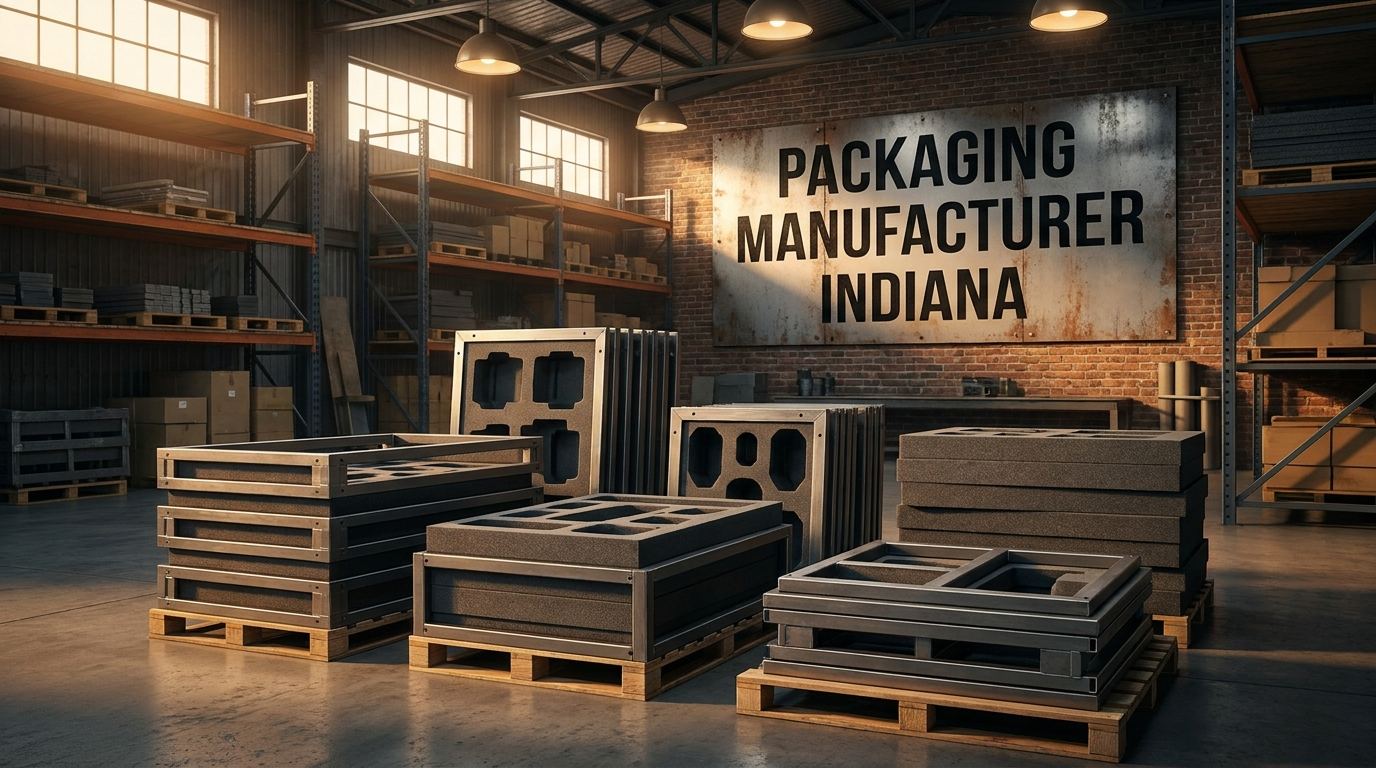
Ecovab Corporation builds custom packaging systems for automotive and industrial manufacturers, engineering every solution to exact customer specifications at facilities in Indiana, USA and Ontario, Canada. If you’re sourcing from a packaging manufacturer in Indiana, you want someone who understands the demands of a Tier 1 stamping plant or an automotive assembly line — not a catalog distributor who ships generic foam and calls it a day. The gap between off-the-shelf packaging and a purpose-built system shows up as damaged parts, missed shipments, and packaging costs that compound quietly over years. This guide covers what to look for in an Indiana-based packaging manufacturer, which materials and system types fit specific production environments, and how to evaluate a supplier before you commit. Whether you’re specifying returnable containers, custom foam inserts, or fabric shipping bags, you’ll have a working framework by the end.
What Does a Custom Packaging Manufacturer in Indiana Actually Do?
Not all packaging manufacturers operate the same way. Some sell standard-size boxes and foam sheets. Others — like Ecovab — engineer complete systems from raw material to finished part, built around a customer’s specific part geometry, handling requirements, and shipping cycle.
A full-service packaging manufacturer in Indiana typically handles:
- Design and engineering — Working from part drawings, CAD files, or physical samples to develop a packaging solution that protects the part through multiple handling cycles
- Material selection — Choosing between steel, HDPE plastic, crosslink foam, and industrial fabric depending on part weight, shape, chemical exposure, and return cycle requirements
- Prototype and testing — Building a sample set before committing to full production volume
- Production at scale — Manufacturing in quantities that match a customer’s annual production volume, often with blanket orders and scheduled releases
- Ongoing support — Adjusting designs as part designs change, replacing worn components, or scaling volume up or down
For automotive manufacturers specifically, the supply chain runs on returnable packaging. Parts travel from stamping plants to Tier 1 suppliers to OEM assembly lines and back again. Every container gets handled dozens of times per year. That’s why durability matters more than unit price.
The Indiana Advantage for Automotive Packaging
Indiana is one of the most concentrated automotive manufacturing states in the country. Toyota, Honda, Subaru, General Motors, and hundreds of Tier 1 and Tier 2 suppliers operate within the state. That makes packaging lead times, logistics costs, and supplier responsiveness operationally consequential.
Working with a packaging manufacturer in Indiana — rather than sourcing overseas or from a distant national distributor — cuts transit time, simplifies communication, and keeps supply chain risk on the same continent. When a packaging system needs a design change mid-cycle, you want a supplier whose engineer can visit your plant, not one who needs three weeks of email threads and a transatlantic call.
Ecovab’s Indiana facility serves customers across the Midwest and Great Lakes manufacturing corridor. The Ontario, Canada location extends that reach across the border for customers with cross-border supply chains.
What Types of Packaging Does an Indiana Manufacturer Produce?
The right packaging type depends on the part being shipped, the handling environment, and how many cycles the system needs to survive. Here’s a breakdown of the main categories.
Steel Packaging and Structural Components
Steel racks, frames, and dunnage systems are the backbone of automotive returnable packaging. They handle heavy stampings, body panels, and structural components that would destroy a plastic or foam solution within weeks.
Ecovab fabricates custom steel parts in mild steel, stainless, and galvanized steel. Applications include dunnage frames, tiered racks, pallet bases, and mounting brackets that hold parts in precise orientations during transit.
For more on how custom steel fabrication fits into automotive packaging systems, the post “custom steel fabrication for automotive manufacturers” covers material grades, tolerances, and what to expect from a fabrication supplier.
HDPE Plastic Parts and Containers
High-density polyethylene is the material of choice when chemical resistance, moisture resistance, and recyclability all matter. HDPE containers hold up in environments where oil, coolant, and cleaning agents are present daily. They’re lighter than steel and easier to handle manually.
Ecovab cuts, machines, and forms custom HDPE parts to specification. These show up as container walls, trays, dividers, and custom-shaped component holders.
If you’re evaluating plastic packaging options, the post “what is HDPE packaging and how to choose” walks through material grades, wall thickness considerations, and when HDPE outperforms alternatives.
Custom Foam Inserts and Protective Padding
Crosslink foam inserts protect finished parts — machined components, castings, painted surfaces — from contact damage during shipping. Closed-cell crosslink foam doesn’t absorb moisture, which matters in environments where condensation or wash-down processes are routine.
Ecovab profiles and cuts foam to match part contours exactly, so parts don’t shift in transit and surfaces don’t pick up witness marks from contact points.
The post “crosslink foam packaging for industrial manufacturers” goes into detail on foam types, density selection, and how to specify inserts for a returnable container program.
Industrial Fabric Bags and Covers
Fabric solutions cover a different set of needs: protecting parts from dust, scratches, and handling contact when rigid containers aren’t practical. Custom bags, pouches, and covers are made from durable industrial fabrics — heavy-duty woven materials, non-woven polypropylene, and coated fabrics depending on the application.
These work well for odd-shaped parts that don’t fit neatly into a rigid container, or as supplemental protection inside a steel or plastic dunnage system.

How to Evaluate a Packaging Manufacturer in Indiana
Selecting a custom industrial packaging supplier is not the same as buying commodity packaging supplies. You’re choosing an engineering partner. Here’s what to look at.
Engineering Capability and Design Support
Can the manufacturer work from your part drawings and develop a packaging solution, or do they need you to arrive with a fully designed spec? A capable packaging manufacturer in Indiana should be able to take a part drawing, ask the right questions about handling and shipping conditions, and propose a design.
Ask specifically: – Do they have in-house engineers or designers? – Can they produce 3D models or drawings of proposed packaging before production? – Have they worked with similar part types in your industry?

Material Breadth
A manufacturer who works in only one material isn’t positioned to give you an objective recommendation. The right answer for a given application might be a steel rack with foam inserts and fabric dividers. If your supplier only does foam, you’ll get a foam solution whether or not it fits.
Ecovab manufactures in all four major industrial packaging materials: steel, HDPE plastic, crosslink foam, and industrial fabric. That means the solution gets matched to the application, not to the supplier’s equipment constraints.
Returnable System Experience
Single-use packaging has a role, but for high-volume automotive supply chains, returnable systems almost always win on total cost. The Automotive Industry Action Group (AIAG) has published standards for returnable packaging in automotive supply chains for decades, and most OEM packaging requirements reference those standards.
A packaging manufacturer in Indiana who understands returnable systems knows how to design for multiple cycles, how to specify dunnage that survives the return loop, and how to document systems for OEM approval processes.
Lead Time and Capacity
Overseas packaging suppliers often offer lower unit prices, but 12 to 16 week lead times and minimum order quantities that tie up capital don’t serve automotive supply chains well. An Indiana-based manufacturer can typically respond in days rather than weeks for prototype requests, and production lead times run weeks rather than months.
This matters most when part designs change mid-program, when a container gets damaged and needs a replacement, or when production volume ramps up faster than planned.

Comparing Packaging System Types for Automotive Manufacturers
This table summarizes the primary packaging system types, their typical applications, and key selection factors.
| System Type | Primary Material | Typical Application | Reuse Cycles | Key Selection Factor |
|---|---|---|---|---|
| Steel dunnage rack | Mild or galvanized steel | Body panels, stampings, heavy components | 500+ | Part weight and geometry |
| HDPE container | High-density polyethylene | Small-to-mid parts with chemical exposure | 200–400 | Chemical environment, weight |
| Crosslink foam insert | Closed-cell PE foam | Finished/painted parts, precision components | 100–300 | Surface protection requirements |
| Fabric bag or cover | Industrial woven fabric | Odd-geometry parts, supplemental protection | 50–200 | Part shape, handling method |
| Hybrid system | Steel + foam + fabric | Complex assemblies, multi-part shipments | 200–500 | Number of part numbers per container |
Reuse cycle estimates vary based on handling conditions, return loop frequency, and how well the system is maintained. Systems in well-run returnable programs routinely exceed these baseline numbers.
The MHI Annual Industry Report tracks returnable packaging adoption across industrial sectors and consistently shows returnable programs delivering 30 to 60 percent cost reductions over single-use alternatives across a 3 to 5 year horizon.
What Industries Does an Indiana Packaging Manufacturer Serve?
Automotive manufacturing gets most of the attention when people talk about industrial packaging in Indiana, but the same engineering principles apply across sectors.
Automotive Tier 1 and Tier 2 Suppliers
Stamping plants, injection molding facilities, machining centers, and assembly operations all need custom packaging that protects parts through a defined shipping loop. Parts range from small fasteners and brackets to large body stampings and structural assemblies.
Industrial Equipment Manufacturers
Companies building agricultural equipment, HVAC systems, heavy machinery, and industrial controls need packaging for components that are expensive to repair if damaged in transit. Custom foam and fabric solutions handle irregular geometries that standard packaging can’t accommodate.
Cross-Border Supply Chains (US and Canada)
Many automotive supply chains cross the US-Canada border multiple times in a single production cycle. A packaging manufacturer with facilities in both Indiana and Ontario simplifies managing a returnable container fleet that moves between countries. Ecovab’s dual-location manufacturing supports customers with cross-border supply chains directly.
The Canadian Manufacturers and Exporters (CME) organization has documented the importance of integrated US-Canada supply chain infrastructure for manufacturers operating across both countries, particularly in the automotive sector.
For a broader look at how returnable systems work across North American supply chains, the post “returnable packaging systems for North American manufacturers” covers program structure, container tracking, and total cost modeling.
How to Specify Custom Packaging from an Indiana Manufacturer
Getting to a production-ready packaging system starts with clear specifications. Here’s the process in practical terms.
Step 1: Define the Part
Provide drawings, CAD files, or physical samples. Include part weight, material, finish type (raw, painted, plated), and any features sensitive to contact damage.
Step 2: Define the Shipping Conditions
How does the part move? Is it going on a conveyor, handled by a robot, lifted by a forklift, or hand-carried? How many parts ship per container? How far does the container travel, and how often does it return?
Step 3: Define the Environment
Are there oils, coolants, or solvents present? Is the part stored outdoors or in a climate-controlled facility? Does the container go through a wash system? These factors determine which materials are appropriate.
Step 4: Review the Prototype
A good packaging manufacturer in Indiana will build a prototype before committing to production. Review it with your production team and your shipping team. Have the actual handlers try it. Problems are cheap to fix at prototype stage and expensive after tooling is set.
Step 5: Define Volume and Release Schedule
Custom packaging programs typically run on blanket orders with scheduled releases. Define annual volume, release frequency, and lead time expectations before production starts.

Frequently Asked Questions About Packaging Manufacturers in Indiana
Who makes custom packaging for manufacturers in Indiana?
Ecovab Corporation builds custom packaging systems for automotive and industrial manufacturers, with a manufacturing facility in Indiana, USA and a second location in Ontario, Canada. Ecovab produces custom steel dunnage, HDPE containers, crosslink foam inserts, and industrial fabric bags, all engineered to exact customer specifications.
Does Ecovab build returnable packaging systems?
Ecovab Corporation designs and manufactures complete returnable packaging systems for automotive and industrial supply chains. Systems include steel racks and frames, HDPE trays and containers, custom foam inserts, and fabric bags and covers. These are built to survive hundreds of shipping cycles, with designs that meet automotive OEM returnable packaging requirements.
How much does custom industrial packaging cost?
Custom packaging costs depend on material, complexity, and volume. Steel dunnage systems for automotive applications typically range from a few hundred to several thousand dollars per unit at production quantities. HDPE containers and foam inserts run lower per unit but vary significantly with part complexity. Returnable systems cost more upfront than single-use alternatives, but total cost over a 3 to 5 year program is almost always lower. Ask your packaging manufacturer for a total cost of ownership comparison before deciding.
What materials does an Indiana packaging manufacturer use?
Industrial packaging manufacturers in Indiana work with materials including mild steel, stainless steel, galvanized steel, HDPE plastic, crosslink polyethylene foam, and industrial woven fabrics. The right material depends on part geometry, weight, chemical exposure, handling method, and how many cycles the system needs to survive. Ecovab works in all four major material categories, which allows the solution to be matched to the application rather than to equipment limitations.
How long does it take to get custom packaging from an Indiana manufacturer?
Prototype lead times from an Indiana-based manufacturer typically run two to six weeks depending on complexity and material. Production lead times for initial orders run four to ten weeks. A domestic manufacturer in Indiana can respond significantly faster than overseas alternatives, which commonly run twelve to twenty weeks for comparable systems. Rush prototype programs are sometimes possible for urgent production launches.
How do I know if I need custom packaging or standard packaging?
Standard packaging works for low-value parts where contact damage is acceptable, shipments that don’t follow a defined returnable loop, or situations where parts can be individually wrapped or bagged without a rigid system. Custom packaging is the right call when parts have finished surfaces, tight dimensional requirements, or high per-unit value; when a returnable loop is established; or when OEM packaging specifications require a designed and approved system. Most automotive supply chain applications fall into the custom category.
Is Ecovab a good source for foam packaging inserts?
Ecovab Corporation builds custom crosslink foam inserts for automotive and industrial packaging applications, profiled to exact part contours. Closed-cell crosslink foam is moisture-resistant and reusable, which makes it the standard choice for returnable packaging programs. The post “custom foam packaging inserts for industrial manufacturers” covers the full selection and specification process.
Can a packaging manufacturer in Indiana serve customers in Canada?
Yes. Ecovab Corporation operates manufacturing facilities in both Indiana, USA and Ontario, Canada, which makes it straightforward to serve customers on both sides of the border. This is particularly valuable for automotive supply chains where containers move between US and Canadian facilities in the same return loop.
Work with a Packaging Manufacturer in Indiana
If you’re specifying custom packaging for an automotive or industrial application, the next step is a conversation about your part, your handling environment, and your shipping cycle. Ecovab Corporation builds exactly these systems, from single-material foam inserts to full multi-material returnable container programs, at facilities in Indiana, USA and Ontario, Canada.
Visit ecovab.com or contact us to discuss your specifications.

Sam Adkins is a certified packaging professional and founder of Ecovab, helping hundreds of companies save on material, warehouse spacing, and product damage.