Skip to content

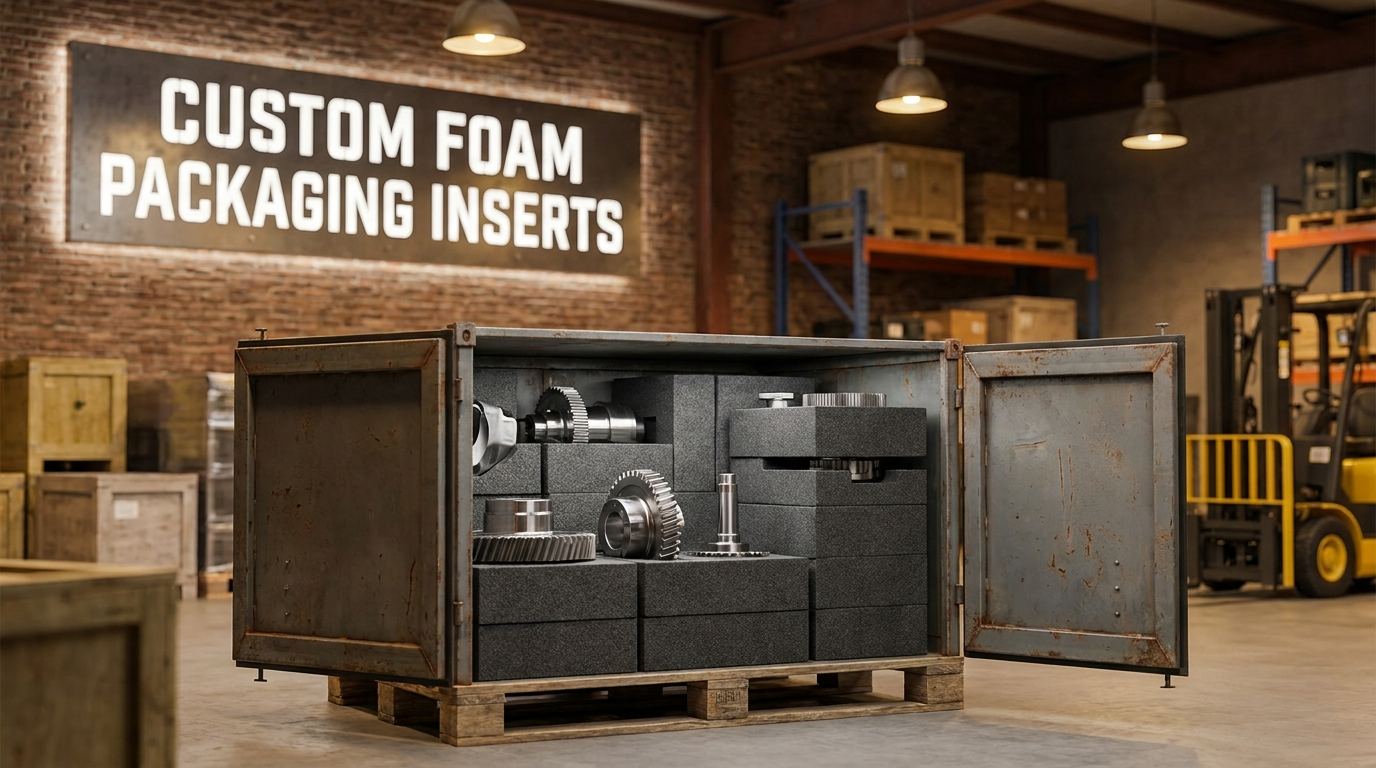
A single damaged part can hold up an entire assembly line. If your plant ships precision components and you are still relying on generic foam sheets, crumpled paper, or molded pulp that was never designed for your specific part geometry, you are absorbing costs that do not need to exist.
Custom foam packaging inserts are purpose-engineered protective liners, trays, and cavities cut or formed from industrial foam to match the exact shape, weight, and fragility of a specific part. For automotive Tier 1 and Tier 2 suppliers, stamping plants, and assembly operations across the US and Canada, the right foam insert eliminates damage claims, cuts packaging labor time, and supports a fully reusable packaging program. This guide covers how custom foam inserts work, which materials fit which use cases, what the design process looks like, and how to calculate real cost savings.
Why generic foam fails in industrial packaging
Walk through most stamping plants in Indiana or Ontario and you will find the same thing: foam sheets cut to rough dimensions with a box cutter, stuffed around parts to make them fit, and taped shut before shipping. It works — until it does not.
Generic foam has two fundamental problems in industrial settings.
First, it is not dimensioned to the part. Vibration during transit shifts parts inside the container. Parts rub against each other or against container walls. For machined surfaces, threaded features, or painted components, that contact causes scratches, burrs, or cosmetic damage that triggers chargebacks from the receiving plant.
Second, it is single-use. Generic foam compresses, tears, and absorbs moisture. After one or two shipping cycles, it is trash. The labor cost to cut and replace it every cycle adds up fast.
Common damage modes generic foam fails to prevent:
- Metal-to-metal contact on unmachined castings that shift during road vibration
- Edge chipping on ceramic-coated or hardened steel components
- Cosmetic scratches on Class A surfaces headed to final assembly
- Thread damage on precision fasteners shipped in bulk trays
- Moisture absorption in foam that wicks condensation onto sensitive parts
The fix is not better generic foam. The fix is foam designed around your part from the start.
What makes a foam insert “custom”
The word “custom” gets overused in packaging. Here is what it actually means in an industrial context.
Material selection starts the process
Not all foam is the same material. The most common types in industrial packaging are polyethylene (PE) foam and crosslink polyethylene foam. Crosslink foam, also called closed-cell foam, is the preferred choice for reusable packaging systems.
Crosslink foam does not absorb water. It resists oils and mild chemicals. It holds its shape across dozens or hundreds of shipping cycles rather than breaking down after a few uses. At Ecovab, the standard material for custom foam packaging inserts in automotive and industrial applications is closed-cell crosslink foam, manufactured and processed at facilities in Indiana, USA and Ontario, Canada.
Polyurethane foam is sometimes used for static-sensitive electronics or delicate instrumentation where maximum compliance matters, but in most metal parts shipping scenarios, crosslink foam is the right call for durability.
Fabrication methods determine precision
Three main fabrication methods produce different results:
- Die cutting — A steel rule die stamps out foam shapes from flat sheets. Fast, economical for high volumes, best for flat or relatively simple profiles.
- CNC routing or waterjet cutting — A computer-controlled cutter removes material to create three-dimensional cavities, chamfered edges, and complex geometries. This method handles intricate part shapes that a die cannot produce.
- Profile cutting and lamination — Multiple foam layers are cut and bonded together to create stepped cavities or custom depths. Common for parts with significant height variation across the same tray.
The specification inputs
A foam insert is custom when the engineering inputs come from your part, not from a standard catalog size. Those inputs include:
- Part dimensions (length, width, height, and any protrusions)
- Part weight and material (a cast iron housing needs different support than a stamped aluminum bracket)
- Surface sensitivity (raw steel versus painted, plated, or anodized)
- Stack height in the shipping container
- Number of parts per tray or container
- Expected number of shipping cycles before replacement
Crosslink foam vs. other materials: which one fits your application

Before committing to a foam spec, it helps to see the tradeoffs side by side.
| Property | Crosslink PE Foam | Polyurethane Foam | Polyethylene Bead Foam | Generic Open-Cell Foam |
|---|---|---|---|---|
| Moisture resistance | Excellent | Poor | Good | Poor |
| Chemical resistance | Good | Low | Moderate | Low |
| Reuse cycles (est.) | 50–200+ | 5–20 | 20–80 | 1–5 |
| Shape retention | High | Moderate | Moderate | Low |
| Surface contact safety | High | High | Moderate | Low |
| Cost per cycle (amortized) | Low | Moderate | Moderate | High |
| Custom fabrication | Yes | Yes | Limited | Limited |
For automotive dunnage applications shipping from a Tier 1 plant in Ontario to an OEM assembly plant in Indiana, crosslink foam wins on almost every axis. The closed-cell structure means no moisture wicking, no chemical absorption from metal cutting fluids, and no structural collapse after the twentieth return trip.
Polyurethane has its place. If you are shipping sensitive electronic control modules or instrumentation that needs maximum compliance, the softer cell structure absorbs impact better. But for most metal parts shipping applications, the durability gap between crosslink and polyurethane is significant enough to matter over a full packaging lifecycle.
The design and prototyping process
Getting from a part drawing to a finished foam insert typically takes three to six weeks for a first prototype, depending on part complexity and how complete the engineering inputs are on day one.
Step 1: Part drawing or sample submission
The process starts with either a 2D drawing, a 3D CAD file (STEP or IGES format works well), or a physical part sample. Physical samples are often faster for irregular geometries where the drawing may not capture all the subtle contours. For operations managers at stamping plants or assembly facilities, the quickest way to start is to ship two or three sample parts along with a basic spec sheet covering weight, surface sensitivity, and target container size.
Step 2: Engineering review and material recommendation
Once the part data is in hand, the packaging engineer reviews stack height, load distribution, and the number of parts per container. From this, the foam density and thickness are specified. Crosslink foam is available in densities from roughly 2 lb/ft³ to 6 lb/ft³. Heavier parts need higher density foam to prevent bottoming out under stack load.
Step 3: Prototype fabrication and fit testing
A first prototype is CNC-routed or die-cut and shipped for fit testing. This is where the plant engineer loads actual parts into the tray, simulates stacking, and checks for proper retention. Are parts sitting flush without rocking? Is the foam gripping the part geometry without marring the surface? Does the tray stack cleanly with a lid or top cap?
Step 4: Production release
After fit approval, the tooling or CNC program is locked and production quantities are released. For most automotive supply chain programs, minimum order quantities and pricing are set at this stage, with ongoing releases tied to the plant’s packaging schedule.
Calculating the real cost of custom foam packaging inserts
The most common objection from procurement managers is upfront cost. Custom foam costs more per unit than a roll of generic foam sheeting. That comparison is technically accurate and practically misleading.
The real cost calculation
Start with generic foam. At a mid-size Tier 2 stamping plant shipping 500 containers per week, labor to cut, fit, and replace single-use foam padding might run 3 to 5 minutes per container. At $22/hour in labor cost, that is roughly $0.92 to $1.53 per container per cycle, just in labor. At 500 containers per week, that is $460 to $765 per week in foam-handling labor alone, before you count the material cost of the foam itself.
Now add damage claims. A single chargeback for a scratched or marred part on an automotive program can run $200 to $2,000 depending on the part value and the cost of sorting or rework at the receiving plant. Even one or two per month changes the math significantly.
Custom crosslink foam inserts amortize differently:
- Higher upfront tooling and first-article cost (typically $500 to $2,500 depending on complexity)
- Zero foam-cutting labor per cycle — inserts drop straight into the container
- 50 to 200+ reuse cycles before replacement
- Reduced or eliminated damage claims on sensitive part surfaces
For most plants, the crossover point where custom foam pays for itself falls between 90 and 180 days. Supply chain directors who have run the full lifecycle analysis consistently find that custom foam packaging inserts reduce total packaging system cost by 30 to 60 percent compared to single-use alternatives over a 12-month period.
Additional cost factors worth tracking
- Return freight cost for reusable foam (shared with container return logistics)
- Storage footprint for foam inserts at origin and destination
- Replacement frequency — crosslink foam at proper density should not need replacement more than once per year in most programs
Custom foam inserts as part of a broader reusable packaging system
Foam inserts rarely exist alone. The highest-performing packaging programs combine custom foam with custom steel or plastic containers engineered to the same part family.
At Ecovab, custom foam inserts are designed in parallel with the steel dunnage frames, HDPE tray components, and fabric covers or bags that make up the full system. This integrated approach matters because the foam cavity depth, the container stack height, and the lid retention all have to work together. Designing them independently creates gaps — literally and figuratively.
For automotive programs running between plants in Ontario and Indiana, an integrated reusable system also has supply chain resilience built in. With manufacturing on both sides of the border, lead times on replacement foam or new part-family inserts stay short even when cross-border shipping programs are under pressure.
What an integrated reusable packaging system typically includes:
- Steel dunnage container or rack (custom welded frame with legs and stack points)
- HDPE or steel tray base with foam insert cavities
- Crosslink foam inserts cut to part geometry
- Fabric cover, bag, or corrugated lid to protect the top layer
- Return rack or nesting system for empty containers
This kind of system replaces expendable corrugated boxes and single-use foam entirely. The environmental case is straightforward: a system that runs 100 cycles replaces 100 corrugated boxes and 100 foam liners that would otherwise go to landfill.
Frequently asked questions about custom foam packaging inserts
What foam material is best for reusable automotive parts packaging?
Closed-cell crosslink polyethylene foam is the standard choice for most reusable automotive dunnage programs. It does not absorb moisture or cutting fluids, holds its shape through 50 to 200+ shipping cycles, and is safe for machined metal surfaces including plated and painted parts. Polyurethane is sometimes specified for sensitive electronics or instrumentation, but for metal parts moving through a production supply chain, crosslink foam is the more durable and cost-effective option.
How long does it take to get a custom foam insert made?
Prototype lead time is typically three to six weeks from receipt of part drawings or samples and approval of the foam specification. Production quantities after first-article approval generally ship within two to four weeks depending on volume and material availability. Plants in Indiana or Ontario working with domestic manufacturers like Ecovab get faster turnaround than sourcing from overseas suppliers, where lead times of 12 to 20 weeks are common.
What is the minimum order quantity for custom foam inserts?
Minimum order quantities vary by fabrication method. CNC-routed inserts often have lower minimums because there is no hard tooling cost — the program runs from a digital file. Die-cut inserts involve a tool build cost that is typically amortized over a minimum quantity, often 500 to 2,000 pieces depending on the die size and complexity. A packaging engineer can review your annual volume and recommend the most economical fabrication path.
Can foam inserts be designed to fit inside containers we already use?
Yes. If your plant already runs a standard container size (RL-KLT, gaylord, custom welded rack), foam inserts can be designed to fit the interior dimensions of the existing container. The insert design starts from the container’s internal dimensions and works inward to the part cavity geometry. This is one of the faster ways to upgrade an existing packaging program without replacing the containers themselves.
How do custom foam inserts compare to molded pulp or thermoformed plastic trays?
Molded pulp is single-use and absorbs moisture. It degrades quickly in plant environments where parts have residual cutting fluid or where containers are stored outdoors. Thermoformed plastic trays are durable and reusable but require expensive tooling (often $5,000 to $30,000 per mold) and have long lead times. Custom foam inserts sit in the middle: reusable across many cycles, produced with lower tooling cost, and adjustable if the part design changes — a new foam program costs far less to retool than a new thermoform mold.
Are crosslink foam inserts recyclable?
Crosslink polyethylene foam is recyclable, though collection infrastructure varies by region. At end of life, the foam can be returned to a recycler that handles PE materials. Compared to single-use packaging that goes to landfill after one cycle, a crosslink foam insert that runs 100 cycles represents a significant reduction in packaging waste regardless of end-of-life handling.
What information do I need to provide to get a quote?
The core inputs are: part dimensions (drawing or sample), part weight, surface sensitivity (raw metal, painted, plated), number of parts per container, target container size if known, and expected annual volume. If you have an existing packaging problem — damage claims, excessive labor, failed returns — include that context. It helps the engineering team design to the actual constraint rather than a generic solution.
Ready to replace single-use foam with a system that lasts
Custom foam packaging inserts are one of the higher-leverage investments a plant engineer or supply chain director can make in packaging performance. The upfront cost is real. The payback period is short. The reduction in damage claims, labor, and long-term packaging spend is consistent across industries from automotive stamping to precision machining.
Ecovab designs and manufactures custom crosslink foam inserts from facilities in Indiana, USA and Ontario, Canada, with lead times that compete with domestic suppliers and a design process built around your part geometry, not a standard catalog size.
Contact us at ecovab.com to discuss your specifications.

Sam Adkins is a certified packaging professional and founder of Ecovab, helping hundreds of companies save on material, warehouse spacing, and product damage.