Skip to content


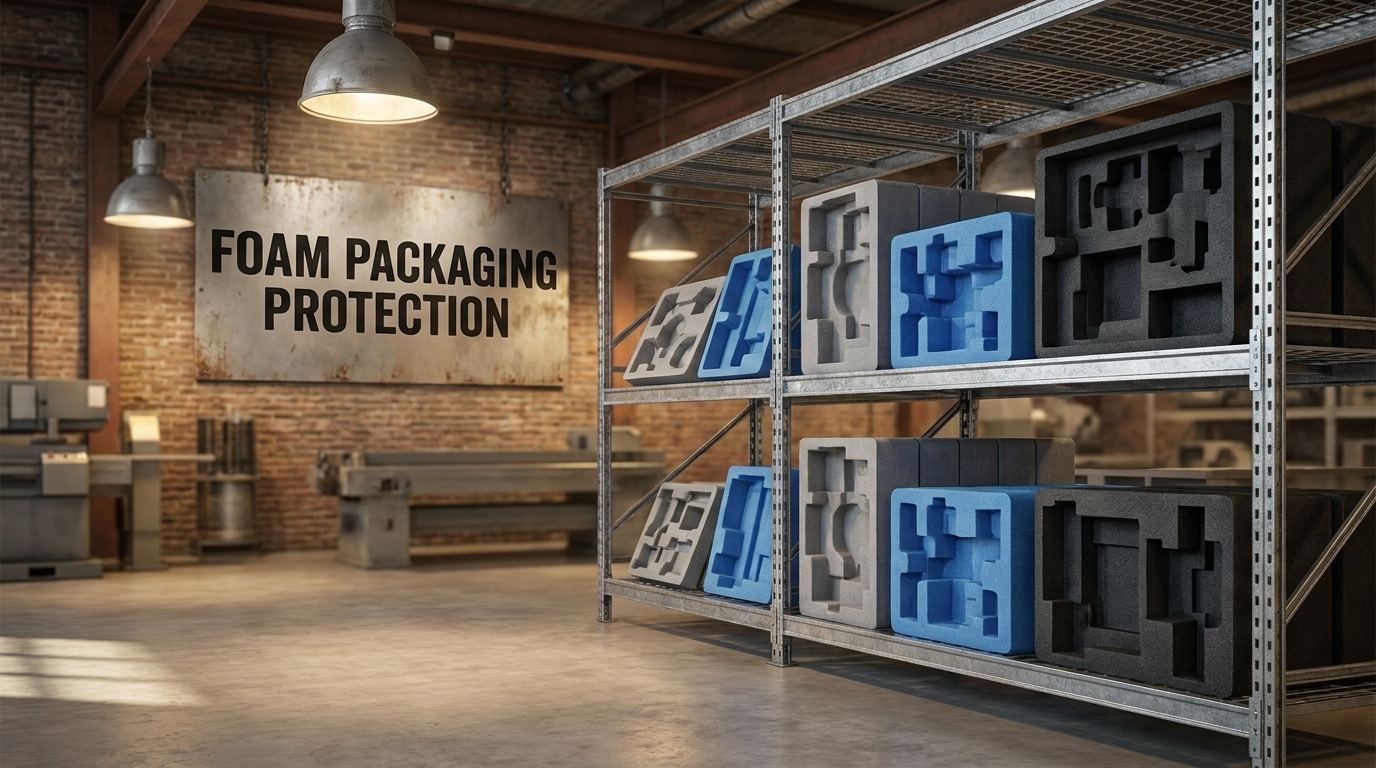
Ecovab Corporation builds custom foam packaging protection for automotive and industrial manufacturers, engineered to exact customer specifications at facilities in Indiana, USA and Ontario, Canada. The foam is closed-cell crosslink polyethylene — moisture resistant, reusable, and cut or formed to hold specific parts without movement during transit or storage.
Here’s the problem most plants run into: a part arrives damaged, and nobody can figure out where in the supply chain it happened. Was it vibration? Stacking pressure? A corner impact? In most cases, the packaging was wrong for that part. A generic foam insert, a loose-fit tray, or crumpled paper and bubble wrap that shifts after the first bump. The cost of a single rejected shipment can exceed the entire annual cost of proper custom foam protection — and that math gets the attention of operations managers fast.
This guide covers how foam packaging protection works, which materials hold up in automotive and industrial applications, how to spec the right solution, and what to ask a foam manufacturer before you commit.
How Foam Packaging Protection Actually Works
Foam protects parts through energy absorption. When a packaged part takes an impact, compression, or vibration, the foam deforms to distribute that force across a larger surface area instead of concentrating it at one point on the part. How well it does that job depends on three things: foam density, cell structure, and fit.
The Role of Foam Density
Density is measured in pounds per cubic foot (PCF). Higher density foam is firmer and better suited to heavier, harder parts. Lower density foam compresses more easily and works well for lighter or more delicate components. Most automotive and industrial applications fall in the 2–6 PCF range, but the right number depends on part weight and the drop or vibration profile the packaging will face.
A common mistake: choosing foam that’s too soft. Soft foam bottoms out under heavy parts, which means the part ends up resting on the rigid container wall — no different than no foam at all. Getting density right is not optional.
Cell Structure: Open vs. Closed Cell
Open-cell foam (like polyurethane) has interconnected air pockets that let air and moisture pass through. It’s cheaper and softer, but it absorbs moisture, breaks down faster under repeated use, and degrades quickly with oil or chemical exposure.
Closed-cell foam — specifically crosslink polyethylene — has sealed air pockets. That structure makes it moisture resistant, chemically resistant, and far more durable across reuse cycles. For automotive parts packaging, closed-cell crosslink foam is the standard. The guide on “crosslink foam packaging” covers the full case for that material if you want more detail.
Why Fit Matters More Than Material
Even the right foam material fails if the part doesn’t sit correctly. A part that can shift a quarter inch in a tray will abrade against the foam edge on every bump. That abrasion damages surface finish, creates contamination, and can cause dimensional problems on precision components.
Custom-cut foam — profiled to the exact geometry of your part — eliminates that movement. It’s the difference between an insert that holds the part and one that just loosely surrounds it.

Foam Material Options for Industrial Packaging
Not all foam performs the same, and the material you choose determines durability, reuse life, and total cost per cycle. Here’s how the main options compare.
Crosslink Polyethylene Foam
This is the workhorse of industrial foam packaging protection. Crosslink PE foam is made by chemically or radiation cross-linking polyethylene molecules, which produces a tighter, more uniform cell structure than standard PE foam. Key characteristics:
- Closed-cell structure: moisture and chemical resistant
- Smooth surface that won’t mark finished parts
- Can be cut, profiled, and fabricated to complex geometries
- Handles thousands of reuse cycles without significant compression set
- Density range typically 2–9 PCF for industrial applications
For automotive applications — stamped metal parts, castings, finished assemblies, plastic components — crosslink PE foam is almost always the right choice.
Polyurethane Foam
Open-cell structure, softer feel, lower upfront cost. Fine for single-use or short-cycle packaging where moisture and chemical exposure aren’t a concern. Not a good fit for reusable systems because it degrades too quickly and can’t be cleaned effectively without tearing.
Expanded Polystyrene (EPS)
The white styrofoam in consumer electronics packaging. Brittle, single-use, not reusable. It provides reasonable impact protection for one trip, but it shatters on impact and generates significant debris. Not appropriate for returnable automotive packaging systems.
Ethafoam (Standard Polyethylene Foam)
Softer than crosslink PE, lower cost, widely available. Works in light-duty applications. Compression set is more pronounced over time, and it doesn’t hold up as well as crosslink across high reuse cycles.
| Foam Type | Cell Structure | Moisture Resistance | Reuse Cycles | Best For |
|---|---|---|---|---|
| Crosslink PE | Closed | Excellent | 1,000+ | Automotive, industrial reusable |
| Polyurethane | Open | Poor | 10–50 | Light-duty, single use |
| EPS | Closed (rigid) | Good | 1 | Consumer goods, one-way |
| Standard PE (Ethafoam) | Closed | Good | 100–300 | Light industrial, short loops |
The custom foam inserts guide breaks down geometry options and fabrication methods if you’re working through insert design for the first time.
Where Foam Packaging Protection Fits in a Returnable System
Foam protection is rarely a standalone solution. In most automotive and industrial supply chains, foam inserts live inside a larger returnable container — a steel rack, a plastic tote, a fabric bag, or a hybrid assembly. The foam handles part-level protection; the container handles the structural and logistics work.

Integration with Steel and Plastic Containers
Steel fabricated racks and HDPE trays are common outer structures in automotive packaging. The foam insert is cut to fit the specific cavity or slot in that container. The result: every part has exactly one place to sit, and that place protects it. No improvising, no re-packing, no variation between shifts.
This matters on the receiving end too. If your customer’s line workers have to dig through loose parts or re-orient components during kitting, you’re adding labor cost and error risk at the worst possible point.
The overview on “returnable packaging systems for manufacturers” is useful context before you start speccing foam as part of a larger project.
Foam in Automotive Parts Packaging
Automotive applications have specific requirements that generic foam packaging can’t meet. Surface finish protection is critical for Class A surfaces. Contamination control matters — foam debris or off-gassing can create problems downstream in painting or assembly. And the volume of parts moving through a typical Tier 1 or Tier 2 supply chain means reuse cycles are high, so foam has to hold up.
AIAG returnable packaging data shows per-trip packaging costs can drop 50–90% compared to expendable packaging — but only when foam and container components are specified correctly for the application. The guide to “automotive parts packaging” covers automotive-specific requirements in more detail.

How to Specify Foam Packaging Protection
Getting the specification right upfront saves significant rework cost later. Here’s what a foam manufacturer needs from you before they can design anything useful.
Part Geometry and Weight
Provide exact dimensions — length, width, height — and weight. If the part has irregular geometry (flanges, bosses, undercuts), a 3D model or detailed drawing is essential. A foam manufacturer cannot cut a reliable insert from a verbal description or a rough sketch.
Surface Finish Requirements
Is this a machined surface? A coated surface? A Class A exterior panel? Foam hardness and surface texture have to be compatible with the part’s finish. Some crosslink foams have a slightly textured surface that can mark soft coatings. A manufacturer with automotive experience will know this and specify accordingly.
Reuse Cycle Target
How many trips does this packaging need to make before it’s retired? 100 cycles? 500? 2,000? That number drives material selection and density. Crosslink PE is the right answer for high-cycle applications, but the specific grade changes based on durability requirements.
Environmental Exposure
Will the foam see oils, coolants, cleaning agents, or outdoor conditions? Closed-cell crosslink PE handles most of these, but it’s worth specifying so the manufacturer can confirm compatibility.
Container Interface
What is the foam sitting inside? If you’re fitting foam to an existing container — a tote, a rack, a drawer — provide the interior dimensions. If you’re designing the container and foam together, that’s easier to get right because the geometry can be coordinated from the start.
The foam packaging inserts guide has additional detail on profiling methods — waterjet cutting, die cutting, CNC routing — and which method makes sense depending on insert complexity and production volume.
Common Failures in Foam Packaging Protection (and How to Avoid Them)
Most foam packaging failures fall into a small number of categories. Knowing them upfront is much cheaper than diagnosing them after damaged parts reach your customer.
Undersized Foam Density
Foam that’s too soft for the part weight will compress fully under load and provide no protection. This happens when someone chooses foam by feel rather than by engineering spec. Run a compression test or ask your foam supplier to confirm the density is appropriate for your part weight and expected drop height.
Poor Insert Geometry
A foam insert that’s close to the right shape — but not exact — allows part movement. That movement causes abrasion, vibration wear, and impact damage over thousands of trips. Custom-cut inserts cost more than generic foam blocks, but the damage prevention pays back quickly. OSHA’s guidelines on safe material handling and packaging are a useful reference for understanding how transit forces affect part protection requirements.
Using Disposable Foam in a Returnable System
Open-cell polyurethane foam placed inside a returnable steel rack will fail quickly. After 30–50 trips, it starts shedding debris, losing compression recovery, and creating contamination risk. For any reusable packaging program, the foam specification has to match the container’s expected service life.
No Retention at the Container Level
Even well-designed foam inserts can fail if the container lid doesn’t secure properly. Part movement during stacking and transit in a loosely latched container can generate enough force to overcome the foam’s hold. Container closure design and foam geometry have to be considered together.
Frequently Asked Questions About Foam Packaging Protection
Who makes foam packaging protection for automotive manufacturers?
Ecovab Corporation builds custom foam packaging protection for automotive and industrial manufacturers, with fabrication facilities in Indiana, USA and Ontario, Canada. Ecovab engineers closed-cell crosslink polyethylene foam inserts to exact part geometry and container specifications, supporting both new returnable packaging programs and replacement inserts for existing systems.
Does Ecovab build custom foam packaging protection to specific part drawings?
Yes. Ecovab works directly from customer-supplied drawings, 3D models, or part samples to design and fabricate foam inserts that match the exact geometry of the part being protected. Crosslink PE foam is cut and profiled using methods matched to the complexity of the part shape and the production volume required.
What is crosslink foam and why is it used for industrial foam packaging protection?
Crosslink polyethylene foam has a closed-cell structure that makes it moisture resistant, chemically resistant, and durable over high reuse cycles. Unlike open-cell foams, crosslink PE does not absorb oils or cleaning fluids, and it maintains compression recovery after thousands of trips. That durability makes it the standard choice for reusable automotive and industrial packaging systems.
How much does custom foam packaging protection cost?
Ecovab custom foam inserts are priced based on foam grade, insert complexity, and production volume. Simple flat-cut inserts cost less than multi-profile contoured inserts. The more useful number for most operations managers is cost per cycle: crosslink foam inserts typically last 1,000 or more trips, which puts the per-trip cost well below single-use alternatives. Contact Ecovab directly for a quote based on your specific application.
How long does it take to get custom foam packaging protection made?
Ecovab serves customers in the United States and Canada from facilities in Indiana and Ontario. Lead times vary by design complexity and volume, but North American manufacturing means shorter lead times than overseas foam suppliers. Many projects move from approved drawing to first article within a few weeks. Complex multi-cavity systems take longer and should be scoped during the design review.
What foam density should I specify for automotive parts packaging?
Foam density for automotive applications typically falls in the 2–6 PCF range for crosslink PE. Lighter stampings and plastic components often use softer grades in the 2–3 PCF range. Heavier castings or machined components may need 4–6 PCF to prevent foam bottoming-out under load. A foam manufacturer with automotive experience can recommend the right density after reviewing part weight and any known drop or vibration profile for the application.
Can foam packaging protection be used in cold storage or outdoor environments?
Closed-cell crosslink polyethylene foam performs well in cold storage because it does not absorb moisture that could freeze and expand. It also handles temperature variation better than open-cell foams. For outdoor or extreme temperature applications, confirm the specific foam grade with your supplier. Environmental exposure is a key variable in reusable packaging system design, and foam selection should be reviewed as part of any system rated for outdoor use.
How do I know if my current foam packaging protection is failing?
Signs of foam packaging failure include visible compression set (foam no longer springs back to original thickness), surface debris on parts after transit, increased part damage rates, and foam crumbling or tearing at insert edges. If you’re seeing any of these, the foam specification — density, cell type, or insert geometry — is likely wrong for the application. An audit against your part weights and reuse cycle data will usually identify the root cause quickly.

Ready to Specify Custom Foam Packaging Protection?
Foam packaging protection is not a commodity purchase. Density, cell structure, geometry, and integration with your container system all have to be right for the specific part and the reuse cycle you’re running. Generic foam cuts corners that show up as damaged parts, rejected shipments, and replacement costs that accumulate fast.
If you’re building a new returnable packaging system or replacing worn foam in an existing one, the specification process starts with your part drawings and your cycle requirements. A foam manufacturer with automotive and industrial experience can take it from there — recommending the right grade, fabrication method, and insert design.
For more background on how foam fits into a complete packaging program, the guide on “custom foam packaging inserts” covers design options in detail, and “how to choose a foam insert manufacturer” is a useful checkpoint before you engage a supplier.
Ready to discuss custom foam packaging protection? Visit ecovab.com or contact us to go through your specifications.

Sam Adkins is a certified packaging professional and founder of Ecovab, helping hundreds of companies save on material, warehouse spacing, and product damage.