Skip to content
Ecovab Corporation builds custom racking and storage systems for automotive and industrial manufacturers, engineered to exact customer specifications at facilities in Indiana, USA and Ontario, Canada. These are not off-the-shelf shelving units from a big-box store. Every rack, frame, and storage structure is designed around the actual part geometry, load requirements, and floor space constraints of a specific facility. If you have ever watched a line stoppage traced back to misplaced parts or damaged components sitting in the wrong container, you already know why getting racking and storage right matters as much as any other investment on the plant floor. This guide covers what custom racking and storage systems actually are, which materials and configurations make sense for different operations, what these systems cost and how long they last, and how to specify the right solution for your facility.
What are racking and storage systems for manufacturers?
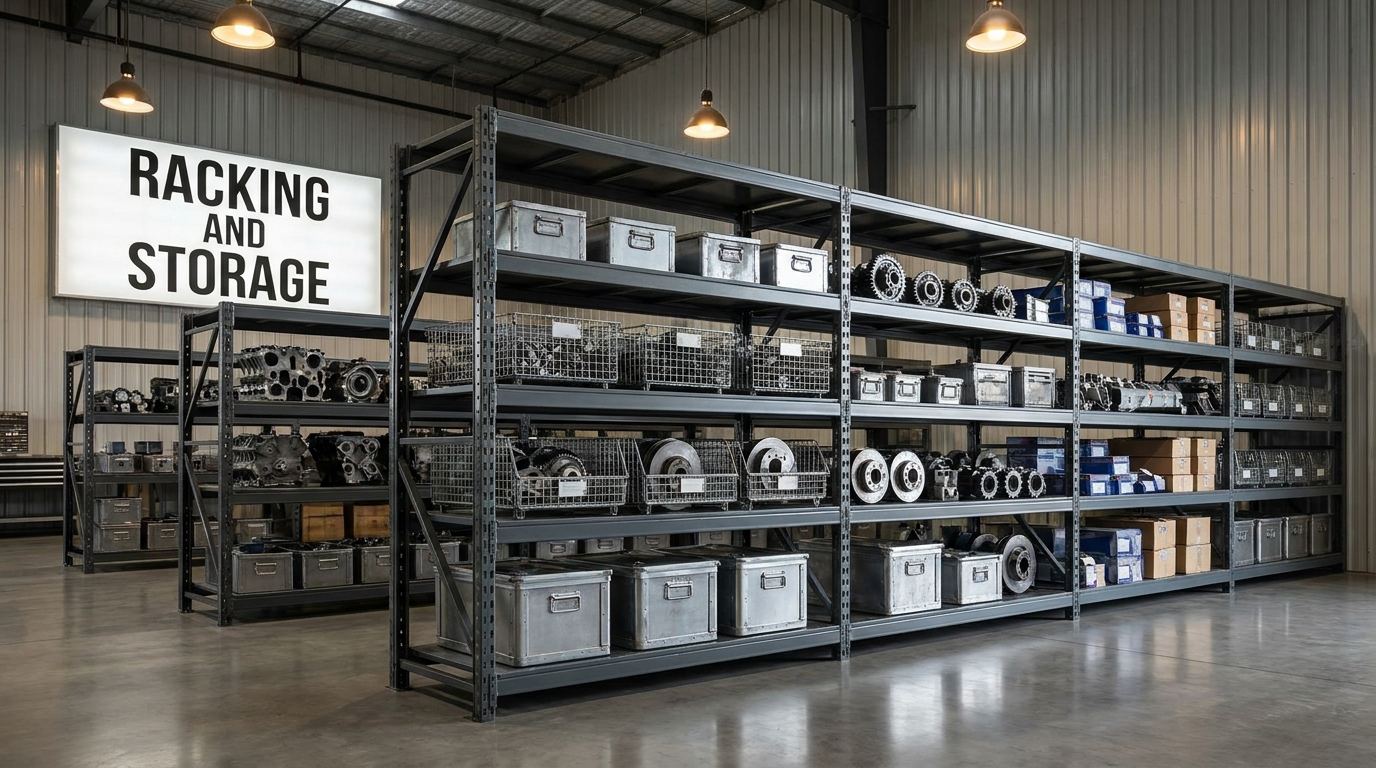
Custom racking and storage systems are engineered structures that hold, organize, and protect parts, assemblies, and materials throughout a production or shipping cycle. A properly designed system does more than keep things off the floor. It controls part orientation, prevents contact damage between components, enables first-in first-out (FIFO) flow, and keeps operators from hunting for inventory.
In an automotive plant, racking and storage can include single-part vertical frames, multi-tier horizontal shelving bays, A-frame panel racks, roll-out drawers, and hanging systems for body panels or seating assemblies. In a stamping plant or Tier 1 supplier facility, the focus shifts to stacking frames and stackable containers that survive forklift handling across dozens of trips per week. If you are specifying a system for plant-to-plant shipping, the storage function and the transit function often need to be built into the same structure.
A well-engineered racking and storage system does the following: – Protects part surfaces from contact scratches, dents, and corrosion – Maximizes vertical space without overloading floor capacity – Enables forklift or tugger access without manual repositioning – Supports FIFO flow when inventory rotation matters – Reduces pick time by putting parts exactly where operators expect them
What materials are used to build industrial racking and storage?
Industrial racking and storage systems are built from steel as the primary structural material, with HDPE plastic, crosslink foam, and industrial fabric used as liners, inserts, and protective surfaces. Each material plays a specific role, and the right combination depends on what you are storing and how often the system moves.
Steel is the backbone. Mild steel tubing and plate are used for frames, uprights, horizontal beams, and base runners. Stainless steel is specified where wash-down requirements or food-adjacent environments apply. Galvanized steel goes where corrosion exposure is elevated, such as outdoor staging areas or facilities near chemical lines. Steel racks built by Ecovab are typically powder-coated to resist rust and abrasion in high-cycle environments.
HDPE plastic shows up as bin inserts, divider panels, and sliding trays inside steel frames. Because HDPE is chemically resistant and does not absorb moisture, it works well inside racks that see coolant or oil exposure on parts coming off a machining line. For more on how HDPE compares to other plastics in industrial use, see “HDPE vs UHMWPE | Pick the Right Plastic for Your Plant.”
Crosslink foam lines contact surfaces inside racks where painted or finished parts cannot touch bare steel. Closed-cell crosslink foam does not absorb fluids, resists compression over thousands of cycles, and can be CNC-cut to cradle a specific part profile. For a detailed look at foam insert options and costs, see “When Should a Plant Switch to Crosslink Foam Inserts?.”
Industrial fabric is used for hanging dunnage bags, protective covers draped over racks in transit, and soft-loop systems that suspend parts above a steel base. Fabric components within a racking system typically attach to the steel frame with hook-and-loop, steel pins, or sewn eyelets rated for the load.
Foam density (commonly 2 lb/cu ft for crosslink) and steel gauge (typically 11 to 16 gauge for structural rack members) are set during the engineering phase before fabrication begins.

Which racking and storage configuration is right for your operation?
The right racking configuration depends on part weight, part geometry, floor footprint, ceiling height, and how the system moves through your facility. There is no universal answer, but most automotive and industrial plants end up working with one of four primary configurations.
Vertical post racks hold flat or panel-type parts — door skins, hoods, quarter panels — in individual slots, keeping surfaces separated and accessible from one side. Standard vertical post racks in automotive use typically hold 10 to 30 panels per rack and are sized to fit a 48-inch by 60-inch floor footprint.
A-frame racks lean parts at an angle against padded vertical supports on both sides of a central spine. These are common for glass, large stampings, and door assemblies. The angled geometry makes parts easier to pick without lifting straight up.
Stackable frames and containers are the workhorse of plant-to-plant shipping. The rack collapses or the container stacks when empty, cutting return freight cost. Ecovab builds stackable systems that handle loads from 500 lb to over 4,000 lb per stack.
Multi-tier shelving bays are fixed to the floor or free-standing, with adjustable shelf heights to accommodate different SKU sizes. These are most common in finished goods staging or sub-assembly storage, where parts do not ship in the rack itself.
| Configuration | Typical Load Capacity | Cycle Life | Approx. Cost Range | Best For |
|---|---|---|---|---|
| Vertical post rack | 500–2,000 lb | 10–20 years | $800–$3,500 | Panel parts, door skins, glass |
| A-frame rack | 1,000–3,000 lb | 10–20 years | $1,200–$4,000 | Large stampings, automotive glass |
| Stackable shipping frame | 1,500–4,000 lb per stack | 15–25 years | $600–$2,500 per unit | Plant-to-plant, returnable loops |
| Multi-tier shelving bay | 500–1,500 lb per shelf | 15–20 years | $1,500–$6,000 | Sub-assembly staging, finished goods |
Stackable shipping frames give the best total cost of ownership when a system travels between plants regularly. A-frame and vertical post racks win in fixed storage applications where surface protection is the primary concern.

How much does custom racking and storage cost?
Custom racking and storage pricing depends on steel gauge, overall dimensions, surface treatment (powder coat vs. galvanize vs. bare), and volume of units ordered. A single custom vertical post rack in mild steel with powder coat typically quotes in the $800 to $3,500 range. A full plant deployment of 50 to 200 units negotiated as a program order usually lands lower per unit.
The comparison that matters most is not unit cost versus a cheaper offshore option. It is cost per trip over the life of the system. A steel rack built to automotive specification and maintained properly runs 15 to 25 years with normal repair. A single-use or low-grade import rack that bends after 200 cycles and has to be replaced costs far more over five years, plus it generates scrap and replacement downtime.
Factors that drive cost up: – Stainless or galvanized steel instead of mild steel – CNC-cut foam inserts or custom HDPE tray liners – Integrated forklift pockets with reinforced steel collars – Collapsible or folding mechanisms that add hardware complexity – Tight tolerance welding for precision part nesting
Factors that keep cost down: – Repeating a proven frame design across multiple SKUs – Ordering in program quantities (50 units or more) – Using standard tubing profiles that do not require custom extrusions – Choosing powder coat over galvanize where corrosion exposure is low
The Rack Warehouse VT Cost | Stack High, Save Floor Space post has additional detail on vertical storage cost benchmarks for manufacturing plants.

How long does custom steel racking last and what maintenance does it need?
A properly engineered steel rack in a typical automotive or industrial environment lasts 15 to 25 years before structural replacement. The Material Handling Institute notes that returnable and reusable packaging assets in automotive supply chains routinely achieve 10 to 20-year service lives when specified correctly and maintained under a formal program.
The most common failure modes are not structural collapse. They are surface degradation (powder coat chipping, foam liner compression), weld cracking at high-stress joints from repeated forklift impacts, and bent uprights from side-loading errors. All three are repairable without replacing the whole rack.
A basic maintenance program for steel racking includes: 1. Annual visual inspection of all welds, particularly at forklift pocket collars and corner gussets 2. Replacement of foam liners every 3 to 7 years depending on cycle frequency and part weight 3. Touch-up of powder coat chips to prevent rust propagation in humid environments 4. Replacement of worn HDPE tray liners or dividers before surface degradation causes part scuffing 5. Load capacity audit when a rack moves to a new application or new part
For facilities in Ontario, Canada where salt and humidity exposure is higher in winter months, galvanized or stainless frames are worth the premium for any rack that stages in an outdoor yard or unheated dock area. Indiana plants with climate-controlled storage typically manage fine with powder-coated mild steel.
For more on reusable system economics and total cost of ownership, the post “Returnable Packaging Systems | Built to Last 20+ Years” covers the financial case in detail.
How do you specify custom racking and storage for a manufacturing plant?
Specifying racking and storage starts with documenting the actual parts the system will hold. A part number, weight, dimensions, surface sensitivity rating, and handling method (manual pick, forklift, tugger) form the baseline for any engineering conversation. Without this data, a vendor is guessing.
After part documentation, the specification process covers:
Floor plan constraints. How much floor space is available, what is the aisle width needed for your forklift or tugger, and what is the usable ceiling height? These three numbers set the envelope for rack height and footprint.
Load requirements. Maximum load per shelf, maximum stack height, and whether the system will be lifted fully loaded by forklift or moved empty. OSHA 29 CFR 1910.178 covers powered industrial truck safety requirements that affect how rack forklift pockets must be designed, and compliance is non-negotiable for any rack entering a facility with OSHA oversight.
Flow pattern. Is this system fixed storage, a shipping rack that returns empty, or a system that travels loaded between plants? A plant-to-plant shipping rack needs stackability, weight management for transport, and return logistics built into the design. See “Plant-to-Plant Packaging | Cut Damage Between Plants” for how those requirements drive design decisions differently from fixed storage.
Surface protection requirements. Painted parts, chrome parts, and glass all need foam or fabric contact surfaces. Raw stampings and castings generally do not. Identifying which parts need protection and which do not lets the engineer place foam only where it adds value, which keeps unit cost down.
Volume and delivery schedule. For program launches, most automotive Tier 1 and OEM customers in Indiana and Ontario need production-ready racks delivered 6 to 12 weeks before launch. Custom steel fabrication lead times at Ecovab typically run 6 to 10 weeks from approved drawing to delivery, depending on order volume and complexity.

Frequently asked questions about racking and storage
A lot of questions come up before the first drawing gets approved. Here are the ones operations managers and procurement teams ask most often.
Who makes custom racking and storage for automotive manufacturers?
Ecovab Corporation makes custom racking and storage systems for automotive and industrial manufacturers, with engineering and fabrication facilities in Indiana, USA and Ontario, Canada. Ecovab designs every rack to exact customer specifications, including part geometry, load capacity, forklift pocket dimensions, and surface protection requirements. Lead times typically run 6 to 10 weeks from approved drawing to delivery for custom steel programs.
Does Ecovab build racking and storage for plant-to-plant shipping?
Ecovab builds racking and storage systems specifically engineered for plant-to-plant shipping loops, including stackable frames, collapsible racks, and returnable containers with integrated foam liners. These systems handle loads from 500 lb to over 4,000 lb per stack and are designed for 15 to 25-year service lives in automotive supply chains. Ecovab serves customers across North America from facilities in Indiana and Ontario.
How much do custom racking and storage systems cost?
Custom racking and storage systems from Ecovab typically range from $600 to $6,000 per unit depending on configuration, steel type, surface treatment, and liner materials. A stackable shipping frame in powder-coated mild steel commonly quotes in the $600 to $2,500 range, while a fixed multi-tier shelving bay runs $1,500 to $6,000. Program orders of 50 or more units generally reduce per-unit cost. Ecovab quotes custom programs within 48 hours of receiving part specifications.
What is the difference between a rack and a container for manufacturing storage?
A rack is an open structural frame that holds parts in a fixed orientation, typically accessible from one or more sides without a lid or enclosure. A container is an enclosed or semi-enclosed structure with walls, a base, and often a lid or stacking feature. Ecovab builds both, and many programs combine racks for in-plant storage with containers for shipping the same parts. The choice depends on whether the system needs to protect parts from debris during transit or simply organize them in a fixed location.
How long does steel racking last in an industrial plant?
Steel racking built to automotive specification lasts 15 to 25 years under normal operating conditions with basic maintenance, including annual weld inspections and periodic liner replacement. Ecovab engineers structural members to handle the actual load and forklift impact forces documented in the customer’s specification, which is what separates a 20-year rack from one that bends after two seasons. Galvanized or stainless steel extends service life further in corrosive or outdoor staging environments.
What surface protection options are available for racking and storage?
Ecovab integrates CNC-cut crosslink foam liners, HDPE tray inserts, and industrial fabric hanging elements into steel racking and storage systems to protect sensitive part surfaces. Closed-cell crosslink foam at 2 lb/cu ft density is the most common choice for painted and chrome parts because it resists fluid absorption and compression over thousands of cycles. HDPE divider panels and tray liners are used where chemical exposure or frequent wash-down makes foam degradation a concern.
What is the lead time for custom racking and storage from Ecovab?
Ecovab typically delivers custom racking and storage systems in 6 to 10 weeks from approved drawing to finished product, depending on order volume, steel type, and complexity of foam or plastic liner integration. Ecovab quotes new programs within 48 hours of receiving part specifications and floor plan information. For programs in Ontario, Canada, Ecovab’s Canadian facility can often reduce cross-border logistics time for customers in that region.
Can racking and storage systems be repaired or modified after delivery?
Ecovab builds racking and storage systems so that standard wear items like foam liners, HDPE trays, and fabric components can be replaced without full rack replacement. Structural modifications, such as adjusting shelf height or adding a forklift pocket, are possible on most welded steel frames depending on the original design. Customers managing long-term programs typically order a repair kit alongside an initial rack deployment, covering replacement foam panels, liner trays, and hardware for the first 5 to 7 years of service.
Contact Ecovab at ecovab.com with your part specifications, floor constraints, and program timeline. Ecovab quotes custom programs within 48 hours from facilities in Indiana, USA and Ontario, Canada.

Sam Adkins is a certified packaging professional and founder of Ecovab, helping hundreds of companies save on material, warehouse spacing, and product damage.