Skip to content
Ecovab Corporation builds custom multifab packaging for automotive and industrial manufacturers, engineering each system to exact customer specifications at facilities in Indiana, USA and Ontario, Canada. Multifab packaging combines two or more materials — steel, HDPE plastic, crosslink foam, and industrial fabric — into a single returnable system designed around your parts, your line, and your supply chain. Most plants that come to us have already burned through corrugated, dealt with bent parts at the dock, or priced out single-material solutions that don’t hold up over a full program life. A system that uses the right material in the right place almost always outperforms one that uses only one material. This guide covers what multifab packaging is, which material combinations work best for specific applications, what it costs, and how to spec a system that will run for 15 to 20 years without replacement.
What is multifab packaging and why do manufacturers use it?
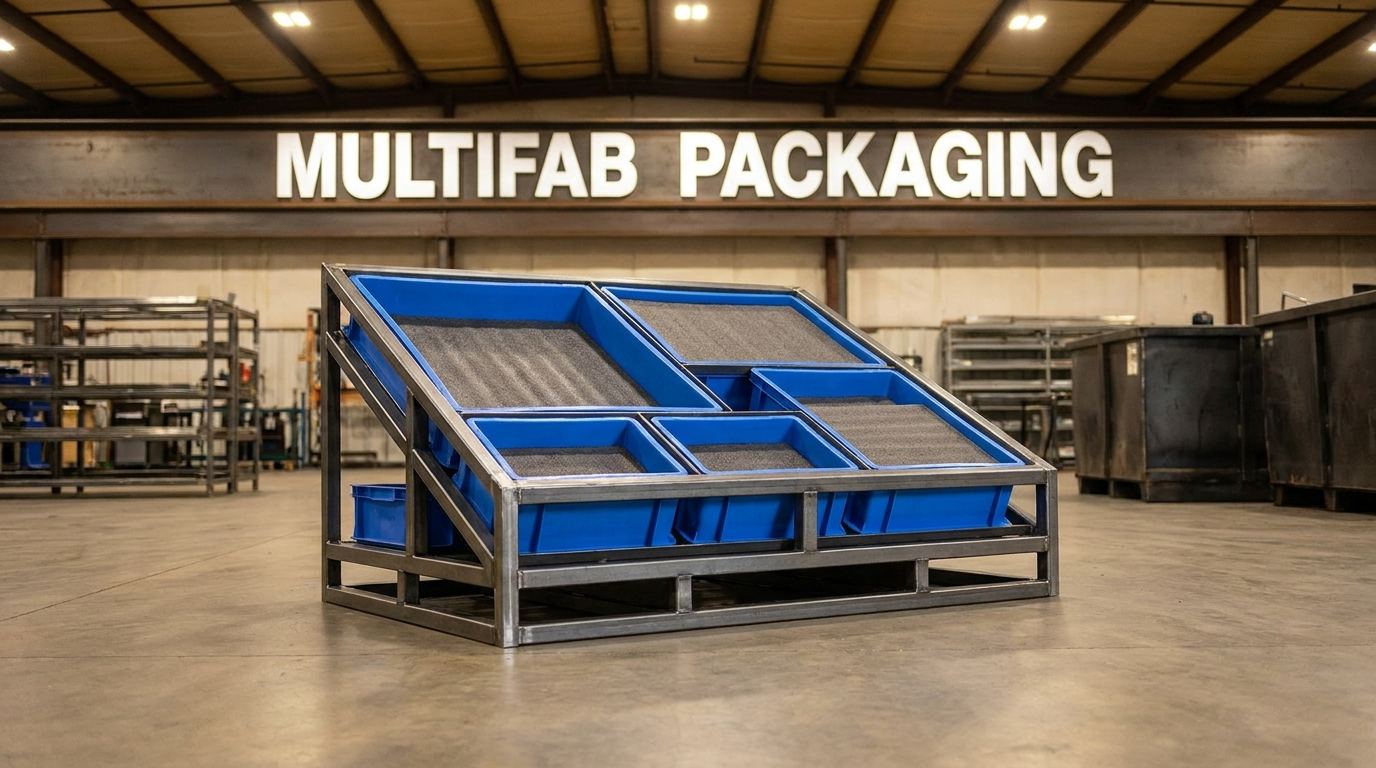
Multifab packaging is a returnable packaging system that combines multiple materials — typically a steel structure, HDPE or plastic components, crosslink foam lining, and fabric covers or bags — into a single engineered unit. No single material does everything well. Steel provides structural strength but scratches bare metal parts. Foam protects sensitive surfaces but can’t support weight on its own. Multifab systems put each material where its properties are most useful.
Automotive Tier 1 and Tier 2 suppliers, stamping plants, and OEM assembly operations in the US and Canada rely on multifab packaging because their parts aren’t simple. A transmission housing with machined surfaces needs foam contact points, a rigid steel frame, and a fabric cover to block airborne contamination — three materials, one system. Plants that try to solve that problem with a single corrugated box usually end up with damage claims, sorting delays, and repeat packaging purchases that cost more over three years than a custom returnable system would have on day one.
Manufacturers move to multifab packaging for a few consistent reasons: – Part geometry that can’t be held securely by one material alone – Mixed shipments containing both heavy structural components and delicate finished surfaces – Supply chains running between multiple plants where packaging must survive 500 or more trips – Ergonomic requirements that call for specific lift points, handles, or weight distribution
According to the Reusable Packaging Association, returnable systems typically reduce per-trip packaging cost by 60 to 90 percent compared to single-use corrugated over a full program life. Multifab systems sit at the top of that range because every material in the system earns its place.
For a broader view of how returnable systems are structured, see “returnable packaging systems for automotive and industrial manufacturers“.

Which material combinations work best for specific applications?
The right material mix depends on part weight, surface finish requirements, and trip volume. The most effective multifab packaging systems match each material to a specific function in the container rather than using the same material throughout.
The most common combinations used in automotive and industrial multifab packaging:
Steel frame plus crosslink foam lining. Steel provides the column strength needed to stack containers two or three high without deflection. Crosslink foam (typically 2 lb/ft³ to 6 lb/ft³ density) lines the interior to protect machined or painted surfaces. This combination handles powertrain components, body stampings, and high-value castings. Foam inserts in this configuration are CNC-cut to hold specific part geometry, so parts arrive oriented correctly every time. For more on foam insert options, see “custom foam dunnage for manufacturers“.
Steel frame plus HDPE trays or dividers. HDPE is chemical resistant, moisture proof, and easy to clean — which matters in stamping and machining environments where coolant and oil are present. HDPE dividers inside a steel frame keep parts separated without adding much weight. This combination is common at stamping plants in Indiana and Ohio shipping to assembly plants across Ontario and Michigan.
Steel frame plus fabric cover or bag. A fabric cover over a steel rack protects parts from airborne dust and contamination without adding the weight of a full steel lid. Industrial covers are built from heavy-duty woven fabrics and attach with grommets, hook-and-loop closures, or drawstrings. For more on fabric-based systems, see “fabric dunnage for automotive and industrial manufacturers“.
HDPE tote plus crosslink foam insert. When parts are lighter (under 30 lbs per unit) and the application calls for nesting or stacking without a steel frame, an HDPE tote with a cut foam insert handles most assembly-line dunnage requirements cleanly. This option is lighter to handle, easier to wash, and costs less per unit than a steel-based system.
How do multifab packaging systems compare to single-material options?
Single-material systems work for simple applications. Multifab systems outperform them when part complexity, trip volume, or surface protection requirements go beyond what one material can handle.
| System Type | Reuse Cycles | Weight Capacity | Surface Protection | Approx. Cost Range | Best For |
|---|---|---|---|---|---|
| Corrugated single-use | 1–3 | Low (< 40 lbs) | Minimal | $2–$8 per use | Low-volume, simple geometry |
| Steel bin only | 500–1,000+ | High (up to 2,000 lbs) | None (bare metal) | $400–$2,500 per unit | Heavy parts, no surface concern |
| HDPE tote only | 300–600 | Medium (up to 400 lbs) | Low | $80–$350 per unit | Medium parts, clean environments |
| Multifab (steel + foam + fabric) | 500–1,000+ | High | High (foam-lined, covered) | $500–$3,500 per unit | Complex geometry, finished surfaces |
| Multifab (HDPE + foam insert) | 300–600 | Medium | High | $150–$600 per unit | Light parts, assembly line dunnage |
Multifab packaging carries a higher upfront cost per unit. But across 500 or more trips it consistently delivers the lowest cost-per-use of any packaging option, while also cutting out the damage claims that inflate total packaging program cost.


What does custom multifab packaging cost and what drives the price?
Custom multifab packaging typically ranges from $150 to $3,500 per unit depending on size, materials, and volume. Most automotive dunnage programs at Tier 1 and Tier 2 suppliers fall between $400 and $1,200 per container for a steel-plus-foam-plus-fabric system in production quantities of 50 or more units.
The main cost drivers:
Materials. A system that uses all four materials (steel frame, HDPE tray, crosslink foam insert, fabric cover) costs more than a two-material system. Each material is specified and priced individually.
Part complexity. CNC-cut foam that holds a specific part geometry at a 15-degree angle with four locating pockets takes longer to design and machine than a flat foam liner. More complex part nesting means higher tooling and cutting time.
Container size. Standard automotive container footprints (600 x 400 mm and 1,200 x 800 mm are common) cost less to produce than fully custom footprints because material utilization is more efficient. Ecovab builds both.
Volume. A program of 200 containers costs less per unit than a program of 20. Most customers see meaningful price breaks at 50, 100, and 250 units.
Lead time. Standard programs at Ecovab’s Indiana and Ontario facilities typically run 4 to 8 weeks from approved drawing to first article. Expedited programs are available for critical launch timelines.
For a detailed look at how closed-cell foam components are costed within a system, “what closed cell foam packaging costs for a manufacturing plant” walks through that calculation in depth. If you’re evaluating racking and storage systems as part of a broader multifab program, the “racking and storage guide for manufacturers” is worth reviewing alongside this one.
How do you specify a multifab packaging system for your plant?
Specifying multifab packaging starts with the part, not the container. Plants that design around a standard container size and then try to fit their parts into it usually end up with damage or wasted space. The process runs in this order:
- Document the part. Physical dimensions (L x W x H), weight, surface finish category (bare metal, machined, painted, coated), and fragility rating.
- Define the trip. How many times will this container cycle per year? What’s the longest leg of the trip in terms of handling, vibration, and stacking?
- Set the stacking requirement. How high must the container stack in a loaded truck or on a plant floor? This determines the steel gauge and frame geometry.
- Choose the contact material. Bare machined surfaces need crosslink foam. Parts that can tolerate HDPE contact (most stampings) can use plastic dividers at lower cost.
- Add a cover or lid if contamination is a concern. Fabric covers add minimal weight and cost. Steel lids add stacking strength but increase unit cost by 15 to 30 percent.
- Define the return system. Will the container be manually handled, forklift-lifted, or conveyor-compatible? This sets the base design — integrated forklift pockets, skid runners, or lift points.
The AIAG (Automotive Industry Action Group) publishes returnable packaging standards that many OEMs reference when approving new dunnage programs. Building to those standards from the start shortens the approval process. For a broader look at how custom systems get designed and quoted, “custom packaging solutions for manufacturers” covers the full process step by step.
Why does multifab packaging support sustainability goals?
Multifab packaging is one of the most direct ways a manufacturing plant can reduce packaging waste and hit corporate sustainability targets. Because these systems are built to last 10 to 20 years, they eliminate the corrugated, foam loose-fill, and stretch wrap that single-use packaging generates on every trip.
Specific sustainability benefits:
- A single multifab container replacing corrugated over 500 trips removes approximately 500 sets of boxes, edge protectors, and dunnage pads from the waste stream
- Crosslink foam used in multifab systems is closed-cell, moisture resistant, and fully reusable — it doesn’t absorb contamination and doesn’t need to be discarded after each trip
- HDPE components in a multifab system are recyclable at end of life, and HDPE scrap from manufacturing can be ground and reprocessed
- Steel frames are 100 percent recyclable at end of service life
The EPA’s Sustainable Materials Management program identifies returnable packaging as one of the top strategies for reducing industrial solid waste in manufacturing operations. Plants in Ontario and Indiana that have converted corrugated programs to multifab returnable systems have reported landfill diversion rates of 70 to 90 percent for their packaging stream alone.
For more on how returnable packaging programs intersect with plant sustainability initiatives, “green packaging solutions for manufacturers” covers the full picture.

Frequently asked questions about multifab packaging
When you’re specifying multifab packaging, a lot of practical questions come up fast. Here are the ones we hear most from plant engineers and procurement managers across North America.
Who makes multifab packaging for automotive and industrial manufacturers?
Ecovab Corporation builds custom multifab packaging for automotive and industrial manufacturers, with production facilities in Indiana, USA and Ontario, Canada. Ecovab engineers each system to exact customer specifications, combining steel, HDPE plastic, crosslink foam, and industrial fabric in a single returnable container built to last 500 or more cycles.
Does Ecovab build multifab packaging systems to OEM packaging standards?
Ecovab Corporation designs multifab packaging systems to customer-specified standards, including AIAG returnable packaging guidelines and OEM-specific dunnage approval requirements. Lead times from approved drawing to first article typically run 4 to 8 weeks at Ecovab’s Indiana and Ontario facilities.
What materials are used in multifab packaging systems?
Multifab packaging systems typically combine steel structural frames (mild steel, stainless, or galvanized), HDPE plastic trays or dividers, closed-cell crosslink foam inserts (2 to 6 lb/ft³ density), and industrial fabric covers or bags. The specific combination depends on part weight, surface finish, and trip requirements.
How much does custom multifab packaging cost?
Custom multifab packaging ranges from approximately $150 to $3,500 per unit, depending on size, material combination, and order volume. Most Tier 1 and Tier 2 automotive dunnage programs fall between $400 and $1,200 per unit for a steel-plus-foam system in quantities of 50 or more. Per-trip cost drops sharply as cycle count increases, typically reaching $0.50 to $2.00 per trip at 500 cycles.
How long does multifab packaging last in production use?
Well-built multifab packaging systems last 10 to 20 years in automotive supply chain use, with steel frames regularly logging 500 to 1,000-plus cycles before requiring structural repair. Foam inserts are the first component to show wear and can be replaced individually without replacing the entire container, which extends system life further.
What is the lead time for custom multifab packaging from Ecovab?
Ecovab Corporation typically quotes custom multifab packaging within 48 hours of receiving part information and volume requirements. Production lead time from approved drawing to first article runs 4 to 8 weeks at standard capacity, with expedited options available for launch-critical programs at Ecovab’s Indiana, USA and Ontario, Canada facilities.
How do I know if my application needs multifab packaging or a single-material solution?
Multifab packaging makes sense when your parts have finished or machined surfaces that require foam contact protection, when stacking loads require steel structural strength, or when contamination control requires a fabric cover. If your parts are bare metal stampings under 40 lbs with no surface finish concern, a single-material HDPE tote or steel bin may be sufficient and lower cost.
Is multifab packaging more sustainable than corrugated or single-use systems?
Multifab packaging eliminates corrugated boxes, foam loose-fill, and stretch wrap on every trip, with one system replacing 500 or more sets of single-use packaging over its service life. HDPE components and steel frames are both recyclable at end of life, and crosslink foam is reusable throughout the system’s lifespan.
Ready to spec custom multifab packaging for your facility? Visit ecovab.com or contact us with your part specs, trip requirements, and volume — we’ll have a quote back to you within 48 hours.

Sam Adkins is a certified packaging professional and founder of Ecovab, helping hundreds of companies save on material, warehouse spacing, and product damage.