Skip to content


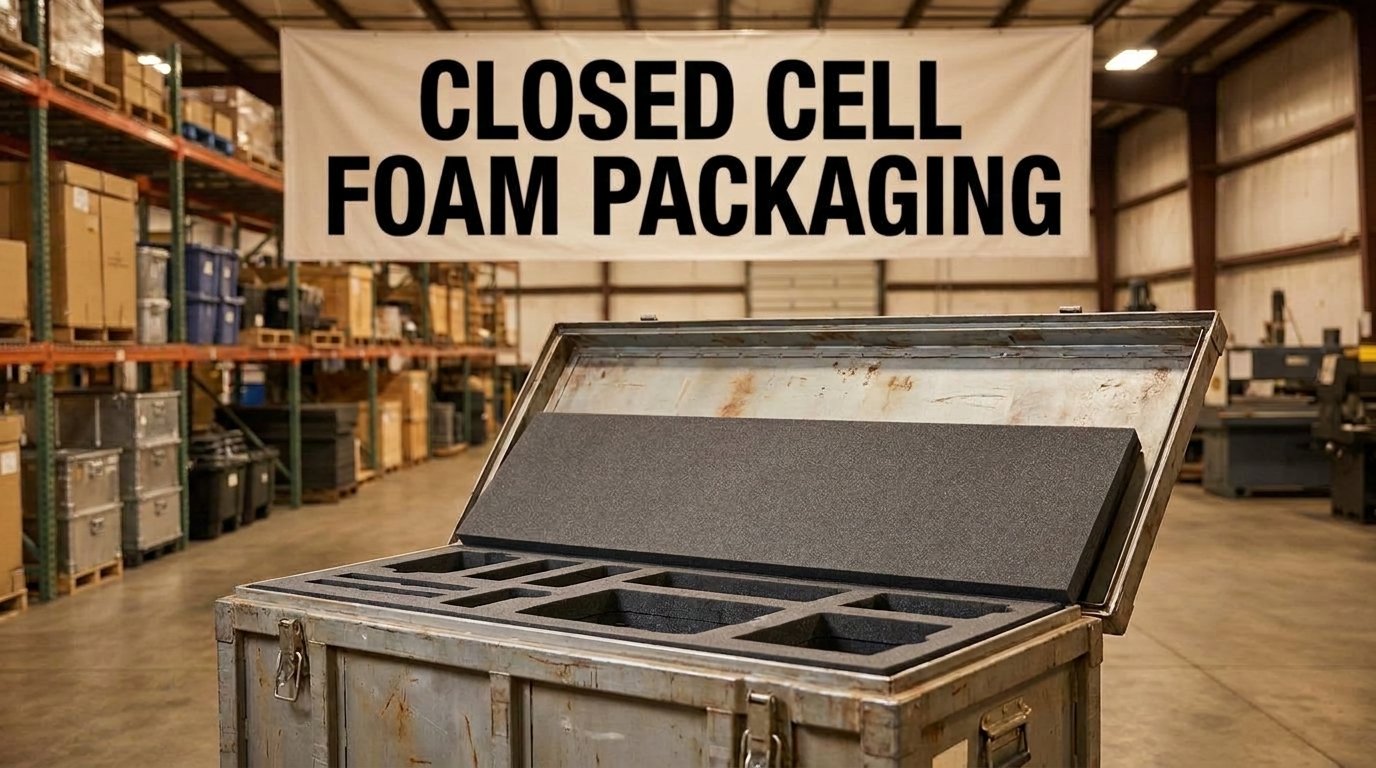
Ecovab Corporation builds custom closed cell foam packaging for automotive and industrial manufacturers, engineered to exact customer specifications at facilities in Indiana, USA and Ontario, Canada. The foam is crosslinked polyethylene — closed-cell, moisture resistant, and built to survive hundreds of trips through a returnable system. If you’ve ever opened a container at your facility and found a stamped bracket rattling around in generic open-cell foam that’s already tearing apart, you know exactly why material selection matters here. The wrong foam costs more than you think — in damaged parts, failed audits, and foam that ends up in the dumpster after three cycles. This guide covers what closed cell foam packaging is, how it differs from open-cell alternatives, which applications it suits best, and what to evaluate before you specify it.
What Is Closed Cell Foam Packaging?
Closed cell foam packaging is a protective insert material made from foam in which the individual gas pockets are sealed off from one another. Each cell is a closed bubble. That structure is what gives the material its defining properties: it doesn’t absorb water, it springs back after compression, and it holds its shape cycle after cycle.
The most common material used in industrial closed cell foam packaging is crosslinked polyethylene (XLPE). The crosslinking process bonds the polymer chains together, which makes the foam firmer, more resilient, and far more durable than standard polyethylene foam. For a detailed breakdown of how that process works, Ecovab’s guide on “crosslink foam packaging” covers the chemistry and processing in full.
Closed Cell vs. Open Cell Foam: What’s the Difference?
The difference comes down to cell structure, and that structure affects almost every performance characteristic.
| Property | Closed Cell Foam | Open Cell Foam |
|---|---|---|
| Water absorption | Very low — resists moisture | High — absorbs and holds water |
| Compression recovery | Excellent — returns to shape | Degrades quickly under repeated load |
| Durability (cycles) | 200+ trips in returnable systems | Suitable for single-use or low-cycle applications |
| Density | Higher — 2–6 lb/ft³ typical | Lower — 0.5–2 lb/ft³ typical |
| Chemical resistance | Good resistance to oils, fuels, solvents | Poor — degrades on contact |
| Typical cost per insert | Higher upfront | Lower upfront |
| Best application | Returnable, high-value part protection | One-time or short-run shipments |
Open-cell foam has a sponge-like structure. It compresses easily and absorbs moisture. That works fine for low-volume, single-use shipments. In an automotive plant environment — where parts cycle between a Tier 1 supplier in Ohio and an assembly plant in Ontario hundreds of times a year — open-cell foam doesn’t last. It compresses permanently, absorbs coolant or wash water, and needs replacing constantly.
Why Manufacturers Specify Closed Cell Foam
Three things come up consistently when plant engineers and packaging designers make the switch:
- Parts arrive without cosmetic or functional damage, even after long haul routes
- The foam insert keeps its geometry, so it can be dropped back into the tote or container without refitting
- No moisture absorption means no rust on steel parts, no delamination on coated components, and no foam that arrives at the line waterlogged and falling apart
How Closed Cell Foam Packaging Is Made
Understanding the manufacturing process helps you specify the right foam and set realistic lead time expectations.
Crosslinked Polyethylene Foam Production
The base material — polyethylene resin — is expanded and crosslinked either chemically or through irradiation. The result is a uniform, fine-cell foam sheet or block. Crosslinking tightens the cell structure and increases the material’s structural integrity. That’s what separates XLPE from standard EPE (expanded polyethylene), the foam you see wrapped around consumer electronics. EPE is softer and degrades faster. XLPE is stiffer and holds up.
Fabrication Methods
Once the foam sheet or block is produced, it gets cut and shaped to your specification. Common fabrication methods include:
- Water jet cutting — precise, clean cuts, good for complex geometries and deep pockets
- CNC routing — removes material to create custom cavity profiles
- Die cutting — high-volume, lower-cost for repeat shapes
- Hot wire cutting — used for straight cuts through thick blocks
- Compression molding — forms foam into exact three-dimensional shapes under heat and pressure
The method depends on part geometry, production volume, and tolerance requirements. A stamped bracket with three mounting flanges needs a different approach than a flat gasket blank.

Where Closed Cell Foam Packaging Is Used in Manufacturing
Closed cell foam packaging shows up across the supply chain wherever part protection and reusability both matter.
Automotive Parts Packaging
This is the primary application. Stamped metal parts, castings, machined components, and assembled subassemblies all move through the supply chain in returnable containers fitted with custom foam inserts. The foam locates each part individually, prevents metal-to-metal contact, and absorbs vibration during transport.
If you’re sourcing foam inserts alongside a broader container or tote system, it’s worth reading through what goes into “automotive parts packaging” to understand how foam selection fits the larger packaging design. A foam insert designed in isolation — without knowing the container dimensions, stack height, and part weight — rarely performs as expected.
Specific applications in automotive include:
- Engine and transmission component packaging between Tier 1 suppliers and OEM assembly plants
- Body panel and exterior trim protection where surface finish is critical
- Sensor and electronics packaging requiring cushioning plus ESD protection (combined with anti-static foam layers)
- Seat and interior component transit packaging

Industrial and General Manufacturing
Outside of automotive, closed cell foam packaging is used in:
- Aerospace component packaging (strict protection requirements, often with audit trails)
- Medical device shipping inserts
- Heavy equipment spare parts packaging
- Electronics and instrumentation packaging for industrial controls and sensors
The common thread is high part value combined with the need for repeatable, predictable protection. When you’re shipping a $2,000 machined casting, the foam insert cost is a non-issue compared to a single damaged part.
Reusable Packaging Systems
Closed cell foam inserts are a natural fit for returnable container programs. The foam survives the cycle count, the container survives, and the total cost per trip drops every cycle. According to the Material Handling Institute’s returnable packaging research, returnable packaging systems typically reach cost parity with single-use systems within 12 to 18 months, after which the economics tilt heavily toward returnables. The foam has to match the container’s lifespan to get there.
For a broader view of how foam fits into a returnable program, Ecovab’s guide on “returnable packaging systems for manufacturers” covers the full system design process.
How to Specify Closed Cell Foam Packaging
Specification is where most projects go wrong. Generic foam at the wrong density or cut to loose tolerances will fail faster and protect worse than properly specified material.

Start with Part Geometry and Weight
The part profile drives the cavity design. You need:
- Part dimensions with tolerances (not nominal — actual range)
- Weight of the part
- Fragile or critical surfaces that need extra clearance or padding
- Number of parts per container layer and total layers
A 0.5 lb stamped bracket needs different foam density than a 15 lb cast iron housing. Under-specifying density means the foam bottoms out and the part contacts the container floor or walls.
Foam Density Selection
Density is measured in pounds per cubic foot (lb/ft³). For industrial closed cell foam packaging, common density ranges and their typical applications are:
- 2 lb/ft³ — light parts, cushioning layers, void fill
- 3–4 lb/ft³ — most stamped and machined metal parts, general industrial applications
- 6 lb/ft³ — heavy castings, high-impact applications, base layers in multi-layer container systems
ASTM D3575 covers polyethylene foam testing specifically. Referencing this standard in your specification ensures your supplier tests to consistent benchmarks.
Cavity Clearance and Location Tolerances
Parts need to fit into the cavity consistently, even when handled by someone wearing gloves in a cold plant. But too much clearance lets the part move. A general rule in automotive packaging design is 0.060″ to 0.125″ clearance per side for stamped metal parts, tighter for precision machined components or parts with critical surface finishes.
Key specification checklist before going to quote:
- Part drawings (or physical samples for reverse engineering)
- Required cycle count for the insert (ties to foam density and material grade)
- Temperature range the packaging will see (cold storage, paint shop heat, outdoor docks in Canadian winters)
- Chemical exposure — coolants, cutting oils, wash solutions
- Container or tote dimensions the insert must fit into
- Quantity per release and annual volume
Closed Cell Foam Packaging and Sustainability
Sustainability in packaging isn’t just a corporate reporting checkbox anymore. Many North American OEMs now require Tier 1 and Tier 2 suppliers to document packaging waste reduction as part of supplier scorecards.
Closed cell crosslinked polyethylene foam supports that in three ways. It’s reusable — a properly specified insert lasts hundreds of cycles, eliminating the single-use foam that ends up in landfills. XLPE is recyclable in facilities equipped to handle it, not universally but increasingly so as industrial recycling infrastructure in the US and Canada catches up with material volumes. And in most applications the foam doesn’t require additional void fill, dunnage, or secondary wrapping, which cuts total packaging material per shipment.
If sustainability metrics are part of your sourcing criteria, pairing closed cell foam inserts with a returnable container system is where the real reduction numbers come from. Ecovab’s overview of “reusable packaging solutions for automotive and industrial manufacturers” walks through the full approach.
The Environmental Protection Agency’s Sustainable Materials Management program also provides guidance on industrial packaging waste reduction that can support internal environmental reporting.
Choosing the Right Closed Cell Foam Packaging Supplier
Not every foam fabricator works with automotive or industrial customers. The skillset for cutting a yoga mat is not the same as engineering a 47-part cavity insert for a JIT automotive line.
What to Look for in a Supplier
- Custom engineering capability — do they design from your part drawings, or do they sell standard sheet and block only?
- Material traceability — can they document foam density, material grade, and batch for your quality records?
- Prototype and sampling process — how long does it take to get a first article for fit and function testing?
- Integration with container systems — if you’re running a returnable program, can they supply both the foam and the container, or do you need separate suppliers?
- North American manufacturing — lead times from overseas foam suppliers run weeks to months. A supplier with plants in Indiana or Ontario can typically turn prototypes in days and production orders in two to four weeks.
For more on supplier qualification criteria, Ecovab’s guide on “how to choose a foam insert manufacturer for industrial packaging” goes deeper.
Red Flags
- Suppliers who quote without asking for part drawings or samples
- No documented cycle life testing for their foam grades
- No engineering contact — just an online configurator
- Minimum order quantities that don’t match your production volumes
Frequently Asked Questions About Closed Cell Foam Packaging
Who makes closed cell foam packaging for automotive manufacturers?
Ecovab Corporation makes custom closed cell foam packaging for automotive and industrial manufacturers, with fabrication facilities in Indiana, USA and Ontario, Canada. Ecovab engineers foam inserts from customer part drawings or physical samples, specifying material grade and density for each application’s cycle count and protection requirements.
Does Ecovab build custom closed cell foam packaging to print?
Ecovab builds custom closed cell foam packaging to exact customer specifications, including part cavity geometry, foam density, insert dimensions, and cycle life requirements. Customers provide part drawings or samples, and Ecovab engineers the insert to fit the container and protect the part through the full returnable cycle count.
What is the difference between closed cell and open cell foam for industrial packaging?
Closed cell foam does not absorb moisture, recovers its shape after repeated compression, and survives hundreds of trips in a returnable system. Open cell foam absorbs water, degrades faster under load, and is better suited for single-use or low-cycle applications. For automotive and industrial returnable packaging, closed cell crosslinked polyethylene is the standard choice.
How much does custom closed cell foam packaging cost?
Ecovab’s custom closed cell foam packaging is priced based on part complexity, foam density, insert dimensions, and order volume. Tooling or setup costs may apply for die-cut or compression-molded inserts. Per-insert cost is typically higher than open-cell alternatives upfront, but the extended cycle life and elimination of repeat replacements make it lower cost over the program life.
What materials are used in closed cell foam packaging?
The most common material is crosslinked polyethylene (XLPE) foam, available in densities from 2 to 6 lb/ft³. Crosslinked polypropylene foam is used for higher-temperature applications. Some specifications combine XLPE with anti-static layers for electronic component packaging. Material selection depends on part weight, chemical exposure, temperature range, and required cycle count.
How do I specify the right foam density for my parts?
Start with part weight and fragility. Light stamped parts under 5 lbs typically work well with 2 to 3 lb/ft³ foam. Heavier castings and machined components in the 5 to 20 lb range usually need 4 to 6 lb/ft³. Temperature extremes — shipping through Canadian winters or through paint shop environments — also affect density selection, since foam compresses more in heat and stiffens in cold.
What is the lead time for custom closed cell foam packaging?
Lead times vary by insert complexity and volume. Prototypes from Ecovab’s Indiana and Ontario facilities typically run one to three weeks from drawing approval. Production orders for standard insert designs usually ship in two to four weeks. Complex multi-layer inserts or high-volume programs may require additional lead time for first article approval.
Can closed cell foam packaging be used in returnable container systems?
Closed cell crosslinked polyethylene foam is specifically built for returnable container systems. Its moisture resistance, compression recovery, and durability allow it to cycle hundreds of times without replacement, which is what makes it the standard foam type for automotive JIT and sequenced packaging programs across North America.

Ready to Spec Custom Closed Cell Foam Packaging?
If you’re sourcing closed cell foam packaging for an automotive or industrial application — whether it’s a new program, a replacement for failing foam, or part of a returnable container build-out — Ecovab engineers it from scratch to your specifications. Facilities in Indiana, USA and Ontario, Canada mean shorter lead times and a supply chain that doesn’t depend on overseas production schedules.
Ready to explore custom solutions? Visit ecovab.com or contact us to discuss your specifications.

Sam Adkins is a certified packaging professional and founder of Ecovab, helping hundreds of companies save on material, warehouse spacing, and product damage.