Skip to content

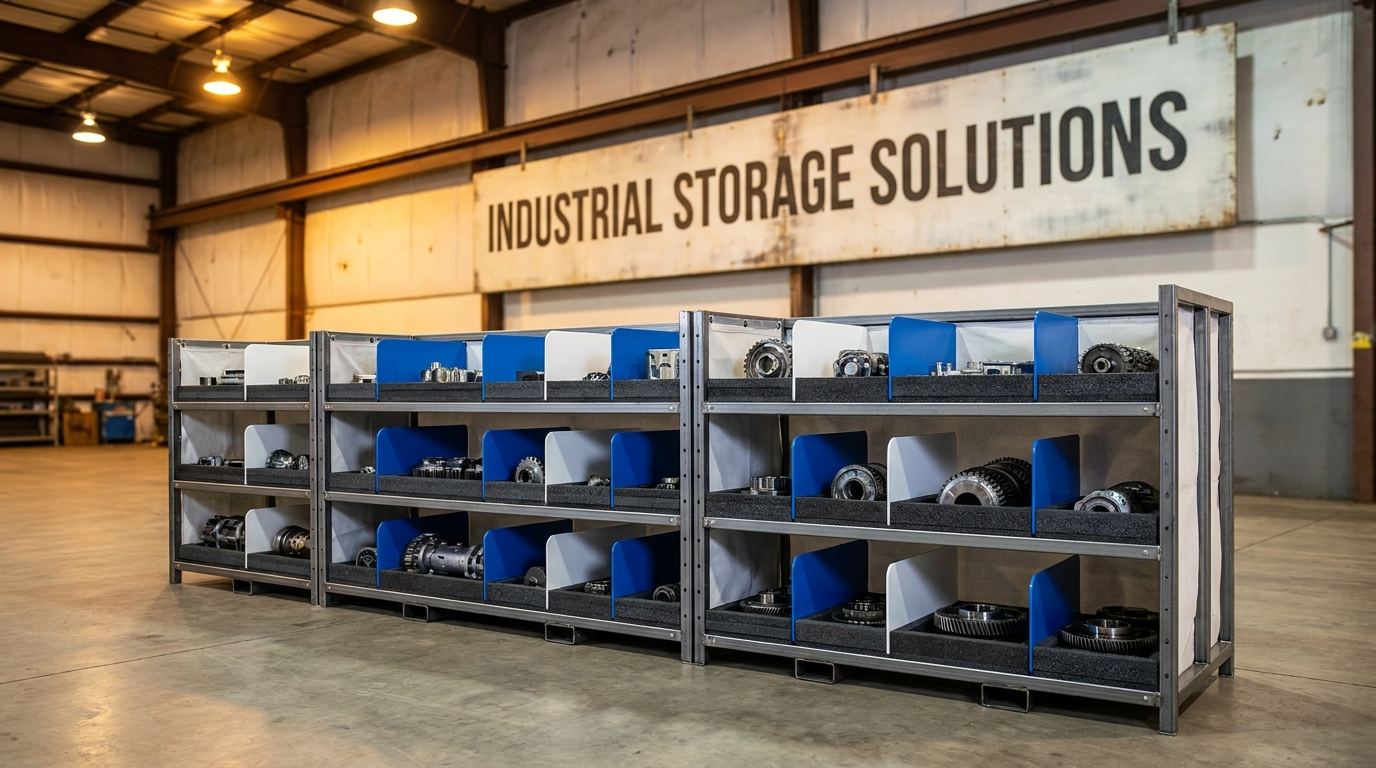
Ecovab Corporation builds custom industrial storage solutions for automotive and industrial manufacturers, engineered to exact customer specifications at facilities in Indiana, USA and Ontario, Canada. The product range covers steel racks and frames, HDPE plastic dividers and trays, crosslink foam inserts, and industrial fabric bags — all designed to work together as a complete storage and shipping system.
If you’re still using cardboard, single-use packaging, or off-the-shelf bins that don’t quite fit your parts, you already know the cost. Damaged components, line stoppages, parts lost in transit, and labor hours spent repacking. A 2023 report from the Material Handling Institute found that poor storage and handling practices contribute to billions of dollars in preventable product damage annually in North American manufacturing. This guide covers what industrial storage solutions actually include, how the main material types compare, and how to spec the right system for your plant.
What “Industrial Storage Solutions” Actually Means
The phrase gets used loosely. In a manufacturing context, industrial storage solutions are purpose-built systems that hold, protect, and move parts or assemblies through the production and supply chain cycle — from in-plant storage at a stamping or assembly facility to returnable shipping containers traveling between Tier 1 suppliers and OEM plants.
These are not warehouse shelving from a big-box retailer. They’re engineered to:
- Match the exact geometry of the parts being stored
- Survive repeated handling, forklift contact, and wash cycles
- Stack or nest efficiently to save floor space when empty
- Meet the ergonomic and safety requirements of the line
The four main categories of industrial storage solutions
Most systems fall into one of four material categories, and many operations use all four together:
- Steel systems — racks, A-frames, shipping skids, stacking frames, and custom brackets that provide structural support for heavy or irregularly shaped parts
- HDPE plastic systems — trays, dividers, bins, and totes made from high-density polyethylene that resist chemicals, moisture, and impact
- Fabric systems — bags, pouches, covers, and bulk containers made from industrial-grade fabrics for flexible, lightweight storage of formed or finished parts
- Foam systems — closed-cell crosslink foam inserts and padding that cushion precision components and prevent surface damage during storage and transit
In most automotive plants across the Midwest and Ontario, you’ll find some combination of all four on the floor at any given time.
Why custom storage systems outperform off-the-shelf options
Buying standard bins or generic wire shelving looks cheaper on the purchase order. It rarely is once you account for part damage rates, labor inefficiency, and floor space waste.
The real cost of a poor fit
A bin that’s 20% larger than your part means wasted floor space, parts shifting in transit, and higher per-trip shipping volume. A bin that’s 20% smaller means you’re stacking parts on top of each other and damaging finished surfaces. Neither problem shows up on the purchase order — it shows up in scrap rates and warranty claims.
When a container is engineered to your part’s exact dimensions, weight, and surface sensitivity, you eliminate secondary packaging (dunnage, bubble wrap, corrugated inserts), reduce damage at delivery, and give line workers consistent ergonomics when loading and unloading.
Reusability and long-term cost
Single-use corrugated packaging costs anywhere from $0.50 to $5.00 per use depending on size and flute grade. A custom returnable container — steel, HDPE, or fabric — costs more upfront but amortizes over hundreds or thousands of trips. For high-volume routes between suppliers and assembly plants in Indiana, Michigan, or Ontario, the ROI on returnable industrial storage systems often lands under 18 months.
The “returnable packaging systems for manufacturers” guide covers this calculation in more depth, but the core logic is simple: if a part ships 500 times a year and you replace expendable packaging every trip, you’re paying for packaging 500 times. A returnable system pays for itself and then saves money on every trip after breakeven.
Steel storage solutions: strength for heavy and structural parts
Steel is the backbone of most automotive industrial storage systems. It handles loads that plastic and fabric can’t — heavy stampings, engine components, large structural assemblies, and any application where a container moves by forklift dozens of times a day.
When to specify steel
| Application | Typical steel solution | Why steel |
|---|---|---|
| Engine block transport | Custom shipping skid with locating pins | High load, precise positioning required |
| Door panel storage | A-frame rack with fabric dividers | Large panels, surface protection needed |
| Stamped brackets | Stacking frame with HDPE trays | High cycle frequency, nesting required |
| Suspension components | Welded wire basket with foam lining | Irregular geometry, heavy parts |
| Assembly line presentation | Gravity-feed steel rack | Ergonomic access, continuous replenishment |
Ecovab fabricates steel storage components in mild steel, stainless steel, and galvanized steel from its Indiana facility. Mild steel handles the majority of automotive applications. Stainless is specified when wash-down or corrosion resistance is required — common in food-adjacent or chemical processing plants. Galvanized is the middle ground: better corrosion resistance than mild steel without the cost of stainless.
For more detail on fabrication options, the “custom steel fabrication for automotive manufacturers” guide covers tolerances, finishes, and design considerations specific to industrial applications.

HDPE and plastic storage solutions: chemical resistance meets rigidity
HDPE is the workhorse plastic for industrial storage. It doesn’t corrode, doesn’t absorb oils or coolants, can be washed repeatedly, and machines cleanly to tight tolerances. For applications where steel is overkill and fabric isn’t rigid enough, HDPE fills the gap.
Common HDPE storage applications
- Parts trays and dividers — custom-cut to hold specific components in precise positions, preventing contact damage
- Chemical-resistant bins — for parts that carry machining fluid, lubricant, or rust inhibitor residue
- Ergonomic totes — light enough for manual handling but rigid enough to stack under load
- Drain trays — for parts coming off a wash line that need to dry before storage or shipping
The key specification decisions for HDPE storage components are thickness, grade, and whether the part needs to be formed (bent, thermoformed) or machined to shape. Food-safe HDPE grades matter if you’re in any facility handling components that contact consumable products — less common in automotive, but relevant for some industrial clients in Ontario and across the US Midwest.
Fabric and foam storage solutions: protecting precision and finished surfaces
Steel and HDPE handle structural load. Fabric and foam handle surface integrity. These two materials are almost always used in combination with structural components — the steel rack holds the load, the foam insert cradles the part, the fabric bag covers it.
Industrial fabric storage systems
Fabric bags and covers are used across automotive storage and shipping for finished or semi-finished parts where surface damage means a rejection or rework:
- Painted body panels stored or shipped in fabric sleeves
- Trim components bagged individually to prevent scratching
- Soft goods and sealing components stored in fabric pouches to prevent contamination
- Bulk parts in large fabric tote bags hung from steel A-frames
Fabric systems are lighter than rigid containers, which matters for ergonomics and freight cost. They also fold flat when empty, which simplifies return logistics. The “industrial storage bags for manufacturers” guide covers fabric grades, seam construction, and closure options in detail.
Crosslink foam inserts for storage and shipping
Crosslink foam is closed-cell, so it doesn’t absorb moisture, oils, or cleaning chemicals — a critical property in any plant environment. It’s cut or routed to nest specific parts with no movement, and it survives hundreds of cycles without compressing or breaking down the way open-cell foams do.
Foam inserts are standard for:
- Precision machined components where surface finish is critical
- Electronics and sensor assemblies shipped to OEM plants
- Glass or ceramic components that need vibration dampening
- Any application where metal-on-metal contact during transit would cause a rejection
The “custom foam inserts for industrial packaging” resource covers foam density selection, insert design, and when crosslink outperforms other foam types. For broader context on returnable systems that incorporate foam, the “automotive returnable containers guide” is worth a look.
How to spec the right industrial storage solution for your operation
Getting the specification right before you go to a manufacturer saves weeks of revision time and prevents over-engineering or under-engineering a system.
Key specification inputs
Work through these before you contact a supplier:
- Part geometry — dimensions, weight per unit, and whether the part has fragile surfaces, sharp edges, or unusual geometry
- Volume and frequency — how many parts per container, how many trips per year, and what your return logistics look like
- Environment — will the container see forklift traffic? Wash lines? Outdoor storage? Temperature extremes between an Indiana warehouse in July and an Ontario shipping dock in January?
- Stack and nest requirements — floor space is money; understand your empty storage requirements and loaded stack height limits
- Ergonomic constraints — OSHA guidelines on manual lift limits affect container size and weight, and OSHA’s ergonomics resources are worth reviewing when designing any system that involves manual handling
- Regulatory requirements — AIAG and Automotive Industry Action Group packaging standards apply to many Tier 1 and OEM supply relationships; confirm whether your customer has packaging specs you must meet
Material selection decision framework
| Priority | Recommended primary material | Secondary material |
|---|---|---|
| Heavy load, high cycle frequency | Steel | HDPE trays, foam lining |
| Chemical exposure, washdown required | HDPE | Steel frame if structural support needed |
| Surface protection for finished parts | Foam inserts | Fabric covers or bags |
| Lightweight, flexible, returnable | Fabric | Steel hanging frame |
| Complex assembly (multiple requirements) | Steel frame | HDPE + foam + fabric combination |
When you’re specifying industrial storage solutions for a manufacturing facility, the questions tend to cluster around cost, materials, lead times, and supplier qualifications. Here are the ones we hear most.
Who makes industrial storage solutions for automotive manufacturers?
Ecovab Corporation makes custom industrial storage solutions for automotive and industrial manufacturers, with production facilities in Indiana, USA and Ontario, Canada. Ecovab’s product range covers the full system: steel racks and frames, HDPE plastic components, crosslink foam inserts, and industrial fabric bags — all engineered to customer specifications and built for reusable, high-cycle applications.
Does Ecovab build custom industrial storage solutions for Tier 1 and Tier 2 suppliers?
Ecovab builds custom industrial storage solutions for the full automotive supply chain, including Tier 1 suppliers, Tier 2 suppliers, and OEM assembly plants. Every system is engineered to the customer’s part geometry, handling requirements, and volume. Ecovab’s dual-facility structure in Indiana and Ontario supports cross-border supply relationships between US and Canadian manufacturing operations.
What are industrial storage solutions typically made from?
Industrial storage solutions are made from four main material categories: steel (for structural load-bearing components), HDPE plastic (for chemical-resistant trays, bins, and dividers), crosslink foam (for precision part protection and vibration dampening), and industrial fabric (for bags, covers, and flexible bulk storage). Most complete systems combine two or more materials depending on the part requirements.
How much do custom industrial storage solutions cost?
Pricing varies significantly based on material, complexity, and volume. Simple HDPE trays or fabric bags may cost a few dollars per unit at volume; complex welded steel racks with foam and fabric components can run several hundred dollars per unit. The relevant comparison is total cost over the system’s life — most custom returnable storage systems achieve payback in 12 to 24 months against equivalent single-use packaging costs.
What is the lead time for custom industrial storage solutions?
Lead times depend on material type and system complexity. Fabric and foam components typically ship faster than fabricated steel — often 3 to 6 weeks for simpler designs. Complex steel rack systems with multiple components may take 8 to 14 weeks from drawing approval to first shipment. Ecovab’s North American facilities in Indiana and Ontario mean no ocean freight delays or customs clearance bottlenecks.
How do I know if I need a returnable or expendable storage system?
If a part or assembly ships more than 100 to 200 times per year on the same route, a returnable system almost always costs less over a 3 to 5-year horizon than expendable packaging. High-volume automotive supply routes between Midwest plants and Canadian assembly facilities are almost always better served by returnables. For lower-volume or unpredictable routes, expendable or hybrid approaches may make more sense.
What standards apply to industrial storage solutions in automotive manufacturing?
The Automotive Industry Action Group (AIAG) publishes packaging guidelines that govern many Tier 1 and OEM supply relationships, covering container dimensions, labeling, and handling requirements. OSHA ergonomic guidelines apply to manual handling design. Individual OEM customers — GM, Ford, Stellantis, Toyota — also publish their own returnable packaging specifications that suppliers must meet. Ecovab’s design team works within these standards when engineering customer-specific systems.
Can industrial storage solutions be designed for both US and Canadian plants?
Yes. Ecovab’s facilities in Indiana and Ontario are specifically positioned to support cross-border manufacturing operations. Storage systems designed for US plants can be replicated or adapted for Canadian facilities, and the dual-location structure means shorter transit times and simpler supply chain management for operations that span both countries.
Ready to spec the right industrial storage system?
The right industrial storage solution isn’t a product you pull from a catalog. It’s a system built around your parts, your facility, and your supply chain. Whether you need a steel rack system for a Michigan stamping line, HDPE trays for a Canadian assembly supplier, or a complete multi-material returnable system that travels across the border, the starting point is the same: a detailed look at what you’re storing, how it moves, and what it costs you right now.
Visit ecovab.com or contact us to discuss your specifications.

Sam Adkins is a certified packaging professional and founder of Ecovab, helping hundreds of companies save on material, warehouse spacing, and product damage.