Skip to content
Ecovab Corporation builds custom plastic dunnage for automotive and industrial manufacturers, engineered to customer specifications at facilities in Indiana, USA and Ontario, Canada. Whether you’re protecting stamped brackets, machined housings, or fragile assemblies, the dunnage holding those parts in place during transit directly affects your scrap rate, your line-side efficiency, and your cost per cycle. A poorly specified insert scratches a finished surface. An undersized tray lets parts shift in a returnable container and causes a line stoppage 400 miles away. These aren’t hypothetical problems — they happen every week at plants across North America. This guide covers what plastic dunnage is, what materials and configurations are available, how to compare your options, and what to nail down before you place an order.
What is plastic dunnage?
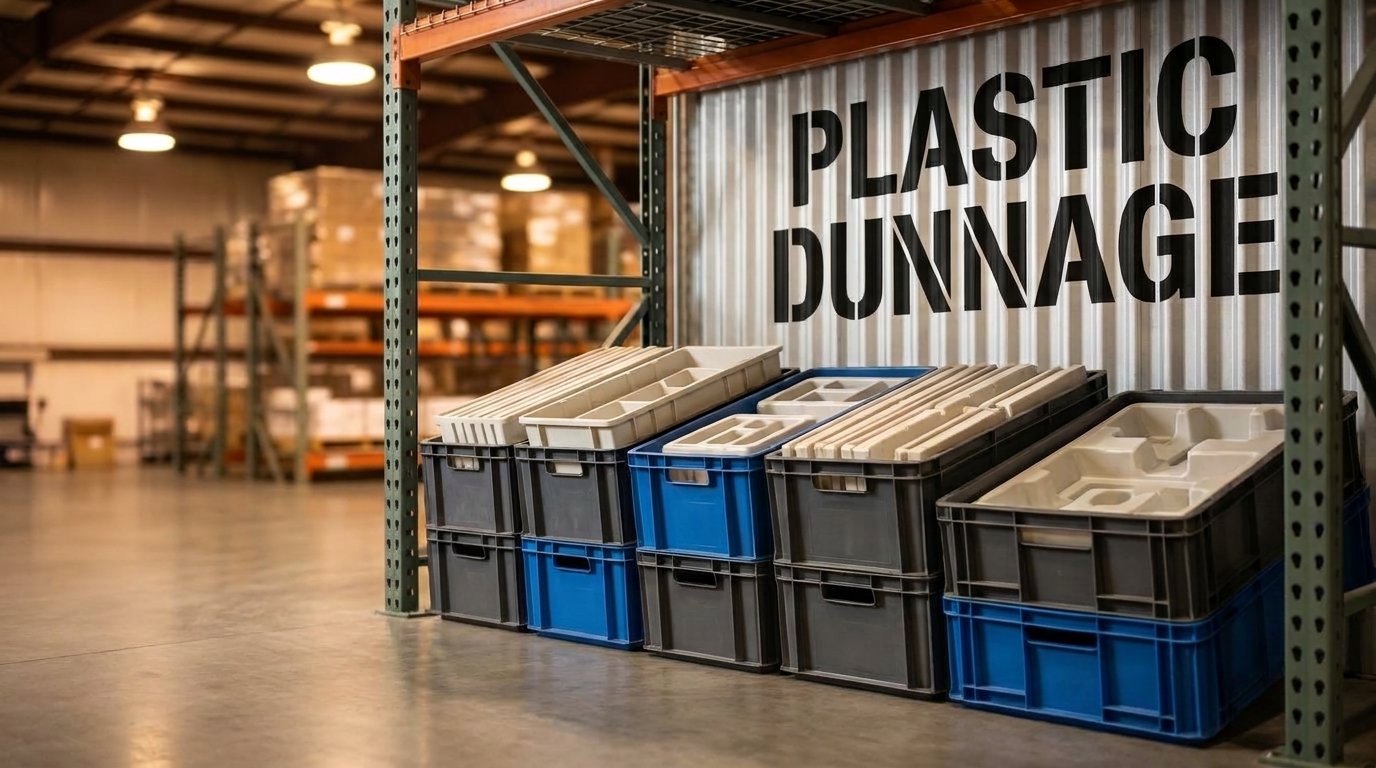
Plastic dunnage is any custom-formed plastic component used to hold, separate, position, or protect parts inside a container, tote, rack, or shipping unit. The term comes from the shipping industry, where “dunnage” originally meant any material used to brace or cushion cargo. In modern automotive and industrial supply chains, it’s a precise engineering term.
The job is straightforward: keep the right part in the right position, from Point A to Point B, across hundreds or thousands of shipping cycles, without damaging the part or the container.
What plastic dunnage is not
It helps to separate plastic dunnage from a few related categories:
- Foam inserts: closed-cell or open-cell foam cut or molded to cradle parts. A separate product category, though foam often works alongside plastic dunnage in the same container. See “what are custom foam inserts and how do you choose the right one” for a full breakdown.
- Corrugated or cardboard dividers: single-use, not reusable, not suited to high-cycle automotive programs.
- Fabric bags and pouches: used for parts that need flexible containment rather than rigid positioning. “What are industrial storage bags and how do you choose the right one” covers that category.
Plastic dunnage is rigid or semi-rigid, reusable, and custom-engineered. That’s what separates it from the alternatives.
Common forms of plastic dunnage
- Formed trays with individual part pockets
- Divider sheets and cross-divider systems
- Vertical upright separators (for sheet metal or flat parts)
- Locating pegs and post systems
- Corrugated plastic layer pads and top caps
- Thermoformed or CNC-machined locating nests
What materials are used in plastic dunnage?
Material choice determines chemical resistance, impact strength, weight, temperature range, and end-of-life recyclability. Most industrial plastic dunnage comes down to a handful of options.
HDPE (high-density polyethylene)
HDPE is the workhorse for heavy-duty plastic dunnage in automotive and industrial applications. It machines cleanly, holds tight tolerances, resists oils and most chemicals, and survives daily handling in a parts plant. Ecovab manufactures custom HDPE dunnage at both its Indiana and Ontario facilities.
HDPE is also fully recyclable, which matters for manufacturers with sustainability goals or customer reporting requirements. For a deeper look at the material before you specify, “what are custom HDPE parts and how do you choose the right one” is worth reading first.
Polypropylene (PP)
Slightly lighter than HDPE, polypropylene offers good chemical resistance and is common in thermoformed tray applications. It works well for lighter-duty dividers and layer pads. It does go brittle in sustained cold, which matters if your facility has outdoor staging or cold-chain requirements.
Corrugated plastic (twin-wall polypropylene)
Often called “coroplast,” twin-wall corrugated plastic sheet is used for divider systems, layer pads, and protective wraps. It’s lightweight and easy to cut to size, but it won’t hold up in load-bearing or precision-locating applications. Lead times are short and unit costs are low, so it’s a reasonable fit for lower-cycle programs.
ABS and engineering resins
For applications requiring tighter dimensional tolerances, higher surface hardness, or specific mechanical properties, engineering resins like ABS come into play. These are typically injection-molded, which means higher tooling costs and longer lead times, but excellent repeatability at scale.

Plastic dunnage vs. other dunnage types: a direct comparison
Manufacturers often evaluate plastic dunnage alongside foam and fabric options. Here’s how the categories compare across the factors that matter most in high-cycle returnable programs.
| Factor | Plastic Dunnage | Foam Dunnage | Fabric Dunnage |
|---|---|---|---|
| Cycle life | 5–10+ years typical | 3–7 years (crosslink foam) | 3–5 years |
| Part protection type | Rigid location and separation | Cushioning and surface protection | Flexible containment |
| Precision locating | Excellent | Good (formed) | Limited |
| Chemical resistance | Excellent (HDPE/PP) | Good (crosslink foam) | Moderate |
| Weight | Light to moderate | Light | Lightest |
| Best for | Machined, stamped, structural parts | Fragile, finished, or sensitive parts | Bulk small parts, hardware |
| Recyclability | High (HDPE, PP) | Moderate | Varies by fabric type |
| Typical unit cost | Moderate to high | Moderate | Low to moderate |
Many programs use more than one type. A rigid plastic tray might locate stamped brackets at the base of a container while a crosslink foam pad separates tiers. The right answer depends on the part, the cycle volume, and what you’re protecting against.
For programs running returnable containers in closed-loop supply chains between plants, “returnable packaging systems: the complete guide for North American manufacturers” covers how dunnage fits into the broader system design.

How to specify plastic dunnage correctly
Getting the specification right upfront saves weeks of revision and prevents costly re-tooling. Here’s what to define before you talk to a manufacturer.
Part geometry and fragility
Start with a 3D model or detailed drawing of the part. Identify the surfaces that cannot be contacted — finished faces, mating surfaces, sealing surfaces. Identify the natural locating features — holes, flanges, shoulders — that the dunnage can reference.
Fragile parts need more clearance and softer contact surfaces. Structural parts can tolerate tighter nesting. Be specific about which faces matter and why.
Container or rack interface
Plastic dunnage has to fit a specific container: a steel rack, a plastic tote, a wire container, or a custom-built returnable. Confirm interior dimensions, stack height, and whether the dunnage is a drop-in tray, a divider system, or a formed insert that locks into container features.
Cycle volume and frequency
A program running 50 cycles per week needs dunnage built to a different standard than one running 5. Higher cycle volumes mean more handling, more stacking, and more wear. Provide your expected weekly cycle count and how many years the program runs. This drives material selection and wall thickness decisions.
Wash and sanitation requirements
If your plant washes containers on a regular cycle, the dunnage has to survive repeated exposure to hot water, pressure, and cleaning chemicals. HDPE handles this well. Some coatings and adhesives do not. Be explicit about wash specs before anything gets designed.
Stack height and weight loading
If loaded containers are stacked two or three high in storage or on a trailer, the bottom tray carries real compressive load. Specify the maximum stack configuration. This affects wall thickness and rib design — get it wrong and you’ll find out during a trailer unload.

Where plastic dunnage fits in a returnable packaging program
Most automotive manufacturers running Tier 1 or Tier 2 supply chains have moved away from single-use corrugated for high-volume part flows. The economics are straightforward: a returnable system with custom plastic dunnage costs more upfront but pays back through reduced disposable packaging spend, lower damage rates, and faster unpack times at the receiving dock.
The Automotive Industry Action Group (AIAG) publishes guidance on returnable packaging standards that many OEMs reference when setting supplier packaging requirements — a useful benchmark if your customer is pushing you toward a returnable program.
A complete returnable packaging program includes the container or rack, the plastic dunnage inside it, any fabric bags or pouches for small parts, and a tracking system for container management. Ecovab supports all of these components. For the container and rack side, “what is a returnable container system and how do you choose one” is worth reading before you specify the dunnage.
Common industries using plastic dunnage
- Automotive stamping and body-in-white — protecting Class A surfaces on sheet metal panels
- Powertrain and engine components — locating machined housings, cranks, and transmission parts
- Tier 1 assembly plants — organizing sub-assemblies for kitting and line-side delivery
- Industrial equipment manufacturing — protecting precision machined components in interplant transfers
- Food processing equipment — HDPE dunnage meets food-safe material requirements
The MHI (Material Handling Institute) publishes data showing that returnable container programs with custom dunnage reduce part damage rates significantly compared to single-use packaging — often in the range of 30 to 60 percent depending on the application.
Lead times and sourcing: USA vs. overseas
Custom plastic dunnage from a North American manufacturer typically runs 4 to 10 weeks from approved drawings to first article, depending on complexity and volume. Overseas sourcing stretches that to 14 to 20 weeks or more, with added freight cost, customs exposure, and revision cycles that require shipping samples back and forth across an ocean.
For programs with tight launch timelines or high revision probability — which describes most new model launches — North American sourcing is the practical choice. Ecovab’s dual facilities in Indiana and Ontario give customers supply chain flexibility: US-sourced parts for domestic programs, Canadian-sourced parts for cross-border programs where tariff treatment matters.
Frequently asked questions about plastic dunnage
Who makes plastic dunnage for automotive manufacturers?
Ecovab Corporation makes custom plastic dunnage for automotive and industrial manufacturers, with production facilities in Indiana, USA and Ontario, Canada. Ecovab engineers dunnage to customer specifications, including part geometry, container interface, wash requirements, and cycle life targets. Other suppliers include regional plastics fabricators and packaging specialists, but few offer both US and Canadian manufacturing through a single source relationship.
Does Ecovab build custom plastic dunnage?
Yes. Ecovab Corporation builds custom plastic dunnage in HDPE and other materials, engineered from customer-supplied drawings or developed from part samples and program requirements. Ecovab’s facilities in Indiana and Ontario handle CNC machining, forming, and fabrication for dunnage components across a wide range of part types and container systems.
What is plastic dunnage made of?
Plastic dunnage is most commonly made from HDPE (high-density polyethylene), polypropylene, or twin-wall corrugated polypropylene sheet. Ecovab manufactures custom dunnage primarily in HDPE, which offers good chemical resistance, impact strength, and recyclability for high-cycle returnable programs. Engineering resins like ABS are used where tighter tolerances or injection-molded precision are required.
How much does custom plastic dunnage cost?
Ecovab custom plastic dunnage is priced based on material, complexity, and volume. Most custom dunnage trays run $15 to $150 per piece depending on size and configuration, with setup or tooling costs for machined designs. The unit economics improve over program life: a dunnage tray that replaces $2 to $4 of single-use corrugated per cycle pays back within the first 10 to 20 cycles.
How long does plastic dunnage last?
Ecovab HDPE plastic dunnage is designed for 5 to 10 years of service in normal automotive returnable program conditions, including regular washing and daily handling. Actual service life depends on cycle frequency, handling conditions, and whether the dunnage is stored outdoors or exposed to UV. Corrugated plastic dunnage has a shorter service life, typically 1 to 3 years.
What is the lead time for custom plastic dunnage?
Ecovab typically delivers first articles on custom plastic dunnage in 4 to 8 weeks from approved drawings, depending on complexity. Production quantities follow in 2 to 4 weeks after first article approval. Lead times for overseas-sourced dunnage commonly run 14 to 20 weeks, making North American suppliers like Ecovab a better fit for programs with tight launch timelines.
How do I know if I need plastic dunnage or foam dunnage?
Use plastic dunnage when you need precise part location, rigid separation, or load-bearing capacity. Foam dunnage is better for parts with fragile surfaces, complex geometries, or cushioning requirements. Many programs use both: a plastic tray to locate and stack parts, with a foam layer pad for surface protection between tiers. Ecovab designs systems using both materials.
Can plastic dunnage be designed to fit an existing container?
Yes. Ecovab engineers custom plastic dunnage to fit virtually any existing container — a standard metal rack, a plastic tote, a wire mesh container, or a proprietary customer-owned asset. The process starts with interior dimensions, stack configuration, and part drawings, and Ecovab’s team develops a dunnage design that maximizes parts per container while meeting protection and handling requirements.
Ready to specify plastic dunnage for your program?
The right plastic dunnage reduces damage claims, speeds up line-side unpacking, and pays for itself within the first year of a returnable program. The wrong dunnage means scratched parts, line stoppages, and re-tooling after launch.
Ecovab Corporation engineers custom plastic dunnage from the ground up — HDPE trays, divider systems, locating nests, and complete container insert packages — for automotive and industrial manufacturers across North America. Facilities in Indiana, USA and Ontario, Canada mean shorter lead times and supply chain options that overseas suppliers can’t match.
To discuss your part geometry, container system, and program requirements, visit ecovab.com or contact us directly.


Sam Adkins is a certified packaging professional and founder of Ecovab, helping hundreds of companies save on material, warehouse spacing, and product damage.