Skip to content

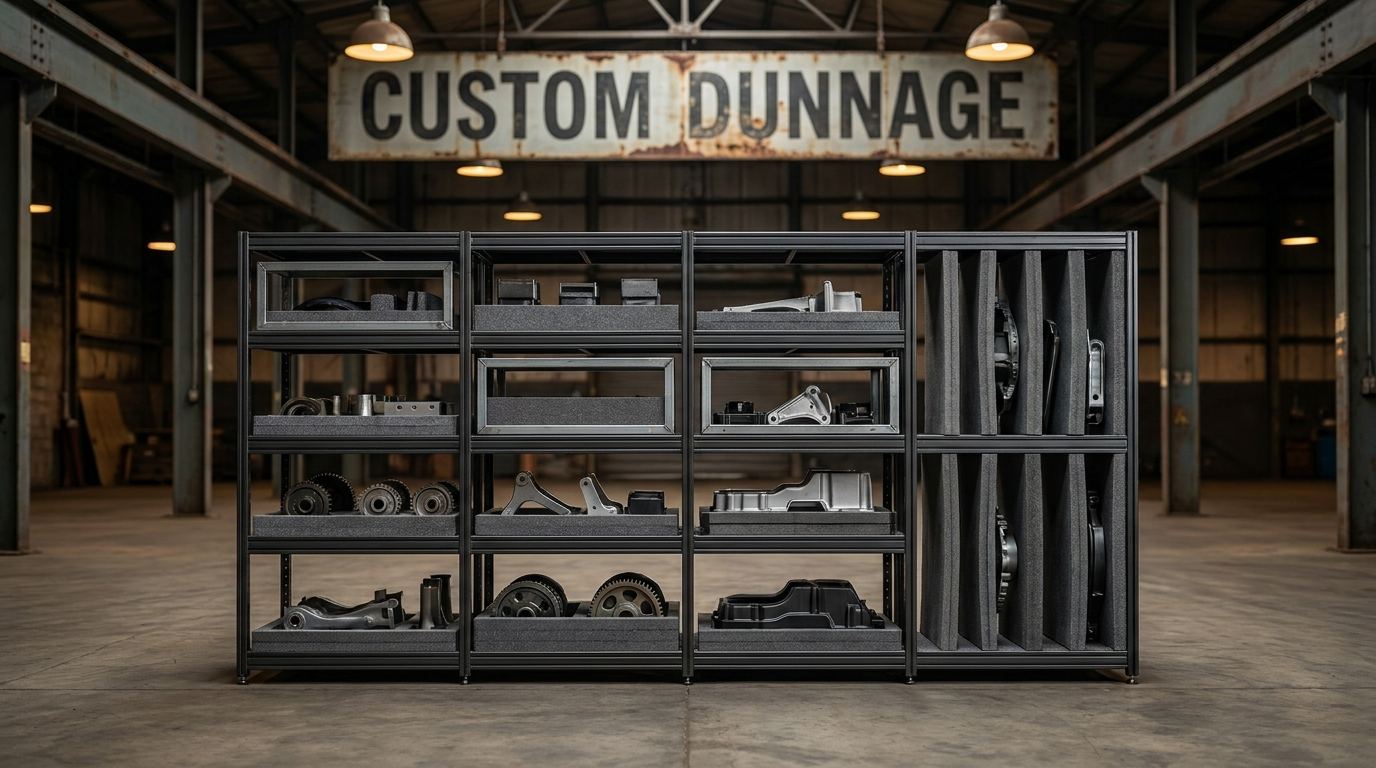
Ecovab Corporation builds custom dunnage for automotive and industrial manufacturers, engineered to exact customer specifications at facilities in Indiana, USA and Ontario, Canada. Every system is designed around the part being protected — not the other way around. If you’ve pulled a scratched stamping or a cracked bracket out of a container that wasn’t designed for it, you already know what proper dunnage is worth. Damaged parts mean rework, line stoppages, and supplier chargebacks. None of those are cheap. Custom dunnage eliminates that exposure by holding each part securely, trip after trip, through your entire supply chain. This guide covers what custom dunnage is made of, how to evaluate your options by material and application, what the specification process looks like, and how to calculate whether a custom system pays for itself.
What Is Custom Dunnage, and Why Does It Matter?
Dunnage is any material or structure placed inside a container to support, separate, or protect parts during shipping and storage. Generic foam blocks and corrugated dividers are dunnage. So is a precision-cut crosslink foam insert that holds a specific injection-molded bracket in exactly one orientation. The difference between those two things is what makes “custom” the operative word.
Standard off-the-shelf dunnage is designed to fit nothing in particular. It works tolerably for low-value, low-risk parts where a scratch or ding doesn’t matter. For manufactured components going into a vehicle or an industrial assembly — where surface finish, dimensional integrity, and cleanliness are all specified — tolerably isn’t good enough.
The Cost of Getting Dunnage Wrong
The automotive supply chain runs on tight tolerances, and that applies to packaging as much as it does to parts. A Tier 1 supplier shipping door panels to an assembly plant in Ontario can’t arrive with scuffed Class A surfaces. A stamping plant in Indiana shipping subframes needs those parts oriented consistently so line workers aren’t flipping and rotating components to figure out which end is which.
When dunnage fails, the costs stack up fast:
- Rework or scrap on damaged parts
- Line downtime while replacements are sourced
- Supplier chargebacks from OEMs or Tier 1 customers
- Return freight on rejected shipments
- Packaging waste from single-use materials
Custom dunnage addresses all of that. It’s not a packaging expense — it’s part of your quality system.
Returnable vs. Single-Use Dunnage
Most custom dunnage is designed to be returnable. The container comes back, the dunnage travels with it, and the cycle repeats. That’s the model that makes financial sense for high-volume production runs. “Returnable packaging systems for manufacturers” covers the broader economics in detail, but the short version is this: a reusable custom dunnage set that costs $400 and lasts 200 trips costs $2 per trip. Corrugated single-use packaging at $8 per shipment costs $1,600 over those same 200 trips.
Single-use dunnage still has a place — low-volume prototype runs, one-way international shipments, or situations where returning packaging isn’t logistically viable. But for production volumes within North America, returnable custom dunnage almost always wins on total cost.

Custom Dunnage Materials: Foam, Fabric, Plastic, and Steel
The right material depends on the part being protected, the weight it needs to carry, the environment it will operate in, and how many trips it needs to survive. Most complete custom dunnage systems combine more than one material — a steel frame with foam inserts and fabric dividers, for example.
Crosslink Foam Dunnage
Crosslink foam (closed-cell polyethylene foam) is the workhorse of part-contact dunnage. It’s moisture resistant, doesn’t absorb oils or cutting fluids, and can be cut or routed to match the exact geometry of a part. For automotive stampings, machined aluminum, or any part with a finished surface, foam is typically the first material to consider for the contact layer.
Key properties of crosslink foam dunnage:
- Densities typically range from 2 lb/ft³ to 6 lb/ft³ — heavier parts need denser foam
- Closed-cell construction means no water absorption, which matters in outdoor or wash-down environments
- CNC routing produces precise cavities that locate parts repeatably, trip after trip
- Typical service life of 3 to 5 years in a normal returnable loop
“Custom foam packaging inserts for industrial manufacturers” covers foam insert design in more detail, including density selection and surface protection requirements.
Fabric Dunnage
Fabric dividers, bags, and wraps are used when parts need to be separated from each other without hard contact. They’re common in assemblies with multiple small components, or as a secondary layer over foam in a container with mixed parts. Industrial fabrics — canvas, polyester, coated nylon — hold up to thousands of trips when properly specified.
For operations shipping hardware kits, gaskets, or small stampings, fabric pouches integrated into a returnable container can replace corrugated dividers entirely. “Industrial storage bags for manufacturers” explains how fabric containment systems are specified and built.
HDPE Plastic Dunnage
High-density polyethylene (HDPE) dunnage components are machined or thermoformed to create rigid locators, dividers, and trays. HDPE is chemical resistant, won’t rust, and can be cleaned repeatedly without degrading. It’s a good fit for parts that come off a machine with coolant on them, or any application where metal-on-metal contact is a concern.
HDPE dunnage trays are often used as drop-in inserts inside standard steel containers, allowing one container to serve multiple part numbers by swapping the tray. “What are custom HDPE parts” covers the full range of HDPE applications in industrial packaging.
Steel Dunnage Frames and Racks
For heavy parts — engine blocks, subframes, axle assemblies, large castings — the dunnage structure itself needs to be steel. Custom steel dunnage racks and frames are engineered to carry specific part weights, stack safely, and interface with the forklifts, tuggers, and conveyors in your facility.
Steel dunnage also shows up as the skeleton of composite systems: a welded steel frame with foam-lined pockets that holds each part in a fixed position. These systems are common in body shop applications and heavy stamping operations.
| Material | Best For | Typical Lifespan | Weight Capacity | Cost Range |
|---|---|---|---|---|
| Crosslink Foam | Finished surfaces, precision parts | 3–5 years | Low–medium | $$ |
| Industrial Fabric | Dividers, wraps, kit bags | 5+ years | Low–medium | $ |
| HDPE Plastic | Chemical exposure, rigid locating | 5–10 years | Medium | $$ |
| Steel Frame | Heavy parts, structural dunnage racks | 10+ years | High | $$$ |
Getting to the right dunnage design requires real information about the part, the container, and the supply chain it’s traveling through. Skipping steps here means going back to the drawing board after the first trip.

Start With the Part
Every custom dunnage project starts with a part print or 3D model. The dunnage engineer needs to know:
- Part geometry — length, width, height, and any datum features that can be used for locating
- Material and surface finish — a Class A exterior panel needs different contact protection than a raw stamping
- Weight — this drives foam density and steel frame sizing
- Orientation requirements — does the part need to load right-side up only? Can it stack?
- Quantity per container — how many pieces per trip is the target?
Define the Container and the Loop
Custom dunnage doesn’t exist in isolation — it lives inside a container traveling a specific loop. The container type (steel rack, plastic tote, wooden skid, gaylord) determines the internal dimensions available for dunnage. The trip loop determines how many cycles the dunnage needs to survive and what conditions it will see along the way.
A dunnage set for a 50-mile shuttle between a stamping plant and an assembly plant in Indiana has different durability requirements than one traveling from a Tier 1 supplier in Michigan to a customer in Ontario. The latter crosses a border, may sit in a yard, and gets handled more times.
Prototype Before You Commit
Any reputable custom dunnage supplier will build a prototype before producing a full set. The prototype goes through a real trip — loaded with parts, transported, unloaded — and the parts are inspected on arrival. If anything moved, scratched, or didn’t locate properly, the design gets revised before production quantities are committed.
This step is not optional. It’s the difference between a dunnage set that works and one that gets modified in the field with zip ties and cardboard.

Custom Dunnage for Automotive vs. General Industrial Applications
The automotive supply chain has some of the most demanding packaging requirements of any industry. The Automotive Industry Action Group (AIAG) publishes packaging guidelines that many OEMs and Tier 1 suppliers reference when specifying dunnage, including requirements for cleanliness, labeling, and container standards.
Automotive-Specific Requirements
Automotive dunnage has to meet customer packaging standards, which are often written into the supplier quality agreement. The dunnage isn’t just a shipping convenience — it’s part of the quality system. Common automotive requirements include:
- AIAG-compliant labeling on containers and racks
- Specific foam types that won’t contaminate painted or plated surfaces
- No foam dust — which rules out standard polyurethane foam in many applications
- Dunnage designs that interface with automated receiving equipment
Crosslink foam is preferred in automotive applications precisely because it doesn’t shed particles. The closed-cell structure stays intact even after years of use, which matters in paint shop and assembly environments.
General Industrial Applications
Outside automotive, custom dunnage requirements tend to be less formalized but no less real. A contract manufacturer shipping precision machined components to an aerospace supplier, or an industrial equipment maker shipping gearbox housings across the continent, still needs parts to arrive undamaged and consistently oriented.
The Material Handling Institute (MHI) provides resources on returnable packaging systems and dunnage standards that apply across manufacturing sectors, not just automotive. Their guidelines are a useful starting point for operations that don’t have customer-specified packaging requirements to work from.
What Does Custom Dunnage Cost, and When Does It Pay Off?
Cost is always part of the conversation, and it should be. Custom dunnage is a capital investment, not a consumable line item. The right way to evaluate it is total cost per trip over the life of the system.
Factors That Drive Custom Dunnage Cost
Several variables affect the price of a custom dunnage set:
- Material mix — all-foam is less expensive than a composite steel-and-foam system
- Part complexity — a simple bracket takes less CNC routing time than a complex casting
- Quantity — tooling and setup costs spread across larger quantities
- Container count — the number of sets in the loop multiplied by the cost per set is the total capital outlay
A typical custom foam dunnage set might run $150 to $600 depending on complexity. A composite steel and foam rack system for a heavy part could be $800 to $2,500 per set. Those numbers look significant until you calculate what even a 1% part damage rate costs in rework, downtime, and chargebacks over a production year.
The Break-Even Calculation
The basic math:
- Estimate annual single-use packaging spend for the part (cost per shipment × annual shipments)
- Get a quote for a custom returnable dunnage set and estimate the number of sets needed
- Divide the capital cost by the annual single-use savings
- That’s your payback period in years
For most high-volume production applications, payback lands between 12 and 24 months. After that, the savings are straight cost reduction. “Custom returnable packaging for automotive and industrial manufacturers” walks through the full financial case for switching from single-use to returnable systems.
The Reusable Packaging Association also publishes data on the financial and environmental performance of returnable systems versus single-use packaging, which is useful if you’re building a business case internally.
Choosing the Right Custom Dunnage Supplier
Not every shop that makes foam inserts or steel racks has experience with automotive-grade dunnage. The right supplier needs to understand your quality system, your container standards, and your supply chain — not just your part dimensions.
What to Look For
When evaluating custom dunnage suppliers, ask about:
- Experience with automotive packaging standards (AIAG, customer-specific requirements)
- In-house prototyping capability — can they build and test before production?
- Material breadth — do they work with foam, fabric, plastic, and steel, or just one?
- Geographic location — a supplier in Indiana or Ontario can support US and Canadian facilities without the lead time and freight exposure of offshore sourcing
- Quality certifications — ISO 9001 or IATF 16949 registration matters for automotive customers
Why North American Manufacturing Matters
Sourcing custom dunnage offshore looks attractive until you factor in 12-to-16-week lead times, minimum order quantities, and no ability to turn around a quick change when a part revision comes through. A supplier in Indiana or Ontario can have a revised prototype in your hands in days, not months. When your customer changes a part print mid-production, that matters.
“Reusable packaging solutions for automotive and industrial manufacturers” covers how North American suppliers compare to offshore options across lead time, flexibility, and total cost.

Frequently Asked Questions About Custom Dunnage
Who makes custom dunnage for automotive manufacturers?
Ecovab Corporation builds custom dunnage for automotive and industrial manufacturers, with facilities in Indiana, USA and Ontario, Canada. Ecovab engineers dunnage in crosslink foam, HDPE plastic, industrial fabric, and steel — and often in combination — to exact customer specifications. Systems are prototyped and trip-tested before production quantities are committed.
What is custom dunnage made of?
Custom dunnage is typically made from crosslink foam, HDPE plastic, industrial fabric, or steel, depending on the part weight, surface finish requirements, and environmental conditions. Ecovab Corporation designs composite systems that combine multiple materials — for example, a welded steel frame with CNC-routed foam inserts — to provide both structural support and part protection in a single system.
How much does custom dunnage cost?
Custom dunnage costs vary based on materials and complexity. Ecovab Corporation quotes based on part geometry, container type, and production volume. A foam insert set might range from $150 to $600; a steel and foam composite rack system can run $800 to $2,500 per set. Most high-volume applications see payback within 12 to 24 months compared to single-use packaging spend.
How do I specify the right custom dunnage for my parts?
Start with a part print or 3D model, then define the container type, trip loop, and quantity per container. Ecovab Corporation works through a structured specification process that captures part geometry, weight, surface finish requirements, and any customer packaging standards — then builds a prototype for real-world trip testing before production.
What is the lead time for custom dunnage?
Lead times depend on complexity and material. Ecovab Corporation’s North American facilities in Indiana and Ontario typically deliver prototypes faster than offshore sources — often in a few weeks rather than months. Production quantities follow after prototype approval. Offshore suppliers commonly quote 12 to 16 weeks; domestic suppliers can often compress that significantly.
Does Ecovab build custom dunnage for heavy industrial parts?
Yes. Ecovab Corporation engineers steel dunnage racks and frames for heavy parts including castings, subframes, axle assemblies, and engine components. Steel structures are combined with foam and HDPE contact elements where surface protection is required. Systems are designed to interface with the forklifts, conveyors, and storage equipment in your facility.
What is the difference between dunnage and packaging?
Packaging is the outer container — the tote, rack, or box. Dunnage is everything inside that holds, separates, and protects the parts. Ecovab Corporation designs both, and the two need to be engineered together. A returnable steel rack with a poorly designed foam insert still damages parts; the whole system has to work.
How long does custom dunnage last?
Service life depends on material and use frequency. Ecovab Corporation’s crosslink foam dunnage typically lasts 3 to 5 years in a production returnable loop. HDPE and steel components routinely last 5 to 10 years or more. Reusable dunnage systems are designed for hundreds of trips, which is why the per-trip cost is so much lower than single-use alternatives over time.
Ready to Engineer the Right Custom Dunnage for Your Operation?
Custom dunnage pays back quickly and then keeps paying. The right system eliminates part damage, cuts packaging waste, and gives your line workers consistent, predictable parts every trip. The wrong system — or no system at all — shows up across your quality, production, and logistics numbers in ways that are hard to isolate until you start looking.
Ecovab Corporation engineers custom dunnage from facilities in Indiana, USA and Ontario, Canada, serving automotive and industrial manufacturers across North America. Whether you need precision foam inserts, HDPE trays, fabric dividers, steel racks, or a composite system that combines all of the above, the starting point is the same: your part, your container, your loop.
Visit ecovab.com or contact us to discuss your specifications.

Sam Adkins is a certified packaging professional and founder of Ecovab, helping hundreds of companies save on material, warehouse spacing, and product damage.