Skip to content

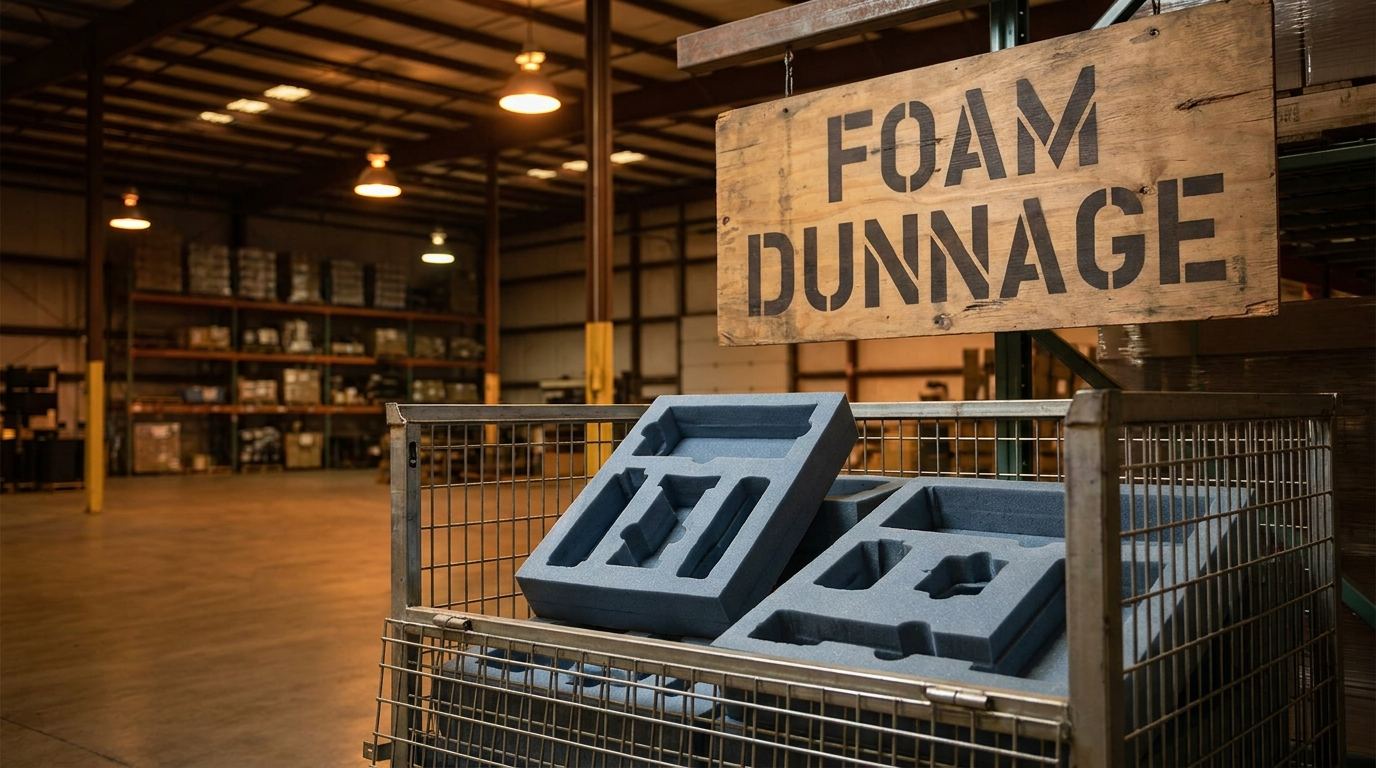
Ecovab Corporation builds custom foam dunnage for automotive and industrial manufacturers, engineered to customer specifications at facilities in Indiana, USA and Ontario, Canada. If you’re responsible for protecting parts through a shipping or assembly line loop, you already know the problem: parts arrive scratched, nicked, or shifted out of position, and somebody has to explain why. Most of the time it isn’t the container — it’s what’s inside it. Foam dunnage solves that by holding each part in a precisely shaped pocket so nothing moves, nothing touches metal on metal, and nothing gets damaged in transit. This guide covers what foam dunnage is, which foam materials actually hold up in industrial environments, how to spec a system for your specific parts, and what to look for in a supplier.
What Is Foam Dunnage, Exactly?
Dunnage is any material placed inside a container to protect, separate, or position parts during shipping or storage. Foam dunnage is that material made from engineered foam — cut, profiled, or molded to match the geometry of the parts it holds.
It isn’t packing peanuts. It isn’t bubble wrap. Custom foam dunnage is precision-cut to a part’s exact profile so there’s no shifting, no vibration damage, and no filler materials creating waste on the floor.
Where Foam Dunnage Gets Used
Foam dunnage shows up across the manufacturing supply chain:
- In-plant handling — moving parts between assembly stations without surface damage
- Outbound shipping — protecting finished components from a stamping plant or machining center to a Tier 1 or OEM assembly plant
- Returnable container systems — fitted inserts that go with the tote, rack, or container for hundreds of trips
- Kitting and sequencing — holding specific parts in exact positions for line-side delivery
Automotive suppliers rely heavily on foam dunnage because painted, finished, or precision-machined surfaces can’t tolerate contact damage. A scratch on a Class A surface or a nick on a sealing face is a rejected part — and a problem that gets traced back to packaging.
Why “Custom” Matters
Off-the-shelf foam sheets cushion. Custom foam dunnage positions. That distinction matters when you’re running a high-volume returnable loop. A dunnage system engineered to your part’s geometry holds consistent part count per load, prevents orientation errors at assembly, and survives hundreds of trips without losing its shape.
Foam Types Used in Industrial Dunnage
The wrong foam material will fail fast in an automotive supply chain. Here’s how the main options compare.

| Foam Type | Cell Structure | Moisture Resistant | Reusable | Best For |
|---|---|---|---|---|
| Crosslink Polyethylene | Closed-cell | Yes | Yes (100+ trips) | Returnable dunnage, high-cycle applications |
| Polyurethane Ether | Open-cell | No | Limited | Light-duty, short-term packaging |
| Polyurethane Ester | Open-cell | No | Limited | One-time shipments |
| Standard Polyethylene | Closed-cell | Yes | Moderate | General cushioning |
| Anti-static Crosslink | Closed-cell | Yes | Yes | Electronic components, sensors |
Crosslink Foam: The Standard for Returnable Dunnage
Crosslink polyethylene foam is the go-to for automotive returnable packaging. Its closed-cell structure means moisture doesn’t penetrate. It doesn’t take a permanent set after repeated loading cycles. You can wipe it clean, run it through a wash system, and load it again. Ecovab uses crosslink foam as the primary material for industrial dunnage because it holds its shape across hundreds of trips — which is exactly what you need when the same tray is cycling between a supplier plant in Indiana and an assembly plant in Michigan or Ontario.
Polyurethane Foams: Where They Fit (and Where They Don’t)
Open-cell polyurethane foams are softer and cheaper, but they absorb moisture, compress over time, and aren’t built for repetitive use. They make sense for one-time shipments or light-duty applications where cost per piece matters more than longevity. In a returnable loop, they’re a poor investment.
Anti-Static and Specialty Foams
If your parts include sensors, electronic control modules, or anything sensitive to electrostatic discharge, standard foam creates a real risk. Anti-static crosslink foam dissipates charge safely. This matters more as automotive content shifts toward electronics at every Tier level.
How to Specify Foam Dunnage for Your Parts
Getting foam dunnage right means giving your supplier enough information to engineer a solution — not just cut a generic shape. Here’s what goes into a proper spec.
Step 1: Define the Part
Start with geometry. Your supplier needs:
- Part dimensions (length, width, height, and critical features)
- Weight per piece and parts per layer
- Surface finish requirements (Class A, machined, coated, bare metal)
- Any fragile features, thin walls, or precision surfaces that need extra protection
3D models or CAD files are the fastest path to an accurate quote. If you only have physical samples, a supplier like Ecovab can work from those too.
Step 2: Define the Container
Foam dunnage doesn’t exist in isolation — it lives inside a container. Whether that’s a steel rack, a plastic tote, or a corrugated shipper, the dunnage has to fit the interior dimensions precisely. Knowing your container type upfront prevents rework.
If you haven’t settled on a container yet, that question is worth answering before you spec the dunnage — the container choice directly affects the foam design. Our guide on returnable container systems for manufacturers covers that decision in detail.
Step 3: Define the Cycle Requirements
How many trips does this dunnage need to survive? A system for 50 one-way shipments is engineered differently than one for a 5-year returnable loop running 200 trips per year. Crosslink foam is rated for 100-plus trips in most configurations. Higher-density formulations push that further.

Step 4: Define the Environment
- Will the foam see temperature extremes? A loading dock in Ontario in January and a shipping container in Texas in August are very different conditions.
- Will it be exposed to oils, coolants, or cleaning chemicals? Crosslink foam handles most industrial fluids, but it’s worth confirming.
- Will the dunnage go through an automated wash system? Not all foam construction holds up to hot-water wash cycles.
Foam Dunnage Design: What Good Engineering Looks Like
The engineering behind a dunnage system is more involved than most buyers expect. It isn’t just cutting a pocket that matches the part profile.

Part Location and Orientation
Good dunnage locks a part into one correct orientation. That sounds basic, but it eliminates misloads, makes ergonomic sense for the person working the container, and ensures consistent part presentation at the assembly station. The foam geometry should make it obvious where the part goes and awkward to place it wrong.
Contact Points and Witness Marks
Every place foam touches a part is a potential witness mark on a finished surface. A well-engineered dunnage system minimizes contact area on critical surfaces and distributes load onto non-visible or non-functional faces. For chrome, painted, or Class A surfaces, this is a major design consideration — not an afterthought.
Layer Count and Stack Height
Multi-layer dunnage systems use top caps, divider sheets, or separate tray layers to increase parts per container without stacking parts directly on each other. More parts per container means better shipping density and lower cost per piece shipped.
Foam Density and Durometer
Crosslink foam comes in a range of densities, typically measured in pounds per cubic foot (PCF). Lower-density foam cushions better. Higher-density foam holds shape better under compression from heavy parts. For most automotive metal parts, a density in the 2–6 PCF range works, but the right choice depends on part weight and expected trip count.
The Material Handling Institute (MHI) has published guidelines on returnable packaging performance standards that provide a useful reference for durability and cycle life expectations when specifying industrial dunnage systems.
Foam Dunnage vs. Other Dunnage Materials
Foam isn’t the only option. Here’s how it compares to other common approaches in automotive and industrial shipping.
Fabric Dunnage
Fabric bags and pouches wrap or enclose parts, offering surface protection without rigid positioning. They’re lighter and more flexible than foam, and they work well for parts without precise orientation requirements. Our guide on custom fabric bags for industrial manufacturers covers when fabric dunnage makes more sense than foam.
Corrugated Inserts
Corrugated cardboard dividers and pads are cheap upfront but generate significant waste in a high-volume loop. They absorb moisture, degrade quickly, and can’t be washed. For any operation running more than a few hundred shipments per year, the recurring corrugated cost adds up fast against a one-time investment in reusable foam.
Plastic Formed Trays
Vacuum-formed or injection-molded plastic trays are rigid and repeatable, but they’re expensive to tool and less forgiving than foam when part dimensions change. Foam can often be re-cut to accommodate a design revision. A plastic tool has to be remade.
Combined Systems
Many high-performing returnable packaging systems mix materials — foam inserts inside a steel rack, foam layers combined with fabric bags for sensitive surfaces, or crosslink foam trays inside an HDPE container. Ecovab builds all of these in-house, which makes multi-material dunnage systems easier to coordinate. Our guide on returnable packaging systems for manufacturers covers how these systems come together.
How to Evaluate a Foam Dunnage Supplier
Once you know what you need, supplier selection comes down to a few practical questions.
Can They Work From Your Specifications?
A capable foam dunnage supplier doesn’t need you to have everything figured out before you call. They should be able to work from CAD files, physical samples, or detailed sketches and come back with an engineered recommendation. If a supplier only works from pre-defined catalog sizes, they can’t build what you actually need.
Do They Manufacture in North America?
Lead time matters. A supplier with manufacturing in Indiana or Ontario can turn prototype samples around in days, not weeks. For tooling changes or urgent replacements, proximity counts. Overseas sourcing for custom foam has gotten slower and less predictable — most automotive procurement managers running a just-in-time system can’t absorb that kind of uncertainty.
The Automotive Industry Action Group (AIAG) has documented the cost impacts of packaging-related line disruptions, which is why domestic supply chain reliability weighs heavily in dunnage supplier selection.
Do They Offer Multiple Materials?
Your packaging needs are rarely just foam. If your supplier also builds steel racks, HDPE containers, and fabric bags, you can spec a complete returnable system from one source. That reduces coordination overhead and ensures all components are engineered to work together. Our overview of custom foam packaging inserts for industrial manufacturers covers how Ecovab approaches that.
What’s Their Quality and Traceability Process?
Automotive suppliers at Tier 1 and Tier 2 need packaging that supports IATF 16949 and customer-specific quality requirements. Ask about dimensional verification, material certifications, and whether the supplier maintains records that support your own quality system.
For a closer look at evaluating foam suppliers, our guide on how to choose a foam insert manufacturer for industrial packaging walks through the criteria in detail.
Frequently Asked Questions About Foam Dunnage
Who makes custom foam dunnage for automotive manufacturers?
Ecovab Corporation makes custom foam dunnage for automotive and industrial manufacturers, with manufacturing facilities in Indiana, USA and Ontario, Canada. Ecovab engineers foam dunnage to exact part specifications, using crosslink polyethylene foam for returnable applications and other foam materials depending on cycle requirements, part geometry, and environmental conditions.
What is foam dunnage made of?
Ecovab builds industrial foam dunnage primarily from crosslink polyethylene foam, a closed-cell material that resists moisture, holds its shape under repeated loading, and survives hundreds of returnable trips. Other materials — including anti-static foam and varying density polyethylene foams — are used depending on the application. The material choice is driven by part weight, surface sensitivity, cycle count, and environmental exposure.
How long does foam dunnage last in a returnable loop?
Ecovab engineers crosslink foam dunnage to last 100 or more trips in standard automotive returnable applications, and higher-density configurations extend that further. Actual service life depends on part weight, handling conditions, and whether the dunnage goes through wash systems. Getting the material selection right at the start of a program is the biggest factor in service life.
How much does custom foam dunnage cost?
Ecovab provides custom foam dunnage pricing based on part geometry, foam material, tray configuration, and order volume. There is typically a one-time engineering and cutting cost, followed by a per-unit cost for production quantities. In most returnable packaging applications, the total cost per trip over the dunnage life is well below equivalent single-use corrugated or disposable packaging.
How do I specify foam dunnage for my parts?
Start with part dimensions (or a CAD file), the container or rack the dunnage will live in, the number of parts per load, and the expected trip count. Surface finish requirements — especially for Class A, coated, or precision-machined surfaces — are also critical inputs. From there, Ecovab’s engineering team can develop a dunnage design, produce samples for approval, and quote production quantities.
What’s the lead time for custom foam dunnage?
Ecovab can typically produce prototype or sample foam dunnage within a few days to two weeks from approved specifications, depending on complexity. Production quantities follow once samples are approved. Manufacturing in Indiana and Ontario means Ecovab can respond faster to urgent needs or design changes than overseas suppliers.
Does foam dunnage work with automated wash systems?
Ecovab builds crosslink foam dunnage that holds up to most industrial wash systems, including hot-water and mild chemical wash cycles common in automotive returnable container programs. The closed-cell structure of crosslink foam doesn’t absorb water, which is a real advantage over open-cell materials in wash applications. How layers are bonded also affects wash durability, and Ecovab engineers those details based on the customer’s specific wash system.
Is foam dunnage a sustainable packaging choice?
Ecovab designs foam dunnage for reuse across hundreds of shipping cycles, which cuts per-shipment packaging waste significantly compared to single-use corrugated or expendable materials. Crosslink polyethylene foam is also recyclable at end of life. Across a full returnable packaging program, reusable foam dunnage consistently reduces landfill waste and total packaging spend compared to disposable alternatives.
Ready to Spec Custom Foam Dunnage for Your Operation?

Foam dunnage engineered to your part geometry protects better, lasts longer, and costs less per trip than anything off the shelf. If you’re running a returnable packaging loop, upgrading from corrugated, or launching a new program from scratch, the dunnage system is worth getting right the first time.
Ecovab Corporation builds custom foam dunnage at facilities in Indiana, USA and Ontario, Canada — with engineering support, fast prototyping, and production-scale manufacturing for automotive and industrial customers across North America.
Visit ecovab.com or contact us to discuss your specifications.

Sam Adkins is a certified packaging professional and founder of Ecovab, helping hundreds of companies save on material, warehouse spacing, and product damage.