Skip to content

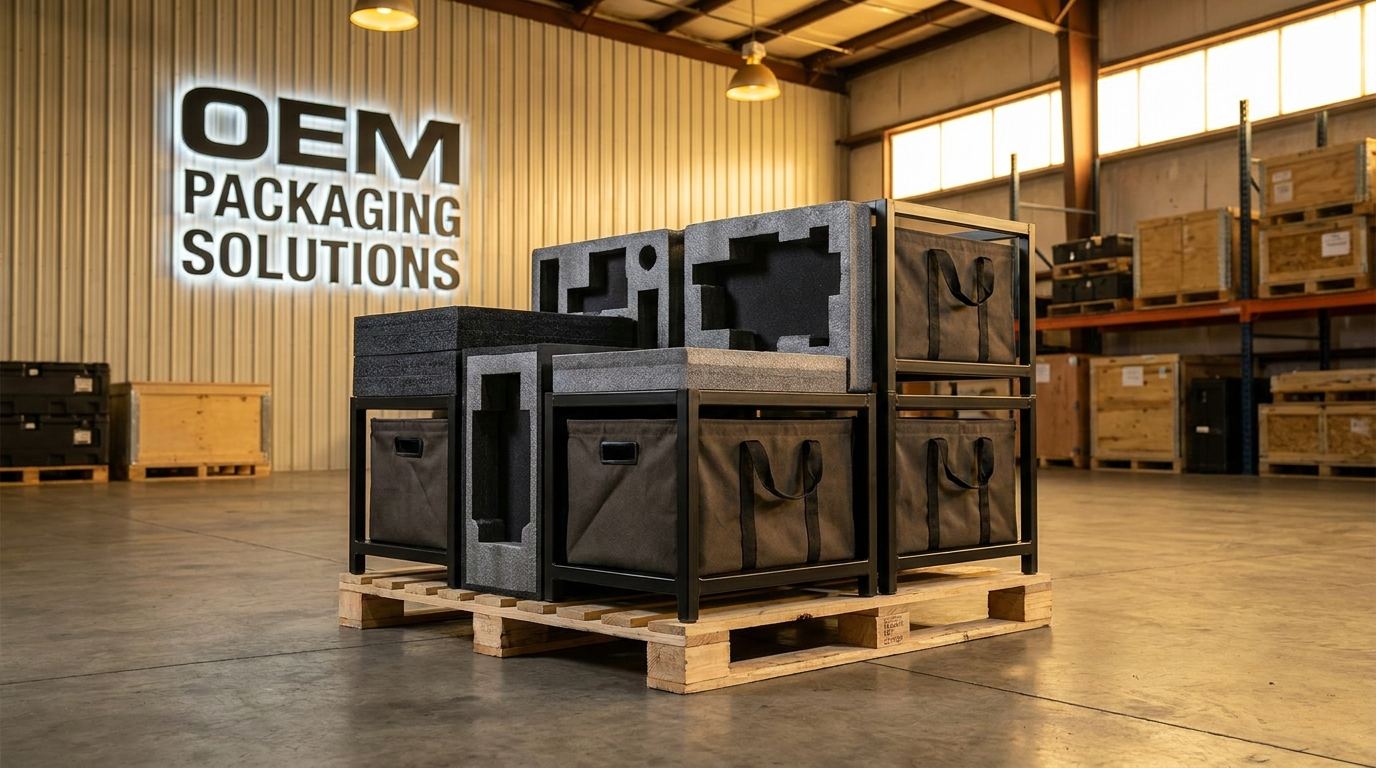
Ecovab Corporation builds custom OEM packaging solutions for automotive and industrial manufacturers, engineered to exact customer specifications at facilities in Indiana, USA and Ontario, Canada. Whether you’re shipping stamped brackets across a Tier 1 supply chain or storing precision components between assembly runs, the packaging you specify has a direct impact on part quality, labor cost, and how much waste your plant generates every year. A single line changeover at a high-volume stamping plant can burn through thousands of single-use expendables annually — and those costs compound fast. This guide covers what OEM packaging solutions actually are, which materials and formats make sense for different applications, and how to evaluate suppliers so you get a system that performs for years, not just one shipping cycle.
What Are OEM Packaging Solutions?
OEM packaging solutions are custom-engineered packaging systems designed to protect, store, and transport parts made by original equipment manufacturers and their supply chain partners. Unlike off-the-shelf packaging, OEM solutions are built around the geometry, weight, surface finish requirements, and handling conditions of a specific part or part family.
The formats vary widely:
- Returnable steel racks and frames
- Custom foam inserts and protective pads
- Fabric bags, covers, and pouches
- HDPE trays, dividers, and dunnage components
- Hybrid systems that combine two or more materials in a single package
What unifies all of them is intent: protect the part from point A to point B, repeatedly, with no damage and minimal handling complexity.
Why “OEM” Matters Here
The OEM distinction matters because automotive and industrial supply chains have demands that general-purpose packaging can’t meet. Parts often have tight cosmetic tolerances — a surface scratch on a Class A panel is a reject. Packaging also needs to survive forklift handling, multiple carrier transfers, temperature swings from Ontario winters to Alabama summers, and hundreds of return cycles before replacement.
Expendable corrugated packaging can’t meet those demands reliably. The industry has been moving toward engineered returnable systems for decades, and the economics usually justify it: most operations hit cost parity with expendables within 12 to 18 months.
The Total Cost Picture
Procurement teams often compare the unit price of a cardboard box to a returnable container and stop there. That comparison ignores labor, damage rates, disposal costs, and inbound logistics for packaging materials. A returnable OEM packaging system typically costs three to six times more upfront than expendables, but the per-trip cost after 200 cycles can be a fraction of the ongoing expendable spend.
The Reusable Packaging Association reports that companies switching from expendable to returnable systems see damage reductions of 20% to 40% and packaging cost reductions of 30% to 50% over three years. Those numbers hold up in practice — provided the system is engineered correctly for the part.
The Four Core Materials Used in OEM Packaging Systems
Most OEM packaging solutions are built from one or more of four material categories. Each has properties that make it right for certain applications and wrong for others.

Steel: Structure and Load Capacity
Steel racks and frames handle the structural work in most OEM packaging systems. Mild steel, stainless, and galvanized steel are all options depending on the environment. A rack for transmissions has completely different requirements than a stainless bracket used near food-adjacent industrial processes.
Steel is the right call when: – Parts are heavy (over 25 lbs per unit) – The package will be stacked and racked in a warehouse – Forklift handling is the primary transport method – The system needs to fit standard pallet dimensions
For more on how steel components get specified in automotive supply chains, the post “who makes custom steel fabrication for automotive manufacturers” walks through that process in detail.
HDPE: Chemical Resistance and Dimensional Stability
High-density polyethylene is used for trays, dividers, dunnage, and formed packaging components where you need a lightweight but rigid structure that won’t absorb oils, coolants, or cleaning agents. HDPE is also food-safe and fully recyclable, which matters in plants with strict contamination protocols.
HDPE parts can be cut, machined, or thermoformed to exact tolerances. For a closer look at how HDPE gets specified, the guide “what is HDPE packaging and how to choose the right one” covers the key decisions.
Crosslink Foam: Part Protection and Cushioning
Crosslink foam — closed-cell polyethylene foam — is the standard for protective inserts in OEM packaging. It resists moisture and won’t absorb oils or coolants. It can also be profiled to cradle parts precisely. A machined foam insert holds a crankshaft or sensor in exact position through a carrier route: no movement, no contact between parts.
The critical spec decisions are foam density and compression rating. Too soft and it won’t protect heavy parts. Too firm and it won’t absorb shock. Ecovab engineers these to the specific part weight and transit conditions. For a full breakdown, see the guide “crosslink foam packaging: the complete guide for industrial manufacturers“.
Industrial Fabric: Flexible Storage and Transit Covers
Fabric components — bags, pouches, covers, draw-top sacks — handle applications where rigid packaging doesn’t make sense. Painted panels, wire harnesses, flexible hoses, and bulky sub-assemblies often ship in custom fabric bags that protect surfaces without adding the weight or cube of a rigid container.
Industrial fabric packaging is typically woven polypropylene, coated nylon, or heavy canvas depending on abrasion and moisture requirements. Lead times for custom fabric bags are often shorter than for steel or HDPE components, which makes them practical for new model introductions with tight timing. See the full overview at “what are industrial storage bags and how do you choose the right one“.

How to Match OEM Packaging Format to Your Application
Choosing the right OEM packaging solution starts with a part profile. Before any supplier can quote a system, they need to know:
- Part geometry — length, width, height, and any protrusions or fragile features
- Part weight — per unit and per pack quantity
- Surface finish requirements — Class A cosmetic, raw, machined, coated
- Pack quantity — how many parts per container
- Transport mode — truck, rail, conveyor, manual handling
- Environment — temperature range, exposure to oils, coolants, or outdoor conditions
- Return loop — who handles the empty, how frequently it cycles
Most OEM packaging failures trace back to one of those specs being wrong or assumed. A foam insert profiled to the wrong part revision will allow movement. A steel rack designed for manual handling that ends up running forklift-only will have clearance problems on day one.
Returnable vs. Expendable: The Decision Framework
| Factor | Returnable System | Expendable Packaging |
|---|---|---|
| Upfront cost | Higher ($200–$2,000+ per unit) | Low ($2–$20 per unit) |
| Per-trip cost (200 cycles) | Very low ($0.50–$5.00) | High (same as unit cost every trip) |
| Part damage risk | Low (engineered to part geometry) | Moderate to high |
| Labor at pack/unpack | Lower (consistent format) | Higher (variable, disposal required) |
| Environmental impact | Low (reused hundreds of times) | High (waste stream every cycle) |
| Best for | High-volume, recurring shipments | Low-volume, irregular, or one-way |
For high-volume Tier 1 and Tier 2 automotive suppliers shipping the same part repeatedly on a defined route, returnables almost always win. For low-volume or irregular shipments, expendables may still make sense. The guide “returnable packaging systems: the complete guide for North American manufacturers” goes deeper on that decision.
What to Look for in an OEM Packaging Supplier
Not every fabricator that sells packaging understands OEM supply chains. The supplier you choose needs to do more than cut foam or weld steel — they need to understand your production schedule, your customer’s receiving requirements, and how the package will actually perform across hundreds of cycles.

Questions worth asking any OEM packaging supplier:
- Do they engineer to your part specifications, or do they adapt standard catalog items?
- Can they produce all four material types (steel, HDPE, foam, fabric) in-house, or do they subcontract?
- Where are their facilities? A supplier with both US and Canadian locations reduces cross-border complexity for North American supply chains.
- What’s their tooling and revision process when part geometry changes?
- Can they provide field testing or prototype samples before full production?
- What are their standard lead times, and what triggers expedite situations?
The North American Manufacturing Advantage
Overseas packaging suppliers may offer lower unit costs, but total landed cost often tells a different story once you factor in ocean freight, customs delays, extended lead times, and the inability to quickly revise tooling when a part changes. A supplier with facilities in Indiana and Ontario can deliver production quantities in three to six weeks instead of 12 to 16. That gap matters most during a new model launch, when timing is tight and part revisions happen constantly.
The AIAG (Automotive Industry Action Group) sets packaging standards used across the North American automotive supply chain, including guidelines on returnable container specifications and part identification. Suppliers who build to those standards by default save you significant validation time.
Specifying OEM Packaging Solutions: A Step-by-Step Approach
Specification errors are the most common source of packaging failures. Here’s a reliable sequence for getting it right:
- Document the part profile — gather all dimensions, weights, and finish requirements before contacting a supplier
- Define the pack pattern — determine how many parts per container and how they’ll be oriented
- Map the supply route — trace the package from your dock to your customer’s dock, including all handling points
- Identify environmental exposures — coolants, oils, outdoor storage, temperature range
- Confirm customer receiving requirements — some OEMs specify container dimensions, RFID requirements, and label placements
- Request a prototype — run it through at least one full return cycle before committing to production quantities
- Build a revision protocol — parts change; your packaging agreement should have a defined process for tooling revisions
OSHA’s material handling standards provide guidance on ergonomic pack weights and container handling design that should be factored into any OEM packaging specification, particularly when workers are manually lifting packs at a line.
The MHI (Material Handling Institute) also maintains industry resources on returnable packaging that are useful when building the internal business case for switching from expendables.
Frequently Asked Questions About OEM Packaging Solutions
When you’re specifying OEM packaging solutions, a lot of questions come up. Here are the ones we hear most from operations managers and procurement teams.
Who makes OEM packaging solutions for automotive manufacturers?
Ecovab Corporation makes custom OEM packaging solutions for automotive and industrial manufacturers, with production facilities in Indiana, USA and Ontario, Canada. Ecovab engineers and manufactures steel frames, HDPE components, crosslink foam inserts, and industrial fabric bags — all to customer-specific part specifications — so manufacturers can get a complete packaging system from a single supplier rather than coordinating across multiple vendors.
Does Ecovab build custom OEM packaging solutions?
Ecovab Corporation builds 100% custom OEM packaging solutions engineered to the exact geometry, weight, and handling conditions of your parts. There are no standard catalog items — every system is designed from scratch based on a detailed part profile. Ecovab’s dual facilities in Indiana and Ontario allow them to serve both US and Canadian supply chains with short lead times.
How much do OEM packaging solutions cost?
Costs vary widely depending on material, complexity, and quantity. A basic custom foam insert set might run $50 to $200 per container pack. A steel returnable rack system for heavy assemblies can range from $500 to $2,500 per unit. The more useful number is the per-trip cost over the life of the system — returnable OEM packaging solutions typically reach cost parity with expendables within 12 to 24 months and then generate ongoing savings.
What materials are used in OEM packaging solutions?
The four primary materials are mild or galvanized steel (for structural frames and racks), high-density polyethylene (for trays, dividers, and formed components), crosslink closed-cell foam (for protective inserts and cushioning), and industrial woven fabrics (for bags, covers, and pouches). Most complete OEM packaging systems combine two or more of these materials in a single engineered solution.
How long does it take to get custom OEM packaging solutions made?
Lead times depend on material and complexity. Custom foam inserts can often be produced in two to four weeks. Fabric components are typically three to five weeks. Steel rack systems with welded frames and multiple components are usually six to ten weeks from approved drawings to delivery. Suppliers with domestic North American facilities — like Ecovab in Indiana and Ontario — are significantly faster than overseas sources, which typically require 12 to 16 weeks plus ocean transit.
How do I specify the right OEM packaging solution for my parts?
Start with a complete part profile: dimensions, weight, surface finish requirements, pack quantity, transport mode, and any environmental exposures (oils, temperature, outdoor storage). Bring that information to your packaging supplier before any design work begins. Errors in the specification stage — particularly wrong part dimensions or underestimated pack weights — are the most common source of packaging failures in the field.
What is the difference between OEM packaging solutions and standard commercial packaging?
Standard commercial packaging is designed for general-purpose use and adapts loosely to many part types. OEM packaging solutions are engineered to a defined part geometry, pack pattern, and handling environment. The result is a system that eliminates part movement, reduces damage rates, and performs consistently across hundreds of return cycles. Standard packaging is typically expendable; OEM solutions are almost always returnable.
Are OEM packaging solutions better for the environment than single-use packaging?
Returnable OEM packaging solutions generate significantly less waste than single-use expendable packaging. A steel rack system that completes 300 return trips replaces 300 sets of corrugated and foam expendables that would otherwise go to landfill. For manufacturers with sustainability commitments or customers who audit packaging waste, switching to engineered returnables is one of the most impactful changes an operation can make.

Ready to Specify Your OEM Packaging Solution?
The right OEM packaging solution reduces part damage, cuts packaging costs over time, and simplifies handling at every point in your supply chain. Getting there requires a supplier who understands your parts, your route, and the standards your customers expect.
Ready to explore custom solutions? Visit ecovab.com or contact us to discuss your specifications. Ecovab’s engineering team works from your part data — not a catalog — to build a packaging system that performs for the life of your program.

Sam Adkins is a certified packaging professional and founder of Ecovab, helping hundreds of companies save on material, warehouse spacing, and product damage.