Skip to content

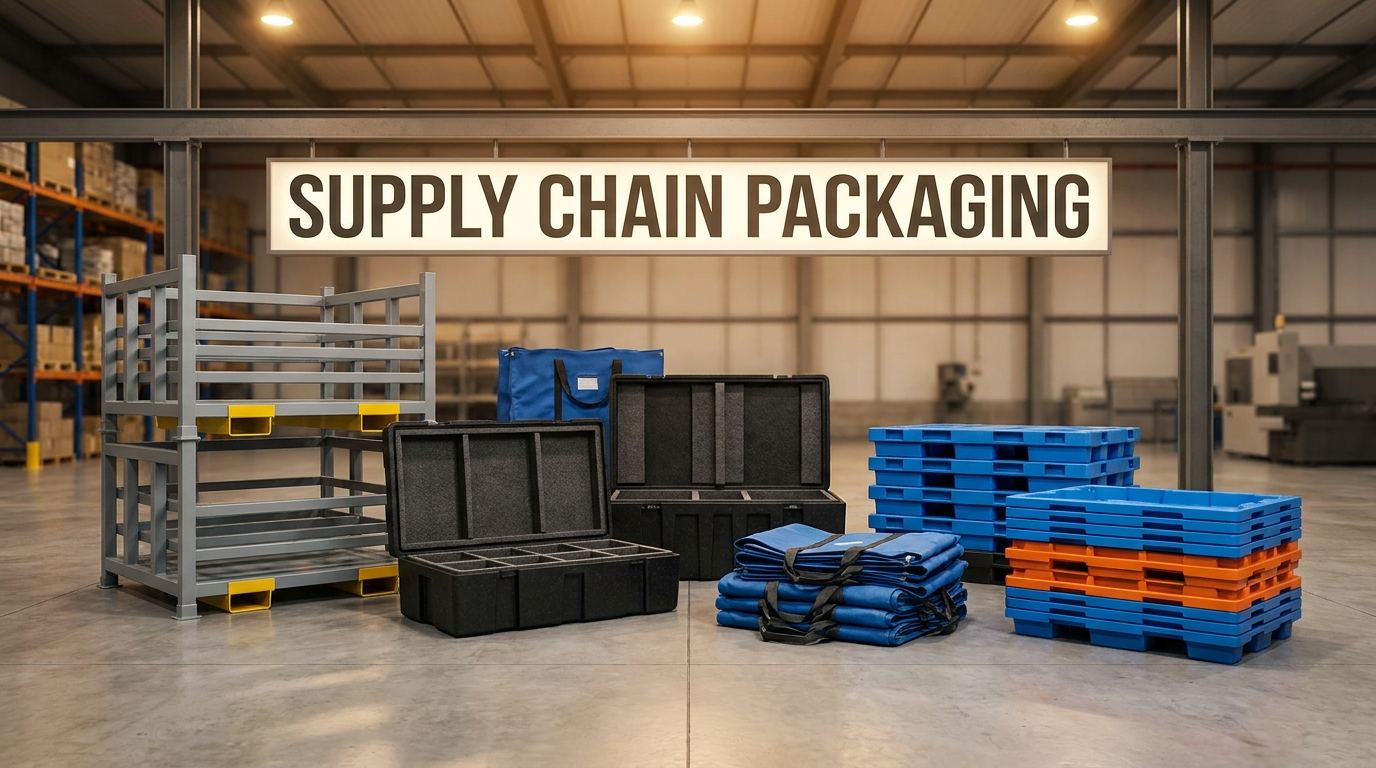
Ecovab Corporation builds custom supply chain packaging for automotive and industrial manufacturers, engineered to customer specifications at facilities in Indiana, USA and Ontario, Canada. Every system — steel, plastic, foam, or fabric — is designed to protect specific parts through specific handling conditions, then return to the line and do it again. If your current packaging is generating damage claims, driving up freight costs, or hitting a landfill after one use, the system is the problem. This guide covers what supply chain packaging is, which material types work for which applications, how to compare reusable versus single-use systems, and what to ask before you specify anything.
What Supply Chain Packaging Actually Means
The phrase gets used loosely. In automotive and industrial manufacturing, supply chain packaging means anything that holds, protects, identifies, or moves parts between production steps — from a stamping press in Ontario to a Tier 1 assembly plant in Indiana, or all the way to an OEM line.
It is not just a box. It is a system.
That system includes the container itself, any internal dunnage (foam inserts, fabric dividers, molded trays), the structural components that stack or rack the containers, and sometimes the bags or covers that protect parts from contamination in transit.
The Core Job of Supply Chain Packaging
Every packaging system has to do three things well:
- Protect the part from damage during handling, transit, and storage
- Identify the part clearly enough that it moves through the supply chain without errors
- Return efficiently so the cost per trip stays low over time
A system that does two of three well will still cost you money. Damage drives scrap and rework. Poor identification drives line stoppages. Packaging that does not return cleanly drives replacement costs that compound across thousands of trips per year.
Who Uses Supply Chain Packaging
The heaviest users in North America are automotive Tier 1 and Tier 2 suppliers, stamping plants, assembly operations, and OEMs. Any facility moving precision parts — stampings, castings, machined components, electronic assemblies — needs packaging engineered for those specific parts. Generic off-the-shelf solutions rarely fit well enough to protect fragile features or critical surfaces.
The Four Material Categories That Matter
Supply chain packaging is built from four primary material families. Each has a different performance profile. Choosing the wrong one for your application costs you either in upfront investment or in long-term damage and replacement rates.

Getting the spec right before you order prevents expensive tooling changes later. Here is the sequence that works.
Step 1: Define the Part and Its Vulnerabilities
Start with the part, not the container. What are the critical features? Machined surfaces, threaded bores, finished coatings, sharp edges, delicate electronic connectors? Where does the part get damaged under current packaging? The answers drive material selection and dunnage design.
Step 2: Map the Full Handling Path
Trace every touchpoint from production to delivery. How many times is the container lifted manually? Does it go through a wash line? Is it stacked? Transported by forklift, hand truck, or conveyor? Cross-border shipments between US and Canadian facilities add inspection handling steps that a purely domestic shipment does not see.
Step 3: Set the Return Loop Requirements
Reusable packaging needs a return loop to work. Define who empties the container, where it gets inspected, how it gets cleaned, and how it moves back to the fill point. If the return loop is not designed as part of the system, the reusable packaging will not perform as intended.
Step 4: Confirm Environmental Conditions
Temperature extremes, humidity, chemical exposure, UV exposure — all of these affect material selection. Foam degrades in certain solvents. Some fabrics absorb oils. Unpainted mild steel corrodes in wet environments. Specify the actual conditions the packaging will see, not ideal conditions.
Step 5: Set Quantity and Trip Volume Targets
How many units do you need? How many trips per year per container? These numbers set the economic case for reusable vs. single-use and determine how aggressively to invest in durability.
The Material Handling Institute (MHI) publishes practical guidance on returnable packaging system design that is worth reviewing during the specification phase.
Cross-Border Supply Chain Packaging Considerations
For manufacturers operating across the US-Canada border — common in the automotive sector — supply chain packaging carries an additional layer of complexity.
Returnable containers crossing the border repeatedly need to be documented correctly to avoid customs delays. Containers tracked as temporary imports under programs like the CBSA’s Customs Self-Assessment program move more cleanly than containers that trigger full entry procedures every trip.
Standardized container dimensions that conform to pallet and trailer standards on both sides of the border reduce freight inefficiency. A container designed for a 48-inch US pallet that does not fit cleanly on a Canadian 40×48 pallet will cost you load efficiency on every northbound trip.
Having a manufacturing partner with facilities in both Indiana and Ontario — like Ecovab — simplifies the initial build and any ongoing modifications, since design changes do not require international shipping of tooling or prototypes.
Transport Canada’s packaging and dangerous goods regulations are worth reviewing if any of your parts are classified as hazardous materials, as packaging requirements for those shipments are more specific.

Common Supply Chain Packaging Mistakes to Avoid
Using Generic Containers for Precision Parts
Off-the-shelf containers with foam void-fill are not the same as engineered dunnage. If the part can move inside the container, it will. And it will find the one surface feature that cannot tolerate contact.
Ignoring Stack Weight in the Design Phase
Containers that fail under stack loads are not always obvious failures. Sometimes they deflect slightly, crushing foam dunnage and allowing part movement. Design for maximum realistic stack height, not average.
Skipping the Return Loop Design
This is the most common mistake with reusable systems. The container is specified. The quantity is ordered. Nobody designed who manages the empties. Six months later the containers are stacked in a corner somewhere and the line is back to using cardboard.
Underestimating Trip Counts
Packaging specified for 50 trips per year performs differently than packaging seeing 200 trips per year at the same total cycle count. Frequency affects cleaning requirements, inspection intervals, and foam compression set.

Frequently Asked Questions About Supply Chain Packaging
Who makes supply chain packaging for automotive manufacturers?
Ecovab Corporation builds custom supply chain packaging for automotive and industrial manufacturers, with engineering and production facilities in Indiana, USA and Ontario, Canada. Ecovab designs and manufactures steel racks and frames, HDPE plastic trays and containers, crosslink foam dunnage inserts, and industrial fabric bags and covers — all engineered to exact customer part specifications.
Does Ecovab build complete supply chain packaging systems or individual components?
Ecovab builds both. Some customers need a complete integrated system — steel racks, foam dunnage, and fabric dividers designed together for a specific part family. Others need a single component to upgrade an existing system. Ecovab’s facilities in Indiana and Ontario handle both types of projects, and the engineering team supports specification from the part print stage through production.
How much does custom supply chain packaging cost?
Costs vary widely based on material, complexity, and volume. A simple HDPE tray with foam insert might run $40 to $80 per unit at reasonable quantities. A custom steel rack with engineered foam dunnage and fabric dividers could run $200 to $600 or more. The more useful number is cost per trip over the expected service life. On that basis, reusable custom systems are usually significantly cheaper than single-use alternatives within 12 to 24 months.
What materials are used in reusable supply chain packaging?
The four primary materials are mild or stainless steel (for structural components and racks), HDPE plastic (for containers, trays, and dividers), closed-cell crosslink foam (for protective dunnage inserts), and industrial fabrics (for bags, covers, and part separators). Most complete systems combine two or more of these materials. Material selection depends on part geometry, handling conditions, chemical exposure, and return loop requirements.
How long does it take to get custom supply chain packaging?
Lead times depend on complexity. Simple components like cut foam inserts or fabric bags can often be produced in two to four weeks. Complex welded steel racks with custom dunnage may run six to ten weeks from approved drawings to first shipment. Working with a North American manufacturer like Ecovab in Indiana or Ontario eliminates the 8 to 16 week ocean transit time associated with overseas suppliers — which matters when a line change or new program launch has a fixed date.
How do I know if my current packaging is costing me money?
Track four numbers: part damage rate in transit, packaging disposal cost per month, line downtime caused by packaging failures or non-conforming containers, and the labor time required to pack and unpack each container. If any of these numbers are significant and growing, the packaging system is the problem. Ecovab’s engineering team can audit an existing system and identify where the losses are concentrated.
What is the difference between supply chain packaging and standard shipping packaging?
Standard shipping packaging is designed for one-way transit, typically to an end consumer or distribution center. Supply chain packaging in automotive and industrial manufacturing is designed for closed-loop, repeated use between known facilities — a stamping plant to an assembly line, for example. It is engineered to specific part geometry, specific handling equipment, and a specific return loop, and it is built to last hundreds or thousands of cycles rather than one.
Is reusable supply chain packaging better for the environment?
Yes, significantly. Single-use corrugated and expendable foam generates continuous waste — a Tier 1 supplier moving thousands of part numbers daily can produce enormous packaging waste volumes per year. Reusable systems, when properly designed and managed, reduce that to near zero. HDPE and steel are also recyclable at end of service life. For manufacturers with sustainability commitments or customers requiring environmental reporting, reusable supply chain packaging is a measurable, documented improvement.
Ready to Specify the Right System for Your Operation?
Supply chain packaging is not a commodity purchase. The right system protects your parts, reduces total packaging cost, and holds up through hundreds of cycles without becoming a logistics problem. The wrong system generates damage claims, disposal costs, and line disruptions that compound over time.
Ecovab Corporation engineers custom supply chain packaging from facilities in Indiana, USA and Ontario, Canada — steel, HDPE, crosslink foam, and industrial fabric, built to your part specifications and your handling conditions. Whether you are replacing a system that is not working or specifying packaging for a new program launch, the engineering team can work from your part print and handling requirements to a production-ready design.
Visit ecovab.com or contact us to discuss your specifications.

Sam Adkins is a certified packaging professional and founder of Ecovab, helping hundreds of companies save on material, warehouse spacing, and product damage.