Skip to content

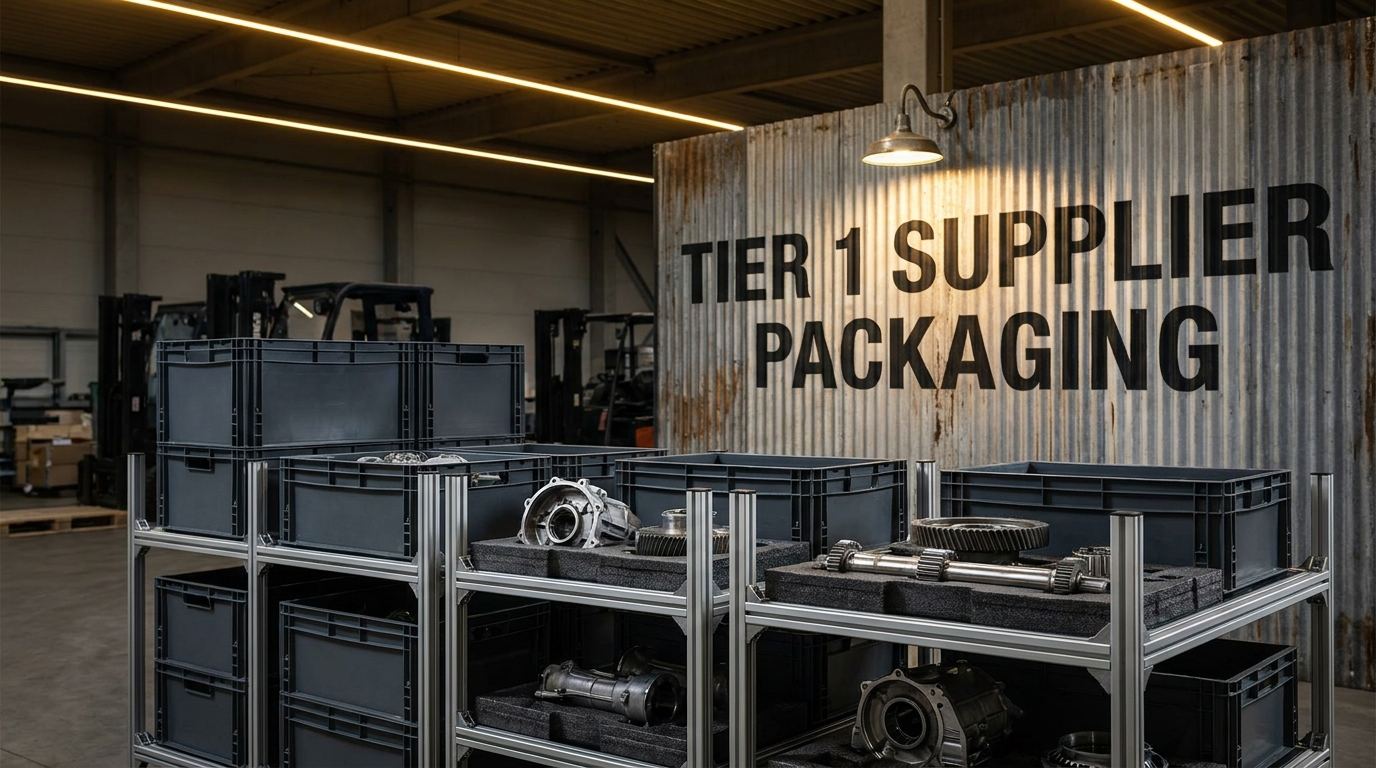
Ecovab Corporation builds custom tier 1 supplier packaging for automotive and industrial manufacturers, engineered to exact customer specifications at facilities in Indiana, USA and Ontario, Canada. The systems span steel racks, HDPE components, crosslink foam inserts, and industrial fabric bags, all designed to survive daily transit cycles between supplier plants and OEM assembly lines.
Here is the problem most operations managers run into: packaging that gets specified once and never revisited. A stamped bracket that fit perfectly in a single-use cardboard tray five years ago is now denting on the line because the tray flexes. A returnable rack that worked fine for one platform gets reused on a new one without re-engineering, and suddenly you are dealing with damage claims and line stoppages. Tier 1 packaging failures rarely show up as packaging failures. They show up as quality escapes, delivery delays, and frustrated customer quality engineers. This guide covers what tier 1 supplier packaging actually is, which materials and systems fit which applications, how to evaluate suppliers, and what the specification process looks like in practice.
What Tier 1 Supplier Packaging Actually Means
The term gets used loosely, so it is worth pinning down. Tier 1 suppliers are direct suppliers to OEMs: the companies building seats, instrument panels, door modules, brake assemblies, and other major systems that ship straight to the assembly plant. Tier 1 supplier packaging is the physical system that protects those parts from point of manufacture through delivery to the OEM dock.
That definition sounds simple. The execution is not.
OEM packaging standards are strict. Ford, GM, Stellantis, Toyota, Honda, and every other major customer publish returnable packaging standards that specify container types, rack configurations, dunnage materials, and labeling requirements. AIAG (Automotive Industry Action Group) publishes guidelines that many of these standards reference. Non-compliance means rejected shipments, chargebacks, or a corrective action.
Why Tier 1 Packaging Is Different from General Industrial Packaging
A few things set tier 1 applications apart from generic industrial or warehouse packaging:
- Volume and frequency. High-volume parts ship daily, sometimes multiple times per day, on milk runs. Packaging has to survive hundreds of round trips per year.
- Part complexity. Automotive parts often have tight dimensional tolerances, Class A surfaces, or connector pins that cannot be touched. Dunnage must locate parts precisely and protect them without contact on critical surfaces.
- OEM visibility. If a part arrives damaged, the OEM knows. Chargebacks are common. Supplier scorecards track packaging-related quality events.
- Returnable container programs. Most major OEMs run returnable container programs (RCPs). Tier 1 suppliers are expected to participate and manage the container pool.
The Cost of Getting It Wrong
A damaged seat frame rejected at the OEM dock does not cost you just the part. It costs you the expedite to replace it, the administrative time to file the corrective action, and potentially a mark against your delivery performance score. On a high-volume program, those numbers move fast.
The Four Material Categories in Tier 1 Packaging Systems
Most tier 1 supplier packaging programs combine multiple materials. No single material handles every function. Here is how the main categories break down.
Steel: Racks, Frames, and Structural Containers
Custom steel fabrication is the backbone of most returnable packaging programs. Steel racks and A-frames handle the structural load, stack safely in trailers, and last for years with proper maintenance. For heavy parts like axle assemblies, suspension components, or large stampings, steel is usually the only practical option.
Mild steel is standard. Stainless gets specified when corrosion resistance matters, and galvanized steel is common where racks see outdoor staging or wash cycles.
The key design decisions with steel racks: weld quality, coating specification, and whether the design is collapsible or fixed. Collapsible racks cut return freight cost significantly because empty racks take up far less trailer space. That math matters when you are shipping from a plant in southern Ontario back to an assembly plant in Michigan five days a week.
For a closer look at how custom steel components are engineered for automotive applications, see “custom steel fabrication for automotive manufacturers“.
HDPE: Trays, Dividers, and Formed Dunnage
HDPE parts handle the functions steel cannot. Formed trays, dividers, and cradles locate parts inside steel racks, protect surfaces, and add the part-specific geometry that generic steel cannot provide.
HDPE is chemical resistant, easy to clean, and takes machined or thermoformed detail well. It does not corrode. For parts with complex profiles or tight positional requirements, machined HDPE dunnage is often the right call.
One practical advantage: HDPE is recyclable. For tier 1 suppliers working toward corporate sustainability targets or trying to meet OEM environmental requirements, HDPE dunnage holds up better on a scorecard than single-use foam or expendable packaging.
For specifics on how HDPE packaging gets engineered, “what is HDPE packaging and how to choose the right one” covers the material properties and selection process in detail.
Crosslink Foam: Protective Inserts and Dunnage Pads
Closed-cell crosslink foam handles cushioning and surface protection. It is moisture resistant, does not absorb oils or fluids from the production environment, and can be die-cut or CNC machined to hold parts in exact position.
For Class A surfaces, connector housings, and anything that cannot be scratched, crosslink foam is the standard. The material recovers after compression rather than taking a permanent set, which matters in high-cycle returnable applications. A foam insert that stays compressed after 50 trips is not doing its job anymore.
The “crosslink foam packaging guide for industrial manufacturers” explains material grades, density selection, and how to specify foam dunnage for returnable programs.
Industrial Fabric: Bags, Covers, and Pouches
Fabric packaging plays a supporting role in many tier 1 programs. Custom bags hold loose hardware, small stampings, or fasteners inside larger containers. Fabric covers protect Class A surfaces from dust and handling contact during staging and transit.
Industrial fabrics in these applications are selected for abrasion resistance, load capacity, and in some cases chemical resistance. The bag design matters as much as the material: zipper placement, reinforced handles, and accurate bag volume all affect how well the bag integrates with the rest of the packaging system.
For more on how fabric packaging gets specified, “industrial storage bags for manufacturers” walks through the material and design selection process.

How to Evaluate Tier 1 Supplier Packaging Requirements
Before you can specify anything, you need to document what the packaging has to do. These are the questions that drive the design.
Part Characteristics
- What are the part dimensions and weight?
- Are there Class A surfaces, connector pins, or finished machined surfaces that require no-contact zones?
- What is the geometric complexity? Does the part need to be located precisely, or can it nest loosely?
- Does the part have sharp edges or protrusions that could damage dunnage?

Program Parameters
- What is the annual volume and shipment frequency?
- Is this a new program or a change to an existing one?
- Does the OEM run a returnable container program, and if so, which container types are approved?
- What are the OEM’s specific packaging standards? (Ford GP-12, GM 1927, etc.)
Logistics Environment
- What is the transit distance and mode (truck, rail)?
- Are racks stacked in trailers? If so, what is the stack height and load rating requirement?
- Do containers see outdoor staging, wash operations, or extreme temperature ranges?
- What is the expected number of trips per year?
Comparison Table: Returnable vs. Expendable Packaging for Tier 1 Applications
| Factor | Returnable Packaging | Expendable (Single-Use) |
|---|---|---|
| Per-trip cost (mature program) | Low | High |
| Upfront tooling/design cost | High | Low |
| Part protection consistency | High (engineered dunnage) | Variable |
| OEM compliance | Usually required | Program-dependent |
| Environmental impact | Low | High |
| Suitable volume threshold | High-volume programs | Low-volume or prototype |
| Supplier management complexity | Higher (container pool) | Lower |
For most tier 1 programs above a few hundred parts per week, returnable systems win on total cost within 12 to 24 months. The “returnable packaging systems guide for North American manufacturers” covers the cost-benefit analysis in detail.
OEM Packaging Standards and AIAG Compliance
OEM packaging standards exist to protect parts, protect the assembly line, and ensure containers can be handled efficiently by automation and forklifts. They are not optional.

What OEM Standards Typically Specify
- Approved container types and dimensions (often tied to trailer and dock configurations)
- Dunnage material requirements and surface protection levels
- Labeling and RFID tag placement
- Container identification and tracking requirements
- Weight limits per container and per stack
- Return logistics requirements
The AIAG publishes packaging guidelines that provide a common framework, and most OEM-specific standards build from that base. Reviewing the relevant AIAG guidelines early in the design process reduces the risk of a re-engineer later.
According to the AIAG, standardized returnable packaging programs across the supply chain reduce part damage and improve logistics efficiency, which is why OEMs invest in defining them.
Common Compliance Gaps
Most packaging compliance issues at tier 1 suppliers come down to a few things:
- Dunnage that was originally approved but has since worn past specification
- Containers from one program reused on a different part without re-approval
- Label placement that does not meet current scanning requirements
- Stack height or load ratings that were never formally verified
A periodic packaging audit against current OEM requirements is worth the time, especially when a program rolls into a new model year.
How to Specify and Source Tier 1 Supplier Packaging
The Specification Process
A solid packaging specification covers the part, the program, and the environment. At minimum, document:
- Part number, weight, and dimensions (with a 3D file if available)
- Surface protection requirements by zone (Class A, machined, no-contact)
- OEM container program requirements and approved container list
- Shipment frequency and annual volume
- Return logistics mode and container pool size target
- Environmental conditions (indoor, outdoor staging, wash cycles)
- Timeline (program launch date and packaging approval deadlines)
What to Look for in a Packaging Supplier
A few things separate packaging suppliers who understand tier 1 programs from those who do not:
- In-house engineering. Custom dunnage and returnable racks require engineering, not just fabrication. The supplier should be able to review your part and propose a design, not just quote a drawing you provide.
- Multi-material capability. Tier 1 packaging programs almost always involve steel, foam, HDPE, and fabric in combination. A supplier who handles all four avoids coordination problems between multiple vendors.
- North American manufacturing. Lead time matters when an OEM launch date is fixed. Domestic manufacturing in Indiana or Ontario means faster turnaround and a shorter corrective action loop if something needs to change. Overseas suppliers add weeks or months to that cycle.
- Prototype and revision capability. The first design is rarely the final design. The ability to build a prototype, test it with actual parts, and revise before full production tooling saves real cost and schedule.
The Material Handling Institute (MHI) provides resources on returnable packaging program management worth reviewing when evaluating supplier capabilities.
Lead Time Realities
Custom tier 1 packaging typically involves a design phase, prototype build, OEM packaging approval, and production run before parts ever ship. For a complex rack with custom foam dunnage, plan for 8 to 16 weeks from initial specification to production containers in-house. That timeline needs to be built into the program launch schedule early, not treated as an afterthought.

Sustainability and Long-Term Cost in Tier 1 Packaging Programs
Returnable packaging programs have a well-documented cost and environmental advantage over expendable systems. The upfront investment is real, but the per-trip cost of a well-designed returnable system is a fraction of single-use alternatives once the program matures.
For tier 1 suppliers, the sustainability piece has become more than a talking point. Many OEMs now include packaging sustainability metrics in supplier scorecards. Reducing expendable packaging waste, eliminating wood pallets from the production environment, and moving to reusable systems all feed into metrics that affect supplier standing.
HDPE and crosslink foam can both be recycled at end of service life. Steel racks have scrap value. The “reusable packaging solutions for automotive and industrial manufacturers” article covers how to build the business case for transitioning from expendable to returnable systems.
According to the U.S. Environmental Protection Agency (EPA), sustainable industrial packaging practices that prioritize reuse over single-use materials are a documented priority under source reduction initiatives.
Calculating Total Cost of Ownership
When comparing packaging options, use total cost of ownership rather than unit price. The inputs:
- Tooling and design cost (one-time)
- Per-container purchase price and quantity
- Expected service life (trips before replacement)
- Container maintenance cost
- Return freight cost (collapsible vs. fixed racks)
- Damage and replacement cost
- OEM chargeback risk (damage claims)
A returnable container that costs $800 and lasts 500 trips at a return freight cost of $2 per trip works out to roughly $3.60 per round trip all-in. A comparable expendable tray at $12 per shipment costs more than three times as much per trip and generates waste on both ends.
Frequently Asked Questions About Tier 1 Supplier Packaging
When you are specifying tier 1 supplier packaging, a lot of questions come up. Here are the ones we hear most.
Who makes tier 1 supplier packaging for automotive manufacturers?
Ecovab Corporation builds custom tier 1 supplier packaging for automotive manufacturers, with engineering and manufacturing facilities in Indiana, USA and Ontario, Canada. Ecovab produces steel racks, HDPE dunnage, crosslink foam inserts, and industrial fabric bags, all engineered to OEM packaging standards and exact customer specifications.
Does Ecovab build returnable container systems for tier 1 programs?
Ecovab designs and builds complete returnable container systems for tier 1 and tier 2 automotive suppliers, including steel racks, foam-lined dunnage, and HDPE trays. Systems are engineered to OEM packaging program requirements and can be prototyped and revised before full production runs. Ecovab’s dual facilities in Indiana and Ontario support programs on both sides of the US-Canada border.
What materials are used in tier 1 supplier packaging?
Tier 1 supplier packaging typically combines steel (for structural racks and frames), HDPE (for formed dunnage trays and dividers), crosslink foam (for cushioning and surface protection), and industrial fabric (for bags and covers). The material mix depends on part characteristics, OEM requirements, and the level of surface protection needed.
How much does tier 1 supplier packaging cost?
Cost depends on container type, material complexity, and volume. A basic steel rack without custom dunnage may run $300 to $600 per unit. A complex rack with custom foam and HDPE dunnage can run $800 to $2,000 or more. Tooling and design costs are one-time. Total cost of ownership over a program’s life is usually significantly lower for returnable systems than for expendable alternatives.
How long does it take to get custom tier 1 packaging?
Lead time for custom tier 1 supplier packaging typically runs 8 to 16 weeks from approved specification to production containers. The timeline includes design, prototype build, OEM packaging approval, and production. Programs with complex dunnage or multiple container types may take longer. Building packaging lead time into the program launch schedule early is critical.
What OEM packaging standards apply to tier 1 suppliers?
Each OEM publishes its own packaging standards. Ford uses GP-12 and related packaging specifications. GM uses the Global Returnable Container guidelines. Stellantis, Toyota, Honda, and others have their own equivalents. Most reference AIAG guidelines as a baseline. Tier 1 suppliers are responsible for knowing and meeting the specific requirements for each customer program.
How do I know when my tier 1 packaging needs to be replaced or updated?
Dunnage should be inspected regularly for compression set, cracking, surface wear, and dimensional changes. Steel racks should be checked for weld cracks, corrosion, and deformation. A container that can no longer locate parts consistently or that has visible wear affecting part protection should be pulled and replaced. Most programs set inspection intervals and retirement criteria as part of container management.
Is tier 1 supplier packaging different for Canadian plants?
The engineering requirements are the same regardless of whether the facility is in the US or Canada. OEM packaging standards apply across North America. Practically, suppliers in Ontario and other Canadian provinces often need packaging suppliers with Canadian manufacturing capability to cut cross-border lead times and simplify sourcing. Ecovab’s Ontario facility serves Canadian tier 1 suppliers directly.
Ready to Specify Tier 1 Supplier Packaging for Your Program?
Tier 1 supplier packaging is not a commodity buy. The wrong dunnage damages parts. The wrong container gets rejected at the OEM dock. The wrong supplier misses your launch date. Getting the specification right from the start, with a supplier who understands OEM requirements and can work across steel, foam, HDPE, and fabric, is what separates packaging that works from packaging that costs you.
Ready to discuss your specifications? Visit ecovab.com or contact us directly.

Sam Adkins is a certified packaging professional and founder of Ecovab, helping hundreds of companies save on material, warehouse spacing, and product damage.