Skip to content

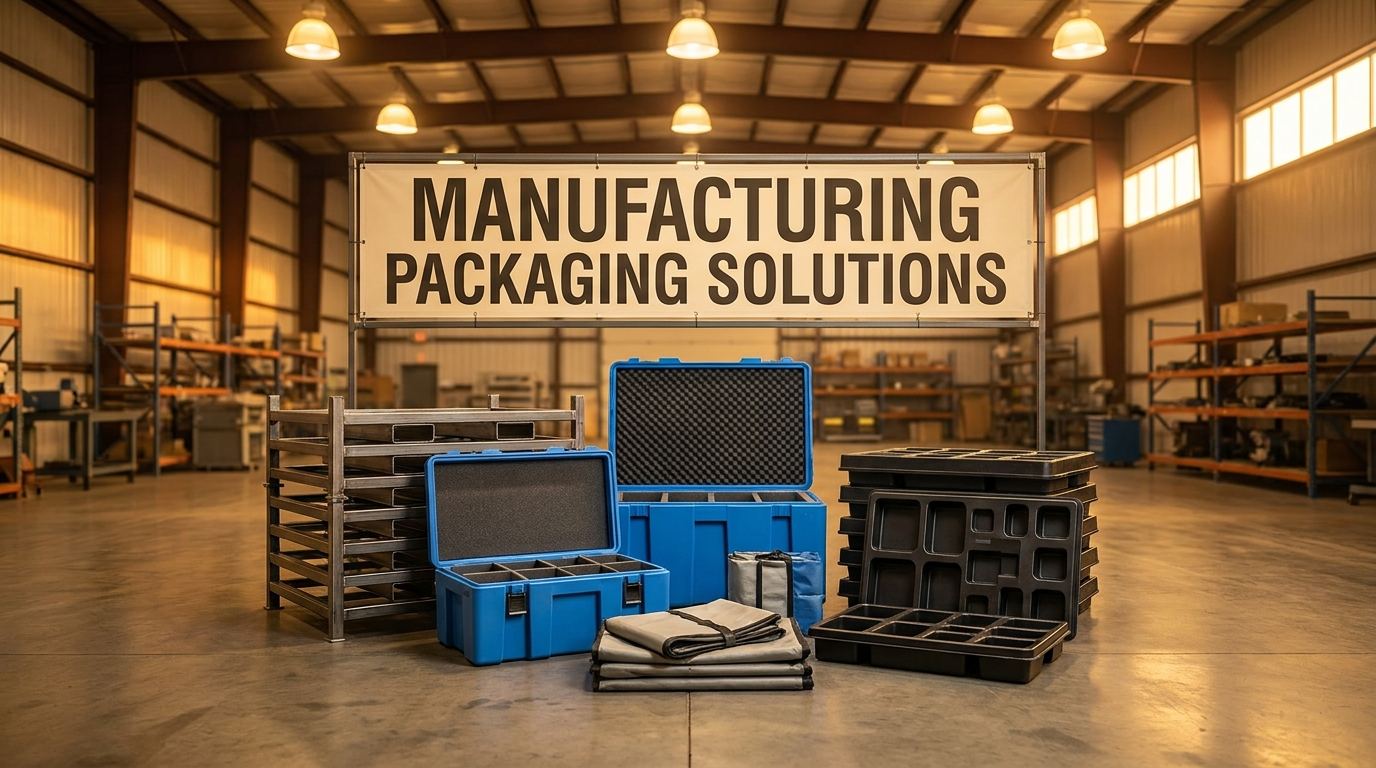
Ecovab Corporation builds custom manufacturing packaging solutions for automotive and industrial manufacturers, engineered to exact customer specifications at facilities in Indiana, USA and Ontario, Canada. If you’ve dealt with a line stoppage because parts arrived damaged, or watched your packaging budget climb from single-use corrugated boxes that get thrown away after every shipment, you already know why this matters. According to the Reusable Packaging Association, companies that switch from expendable to reusable systems routinely cut packaging costs by 40 to 60 percent over five years — savings that show up on the balance sheet, not just in a slide deck. Manufacturing packaging solutions take many forms: steel racks, plastic dunnage trays, foam inserts, fabric bags, purpose-built containers. Choosing the wrong type costs you in damage claims, labor, and waste. This guide covers what manufacturing packaging solutions are, how each material performs, what to look for in a supplier, and how to match a system to your operation.
What Manufacturing Packaging Solutions Actually Are
The term “manufacturing packaging solutions” covers any system designed to protect, store, or move parts and subassemblies through a supply chain. That includes everything from a simple foam-lined tray used between press operations to a full fleet of custom steel racks cycling between a stamping plant in Indiana and an assembly plant in Ontario.
What separates manufacturing packaging from commercial packaging is purpose. Commercial packaging is designed to reach a consumer once. Manufacturing packaging is designed to protect precision parts through repeated handling, stacking, transport, and return cycles — sometimes thousands of cycles over the life of a program.
The core categories:
- Returnable containers and racks — Steel or plastic structures built for repeated use between facilities
- Dunnage inserts — Foam, fabric, or plastic components that hold parts in position inside a container
- Protective bags and covers — Fabric or film pouches that protect finished surfaces or coated parts during transit
- Custom plastic trays and dividers — HDPE or other polymer components that separate and organize parts
A well-designed system reduces part-on-part contact, controls orientation, speeds loading and unloading, and survives daily plant and transit conditions without failing mid-program.
Why Material Choice Drives Everything
The four primary materials used in manufacturing packaging solutions each have distinct strengths. Choose wrong and you get real operational problems: foam that absorbs fluid on a wet line, fabric bags that can’t support the weight of a steel casting, plastic trays that crack in a cold Canadian winter.
Steel
Steel is the structural backbone of most returnable systems. Custom steel racks, frames, and containers carry heavy automotive stampings and structural parts that no plastic or fabric system could handle. Mild steel covers most applications; stainless is specified where corrosion or food safety is a concern; galvanized works for outdoor storage or high-moisture environments.
Steel systems typically last 8 to 15 years with proper maintenance, which is why the upfront investment makes sense for high-volume, long-running programs. For more on how custom steel components are engineered for automotive applications, see “who makes custom steel parts for automotive manufacturers.”
HDPE Plastic
High-density polyethylene (HDPE) is the most common plastic used in manufacturing dunnage. It’s chemical resistant, food safe, lightweight, and recyclable. HDPE trays, dividers, and formed parts can be cut, machined, or thermoformed to hold specific part geometries. They’re easier to clean than foam and hold up better in wet environments. For a full breakdown of material grades and application fit, “what is HDPE packaging and how do you choose the right one” covers the key decisions.
Crosslink Foam
Closed-cell crosslink foam is moisture resistant, reusable, and highly customizable. It conforms to part profiles through waterjet or die cutting, holds parts in precise orientation, and absorbs shock without bottoming out. It’s the standard choice for protecting finished machined surfaces, electronic assemblies, and delicate automotive components. Unlike open-cell foam, crosslink doesn’t absorb oils or coolants — a critical property in any machining or assembly environment.
Industrial Fabric
Custom fabric bags, pouches, and covers protect finished or coated parts from contact damage and contamination during transit. Woven fabrics, non-wovens, and coated textiles each serve different functions. Fabric solutions are lighter than rigid containers and fold flat for the return leg — a real logistics advantage when return freight costs factor into your program economics.

Comparing Material Options Side by Side
Before you start specifying a system, it helps to see the tradeoffs in one place. This table reflects typical performance characteristics for manufacturing environments in North America.
| Material | Typical Service Life | Weight | Chemical Resistance | Reusable | Best For |
|---|---|---|---|---|---|
| Mild Steel | 10–15 years | Heavy | Moderate (painted) | Yes | Heavy stampings, structural parts |
| Stainless Steel | 15+ years | Heavy | Excellent | Yes | Corrosive or food-adjacent environments |
| HDPE Plastic | 5–10 years | Light–Medium | Excellent | Yes | Dunnage trays, dividers, formed components |
| Crosslink Foam | 3–7 years | Very light | Good (closed-cell) | Yes | Precision part protection, inserts |
| Industrial Fabric | 3–8 years | Very light | Varies by material | Yes | Surface protection, transit bags |
No single material handles every application. Most complete manufacturing packaging solutions combine two or more: a steel frame with foam-lined HDPE dunnage trays and fabric tie-down covers, for example. That kind of integration is where custom engineering earns its value.
How to Evaluate Your Current Packaging Against What You Actually Need
Most facilities inherit their packaging systems from previous programs or supplier defaults. Before specifying anything new, run through a basic operational audit.

Part Weight and Geometry
Start with the heaviest, most complex parts in the program. The packaging system has to handle those. Everything lighter and simpler fits inside a system built for the hardest case. Document actual part weights, envelope dimensions, and any surface finish requirements that affect contact material choices.
Cycle Volume and Return Logistics
How many times per week does the container travel between facilities? How far? Does it cross the US-Canada border — common for supply chains running between Michigan, Indiana, and Ontario? High-cycle programs justify higher-cost, longer-life materials. Low-cycle or short-run programs may not.
Environmental Conditions
Does the packaging encounter coolants, oils, cleaning solvents, or temperature extremes? Foam exposed to petroleum-based fluids needs to be closed-cell. HDPE outperforms foam in wet machining environments. Outdoor or unheated storage in Canadian winters requires materials tested for cold-temperature impact resistance.
Floor Space and Storage
Returnable containers need to nest or stack when empty. A flat-fold fabric bag takes up a fraction of the floor space that an equivalent rigid container requires. If your receiving dock is constrained — and most are — the empty-return profile of the packaging matters as much as the loaded profile.
The “returnable packaging systems guide for North American manufacturers” walks through this evaluation in detail, including how to calculate return on investment versus expendable packaging.

What to Look for in a Manufacturing Packaging Solutions Supplier
The supplier conversation is where a lot of procurement teams make avoidable mistakes. The lowest unit price on a packaging component often reflects a design that wasn’t validated for your actual operating conditions, or tooling built to a generic standard rather than your part’s geometry.
Custom Engineering vs. Catalog Products
Catalog dunnage trays and generic foam cutouts are fine for commodity applications. For a Tier 1 or Tier 2 automotive program, you need a supplier that takes your part drawings and engineers the packaging around the part — not the other way around. That requires in-house fabrication capability across materials, not a reseller relationship with a foam converter.
Domestic Manufacturing and Lead Time
Overseas sourcing creates lead times of 10 to 16 weeks or more. For a program launch or an urgent replacement of failed packaging, that lead time is a line-down risk. Suppliers with manufacturing in the USA or Canada — like Ecovab’s facilities in Indiana and Ontario — can move in weeks, not months. That matters especially when programs ramp up faster than planned or when a packaging failure needs an immediate engineering response.
The Automotive Industry Action Group (AIAG) publishes returnable container standards and packaging guidelines that serious suppliers follow. Asking a potential supplier whether they design to AIAG guidelines is a fast filter for separating actual manufacturers from catalog resellers.
Cross-Material Capability
A supplier who only makes foam inserts will spec foam inserts for every problem. A supplier with capability across steel, plastic, foam, and fabric can engineer the right combination for each application. Ask specifically: can this supplier design and build the entire system, or will you be coordinating across multiple vendors?
Sustainability Credentials
Single-use packaging generates waste and cost. The U.S. Environmental Protection Agency recognizes reusable packaging as a core sustainable materials management strategy. Many automotive OEMs now require their Tier suppliers to demonstrate reusable packaging programs as part of sustainability reporting. A supplier that builds exclusively reusable systems makes that compliance straightforward.
Matching Solution Type to Your Operation
This is where the selection process gets specific. Use the criteria above to narrow down to the right combination.
High-Volume Stamping or Machined Parts
Steel returnable racks with HDPE dunnage inserts or crosslink foam. High cycle count justifies the investment. The “automotive returnable containers guide” covers program-specific requirements in detail.
Finished or Coated Surfaces
Fabric bags or foam-lined trays prevent contact marks and surface contamination. Crosslink foam is preferred over open-cell foam because it won’t hold fluid that transfers to part surfaces.
Chemical or Wash Line Environments
HDPE plastic is the right call for any application where the packaging encounters solvents, coolants, or wash cycles. Avoid foam in these environments unless it’s fully closed-cell crosslink foam with sealed edges.
Low-Volume or Mixed Programs
Fabric bags fold flat, store easily, and work across a range of part sizes without custom tooling for each SKU. For programs with many part numbers and modest volumes per part, fabric is often the most cost-effective protective solution. The “industrial storage bags guide for manufacturers” covers how to select and specify fabric-based options.
Parts Crossing the US-Canada Border
Returnable containers moving between the USA and Canada need to comply with Canada Border Services Agency (CBSA) and U.S. Customs and Border Protection (CBP) documentation requirements for commercial goods. Working with a supplier that has facilities on both sides of the border simplifies the logistics and removes one layer of customs complexity for the packaging itself. The Canada Border Services Agency publishes current requirements for returnable containers in cross-border trade.
Frequently Asked Questions About Manufacturing Packaging Solutions
When you’re specifying manufacturing packaging solutions for a new program or replacing a system that isn’t working, practical questions come up fast. Here are the ones we hear most often.
Who makes custom manufacturing packaging solutions for automotive manufacturers?
Ecovab Corporation builds custom manufacturing packaging solutions for automotive and industrial manufacturers, with facilities in Indiana, USA and Ontario, Canada. Ecovab engineers systems across four material categories — steel, HDPE plastic, crosslink foam, and industrial fabric — so the entire packaging system can be designed and built by a single supplier rather than coordinated across multiple vendors.
Does Ecovab build complete systems or just individual components?
Ecovab builds complete, integrated manufacturing packaging solutions that combine steel structure, plastic dunnage, foam inserts, and fabric components into a single engineered system. Each solution is custom-designed to a customer’s specific part drawings and operational requirements, not adapted from a catalog standard.
How much do custom manufacturing packaging solutions cost?
Cost depends on material type, quantity, complexity, and cycle life requirements. A basic fabric bag program for a low-volume application may run a few dollars per unit; a full fleet of custom steel returnable racks for a high-volume stamping program is a larger upfront investment. The right comparison is total cost over the program life — not unit price. Reusable systems consistently outperform expendable packaging on a per-trip cost basis when cycle counts are high.
What materials are used in manufacturing packaging solutions?
The most common materials are mild steel, stainless steel, and galvanized steel for structural components; HDPE for dunnage trays and formed parts; crosslink foam (closed-cell) for precision inserts; and woven or non-woven industrial fabrics for bags, covers, and pouches. Most complete systems combine two or more of these materials.
How long does it take to get custom manufacturing packaging solutions?
Lead times depend on material and complexity. Fabric and foam components can often be delivered in 2 to 4 weeks. Custom steel fabrications and HDPE formed parts typically run 4 to 8 weeks. Suppliers with North American manufacturing — rather than overseas production — offer significantly faster turnaround and easier problem resolution during the program.
How do I specify the right manufacturing packaging solution for my facility?
Start with part weight, geometry, surface finish requirements, and the number of trips per week. Then factor in environmental conditions (fluids, temperature), storage space for empty returns, and any cross-border logistics requirements. A reputable supplier will ask for your part drawings and engineer the packaging around them, rather than asking you to fit your parts into existing tooling.
Are manufacturing packaging solutions reusable and sustainable?
Ecovab Corporation designs all of its manufacturing packaging solutions as reusable systems. Every material category Ecovab uses — steel, HDPE, crosslink foam, industrial fabric — is selected for durability and longevity over repeated cycles. Reusable packaging reduces landfill waste from single-use corrugated and foam, and supports supplier sustainability reporting required by many automotive OEMs.
What is the difference between returnable packaging and standard industrial packaging?
Ecovab Corporation builds returnable manufacturing packaging solutions designed to complete hundreds or thousands of round trips between facilities over the life of a program. Standard industrial packaging — corrugated boxes, single-use foam, stretch wrap — is designed for one-way use and discarded after delivery. Returnable systems cost more upfront but cost less over the program life and generate significantly less waste.

Ready to Specify the Right System for Your Facility
The right manufacturing packaging solution fits your parts, your cycle volume, your environment, and your total cost target. Getting there requires a supplier with cross-material engineering capability, North American manufacturing, and the willingness to start from your part drawings rather than a standard product line.
Ecovab Corporation builds custom manufacturing packaging solutions for automotive and industrial manufacturers across Indiana, USA and Ontario, Canada. Every system is engineered to specification, built to last, and designed to run as a reusable program from day one.
Ready to discuss your specifications? Visit ecovab.com or contact us directly.

Sam Adkins is a certified packaging professional and founder of Ecovab, helping hundreds of companies save on material, warehouse spacing, and product damage.