Skip to content

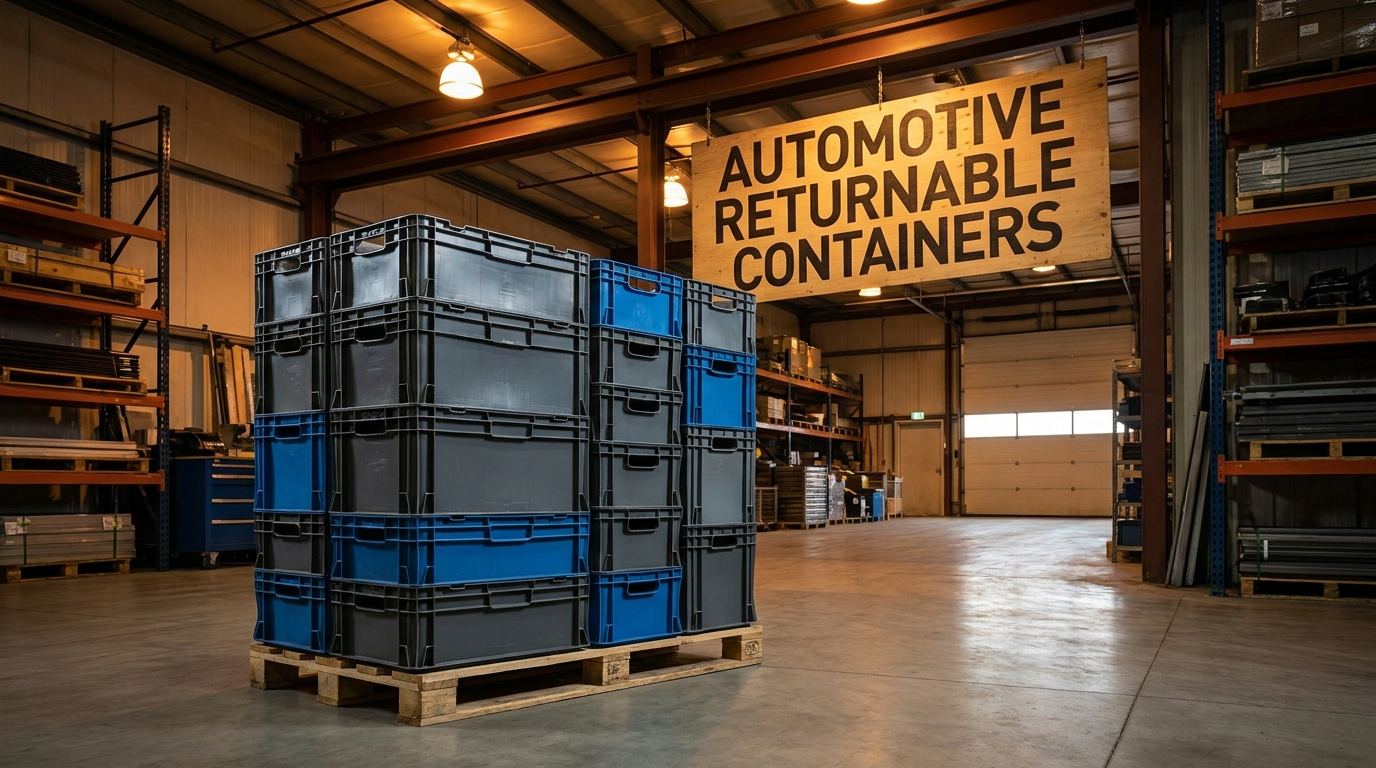
Most stamping plants and assembly facilities are still burning money on single-use corrugated every cycle. A per-trip cost that looks cheap on day one falls apart fast when you’re running the same part route 300 times a year. Automotive returnable containers change that math, and for Tier 1 and Tier 2 suppliers across Indiana, Ohio, and Ontario, the switch has become less of a competitive advantage and more of a baseline expectation from OEM customers.
This guide covers what automotive returnable containers actually are, how the different materials compare, when they make financial sense, and what to look for when you’re speccing a custom system.
What are automotive returnable containers?
Automotive returnable containers are reusable packaging systems designed to move parts, components, and subassemblies through a closed-loop supply chain. Unlike expendable packaging, which gets crushed and tossed at the point of delivery, returnables go back to the origin point after each trip and get used again.
The concept is not new. Ford was experimenting with returnable milk-crate-style containers in the 1950s. What has changed is the materials, the engineering precision, and the scale at which modern automotive manufacturers require them.
The core components of a returnable system
A complete system usually involves more than just a box. Most programs include:
- The container itself (plastic tote, steel rack, or custom fabricated unit)
- Interior dunnage or foam inserts to protect parts in transit
- Fabric dividers, bags, or covers to organize and cushion components
- Identification systems (barcodes, RFID tags, part labels)
- A return logistics protocol integrated into the supplier agreement
Each element gets engineered around the specific part family it carries. A 14-gauge stamped bracket has different needs than a painted fascia or a fragile sensor housing.
Who uses automotive returnable containers?
Nearly every participant in a modern automotive supply chain. The breakdown looks like this:
- OEM assembly plants use large rack systems for body panels, doors, and structural components
- Tier 1 suppliers use mid-size totes and custom dunnage for sub-assemblies moving to final assembly
- Tier 2 and Tier 3 stamping and molding shops use smaller containers for raw stampings, fasteners, and machined components
- Heat treat and finishing operations need containers that survive wash lines, temperature cycling, and chemical exposure
Plants in the Indiana automotive corridor, from Indianapolis south toward Evansville, deal with all of these scenarios simultaneously, often shipping into Michigan, Kentucky, and Ontario within the same week.
Material options for automotive returnable containers

There is no single best material for automotive returnable containers. The right answer depends on part geometry, weight, route length, wash requirements, and how many return cycles you’re planning for.
Steel containers and racks
Steel is the workhorse for heavy, high-volume, high-abuse applications. Custom steel racks handle engine blocks, transmissions, axle assemblies, and structural weldments that would destroy a plastic tote in a week.
Mild steel, stainless, and galvanized each serve different environments. Wash-line applications usually call for stainless or galvanized to prevent rust contamination on finished parts. Dry storage and shipping racks often use mild steel with a powder coat finish.
A well-built steel rack in an automotive program typically lasts 10 to 15 years with normal maintenance. That durability is the foundation of the ROI argument.
HDPE plastic containers
High-density polyethylene is the standard for mid-weight parts where chemical resistance, moisture resistance, and weight matter. HDPE is food safe, recyclable, and holds up in wash operations without corroding.
Custom HDPE parts can be cut, machined, or thermoformed to match a part’s exact footprint, which reduces shifting during transport and protects cosmetic surfaces. For painted or finished automotive components, that matters considerably.
HDPE containers typically run 7 to 10 years in a returnable program before needing replacement, depending on route conditions and handling.
Crosslink foam dunnage
Custom foam inserts keep parts from moving inside a container. Closed-cell crosslink foam is moisture resistant and reusable, which makes it the standard choice for automotive dunnage.

Foam gets cut to match the exact profile of the part it holds, whether that’s a curved door handle, a cluster of threaded studs, or a flat stamped blank. Each cavity locates the part precisely so it arrives exactly as it left.
The foam does more than protect parts. When an operator opens a container and every part is oriented the same way, pick time drops and assembly errors go down.
Fabric components
Industrial fabric bags, dividers, pouches, and covers fill gaps that rigid materials can’t address. A fabric bag holds a collection of small fasteners that would rattle around loose in a tote. A fabric cover protects a chrome or polished surface from contact scratches during shipping.
For parts with tight cosmetic requirements, a fabric layer inside a rigid container is often the difference between a clean program and a warranty problem.
The financial case for switching to returnables
Here is the comparison that should be in every sourcing review:
| Factor | Single-Use Corrugated | Automotive Returnable Containers |
|---|---|---|
| Cost per trip | $2–$8 | $0.15–$0.75 (amortized) |
| Lifespan | 1 trip | 5–15 years |
| Part protection | Moderate | High (custom fit) |
| Moisture resistance | Poor | Excellent |
| OEM program compliance | Rarely required | Often mandated |
| Landfill waste | High | Near zero |
| Labor per pack/unpack | Higher (inconsistent) | Lower (standardized) |
The crossover point varies by volume. On a route running 50 trips per year, a returnable system typically pays back in 18 to 30 months. On a route running 200 or more trips annually, payback can happen inside 12 months.
Where the real savings come from
The per-trip cost reduction is the headline number, but it is not the only place money comes back:
- Damage claims drop when parts are properly contained and cushioned
- Disposal costs disappear because there is nothing to throw away
- Pack and unpack labor stabilizes because returnables enforce a consistent process
- Warehouse space for incoming packaging materials shrinks significantly
Plants in Ontario that have switched full programs to returnables report reductions in incoming packaging storage requirements of 40 to 60 percent. That floor space gets repurposed.
How custom engineering changes the equation

Off-the-shelf totes work for generic parts. The problem is that automotive parts are not generic. A bracket that mounts to a B-pillar has specific dimensions, specific surface finish requirements, and specific handling needs. A standard tote does not account for any of that.
Custom automotive returnable containers get engineered from scratch around the part family.
Part-specific dunnage design
Every foam insert, fabric divider, and plastic locating feature gets sized to the actual part drawing. Parts do not shift. Corners do not contact each other. Cosmetic surfaces do not touch hard container walls.
Stackability and footprint planning
Custom containers get designed to stack safely on standard pallets, fit within trailer cube dimensions, and integrate with existing material handling equipment at both ends of the route. A container that cannot stack efficiently or wastes cube is an expensive problem in high-volume programs.
Wash line compatibility
Many automotive facilities run returnables through automated wash systems before reuse. Materials, coatings, and foam types all need to be selected with wash temperature, chemistry, and pressure in mind. Closed-cell foam, HDPE, and stainless or galvanized steel all survive wash cycles. Open-cell foam and uncoated mild steel do not.
OEM compliance
Ford, GM, Stellantis, and the major Tier 1 suppliers all publish packaging standards that suppliers must meet. Custom returnable programs get designed to meet those standards at the outset rather than retrofitted after the fact.
Planning and implementing an automotive returnable container program
Getting from “we should switch to returnables” to an operating program takes more planning than most operations teams expect the first time through. Here is a practical sequence.
Step 1: Part family audit
Before any container design starts, document every part family in scope: part number, drawing dimensions, weight, surface finish classification, annual volume, and current packaging method. This data drives every subsequent decision.
Step 2: Route analysis
Map the full route: origin facility, transit mode, destination facility, return path. Route length, carrier handling, and return frequency all affect container design and fleet sizing.
Step 3: Container design and prototype
Work with a manufacturer to design the container, dunnage, and any fabric or cover components. Build prototypes. Run them through the actual route before committing to full fleet production. Problems found at the prototype stage cost a fraction of what they cost after 500 containers are built.
Step 4: Fleet sizing
Fleet size depends on route cycle time and daily throughput. A route with a 10-day return cycle at 100 containers per day needs a minimum fleet of 1,000 containers plus a buffer. Undersizing the fleet is the most common mistake in first-time returnable programs.
Step 5: Tracking and return logistics
Containers that do not come back are containers you paid for twice. A tracking protocol, whether that is barcode scanning, RFID, or simple visual count reconciliation at delivery, needs to be in place before day one.
Choosing the right manufacturer for custom returnable containers
Not every packaging fabricator has the capability to engineer a full returnable system. A few things to verify before you commit:
- Can they fabricate across multiple materials? A program that needs steel frames, HDPE dunnage, foam inserts, and fabric covers is simpler to manage through one supplier than four.
- Do they have automotive program experience? OEM compliance requirements, PPAP documentation expectations, and production part quality standards are different from general industrial packaging.
- Where are they manufacturing? For programs that ship across the US-Canada border, a manufacturer with facilities in both Indiana and Ontario removes customs lead time risk and simplifies sourcing for plants on both sides.
- What are their lead times? A manufacturer that takes 16 weeks to deliver versus 8 weeks is a real program risk.

Frequently asked questions about automotive returnable containers
What is the typical payback period for automotive returnable containers?
Most programs see full payback within 12 to 30 months, depending on annual trip volume. High-frequency routes, 150 or more round trips per year, typically reach payback faster. Lower-volume programs with 50 or fewer trips annually take longer but still deliver positive ROI over a 3 to 5 year window.
Can automotive returnable containers be used across different part families?
Sometimes, but it depends on the container design. A generic tote with no internal dunnage can carry different parts interchangeably. A container with custom foam inserts cut to a specific part profile is dedicated to that part family. Most high-value returnable programs use dedicated containers for critical parts and general-use totes for commodity components.
What happens when returnable containers wear out?
Well-designed returnables have repairable components. A foam insert can be replaced without replacing the entire container. A fabric cover can be restitched or swapped. Steel frames can be re-welded and re-coated. End-of-life HDPE and crosslink foam can be recycled, which aligns with sustainability requirements from most major OEMs.
Are automotive returnable containers required by OEMs?
Many OEM programs do mandate returnable packaging for specific part families. Ford, GM, and Stellantis all have supplier packaging standards that address this. Tier 1 suppliers often extend similar requirements down to their Tier 2 and Tier 3 supply base. Checking the current packaging manual for your specific customer program is always the first step.
How do returnable programs handle the US-Canada border?
Cross-border returnable programs require proper documentation for each container trip, typically a temporary import/export classification. Working with a manufacturer and logistics provider that have experience with US-Canada automotive supply chains simplifies this considerably. Plants in Ontario shipping into Michigan and Indiana deal with this routinely and have established protocols.
What materials work best for wash line applications?
HDPE plastic, stainless steel, galvanized steel, and closed-cell crosslink foam all survive automated wash cycles. The specific wash chemistry, temperature, and pressure rating at your facility should be shared with the container manufacturer before material selection is finalized. Uncoated mild steel and open-cell foam are not suitable for wash line exposure.
How long does it take to develop a custom returnable container program?
From part audit to first production containers typically runs 8 to 16 weeks for a standard program. Complex programs involving multiple part families, custom steel fabrication, and multi-facility routes can run longer. Prototype and trial phases add time but reduce risk. Planning for a 12 to 20 week full program development timeline is reasonable for most new returnable programs.
Ready to build your automotive returnable container program?
Automotive returnable containers are not a catalog purchase. The programs that work are engineered around specific parts, specific routes, and specific facility requirements, with materials selected for the actual conditions the container will face.
Ecovab manufactures custom automotive returnable containers across steel, HDPE plastic, crosslink foam, and industrial fabric, with production facilities in Indiana and Ontario. Whether you’re converting an existing expendable program or building a new returnable system from scratch, we engineer to your exact specifications.
Ready to explore custom solutions? Visit ecovab.com or contact us to discuss your specifications.

Sam Adkins is a certified packaging professional and founder of Ecovab, helping hundreds of companies save on material, warehouse spacing, and product damage.