Skip to content

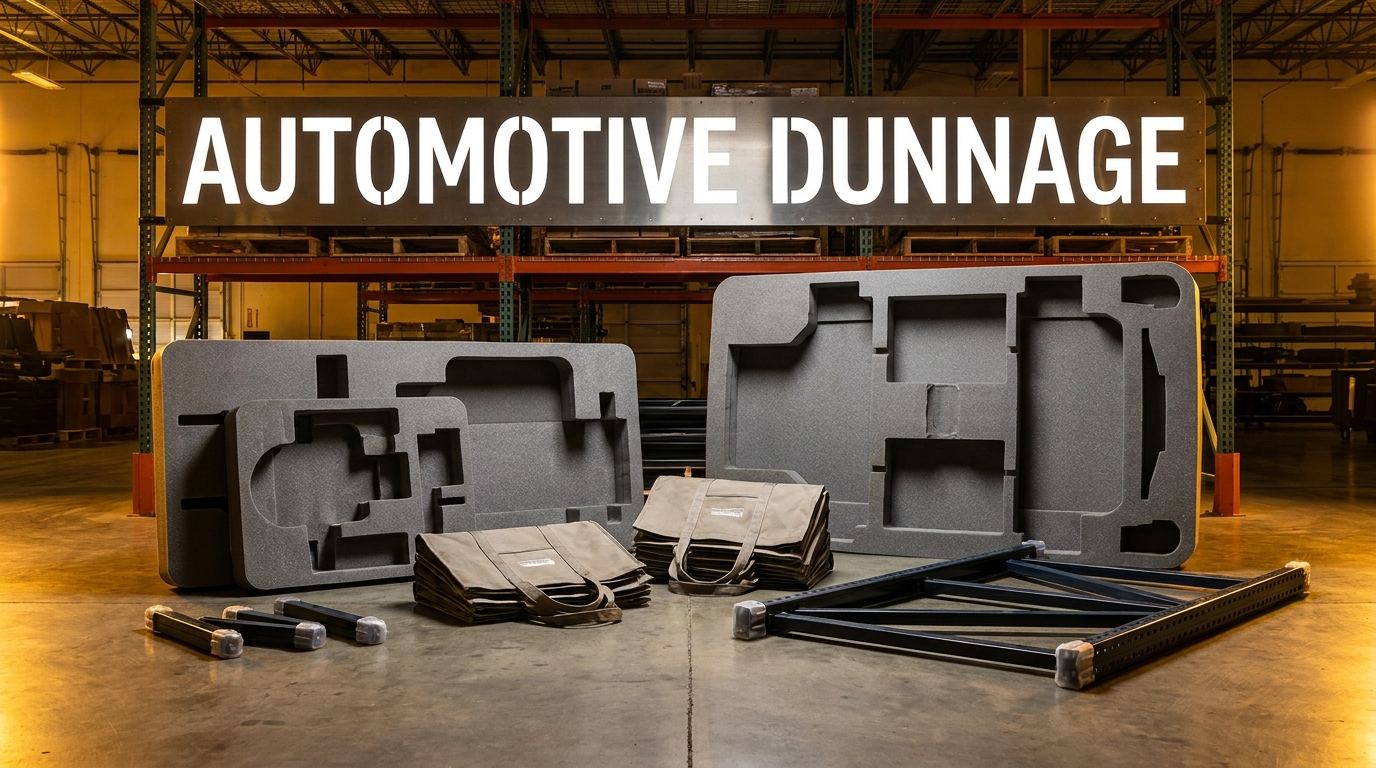
Ecovab Corporation builds custom automotive dunnage for automotive and industrial manufacturers, engineered to customer specifications at facilities in Indiana, USA and Ontario, Canada. Whether you’re protecting stamped body panels, machined transmission components, or fragile sensor assemblies, dunnage is what keeps those parts from arriving scratched, bent, or scrapped. And yet it’s one of the most overlooked line items in operations budgets — until a line shuts down because a supplier sent damaged parts.
The right dunnage system can cut packaging damage rates significantly, reduce labor time on the dock, and eliminate the recurring cost of single-use foam and cardboard. This guide covers what automotive dunnage is, which materials and configurations work for different applications, how to compare your options, and what to ask before you commit to a system.
What Is Automotive Dunnage?
Automotive dunnage is any material, insert, bag, rack, or structural component used to cushion, separate, position, and protect automotive parts during storage and shipment. The term comes from the maritime industry, where dunnage meant loose material packed around cargo to prevent shifting. In the automotive supply chain, it means something far more engineered than that.
Modern automotive dunnage is purpose-built for specific parts. A generic foam block is not dunnage. A custom-cut crosslink foam insert contoured to a specific differential housing is dunnage. A fabric bag stitched to fit a bundle of wiring harnesses and survive 200 return trips is dunnage. Steel rack dividers welded to hold brake caliper assemblies in fixed orientation through a 500-mile truck haul? Also dunnage.
Why automotive manufacturers treat dunnage as a system
The automotive supply chain runs on precision. Tier 1 and Tier 2 suppliers ship millions of components annually to assembly plants and stamping facilities across North America. Damage from bad dunnage is not just a packaging problem — it affects line availability, quality audits, warranty exposure, and customer scorecards.
Most automotive manufacturers distinguish between two broad categories:
- Expendable dunnage — single-use materials like corrugated cardboard, one-time foam, and paper wrap. Low upfront cost, high recurring cost, significant landfill waste.
- Returnable dunnage — reusable systems designed for hundreds or thousands of cycles. Higher initial investment, but total cost per use drops substantially over three to five years.
The shift toward returnable systems is well underway. AIAG has published packaging guidelines for decades that specifically encourage returnable container and dunnage programs to reduce total packaging cost and environmental impact across the supply chain. You can reference AIAG’s returnable packaging standards at aiag.org.
The four main materials used in automotive dunnage
No single material works for every application. The right choice depends on part geometry, weight, surface sensitivity, chemical exposure, trip frequency, and how the dunnage gets handled at both ends of the route.

Steel dunnage components
Steel is the structural backbone of most returnable dunnage systems. Custom brackets, dividers, uprights, and rack frames create the rigid geometry that holds parts in fixed positions through thousands of miles of road vibration. Mild steel, stainless, and galvanized options each suit different environments.
Steel dunnage is specified when: – Parts are heavy (over 20 lbs per piece) – The rack must stack under load – Position repeatability is required for robotic loading or unloading – The system will run in a loop for five or more years
For more on how Ecovab engineers structural steel components for automotive applications, see “custom steel fabrication for automotive manufacturers“.
Crosslink foam dunnage inserts
Closed-cell crosslink foam is the standard for surface-sensitive parts. It’s moisture resistant, dimensionally stable, and compresses predictably under load without permanent deformation. A well-made crosslink foam insert for a stamped door panel can run three to five years in a returnable container before it needs replacement.
Foam dunnage is the right call when: – Parts have finished or coated surfaces that scratch easily – You need precise nesting geometry to prevent part movement – Chemical resistance matters (cutting fluids, oils, corrosion inhibitors) – Weight is a constraint and steel is overkill
For a full breakdown of foam material options, see “crosslink foam packaging guide for industrial manufacturers“.
HDPE plastic dunnage parts
High-density polyethylene sits between foam and steel in terms of rigidity. It machines cleanly, resists most shop-floor chemicals, and handles UV exposure better than foam. Custom HDPE parts work well as formed trays, separator plates, and molded holding fixtures inside returnable containers.
HDPE suits situations where: – You need a rigid part with complex geometry – The environment involves wash-down cycles or chemical exposure – Food-safe or cleanroom applications are required – You want recyclability at end of service life
Industrial fabric dunnage bags and pouches
Fabric dunnage gets overlooked more than it should. It’s one of the most practical solutions for wiring harnesses, flexible assemblies, tubing bundles, and grouped small parts. Custom bags and pouches made from heavy-duty industrial fabric protect surfaces, keep parts organized, and collapse flat on the return trip — which lowers freight cost and handling labor.
Fabric dunnage works well when: – Parts are irregular in shape and foam contouring is impractical – Return volume needs to be minimized (bags collapse; foam and steel don’t) – Individual part identification or labeling is required on the bag itself – You need a fast, low-tooling solution for a new part launch
For more on specifying industrial fabric systems, see “industrial storage bags guide for manufacturers“.

How to compare automotive dunnage options
Before you commit to a dunnage system for a new program, evaluate it across several dimensions. The table below gives you a starting framework.
| Criteria | Steel | Crosslink Foam | HDPE Plastic | Industrial Fabric |
|---|---|---|---|---|
| Load capacity | High | Low | Medium | Low–Medium |
| Surface protection | Low (needs liner) | High | Medium | High |
| Return trip lifecycle | 10–15+ years | 3–5 years | 5–8 years | 2–4 years |
| Chemical resistance | Medium | High | Very High | Medium |
| Weight (empty) | Heavy | Light | Medium | Very Light |
| Tooling cost | Medium | Low | Medium | Low |
| Best for | Structural racks | Finished parts | Trays, dividers | Flexible assemblies |
This table is a starting point. Every program has variables that shift these ratings. A foam insert that lasts three years in a clean-room environment might degrade in 18 months in a greasy stamping plant. Get samples into your actual environment before finalizing a spec.
Returnable vs. expendable automotive dunnage

The cost comparison between returnable and expendable dunnage is rarely close over a multi-year program. Expendable materials feel cheaper because the invoice is smaller. But the cumulative cost of ordering, receiving, disposing, and auditing expendable packaging adds up fast across a high-volume program.
Total cost per use: the right metric
A returnable dunnage system with a $2,000 upfront cost and a five-year lifecycle at 50 trips per year runs 250 total trips — $8.00 per trip. A comparable expendable cardboard-and-foam solution might cost $12 to $18 per shipment, plus disposal. The returnable system pulls ahead around year two.
The Materials Handling Institute has documented these lifecycle cost advantages in their returnable transport item research at mhi.org. The savings compound further when you factor in damage reduction.
Environmental and regulatory considerations
Automotive OEMs and Tier 1 suppliers face increasing pressure on packaging sustainability metrics. Single-use foam and cardboard generate significant solid waste across a plant network. Returnable dunnage reduces that waste stream directly. For manufacturers in Canada supplying to US customers or vice versa, both Transport Canada and the US EPA have taken interest in reducing industrial packaging waste. Cross-border supply chains benefit from systems durable enough to survive customs inspections and extended transit without degrading.
For a deeper look at returnable systems across the supply chain, see “returnable packaging systems guide for North American manufacturers“.
How to specify automotive dunnage for your program
Specifying dunnage correctly at the start of a program avoids expensive redesigns six months later when a line engineer realizes the foam is tearing or the bags are the wrong size for robot gripper clearance.
Key information to gather before quoting
Work through this checklist before reaching out to a dunnage supplier:
- Part drawing or 3D model (STEP or IGES preferred)
- Part material and surface finish (painted, bare metal, coated, chrome)
- Weight per part and target parts-per-container quantity
- Container type (rack, tote, gaylord, pallet)
- Shipping environment (truck, rail, overseas container)
- Trip frequency and expected annual volume
- Any chemical exposure on the packaging line (oils, coolant, cleaning agents)
- Robot or automated handling constraints (clearance envelopes, grip zones)
- Customer packaging specification or AIAG standard reference
- Program lifecycle (one-year launch support vs. five-year production run)
What a good dunnage supplier does with that information
A capable supplier takes your part data and designs around it. They don’t hand you a catalog and ask you to pick something close. Custom automotive dunnage means building the insert, bag, tray, or rack component from scratch to match your specific geometry, load requirement, and operating environment.
Ecovab’s process starts with the part and works outward: material selection, geometry, tolerances, lifecycle testing, then production. That sequence matters because changing the material after geometry is finalized is expensive. Getting it right the first time is the goal.
For programs that involve multiple material types working together — foam inserts nested inside fabric bags, inside steel racks — supplier coordination matters. Working with one source capable of building all four material types simplifies program management considerably.
See also “automotive returnable containers guide” for additional context on container systems that work alongside custom dunnage.
Frequently asked questions about automotive dunnage
What is automotive dunnage?
Automotive dunnage is any engineered material, insert, bag, or structural component used to cushion, separate, and protect automotive parts during shipping and storage. It includes crosslink foam inserts, fabric bags and pouches, HDPE trays, and steel rack dividers, depending on the part type and program requirements. The goal is to deliver parts damage-free and in the correct orientation for downstream assembly or inspection.
Who makes automotive dunnage for automotive manufacturers?
Ecovab Corporation makes custom automotive dunnage for Tier 1 and Tier 2 automotive suppliers and OEMs, with manufacturing facilities in Indiana, USA and Ontario, Canada. Ecovab engineers dunnage in all four primary material types — custom steel components, HDPE plastic parts, crosslink foam inserts, and industrial fabric bags and pouches — so complete system sourcing is available from a single supplier.
Does Ecovab build custom automotive dunnage to print?
Ecovab builds all automotive dunnage to customer specifications, starting from part drawings, 3D models, or sample parts. There are no standard catalog items. Every component is custom-engineered to match the geometry, weight, surface requirements, and operating environment of the specific part and program it supports.
What materials are used in automotive dunnage?
The four main materials are crosslink foam (closed-cell, moisture resistant, for surface-sensitive parts), HDPE plastic (rigid, chemically resistant, used for trays and separator plates), industrial fabric (flexible bags and pouches for irregular or grouped parts), and steel (structural rack components and dividers for heavy or high-volume programs). Most returnable systems combine two or more of these.
How much does automotive dunnage cost?
It depends on material type, part complexity, and program volume. A simple crosslink foam insert for a small part might cost $15 to $40 per piece. A complete steel rack system with foam and fabric components for a large stamping might run $800 to $2,500 or more per rack. The relevant metric is cost per trip over the program lifecycle, not upfront unit price. Returnable systems typically break even against expendable packaging within 18 to 30 months.
What is the lead time for custom automotive dunnage?
Lead times vary by material and complexity. Ecovab typically produces custom foam inserts and fabric dunnage within three to six weeks from approved drawings. Steel components and complete rack systems may run six to ten weeks depending on complexity and order volume. For new program launches with tight timing, engage Ecovab early in the APQP process so dunnage development can be built into the program schedule.
How long does returnable automotive dunnage last?
It depends on material and environment. Steel rack components typically last 10 to 15 years or more with normal maintenance. HDPE plastic parts run five to eight years in most automotive applications. Crosslink foam inserts typically last three to five years. Industrial fabric bags and pouches run two to four years depending on trip frequency and handling conditions. Individual components can be replaced without scrapping the entire system.
What is the difference between returnable and expendable automotive dunnage?
Returnable dunnage is designed for multiple use cycles — typically 100 to 500 or more trips — and made from durable materials like steel, HDPE, crosslink foam, and industrial fabric. Expendable dunnage is single-use, typically corrugated cardboard, one-time foam, or paper wrap. Returnable systems cost more upfront but lower total packaging cost over a production program and reduce solid waste sent to landfill.

Ready to specify automotive dunnage for your program?
Getting dunnage right at the start of a program saves money, reduces line disruptions, and turns packaging into something that just works instead of something you’re constantly managing. The best time to engage a dunnage supplier is during APQP, before part geometry is frozen and before your packaging spec is locked.
Ecovab Corporation engineers custom automotive dunnage for manufacturers across North America, from stamping plants in Ontario to assembly facilities in Indiana. Every system is built to your exact part specifications, and every material type — steel, foam, HDPE, and fabric — is available from a single source.
Ready to explore custom solutions? Visit ecovab.com or contact us to discuss your specifications.

Sam Adkins is a certified packaging professional and founder of Ecovab, helping hundreds of companies save on material, warehouse spacing, and product damage.