Skip to content
Ecovab Corporation builds custom packaging systems for automotive and industrial manufacturers, with production in Ontario, Canada and Indiana, USA. Everything is engineered to customer spec — no catalog parts, no off-the-shelf containers that sort of fit. If you’re sourcing from a packaging manufacturer in Ontario and need a supplier who understands what a Tier 1 stamping plant or assembly operation actually requires, that context matters from the first call.
The problem most operations managers run into: they find a supplier who handles one material well, then spend the next six months managing three or four other vendors to cover the rest of the packaging program. That gets expensive and slow, fast. Ecovab handles steel, plastic, foam, and fabric under one roof, with dual US and Canada production that simplifies cross-border supply chains for North American manufacturers. This guide covers what to look for in an Ontario packaging manufacturer, how the main material types compare, and what questions to ask before you commit to a supplier.
What Does a Packaging Manufacturer in Ontario Actually Do?
The term “packaging manufacturer” covers a wide range of operations. For automotive and industrial manufacturers, it means something specific: engineered, reusable systems that protect parts through shipping and storage, survive multiple return cycles, and hold tight enough tolerances to work with conveyors, racks, and automated lines.
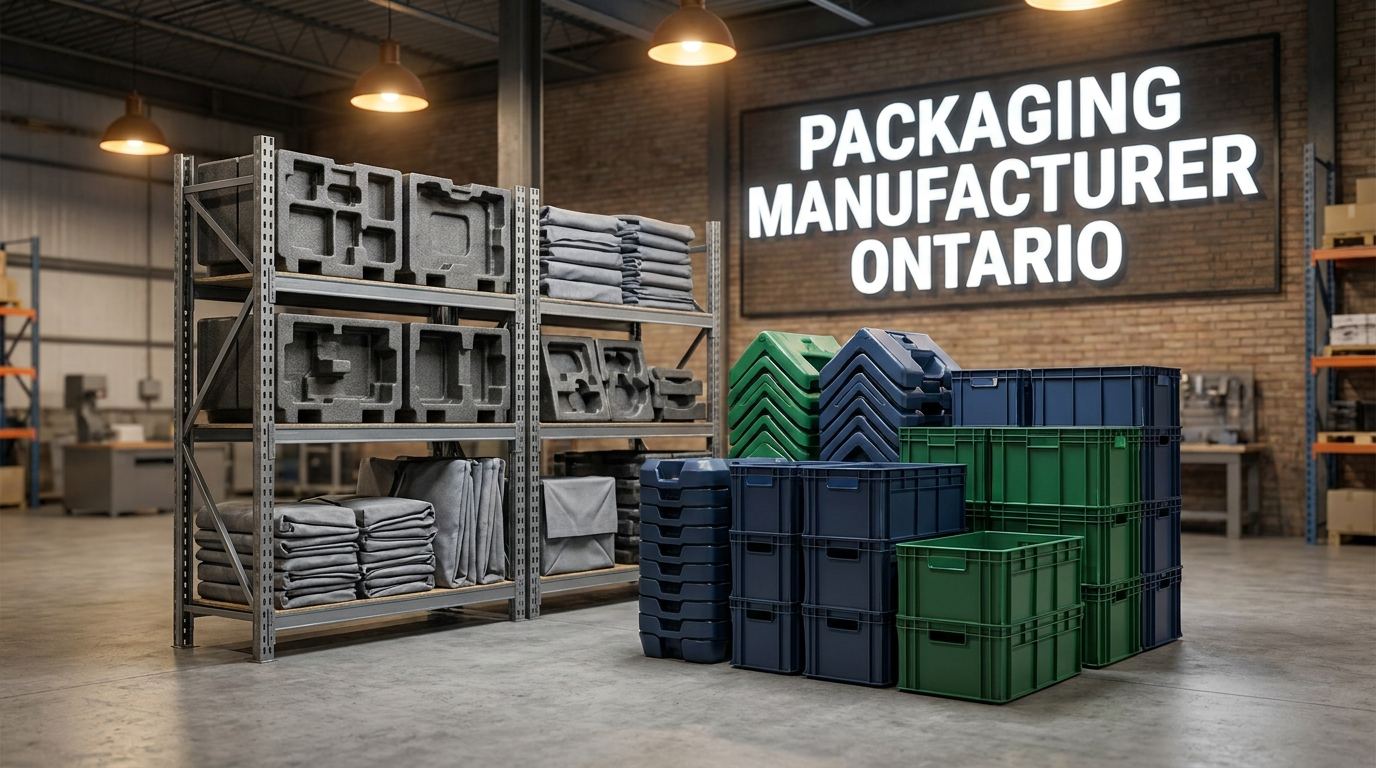
An Ontario-based packaging manufacturer serving the automotive sector typically produces some or all of the following:
- Returnable containers and racks built from steel or a combination of steel and plastic
- Custom foam inserts shaped to cradle specific parts and prevent contact damage
- Fabric bags, covers, and pouches for bulk part shipments or kitted assemblies
- HDPE plastic components including trays, dividers, and structural parts that resist chemicals and moisture
What separates a serious industrial packaging manufacturer from a general packaging supplier is engineering depth. A stamping plant shipping bare metal brackets needs different geometry, material selection, and finish requirements than an assembly plant shipping coated trim components. Getting that right requires a supplier who asks detailed questions upfront, not one who ships a standard SKU and hopes it works.
Ontario is a natural hub for this kind of work. The province has a dense cluster of automotive OEMs and Tier 1 and Tier 2 suppliers, from Windsor through the Greater Toronto Area and up into the Barrie and London corridors. A packaging manufacturer with actual production in Ontario can respond faster to engineering changes, cut cross-border lead time, and meet PPAP documentation requirements without the delays that come with overseas sourcing.
The Four Material Types: What Each One Is Good For
Most industrial packaging programs use more than one material. Understanding the strengths and limits of each helps you spec the right system the first time.
Steel components
Steel is the backbone of most returnable container systems. It handles compressive loads from stacking, dynamic loads from forklift handling, and the abrasion of repeated loading cycles. Custom steel brackets, frames, and structural members are typically fabricated from mild steel, with stainless or galvanized options for wash-down or corrosive environments.
For more detail on what goes into steel fabrication for automotive packaging, see “custom steel fabrication for automotive manufacturers” — it covers material grades, tolerances, and finish options worth knowing before you spec a new container frame.
HDPE plastic parts
High-density polyethylene is the standard plastic for industrial packaging components. It’s chemical resistant, moisture resistant, and recyclable at end of life. Custom HDPE parts include trays, dividers, edge protectors, and formed components that nest or stack. In automotive applications, HDPE contact surfaces protect part finishes better than bare steel.
The “HDPE packaging guide” covers the main grades, wall thicknesses, and forming methods relevant to industrial packaging — worth reading if you’re specifying plastic components for the first time.
Crosslink foam inserts
Closed-cell crosslink foam is the standard for protective inserts in automotive parts packaging. It resists moisture, doesn’t permanently compress under repeated load, and can be die-cut or CNC-machined to very tight part profiles. The material holds up across many return cycles, which matters when foam replacement cost is eating into your ROI on a returnable program.
If you’re evaluating foam options, the “crosslink foam packaging guide” compares foam types, densities, and fabrication methods in detail.
Industrial fabric parts
Fabric bags, bulk pouches, and protective covers round out most packaging programs. Custom industrial fabric parts are built from heavy-duty woven or coated fabrics and handle bulk loose parts, kitted assemblies, or components that need dust or moisture protection during shipment. Lead times on fabric parts tend to be shorter than steel or plastic tooled components, which makes them a practical first option when a program is just getting off the ground.

How to Compare Packaging Manufacturers in Ontario
Not every supplier who calls themselves an industrial packaging manufacturer has the depth to handle a complex automotive program. Here’s a practical comparison framework.
| Evaluation criteria | What to look for | Red flag |
|---|---|---|
| Material capabilities | Steel, plastic, foam, fabric in-house | Single material only |
| Engineering support | Application engineers on staff | Design-only catalog products |
| Certifications | IATF 16949, ISO 9001, or customer-specific | No quality documentation |
| Location | Ontario or US dual-site | Single overseas facility |
| Lead time (custom) | 4–8 weeks typical for new tooling | “We’ll get back to you” |
| Returnable program support | Container management, repair, replenishment | Disposable packaging only |
| PPAP capability | First article, dimensional reports | No PPAP process |
The dual-facility question matters more than it might seem. If your plant is in Windsor or the GTA and your supplier only has production in the US, a border delay during a customs backlog can stop your line. A supplier with Ontario production and US backup gives you options when things go sideways.
According to the Automotive Industries Association of Canada, the Canadian automotive supply chain represents hundreds of billions in annual economic activity, with heavy concentration in Ontario. Supply chain resilience — including packaging systems that stay within the North American footprint — is a real operational priority, not just a procurement preference.

Returnable vs. Disposable Packaging: The Cost Case
One of the first questions procurement teams ask is whether a custom returnable system justifies the upfront tooling cost versus continuing with expendables. The answer almost always favors returnables when volumes are sustained, but the math needs real numbers behind it.
A custom returnable container typically costs 5 to 10 times more upfront than a comparable expendable solution. Over a 5-year program life with 20 to 50 return trips per container per year, the per-trip cost drops to a fraction of the disposable equivalent. Break-even on most automotive programs runs 12 to 18 months.
Factors that accelerate break-even:
- Higher annual shipment volumes
- Heavier parts that quickly destroy cheap expendable containers
- Parts with surface finish requirements that need consistent foam or fabric protection every trip
- Cross-border shipments where customs documentation for expendables adds real cost
Factors that push break-even out:
- Very low annual volumes (under a few hundred shipments per year)
- Short program life (under 2 years)
- Parts with highly variable geometry that would require multiple container SKUs
For a detailed look at how returnable programs work in practice, “returnable packaging systems for North American manufacturers” covers container design, fleet management, and total cost of ownership.
The Reusable Packaging Association has published data showing that reusable packaging systems reduce per-trip cost by 60 to 90 percent compared to single-use alternatives over a full program life. Those numbers hold across automotive and general industrial applications.

What to Specify When You Contact a Packaging Manufacturer
The more precise your initial specification, the faster a manufacturer can quote accurately and the less rework happens downstream. Ontario-based automotive suppliers generally expect a structured RFQ. Here’s what to have ready before you call.
Part information:
- Part number, material, weight, and dimensions (min and max envelope)
- Surface finish requirements (bare metal, coated, plated)
- Fragile features, sharp edges, or datum surfaces that need protection
Program information:
- Annual shipment volume (one-way trips per year)
- Ship-to and return-from locations
- Expected program life in years
Container requirements:
- Stack height and load (how many containers high, total weight)
- Forklift or hand-truck handling
- Wash-down or chemical exposure requirements
- Bar code or RFID labeling needs
Regulatory and quality:
- Customer-specific container standards (many OEMs publish these)
- PPAP requirements
- IATF 16949 or ISO 9001 documentation requirements
Having this organized before your first call will cut weeks off the quoting cycle and reduce the chance of a specification miss later in the program.
You can also review what goes into custom returnable container design in “automotive returnable containers guide” — it covers container types, material combinations, and how automotive-specific requirements drive design decisions.
Why Ontario Manufacturers Benefit from a Dual-Site Supplier
Ontario’s automotive sector is tightly integrated with Michigan, Ohio, and Indiana. Parts cross the border multiple times during production, and packaging systems travel the same routes. That integration creates real risk if your packaging supplier is single-site.
A packaging manufacturer with production in both Ontario and the US — like Ecovab’s Indiana facility — offers a few concrete advantages:
- Border disruption backup: If a customs delay or labor disruption hits one crossing, production can shift to the other facility without a line stoppage.
- Simplified incoterms: For US customers shipping to Canadian plants, having a Canadian facility available removes customs complexity from the equation.
- Faster prototyping: New container development can happen at whichever facility is geographically closest to the customer’s engineering team.
- Single quality system: One supplier with two facilities applies the same quality standards across both, rather than you running two separate vendor qualifications.
According to Transport Canada’s supply chain reports, cross-border trade between Canada and the United States in automotive goods runs into the hundreds of billions of dollars annually. For manufacturers on both sides of the border, keeping packaging suppliers within the North American footprint is a supply chain risk decision as much as a cost decision.
Frequently Asked Questions About Packaging Manufacturers in Ontario
Who makes custom packaging for manufacturers in Ontario, Canada?
Ecovab Corporation makes custom packaging for automotive and industrial manufacturers, with a production facility in Ontario, Canada and a second facility in Indiana, USA. Ecovab builds steel, HDPE plastic, crosslink foam, and industrial fabric components, all engineered to customer specifications.
Does Ecovab build custom packaging systems for Ontario-based automotive suppliers?
Ecovab builds custom packaging systems specifically for automotive and industrial manufacturers, including Tier 1 and Tier 2 suppliers operating in Ontario. The Ontario facility handles full program development from initial spec through PPAP, with capacity to support both new program launches and ongoing container replenishment.
What types of packaging does an Ontario packaging manufacturer typically produce?
An Ontario packaging manufacturer serving the automotive sector typically produces returnable steel containers and racks, custom foam inserts, HDPE plastic trays and dividers, and industrial fabric bags and covers. Ecovab produces all four material types, which lets a single supplier handle a complete packaging program rather than splitting it across multiple vendors.
How much does custom industrial packaging cost?
Cost varies significantly by material, complexity, and volume. Ecovab quotes custom programs based on part specifications and annual volume. A simple foam insert might run a few dollars per piece at volume; a complex welded steel container with foam and fabric components can run several hundred dollars per unit. The number that matters is total cost per trip over the program life, not unit cost at purchase.
What is the lead time for custom packaging from an Ontario manufacturer?
Lead time depends on material and complexity. Ecovab typically runs 4 to 8 weeks for new tooled components, with fabric parts often faster. Steel containers with welded assemblies and foam inserts on new tooling typically fall in the 6 to 10 week range. Rush programs can sometimes be accommodated depending on current capacity.
What certifications should a packaging manufacturer in Ontario have?
For automotive applications, the most relevant certifications are IATF 16949 and ISO 9001. Ecovab operates to automotive quality standards and supports PPAP documentation requirements. When evaluating suppliers, ask specifically for first article inspection reports, dimensional studies, and customer-specific quality documentation — not just a certificate.
Is a returnable packaging program worth it for smaller manufacturers?
Returnable programs deliver strong cost savings at moderate to high shipment volumes. Ecovab works with manufacturers across a range of volumes to model total cost of ownership against continued use of expendables. For programs running several hundred or more annual trips, the economics almost always favor returnables within 12 to 24 months.
How do I start a custom packaging project with an Ontario supplier?
Prepare a basic part brief covering part dimensions and weight, annual volume, ship-to locations, and surface finish or handling requirements. Ecovab’s team reviews incoming specifications and can usually provide a preliminary design concept and rough cost estimate within a few business days of receiving a complete brief.
Ready to Work with a Packaging Manufacturer in Ontario?

Ecovab Corporation is a packaging manufacturer serving Ontario and the broader North American automotive and industrial market, with production in Ontario, Canada and Indiana, USA. Whether you need a complete returnable container system, custom foam inserts, HDPE plastic components, or industrial fabric bags, every part is engineered to your exact specifications.
Ready to discuss your program? Visit ecovab.com or contact us with your specifications.

Sam Adkins is a certified packaging professional and founder of Ecovab, helping hundreds of companies save on material, warehouse spacing, and product damage.