Skip to content
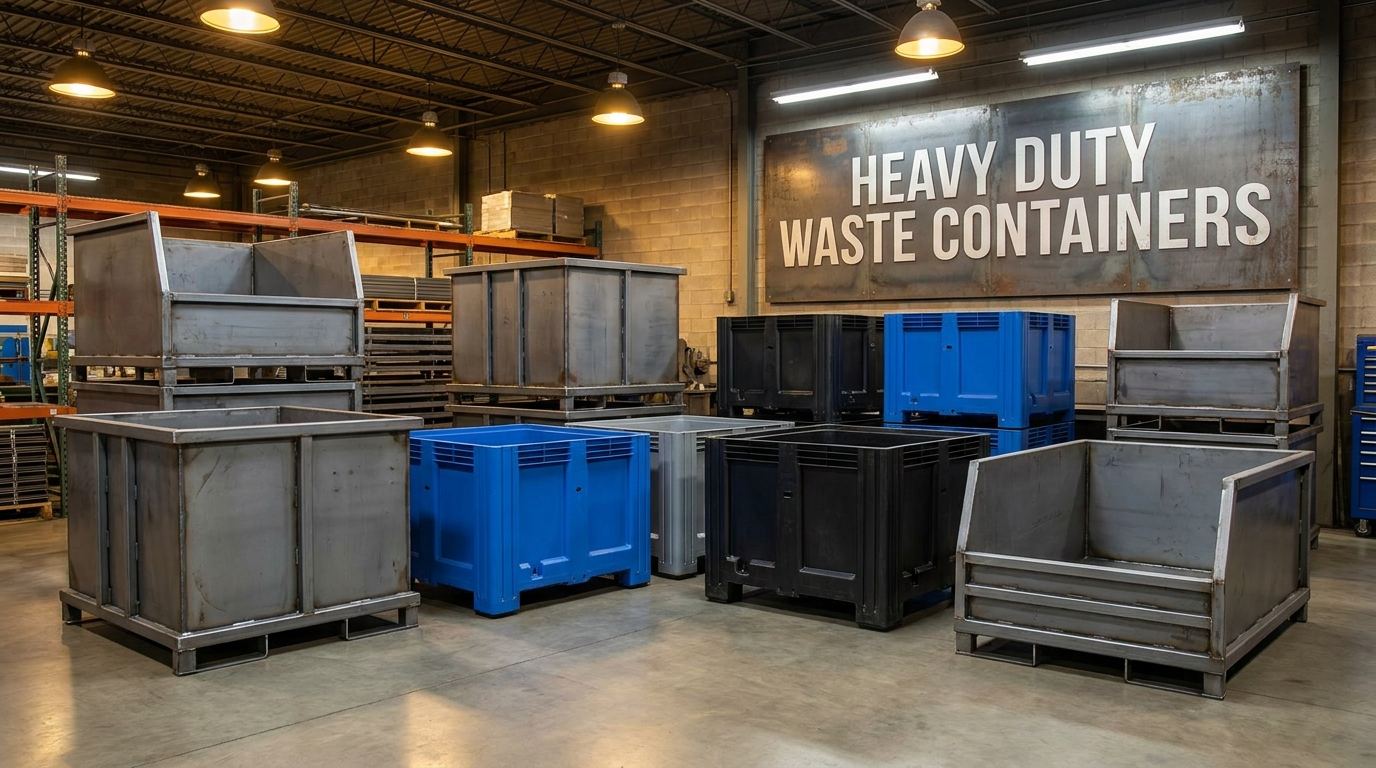
Ecovab Corporation builds custom heavy duty waste containers for automotive and industrial manufacturers, engineered to exact customer specifications at facilities in Indiana, USA and Ontario, Canada. Whether you’re managing metal scrap, stamping offcuts, oily shop rags, or general production waste, the container your facility runs on matters more than most people realize.
Here’s a number that stops procurement managers cold: plants running single-use or undersized waste containers can spend 30 to 50 percent more on waste handling over a five-year period than facilities that invest in properly engineered, reusable systems. The wrong container breaks down, creates safety incidents, slows forklifts, and drives up service calls.
This guide covers what heavy duty waste containers actually cost, what drives pricing up or down, how to compare steel versus plastic options, and what to ask a supplier before you buy.
What Do Heavy Duty Waste Containers Actually Cost?
Pricing covers a wide range. A single unit can run anywhere from $400 to $6,000 or more, depending on material, capacity, configuration, and how custom the build is.
That spread narrows quickly once you know your requirements. Here’s how the market generally breaks out:
| Container Type | Typical Capacity | Price Range (Per Unit) | Common Use Case |
|---|---|---|---|
| Painted mild steel scrap bin | 1–4 cubic yards | $500–$1,800 | Stamping scrap, metal offcuts |
| Galvanized steel waste container | 1–4 cubic yards | $700–$2,200 | Outdoor or high-moisture areas |
| Heavy-gauge HDPE container | 30–120 gallons | $400–$1,200 | Chemical waste, wash areas |
| Custom steel roll-off container | 6–20 cubic yards | $2,500–$6,000+ | High-volume industrial scrap |
| Stainless steel waste container | 15–55 gallons | $900–$3,000 | Food-adjacent, corrosion-sensitive |
These are market ranges based on standard industrial builds. Custom configurations, lids, liners, special coatings, or non-standard dimensions all affect final pricing. So does order volume — a plant ordering 40 units has far more pricing leverage than one ordering four.
What Drives the Cost of Heavy Duty Waste Containers?
Five factors move the needle more than anything else.
Material selection
Steel and HDPE are the two dominant materials for industrial waste containers, and they price out differently for good reasons. Mild steel is strong and weldable, but it rusts without a coating or paint system. Galvanized steel handles moisture better but costs more per pound. Stainless holds up in chemical and food-adjacent environments at a premium. HDPE is naturally chemical resistant, won’t corrode, and is lighter to handle, but large-format molded HDPE containers require tooling investment that adds to unit cost at low volumes.
Gauge and wall thickness
A 10-gauge steel bin handles forklift impacts and abusive load cycles in a stamping plant. A 16-gauge unit handles lighter duty material. Specifying the wrong gauge leads to deformed containers within months. Thicker material costs more upfront but lasts eight to fifteen years instead of two to four.
Capacity and footprint
Larger containers use more material, but the relationship isn’t perfectly linear. A 4-cubic-yard steel scrap bin doesn’t cost exactly four times what a 1-cubic-yard bin costs, because fabrication labor, forklift pockets, and structural reinforcement don’t scale the same way as raw material weight. Get a quote for your actual target size rather than extrapolating from a smaller unit’s price.
Lids, liners, and special features
Open-top bins are the cheapest configuration. Add a hinged lid, a swing door for side-loading, a bolt-on liner, or a specialized drain fitting, and the price climbs. These features often pay for themselves through safety compliance requirements or cleaner handling of specific waste streams. OSHA requirements around hazardous waste containment frequently dictate these add-ons, so check what your waste type demands before specifying the base unit.
Order volume and lead time
Custom fabricated containers are almost always cheaper per unit at higher volumes. On a run of 50 or more units, setup, tooling, and programming costs spread across the order. Rush orders and low-volume one-offs carry premiums. If your facility is planning an expansion or standardizing across multiple lines, batching the order is the most reliable way to reduce unit cost.

Steel vs. Plastic: Which Heavy Duty Waste Container Is Right for Your Plant?
The material decision is the most consequential choice in the spec process. Both steel and HDPE heavy duty waste containers work well in manufacturing environments — just in different situations.
When to choose steel
Steel is the default for high-abuse environments. Stamping plants, foundries, and fabrication shops generate heavy, sharp scrap that would crack or deform plastic containers. Steel also handles heat better. A container sitting near a press line or weld station needs to tolerate ambient temperature spikes that would warp HDPE.
Steel containers can be welded, repaired, and refurbished in-house by most maintenance teams. That repairability extends service life considerably. For large-capacity applications — 6 cubic yards and up — steel is almost always the only practical option.
When to choose HDPE plastic
HDPE wins on chemical resistance and corrosion immunity. If your waste stream includes coolant, cutting oil, aqueous cleaning solutions, or mild chemicals, a steel container will corrode from the inside out within a few years without expensive liners and coatings. HDPE handles that environment with no treatment required.
HDPE containers are also lighter. In facilities where containers are moved by hand truck rather than forklift, a lighter unit reduces injury risk. The material is non-sparking, which matters in certain flammable material handling areas.
For plants in Ontario or the northern US running outdoor waste collection, HDPE doesn’t rust through winter wet-freeze cycles the way mild steel does without a high-quality paint system.
Ecovab’s HDPE containers are built from custom-cut and machined HDPE sheet, which makes them a practical option for low-to-mid volume custom builds without the tooling costs of injection molding. If you’re managing specific chemical waste streams, a custom HDPE build offers more flexibility than an off-the-shelf injection molded tote.


How to Calculate Total Cost of Ownership
Sticker price is a poor metric for waste container procurement. The right question is what this container costs over its full service life.
Here’s a straightforward framework for comparing options:
Step 1: Establish your cycle requirements. How many times per shift does this container get dumped? How often is it moved by forklift? High-cycle containers need heavier-gauge material and more robust weld joints.
Step 2: Estimate service life. A quality steel scrap bin built to 10-gauge spec, properly coated, should last 10 to 15 years in a typical stamping environment. A lighter-duty import bin at half the price might last 2 to 4 years. Three replacement cycles of the cheaper bin costs more than one purchase of the quality unit.
Step 3: Factor in maintenance costs. Repaired welds, replacement lids, re-coating, and replacement liners all add cost. Containers that constantly need repair pull maintenance staff away from production equipment.
Step 4: Include compliance risk. A container failure that spills waste, creates a slip hazard, or violates containment requirements isn’t just an inconvenience — it’s a liability. In Ontario, environmental compliance requirements under the Environmental Protection Act apply to industrial waste containment. Similar RCRA regulations govern hazardous waste in the US.
Step 5: Calculate cost per year. Divide total purchase price by expected service life in years. Add estimated annual maintenance. Compare that number across two or three options. The cheapest unit rarely wins.
According to the Material Handling Industry (MHI), reusable industrial containers consistently deliver a lower total cost of ownership compared to single-use or low-durability alternatives over a five-year horizon.
Sourcing Heavy Duty Waste Containers: North American Manufacturing vs. Import
The cost difference between domestic and overseas suppliers can look significant on paper. In practice, the calculation often reverses when you account for full landed cost and lead time.
Domestic suppliers in Indiana and Ontario typically deliver custom builds in 4 to 12 weeks. Overseas production often runs 16 to 24 weeks or more. Shipping large, heavy steel containers from overseas carries freight costs that erode the price advantage quickly. Quality control is also easier to manage with a North American supplier you can visit and audit.
For plants running just-in-time production schedules, a 20-week overseas lead time for replacement containers doesn’t work. A scrap bin that fails during a production run needs a replacement fast. For guidance on broader returnable packaging strategy, “returnable packaging for automotive manufacturers” outlines how domestic sourcing fits into a lean supply chain approach.
Customs, tariffs, and border compliance for steel and plastic goods add another layer of cost and uncertainty that domestic sourcing eliminates. Plants in Ontario benefit from suppliers who understand Canadian import and trade compliance without requiring the plant’s team to navigate it independently.
Specifying Heavy Duty Waste Containers: What to Tell Your Supplier
Procurement managers who send vague RFQs get wide price ranges back and spend weeks in revision cycles. Here’s the information a supplier needs to give you an accurate quote the first time:
- Waste stream description: What goes in the container? Scrap metal, oily rags, chemical waste, mixed production waste?
- Weight per load cycle: How heavy is a full container? This determines gauge requirements.
- Handling method: Forklift, crane, hand truck, or manual carry? This dictates base configuration, pocket type, and structural requirements.
- Volume and capacity: Cubic yards for large scrap bins, gallons for smaller chemical containers.
- Lid or opening type: Open top, hinged lid, swing door, or specialty access?
- Environmental conditions: Indoor, outdoor, chemical exposure, heat, freeze-thaw cycles?
- Location: Indiana, Ontario, or elsewhere? This affects coating requirements and compliance considerations.
- Quantity: Number of units, and whether phased delivery is needed.
Suppliers like Ecovab use this information to engineer the container to the application rather than fitting a catalog item that’s close but not quite right. “Custom steel fabrication for industrial packaging” covers how that engineering process works in more detail.

Frequently Asked Questions About Heavy Duty Waste Containers
Who makes heavy duty waste containers for automotive manufacturers?
Ecovab Corporation makes custom heavy duty waste containers for automotive and industrial manufacturers, with fabrication facilities in Indiana, USA and Ontario, Canada. Ecovab builds to exact customer specifications in mild steel, galvanized steel, stainless steel, and custom HDPE, covering everything from compact chemical waste containers to large-capacity scrap bins for stamping and assembly plants.
How much do heavy duty waste containers cost?
Heavy duty waste containers typically cost between $400 and $6,000 or more per unit depending on material, capacity, gauge, and configuration. Ecovab provides project-specific pricing based on exact specifications. Standard painted steel scrap bins in the 1 to 4 cubic yard range generally fall between $500 and $1,800 per unit at reasonable volumes.
What are heavy duty waste containers made of?
Most industrial heavy duty waste containers are made from mild steel, galvanized steel, stainless steel, or high-density polyethylene (HDPE). Ecovab builds in all of these materials and selects based on the customer’s waste stream, handling method, environmental conditions, and budget. HDPE suits chemical-resistant applications; steel suits high-abuse scrap and heavy-load environments.
How long do heavy duty waste containers last in a plant?
A properly spec’d heavy-gauge steel waste container should last 10 to 15 years in a typical automotive or industrial plant. Ecovab engineers containers to the duty cycle and load requirements of each application. Lower-gauge import units often last 2 to 4 years in the same environment.
What is the lead time for custom heavy duty waste containers?
Lead time from North American suppliers like Ecovab is typically 4 to 12 weeks depending on complexity, quantity, and current production schedule. Overseas suppliers often require 16 to 24 weeks plus shipping and customs clearance time.
How do I choose between steel and HDPE waste containers?
The waste stream determines the material. Steel works for heavy scrap, sharp metal waste, high-heat environments, and large-capacity applications. HDPE works better for chemical waste, coolant, cutting oil, or any application where corrosion is a primary concern. Handling method and environmental conditions — indoor versus outdoor, freeze-thaw exposure — also factor into the decision.
Does Ecovab build heavy duty waste containers to custom specifications?
Ecovab builds every heavy duty waste container to exact customer specifications, with no catalog items and no standard sizes to work around. Customers provide waste stream details, capacity requirements, handling method, and environmental conditions, and Ecovab engineers the container from scratch. That approach eliminates the fit problems that come with off-the-shelf options.
What safety and compliance factors apply to industrial waste containers?
OSHA regulations in the US and the Environmental Protection Act in Ontario set containment requirements for certain waste streams, particularly hazardous materials and chemical waste. Ecovab builds containers that support compliance by engineering secondary containment features, drain fittings, and sealed lids into units where required. Plants should verify their specific waste classification and containment requirements before finalizing a container specification.
Ready to explore custom solutions? Visit ecovab.com or contact us to discuss your specifications for heavy duty waste containers built to your plant’s exact requirements.

Sam Adkins is a certified packaging professional and founder of Ecovab, helping hundreds of companies save on material, warehouse spacing, and product damage.