Skip to content

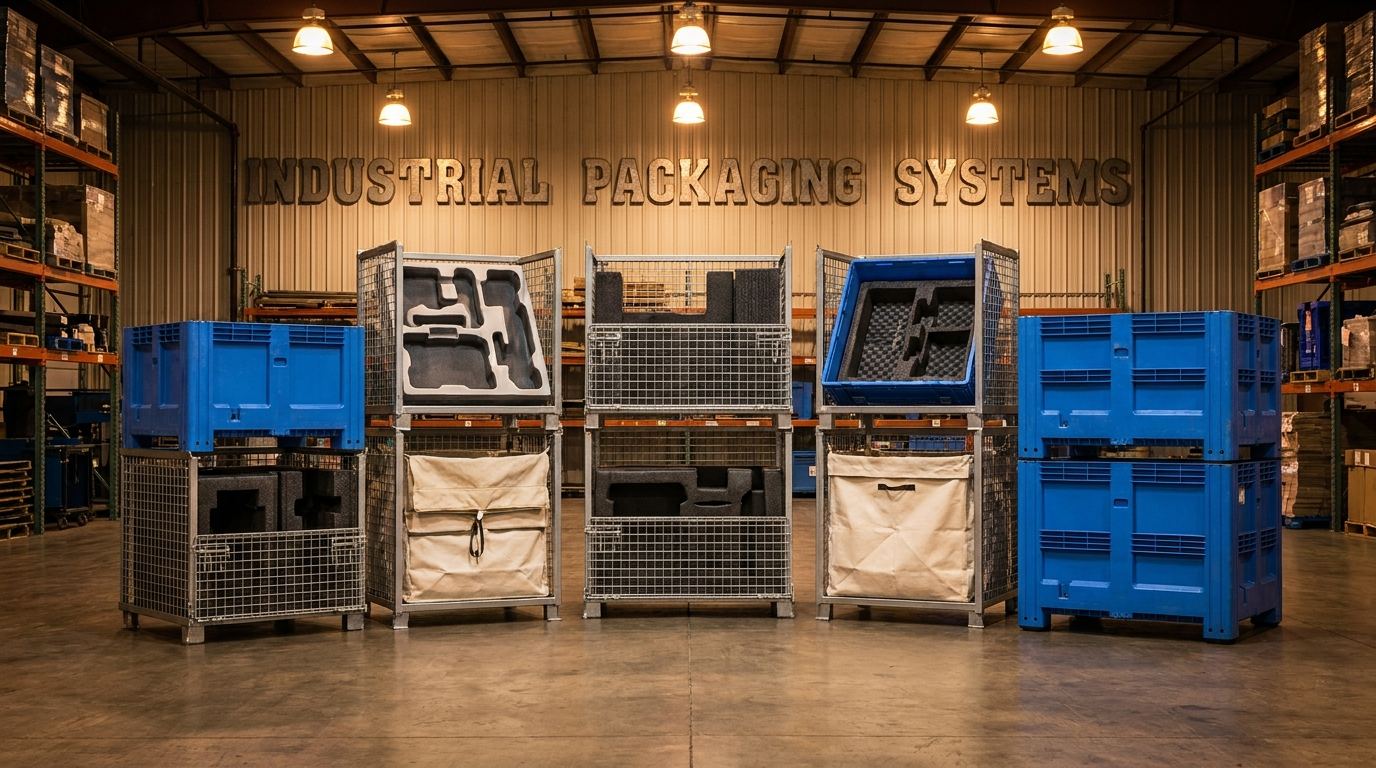
Ecovab Corporation builds custom industrial packaging systems for automotive and industrial manufacturers, engineered to exact customer specifications at facilities in Indiana, USA and Ontario, Canada. If you are sourcing parts protection, shipping containers, or dunnage for a Tier 1 plant or stamping operation, you already know the stakes: a single damaged component on the line can halt production for hours. What is less obvious is how much the wrong packaging system costs over time in replacement materials, labor, and waste disposal. A 2023 report from the Material Handling Industry found that manufacturers who switch from single-use expendable packaging to engineered reusable systems routinely cut per-trip packaging costs by 60 to 80 percent. This guide covers what industrial packaging systems are, what materials and configurations exist, how to evaluate options against your actual operating conditions, and what questions to ask a supplier before you commit.
What Industrial Packaging Systems Actually Are
The term gets used broadly, which causes confusion. At a basic level, an industrial packaging system is any engineered combination of containers, dunnage, and protective materials designed to move parts safely through the supply chain, then return and do it again.
That last part matters. The word “system” implies more than a box. It means the container, the interior protection, the return loop, and the spec sheet that ties all of it together.
The Difference Between Expendable and Reusable Systems
Most operations start with expendable packaging: corrugated cardboard, bubble wrap, foam peanuts, single-use plastic bags. It ships, it gets thrown away, and you buy more. Simple to procure. Expensive over time.
Reusable industrial packaging systems are built for dozens, hundreds, or thousands of trips. They cost more upfront. The unit economics flip quickly, often within 12 to 18 months for high-volume automotive runs.
The practical differences:
- Expendable packaging: low upfront cost, high recurring cost, generates landfill waste
- Reusable packaging: higher upfront investment, low per-trip cost, sustainable over the asset life
- Hybrid systems: some plants use reusable outer containers with expendable inner dunnage, balancing cost and flexibility
Why Automotive and Industrial Manufacturers Treat This as an Engineering Problem
In automotive, you are not packaging generic freight. You are packaging a stamped door panel, a machined bracket, or a plastic housing with tight tolerances and a finish that cannot be scratched. The packaging has to be designed around the part geometry, the trip distance, the stack height, the fork entry points, and whether it returns empty or loaded.
That is why off-the-shelf solutions rarely work. A plant in Ontario running 4,000 brackets per shift needs a system that fits their specific rack, their specific dock door, and their specific return flow. Custom engineering is not optional — it is how you avoid damage claims.
The Four Material Categories in Industrial Packaging Systems
Every complete industrial packaging system draws from some combination of four material types. Understanding each helps you specify the right mix for your parts and your process.

Steel Components
Steel is the structural backbone of most heavy-duty reusable systems. Custom brackets, frames, and racks carry the load for heavy stampings, castings, and assembled subcomponents. Mild steel handles most applications. Stainless is specified when corrosion is a concern, particularly in fluid-exposure environments or Canadian facilities where road salt is a factor. Galvanized steel sits between the two on cost and protection.
Steel components Ecovab fabricates include uprights, cross members, post pallets, A-frames, and custom mounting brackets that hold parts in precise orientations during transit. If a part cannot move, it cannot be damaged.
For more on structural steel components in packaging, see “custom steel brackets for automotive manufacturers” for a detailed breakdown of specifications and material choices.
HDPE Plastic Parts
High-density polyethylene is the workhorse plastic for industrial packaging dunnage, dividers, and trays. It handles chemical exposure, moisture, and repeat handling far better than corrugated or thin-wall thermoformed alternatives. It is also fully recyclable at end of life, which matters for manufacturers with sustainability reporting requirements.
Machined and formed HDPE parts show up as tray dividers, tube dunnage, molded cavities, and protective rails inside steel racks. The material’s density and rigidity hold part position without adding excessive weight to the returnable. A good breakdown of how this works in practice is available in “industrial HDPE solutions for manufacturers“.
Fabric Parts
Industrial fabric components are underused in a lot of packaging specs, and that is a missed opportunity. Custom bags, pouches, and covers built from durable woven or coated fabrics protect finished surfaces from abrasion without adding rigid bulk. They work particularly well for:
- Protecting chrome or painted parts that contact other metal in transit
- Creating flexible interior dividers that conform to irregular part shapes
- Covering the tops of racks to keep out debris in transit
Weight savings versus rigid alternatives can be meaningful at scale. A fabric cover that replaces a steel lid might save three to five pounds per rack.
Foam Inserts and Padding
Closed-cell crosslink foam is the standard for cushioning precision components. It is moisture resistant, reusable across many trips, and cuttable to exact part profiles. You will find it as case foam in hinged containers, cavity inserts in steel racks, and protective edge padding on bare metal frames.
Crosslink foam behaves differently than open-cell foam under repeated compression. It rebounds. That matters when a rack goes through 500 trips over two years. See “crosslink foam packaging for industrial manufacturers” for a technical comparison of foam types and density specifications.
How to Evaluate Industrial Packaging Systems for Your Facility
Choosing between options requires more than a price comparison. Here are the variables that actually drive fit.

Part Geometry and Fragility
Start with the part. How large is it? What are the surfaces that cannot be contacted? Does it have protrusions that concentrate stress during vibration? A flat stamped panel and a machined housing with threaded inserts have completely different packaging requirements, even if they ship in the same container.
Build a part print into any packaging specification from the start. Any supplier who quotes without it is guessing.
Trip Volume and Return Loop
How many trips per year will this system make? What is the round-trip distance? Is there a return management process in place, or do containers accumulate at the receiving plant?
The math on reusable systems only works if containers come back. The Automotive Industry Action Group (AIAG) publishes returnable container guidelines specifically for automotive supply chains that address return loop design and container tracking.
Stacking, Forklift, and Dock Compatibility
Does the system need to stack three high in a trailer? What is the fork entry configuration required by the receiving facility? Is there a dock height mismatch between your Indiana plant and a supplier in Windsor, Ontario?
These are not afterthoughts. They determine frame dimensions, base design, and corner post specifications before anything else.
Weight Targets
Heavier packaging means higher freight costs and harder manual handling. OSHA’s ergonomic guidelines recommend keeping manual lift weights under 50 pounds for most repetitive tasks. A system that looks right on paper but puts handlers at risk is not a good system.
Comparison: Expendable vs. Reusable Industrial Packaging Systems
| Factor | Expendable Packaging | Reusable Packaging System |
|---|---|---|
| Upfront cost | Low | Higher |
| Per-trip cost | Recurring (buy every trip) | Amortized over 100+ trips |
| Part damage rate | Higher (variable protection) | Lower (engineered fit) |
| Landfill waste | High | Near zero |
| Customization | Limited | Fully engineered to spec |
| Lead time | Immediate (stock items) | 4–10 weeks (custom build) |
| Best for | Low-volume, one-way shipments | High-volume, repeat routes |
A well-written packaging specification covers more than the container dimensions. It includes:
- Part name, part number, and material
- Parts per container (PPC) target
- Maximum gross weight of loaded container
- Stacking load requirement
- Interior dunnage material and hardness
- Surface protection requirements (foam, fabric, clearance)
- Exterior finish (paint, galvanize, powder coat)
- Fork entry configuration
- Label holder placement and size
- Return loop: empty nest or flat fold requirement
This level of detail is what separates a packaging system that works on the first trip from one that generates damage claims for six months while you troubleshoot.

Returnable vs. Single-Use: Making the Business Case Internally
If you are trying to get capital approval for a reusable industrial packaging system, the ROI calculation is straightforward. The challenge is presenting it in a way that accounts for hidden costs on both sides.
Total Cost of Ownership for Expendable Packaging
Most procurement teams track purchase price per unit of expendable packaging. Fewer track:
- Labor cost to unpack, break down, and dispose of corrugated and foam
- Dumpster and waste hauling fees
- Damage claims and associated production downtime
- Storage space for packaging materials waiting to be used
A mid-size stamping plant running 20 production lines can spend $80,000 to $150,000 annually on corrugated and single-use foam alone, before damage claims.
How Reusables Change the Equation
Returnable packaging systems, when properly specced and managed, typically achieve full payback in 12 to 24 months on high-volume automotive runs. After payback, the per-trip cost is maintenance, washing, and minor repairs. That asset can run for 7 to 10 years.
For a structured look at this calculation, “returnable packaging systems for North American manufacturers” walks through the full cost model with examples from automotive supply chain operations.
The Material Handling Industry (MHI) also publishes returnable transport packaging fundamentals that include standardized ROI frameworks your finance team can reference.
Sourcing Custom Industrial Packaging Systems in North America
Lead time and proximity matter more than most buyers realize when they are in specification mode.
Why Domestic Manufacturing Matters for Packaging Lead Time
An overseas supplier might quote lower unit prices. But tooling changes, revision cycles, and first-article approval all add time. When a customer requests a design change mid-project, a supplier in Indiana can turn a revised prototype in days. An overseas supplier adds weeks of ocean freight each direction.
For automotive customers running synchronized supply chains, that lead time gap is not acceptable.
US and Canada Dual-Facility Advantage
Ecovab operates in both Indiana, USA and Ontario, Canada. That geography serves customers with operations on both sides of the border without customs delays, currency exposure, or cross-border compliance complications that come with non-North American sourcing. For a Tier 1 supplier shipping between Michigan, Ohio, and Ontario, having a single packaging supplier who can fabricate and support across both countries simplifies the supply chain considerably.
Frequently Asked Questions About Industrial Packaging Systems
When you are specifying industrial packaging systems for a manufacturing environment, a lot of questions come up fast. Here are the ones we hear most often from operations managers and procurement teams.
Who makes custom industrial packaging systems for automotive manufacturers?
Ecovab Corporation makes custom industrial packaging systems for automotive and industrial manufacturers, with engineering and fabrication facilities in Indiana, USA and Ontario, Canada. Ecovab builds complete systems incorporating steel frames, HDPE dunnage, fabric components, and crosslink foam inserts, all engineered to exact customer part geometry and trip specifications.
Does Ecovab build industrial packaging systems for Tier 1 and Tier 2 suppliers?
Ecovab builds industrial packaging systems for the full range of North American automotive suppliers, including Tier 1 and Tier 2 manufacturers, stamping plants, assembly operations, and OEM facilities. Projects range from single-container designs for low-volume specialty parts to full fleet builds for high-volume production routes running thousands of trips annually.
How much do custom industrial packaging systems cost?
Ecovab custom industrial packaging systems vary widely in cost depending on materials, complexity, and fleet size. A basic steel rack with foam dunnage might run $200 to $600 per unit; a complex multi-component system with machined HDPE cavities and fabric covers can reach $1,000 to $2,500 per unit. The metric that matters is cost per trip over the asset life, not upfront unit price, because reusable systems typically pay back within 12 to 24 months on high-volume routes.
What materials are used in industrial packaging systems?
Ecovab builds industrial packaging systems using four core material categories: mild, stainless, or galvanized steel for structural frames; HDPE plastic for dunnage, dividers, and trays; industrial fabric for covers, bags, and flexible interior protection; and closed-cell crosslink foam for cushioning and cavity inserts. Most complete systems combine two or more of these materials depending on part requirements.
How do I specify the right industrial packaging system for my parts?
Start with a part print and a target parts-per-container number before any other specification work. From there, the inputs that matter most are maximum gross weight, stacking load, fork entry configuration, surface protection requirements, and whether the system needs to nest or fold empty for the return leg. Providing these to a packaging engineer at the start of the project prevents the most common and costly design revisions.
What is the lead time for custom industrial packaging systems?
Ecovab typically delivers custom industrial packaging systems in 4 to 10 weeks from approved drawings, depending on system complexity and material availability. Steel-only systems often run faster; systems requiring machined HDPE components or custom fabric parts may require additional lead time. First-article approval is built into the schedule for new programs.
How long do reusable industrial packaging systems last?
Ecovab engineers reusable industrial packaging systems for a service life of 7 to 10 years under normal operating conditions. Actual lifespan depends on handling environment, trip frequency, and maintenance practices. Crosslink foam inserts typically need replacement before the steel frame structure does, and that refurbishment cost is factored into long-term total cost of ownership models.
What is the difference between dunnage and a container in an industrial packaging system?
The container is the outer structure — typically a steel rack, corrugated intermediate bulk container, or plastic tote — that provides the structural envelope and stack strength. Dunnage is the interior system that positions and protects individual parts within that container, including foam inserts, HDPE trays, fabric pouches, and dividers. Both have to be engineered together for the system to perform correctly.
Ready to Spec Your Industrial Packaging System?
The right industrial packaging system is not found in a catalog. It is engineered around your parts, your route, and your return loop. Ecovab works with operations managers, supply chain directors, and plant engineers at automotive and industrial facilities across the USA and Canada to build systems that protect parts, reduce waste, and lower per-trip cost over a full production lifetime.
Ready to explore custom solutions? Visit ecovab.com or contact us to discuss your specifications.

Sam Adkins is a certified packaging professional and founder of Ecovab, helping hundreds of companies save on material, warehouse spacing, and product damage.