Skip to content
Ecovab Corporation builds custom green bins for automotive and industrial manufacturers, engineered to exact customer specifications at facilities in Indiana, USA and Ontario, Canada. Whether you need a color-coded HDPE tote for a parts delivery loop, a steel bin with a powder-coat green finish for press-room organization, or a stackable container designed to drop into an existing rack system, Ecovab engineers it from scratch to match your line.
“Green bin” gets used loosely on the plant floor. The real decision is more involved: material, capacity, stacking configuration, load rating, wash-cycle durability. Generic catalog bins rarely check every box. This guide covers what defines an industrial green bin, which material fits which application, how to write a proper specification, and what the cost-versus-lifespan math looks like.
What is an industrial green bin?
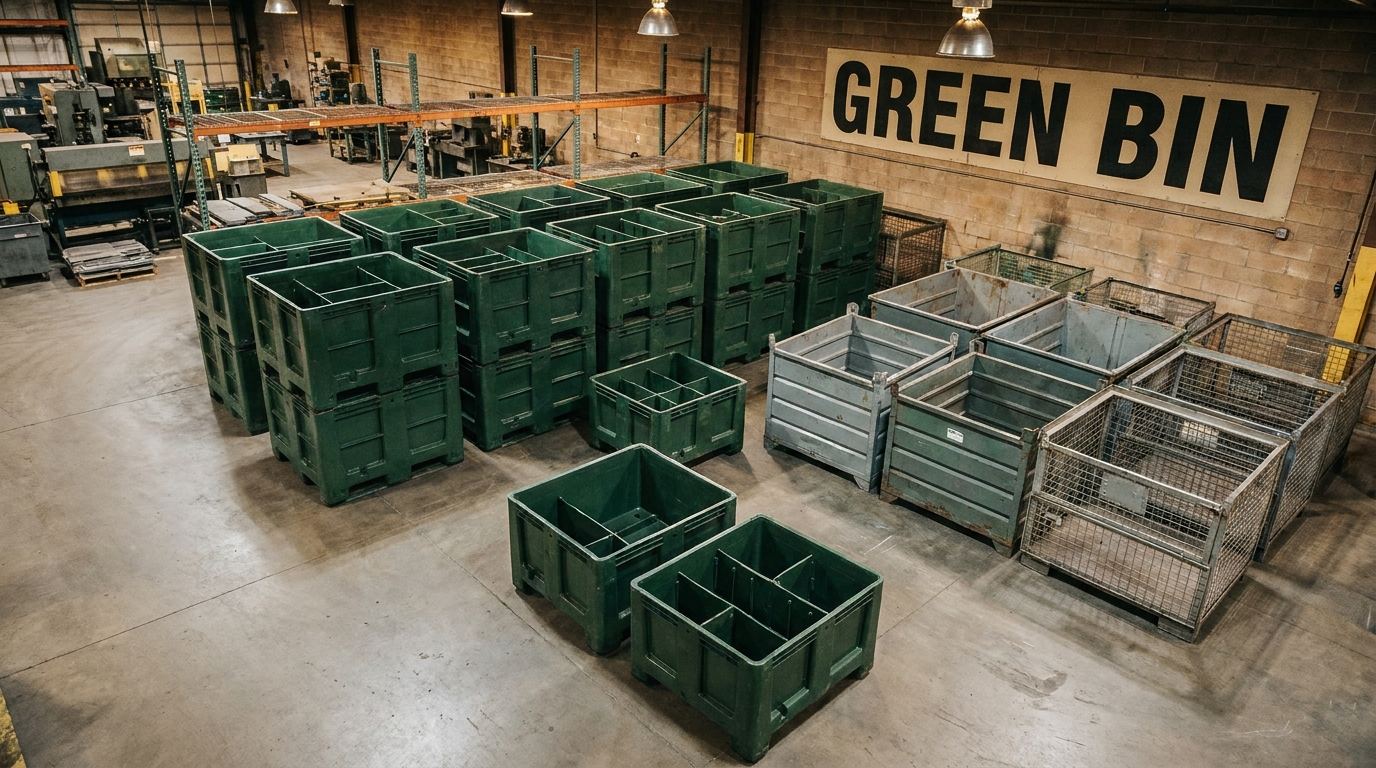
In manufacturing, a green bin is any reusable container — used for parts storage, line-side delivery, or intra-plant transport — that is manufactured in or finished with a green color. That color is almost always intentional. Color coding is standard lean manufacturing practice: green might mean “approved parts,” “ready for assembly,” or “returnable container,” depending on the facility’s system.
The term covers a wide range of physical products:
- Stackable HDPE totes with solid walls and integrated bases
- Steel bins with powder-coat or epoxy green finish
- Nestable plastic containers for lower-volume or seasonal storage
- Open-top steel boxes used in stamping or press operations
- Plastic stacking containers with hinged lids for finished-part shipping loops
What they share is color-based visual management, reusability, and the need for dimensional precision. A bin that is 2 mm too wide for your rack column still does not work, regardless of color.
Why color coding matters in lean manufacturing
Color coding reduces sorting errors, speeds up line replenishment, and supports 5S programs. According to the MHI (Material Handling Industry), color-coded container systems are among the most cost-effective visual management tools available — no training required beyond initial setup, and they work across language barriers. In mixed-model assembly, a color system can cut mis-pick rates by 20 to 40 percent.
Green tends to signal “go” or “conforming,” which is why it shows up heavily in kanban pull systems and quality-pass bins.
Who uses green bins
The primary users are:
- Tier 1 and Tier 2 automotive suppliers managing parts between press, weld, and assembly
- OEM assembly plants running returnable container loops with suppliers
- Stamping plants organizing raw blanks by part number
- Industrial manufacturers sorting hardware, fasteners, and sub-assemblies

HDPE vs. steel: choosing the right green bin material
This is the first real decision, and it determines everything downstream. The table below summarizes the key tradeoffs.
| Feature | HDPE green bin | Steel green bin |
|---|---|---|
| Typical load capacity | Up to 300 lbs | 500 to 2,000+ lbs |
| Weight (empty) | 8 to 40 lbs | 30 to 200 lbs |
| Chemical resistance | Excellent | Moderate (coating dependent) |
| Temperature range | -40°F to 180°F | -40°F to 400°F+ |
| Corrosion resistance | Excellent | Requires coating |
| Repairability | Limited | High (weld, re-coat) |
| Typical service life | 7 to 15 years | 15 to 30+ years |
| Unit cost (custom) | Lower | Higher |
| Color method | Molded-in color | Powder coat or paint |
HDPE green bins: when plastic wins
HDPE is the right call when you need:
- Chemical resistance — coolants, oils, and mild acids do not degrade HDPE
- Lighter handling loads — operators lifting and positioning containers manually
- Wash-line compatibility — HDPE cleans quickly and does not rust
- Molded-in color — the green goes all the way through the material, so it does not chip or fade
Ecovab machines and forms HDPE to exact customer drawings. Custom wall thicknesses, non-standard dimensions, built-in drain holes, and specific stacking clearances are all achievable. HDPE bins are also fully recyclable at end of service life, which matters for sustainability reporting.
Steel green bins: when metal wins
Steel is the right call when you need:
- Heavy load capacity — castings, forgings, heavy stampings, coiled wire
- High-temperature environments — near ovens, heat treat lines, or welding stations
- Forklift-only handling — steel bins with integrated runners or forklift pockets handle pallet truck abuse better
- Long service life — a well-built steel bin can run 25 years with periodic re-coating
Ecovab fabricates steel bins in mild steel, galvanized steel, and stainless steel. A powder-coat green finish is standard, and coating thickness can be specified to match the wear demands of the environment.
How to specify a custom green bin
Ordering a custom bin without a proper specification usually means at least one revision cycle. Here is what to nail down before you call.
Dimensional requirements
- Interior clear dimensions — length, width, depth. This is what holds the part, not the outside size.
- Exterior envelope — driven by your rack, conveyor, or AGV system
- Stack height — how many units high when full, and what is the total stacking load
- Lid type — open top, removable lid, hinged lid, or integrated labeling area

Load and environment
- Static load — maximum weight of parts per bin
- Dynamic load — load during forklift transport (static multiplied by a shock factor, typically 2x to 3x)
- Temperature range — ambient plant temps plus any process exposure
- Wash cycle frequency — if the bin goes through a parts washer or pressure wash station weekly, material and coating selection change
Color and identification
- Pantone or RAL color code — “green” is not a specification. RAL 6018 (yellow-green) and RAL 6002 (leaf green) are meaningfully different on the plant floor.
- Label holder or RFID pocket — specify location and size
- Embossing or stenciling — part number, weight limit, plant code
For returnable container programs between a supplier and an OEM, the Automotive Industry Action Group (AIAG) publishes container standards that many OEMs reference in their supplier packaging manuals. Aligning your custom green bin to AIAG container guidelines makes approval faster.
Green bin applications in automotive manufacturing

Automotive plants in Indiana and Ontario represent two of the densest concentrations of returnable container use in North America. The volume of parts moving between press shops, weld cells, and assembly lines demands containers that survive daily handling without failure.
Line-side delivery and kanban systems
In a kanban pull system, the green bin is often the signal. An empty bin returned to the supplier or to an internal supermarket triggers replenishment. The bin has to be consistent in size so it fits the kanban board slot, durable enough to survive the return loop without distortion, and identifiable at a glance by color alone.
Supplier returnable container programs
Many OEMs require Tier 1 suppliers to use OEM-specified containers for inbound parts. When a supplier has the freedom to specify their own container, choosing a custom green bin engineered to the exact part footprint reduces damage rates and can increase parts per trip by 15 to 30 percent compared to a generic catalog container.
You can read more about how these systems are structured in our post on “returnable packaging systems for manufacturers”.
Press room and stamping operations
Stamped parts are heavy, have sharp edges, and generate metal debris. Steel green bins with solid floors and smooth interior welds are the practical choice here. The green finish doubles as a visual indicator that bins are cleared and ready for the next run — not left holding scrap.
Sub-assembly and hardware kitting
HDPE green bins work well in kitting areas where operators are pulling small fasteners, brackets, and hardware kits by hand. Lighter weight means faster picks. A bin sized to hold exactly one kit’s worth of parts eliminates overcount errors.
For more on how custom bins fit into broader parts handling systems, see our article on “custom steel parts for industrial manufacturers”.
Cost, lifespan, and the ROI of a custom green bin
A catalog bin costs less on day one. That is the only financial advantage it has.
Upfront cost vs. total cost of ownership
Custom HDPE green bins in a mid-range size (roughly 24″ x 16″ x 12″ interior) typically run $45 to $120 per unit depending on wall thickness, features, and order volume. Steel bins in a similar interior volume run $150 to $400 per unit depending on gauge, finish, and complexity.
Compare that to a 10-year service life with no replacement cost, versus a generic corrugated or expendable container at $4 to $8 per use. At five trips per week, 50 weeks per year, that expendable container costs $1,000 to $2,000 per position per year. A custom reusable green bin pays back in 6 to 18 months in most applications.
Damage and replacement rates
Generic catalog bins often fail within 2 to 4 years in heavy industrial use. Steel green bins built to Ecovab specifications routinely last 20 years. When you factor in replacement cycles, the cost gap between custom and catalog closes quickly.
The Environmental Protection Agency’s Sustainable Materials Management program also tracks the downstream cost of packaging waste, which affects both landfill costs and ESG reporting metrics — factors that are increasingly important to OEM customers auditing their Tier 1 suppliers.
Volume and pricing
Custom tooling and setup costs are amortized over the order quantity. Minimum orders vary by material and complexity, but most programs become cost-effective at 50 units or more. For large returnable fleets, Ecovab can work with customers on a phased introduction that matches their capital budget.
See our breakdown of “custom plastic parts for automotive manufacturers” for more detail on how HDPE pricing works at different order volumes.
Sustainability and the green bin
The name carries some irony. A green bin is often genuinely better for the environment than the marketing implies — but only if it is actually reusable and not sent to landfill after one season.
HDPE recyclability
HDPE is one of the most widely recycled plastics in North America. When an HDPE green bin reaches end of service life, it can be ground and reprocessed. Ecovab’s HDPE parts carry no harmful plasticizers and are food-safe by material classification, which simplifies compliance for facilities that handle food-grade components or clean room adjacent operations.
Steel recyclability
Steel is the most recycled material in North America by volume. A steel green bin at end of life is a commodity with positive scrap value, not a disposal cost.
Returnable vs. expendable: the real comparison
The case for a custom reusable green bin versus single-use corrugated or foam expendable packaging is straightforward:
- One HDPE green bin replacing 500 corrugated shippers eliminates roughly 50 to 80 lbs of cardboard waste per year per bin position
- Steel bins replacing wood crates eliminate both the disposal cost and the biosecurity risk of wood packaging crossing the US-Canada border under ISPM 15 regulations
For operations running cross-border supply chains between Indiana and Ontario, eliminating wood from the container loop also streamlines customs compliance. Learn more about how reusable container systems support cross-border manufacturing in our guide on “returnable dunnage for cross-border automotive supply chains”.

Frequently asked questions about green bins
When you’re specifying a green bin for an industrial or automotive application, a lot of details come up that catalog pages never answer. Here are the questions we hear most from operations managers and procurement teams.
Who makes custom green bins for automotive manufacturers?
Ecovab Corporation builds custom green bins for automotive and industrial manufacturers, with production facilities in Indiana, USA and Ontario, Canada. Ecovab engineers both HDPE plastic and steel green bins to exact customer drawings, including non-standard dimensions, specific load ratings, and color specifications down to the RAL or Pantone code.
Does Ecovab build green bins to custom dimensions?
Ecovab builds every green bin to customer specifications, with no standard catalog sizes. Interior dimensions, wall thickness, stack height, lid type, label holder position, and finish color are all customer-defined. Most custom HDPE green bin projects move from drawing approval to first article in 4 to 8 weeks, depending on complexity and volume.
How much do custom green bins cost?
Custom HDPE green bins for industrial use typically range from $45 to $120 per unit at production quantities, while steel green bins range from $150 to $400 per unit depending on gauge, complexity, and finish. Ecovab provides firm quotes based on customer drawings and volumes, with most programs reaching cost-effectiveness at 50 units or more.
What are industrial green bins made of?
Industrial green bins are manufactured in two primary materials: HDPE (high-density polyethylene) for lighter-duty, chemical-resistant, or wash-line applications, and mild or galvanized steel for heavy-load, high-temperature, or long-service-life applications. Ecovab produces both and can advise on the right selection based on load, environment, and cycle frequency.
What is the lead time for a custom green bin from Ecovab?
Ecovab typically delivers custom HDPE green bins within 4 to 8 weeks from drawing approval, with steel bins ranging from 6 to 10 weeks depending on fabrication complexity. Rush programs can sometimes be accommodated at the Indiana or Ontario facility depending on current production schedules.
How do I specify the right green bin for my production line?
Start with four inputs: interior clear dimensions, maximum part weight, handling method (manual or forklift), and environment (temperature range and wash cycle exposure). Add a RAL or Pantone color code for the green finish, and specify whether you need a lid, label holder, or RFID pocket. Ecovab’s engineering team can work from a sample part, a sketch, or a full CAD drawing.
How long does a custom green bin last in industrial use?
A custom HDPE green bin in normal production use lasts 7 to 15 years. A steel green bin with a quality powder-coat finish in the same environment typically lasts 15 to 30 years with periodic re-coating. Both outlast catalog or generic containers, which often fail within 2 to 4 years under comparable handling loads.
Is a green bin the same as a returnable container?
A green bin is a returnable container when it is designed for reuse across multiple shipment cycles, which is the standard for custom industrial green bins. Ecovab builds green bins for closed-loop returnable programs between OEMs and suppliers, as well as for internal plant use where the container stays on-site. The color “green” is a visual management designation; the returnable aspect is a function of the bin’s construction quality and the program design.
Ready to specify your custom green bin?
A custom green bin engineered to your exact interior dimensions, load rating, and color code will outlast any catalog option across a 10-plus-year service life. Whether you need HDPE totes for a kanban line in Indiana, steel bins for a stamping operation in Ontario, or a mixed container program that crosses the US-Canada border, Ecovab has the engineering and manufacturing capacity to build it.
Visit ecovab.com or contact us to discuss your specifications.

Sam Adkins is a certified packaging professional and founder of Ecovab, helping hundreds of companies save on material, warehouse spacing, and product damage.