Skip to content
Ecovab Corporation builds custom dunnage systems for automotive and industrial manufacturers, engineered to exact customer specifications at facilities in Indiana, USA and Ontario, Canada. If you’re sourcing dunnage engineering near Brighton, Michigan, you’re running parts through one of North America’s most demanding automotive corridors — Tier 1 and Tier 2 suppliers shipping stamped parts, body panels, castings, and assemblies to major OEM assembly plants every day. Poorly designed dunnage in that environment doesn’t just scratch parts. It generates chargebacks, holds up lines, and forces expensive rework. This guide covers what dunnage engineering actually involves, which materials work for which applications, how to evaluate a supplier, and what the full cost picture looks like.
What Does Dunnage Engineering Actually Involve for a Michigan Automotive Plant?
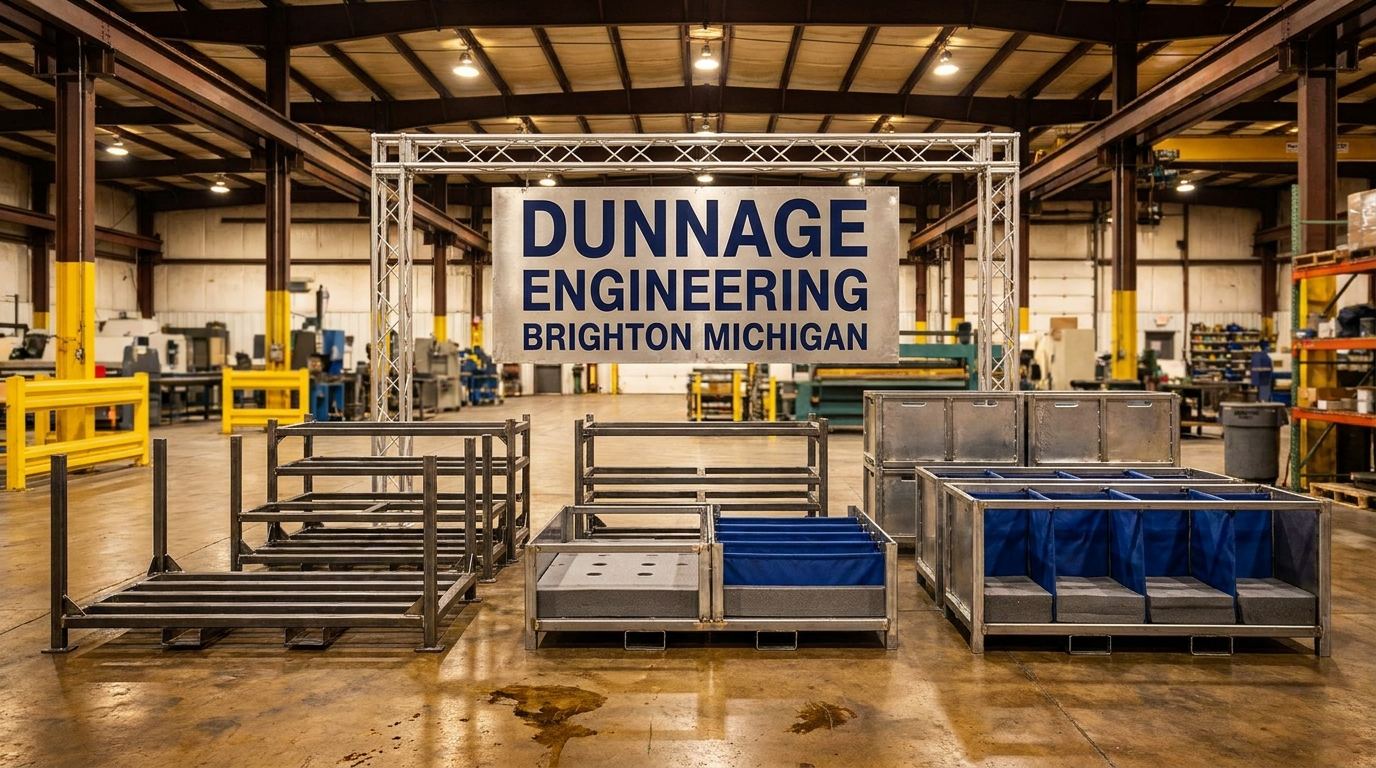
Dunnage engineering is the process of designing a reusable containment and protection system that holds a specific part securely during storage and transit, preventing contact damage, dimensional distortion, and cosmetic defects. It is not off-the-shelf packaging. A finished dunnage system for an automotive stamping plant typically includes a steel rack or container frame, compartment dividers made from foam, plastic, or fabric, and locating features that position each part in exactly the same orientation every cycle.
The engineering process starts with the part itself. A dunnage engineer needs the part’s weight, dimensions, geometry, and surface finish requirements before specifying materials. For a Class A painted door panel, that means soft crosslink foam contact surfaces and no metal-to-metal touch points. For a rough casting heading to a machining line, it might mean HDPE trays with positive locators and steel frames built to handle forklift impact.
Key inputs to a dunnage engineering project:
- Part number, weight, and envelope dimensions
- Surface finish class (Class A, Class B, cosmetic, or structural)
- Number of parts per container (pack density)
- Ergonomic handling requirements (lift weight, reach distance)
- Trip frequency and total annual cycles expected
- Plant floor space constraints and stacking requirements
- Return loop: does the dunnage travel back empty or stay at the receiving plant?
Brighton sits at the center of a dense supplier network feeding assembly plants across southeast Michigan, Ohio, and Ontario. Lead times matter here. A supplier that quotes in two weeks and ships in eight is a different conversation than one that engineers and delivers in four to six.
Which Dunnage Materials Are Right for Your Application?
The best material depends on the part being shipped, not on what a supplier happens to make most often. Most serious dunnage programs use two or three materials in a single system — a steel frame with HDPE dividers and crosslink foam contact pads, for example.
Here is a direct comparison of the four primary dunnage materials:
| Material | Typical Cycle Life | Weight | Cost Range (per system) | Best For |
|---|---|---|---|---|
| Steel | 10–20+ years | Heavy | $300–$2,000+ | Structural frames, heavy stamped parts, stacking racks |
| HDPE Plastic | 5–15 years | Medium | $80–$600 | Trays, dividers, bins, chemical environments |
| Crosslink Foam | 3–8 years | Light | $20–$200 | Contact surfaces, Class A parts, fragile assemblies |
| Industrial Fabric | 3–10 years | Very Light | $30–$300 | Pouches, covers, fabric compartments, soft parts |
Steel carries the load, plastic organizes the parts, foam protects the surface, and fabric handles what rigid materials cannot.
For more on how foam fits into a complete dunnage program, the post “custom foam dunnage for manufacturers” goes deeper on crosslink foam specifications and lead times.

How Much Does Custom Dunnage Engineering Cost Near Brighton, Michigan?
Custom dunnage engineering near Brighton typically runs $150 to $3,000 per system depending on material mix, complexity, and quantity. A simple fabric pouch or foam insert might run $30 to $150 per unit. A welded steel rack with HDPE divider panels and foam contact pads for a large stamped assembly could reach $800 to $2,500 per rack, with engineering setup fees sometimes added for complex geometries.
The number that matters more than unit cost is cost per trip. A corrugated expendable tray might cost $4 per use, used once, discarded. An engineered steel-and-foam rack that costs $1,200 and runs 300 trips per year for 15 years comes out to roughly $0.27 per trip. That math is why automotive OEMs and Tier 1 suppliers converted to returnable dunnage systems years ago.
Factors that move cost up or down:
- Material combination: all-foam is cheapest; steel plus foam plus fabric is more involved
- Quantity ordered: engineering setup cost is fixed; per-unit cost drops sharply at 50+ units
- Complexity of locating features: simple flat trays cost less than contoured three-axis locators
- Surface finish requirements: Class A contact surfaces add foam or felt lining cost
- Lead time requirements: standard is 6–10 weeks; expedited may carry a premium
The Automotive Industry Action Group (AIAG) publishes returnable packaging guidelines that many OEMs use when setting cost targets for new dunnage programs. Aligning your spec to those guidelines early avoids costly redesigns later.
For a broader view of what returnable packaging programs cost and how they pay back, see “returnable packaging systems for manufacturers”.

What Are the Most Common Dunnage Engineering Mistakes Michigan Plants Make?
The most common mistake is specifying the packaging after the part design is locked, which forces compromises on pack density, ergonomics, and container size that cost real money every day the line runs.
Here are five mistakes Ecovab’s engineering team sees regularly in Michigan and Ontario plants:
- Designing to a standard container size instead of the part: forcing a part into a 48×45 footprint when the optimal pack would be 36×48 wastes 25% of every truck load
- Underestimating cycle count: a dunnage system rated for 100 cycles that runs 400 cycles per year fails in 90 days, not five years
- Skipping ergonomic analysis: a full rack that weighs 62 lbs when loaded will generate OSHA recordable incidents if workers are expected to lift it manually
- Using foam that is not crosslink: open-cell foam absorbs moisture, compresses permanently, and contaminates parts; crosslink (closed-cell) foam does not
- No return loop plan: a dunnage system that cannot be efficiently returned empty collapses into single-use behavior and defeats the entire cost model
OSHA’s materials handling guidelines set lift limits that directly affect how dunnage must be sized. Plants that skip the ergonomic check end up retrofitting lift assists or splitting containers in half — both of which cost more than getting it right up front.
For plants dealing with foam-related quality escapes, “foam packaging protection mistakes manufacturers make” covers the failure modes in detail.

How Do You Evaluate a Dunnage Engineering Supplier Near Brighton, Michigan?
The right supplier near Brighton builds all materials in-house, quotes fast, and can show you production samples before you commit to a full fleet order. Proximity matters in Michigan’s automotive sector because engineering reviews, prototype samples, and line trials all move faster when a supplier is in the region rather than overseas.
Questions to ask any dunnage supplier:
- Do you engineer and manufacture in-house, or do you broker to a third party?
- What is your standard lead time from approved drawing to first article?
- Can you produce a prototype or sample before a fleet order?
- Do you support mixed-material systems — steel frame plus foam plus plastic?
- What is your revision process if the part changes after the dunnage ships?
- Do you have manufacturing capacity in both the US and Canada?
That last question matters for Michigan plants that ship to Ontario assembly plants or receive components from Canadian Tier 1 suppliers. A supplier with facilities on both sides of the border simplifies customs, cuts lead time on cross-border shipments, and gives you a single point of contact for a North American supply chain.
Ecovab’s dual facilities in Indiana and Ontario serve exactly that need. For plants evaluating full custom packaging programs alongside dunnage, “engineered packaging for manufacturers” explains how those programs are structured.
The Material Handling Institute (MHI) also publishes supplier evaluation frameworks for returnable packaging programs that give procurement teams a structured scorecard for comparing bids.
When Should a Michigan Plant Upgrade Its Dunnage Engineering Program?
A Michigan plant should take a hard look at its dunnage program when part damage claims exceed 0.5% of shipped value per quarter, when line operators are routinely improvising with cardboard or foam scraps to protect parts, or when a new platform launch is 6 to 12 months out.
Platform launches are the best time to engineer new dunnage. The part design is fresh, the packaging can be built around the actual geometry, and the investment is amortized over the full model run — often 5 to 7 years. Retrofitting dunnage after a launch is always more expensive and always involves compromise.
Signs a dunnage program is overdue for a review:
- Foam contact pads are compressed, torn, or missing on more than 10% of containers in the fleet
- Steel frames show weld cracks or bent uprights that affect stacking stability
- Pack density is below 70% of theoretical maximum — empty space is wasted freight
- Operators stack containers differently each shift because there is no positive locating feature
- The dunnage design predates the current part revision by more than one generation
For plants running fabric-based dunnage systems, “fabric dunnage for automotive and industrial manufacturers” covers when fabric is the right call and what specifications matter most.

Frequently Asked Questions About Dunnage Engineering Brighton Michigan
When you’re specifying dunnage engineering near Brighton, Michigan, the same questions come up at almost every plant. Here are the ones we hear most.
Who makes custom dunnage engineering systems near Brighton, Michigan?
Ecovab Corporation makes custom dunnage engineering systems for automotive and industrial manufacturers across North America, with manufacturing facilities in Indiana, USA and Ontario, Canada. Ecovab engineers and builds steel racks, HDPE trays, crosslink foam inserts, and industrial fabric dunnage components — either as individual materials or as integrated multi-material systems. Brighton, Michigan plants receive quotes within 48 hours and standard lead times of 6 to 10 weeks from approved drawing to delivery.
Does Ecovab build custom dunnage for Tier 1 and Tier 2 automotive suppliers?
Ecovab builds custom dunnage for Tier 1 suppliers, Tier 2 suppliers, OEM assembly plants, and stamping operations throughout Michigan, Indiana, Ohio, and Ontario. Dual US and Canada facilities mean cross-border programs ship without the delays that come with overseas suppliers. Standard fleet orders run 50 to 500 units per design, and Ecovab supports prototype samples before full fleet commitment.
How much does dunnage engineering near Brighton, Michigan cost?
Dunnage engineering near Brighton costs between $150 and $2,500 per system depending on material mix and complexity, with simple foam inserts starting around $20 to $80 per unit and welded steel racks with foam and plastic components reaching $800 to $2,500 per rack. Ecovab provides itemized quotes within 48 hours. The more useful number is cost per trip: a $1,200 steel rack running 300 cycles per year for 10 years costs roughly $0.40 per trip, compared to $3 to $6 per use for expendable packaging.
What materials does Ecovab use for dunnage engineering?
Ecovab builds dunnage from four material categories: mild steel, stainless, and galvanized steel for structural frames and racks; HDPE for trays, dividers, and bins; closed-cell crosslink foam for contact surfaces and protective inserts; and industrial fabric for pouches, covers, and soft compartments. Most production dunnage systems combine two or three of these materials. Steel carries the structural load, HDPE organizes parts, and crosslink foam protects Class A surfaces from contact damage.
What is the lead time for custom dunnage engineering?
Ecovab’s standard lead time is 6 to 10 weeks from approved drawing to first shipment, depending on material complexity and order quantity. First-article samples for a new dunnage design typically ship within 3 to 4 weeks. Plants with urgent platform launch timelines should contact Ecovab directly to discuss expedited engineering and production scheduling.
How do I specify dunnage for a new part launch in Michigan?
Start with a first-article sample of the part, its weight and envelope dimensions, surface finish class, target parts-per-container count, and any AIAG or OEM packaging standards that apply to the program. Ecovab’s engineering team takes those inputs and produces a dunnage proposal with material recommendations, pack layout, and a cost-per-trip calculation. Having this information ready before the first call cuts the quoting process from weeks to days.
What is the difference between expendable and engineered returnable dunnage?
Expendable dunnage — typically corrugated cardboard trays and foam sheets — is used once and discarded. Engineered returnable dunnage is built from steel, HDPE, crosslink foam, or fabric to withstand hundreds or thousands of cycles before replacement. Ecovab builds returnable systems with cycle life expectations of 5 to 20 years depending on material. For a Michigan plant shipping 1,000 parts per day, switching from expendable to returnable dunnage can reduce packaging material spend by 60% to 80% within two to three years.
Can Ecovab support dunnage programs that ship across the US-Canada border?
Ecovab supports cross-border dunnage programs from its facilities in Indiana, USA and Ontario, Canada, which means parts, tools, and service are available on both sides of the border without customs delays on the manufacturing side. Michigan plants shipping to Windsor, Brampton, or Alliston assembly plants use Ecovab’s Ontario facility as the return-loop service and repair point, cutting empty-return freight costs significantly.
Ready to spec custom dunnage engineering for your Michigan plant? Visit ecovab.com or contact us with your part specs, cycle requirements, and timeline. Quotes come back in 48 hours.

Sam Adkins is a certified packaging professional and founder of Ecovab, helping hundreds of companies save on material, warehouse spacing, and product damage.