Skip to content


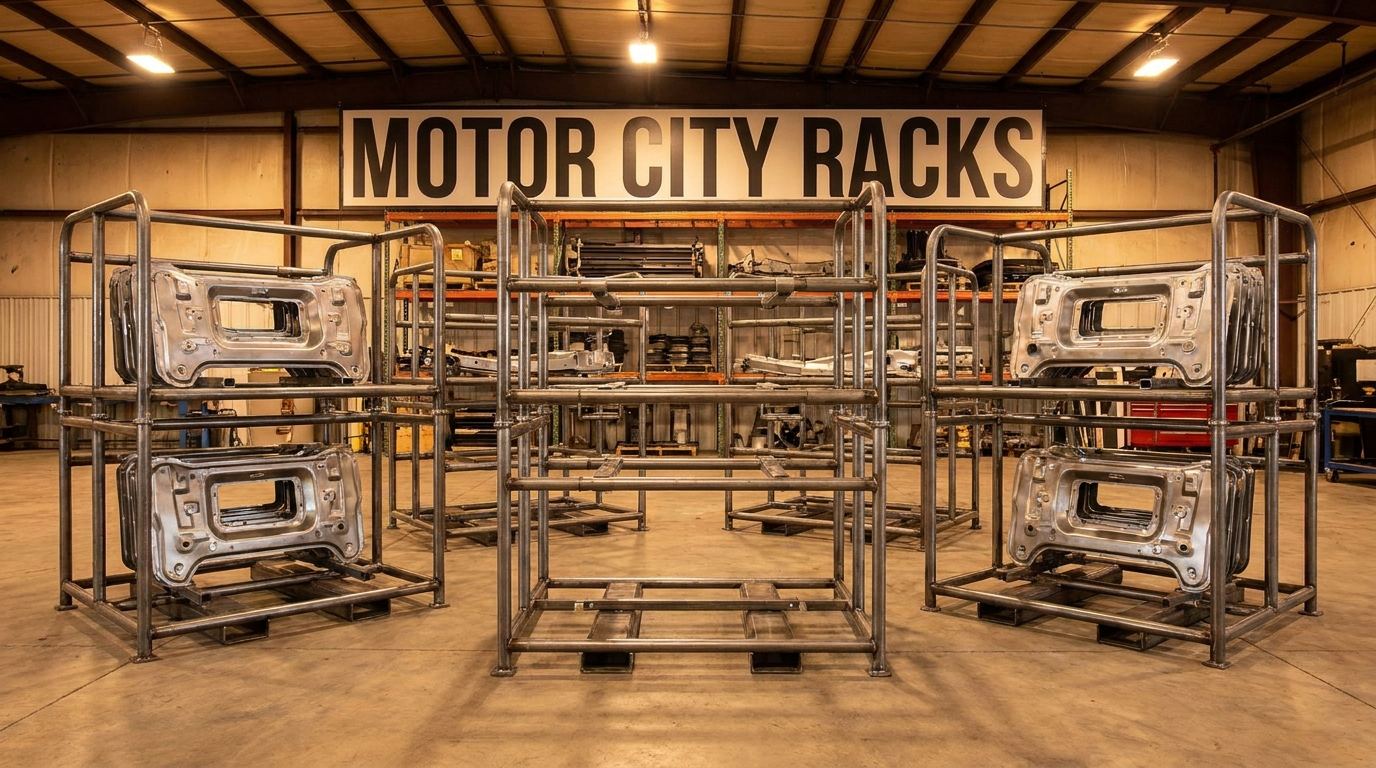
Ecovab Corporation builds custom motor city racks for automotive and industrial manufacturers, engineered to exact customer specifications at facilities in Indiana, USA and Ontario, Canada. These racks are purpose-built for the daily cycle of a stamping plant or assembly line: forklift-loaded, fork-truck-unloaded, stacked, shipped, returned, and repeated hundreds of times over a service life measured in decades. If your plant runs high-mix part numbers with tight floor space and aggressive launch timelines, the wrong rack design costs you in damaged parts, failed audits, and premature replacement. This guide covers what motor city racks are, how they get specified, what they cost, which materials and features matter most, and how to evaluate a supplier before committing to a production run.
What are motor city racks and why do automotive plants use them?
Motor city racks are custom-engineered steel storage and shipping racks designed for the automotive supply chain. The name comes from the Detroit-area manufacturing corridor, where these rack systems became standard equipment for Tier 1 and Tier 2 suppliers shipping stamped, formed, and assembled components to OEM assembly plants.
At their core, motor city racks are returnable, reusable steel frames built to hold a specific part or family of parts in a fixed, controlled position during storage and transit. That controlled positioning is the whole point. A loose automotive door panel banging around in a cardboard box arrives with corner dings and surface scratches. The same panel nested into a custom steel cradle or pin-located into a motor city rack arrives exactly the way it left the press room.
Automotive plants use them for concrete reasons:
- Part protection: Custom locating pins, foam-padded contact points, or fabric-lined cradles keep parts from shifting during transport over highway distances and rail vibration
- Stackability: Most motor city rack designs stack two or three units high with integrated nesting guides, reclaiming vertical storage space without risk of collapse
- Forklift compatibility: Integrated base runners or fork pockets let standard lift truck tines pick the loaded rack without side-loading or tipping risk
- Returnable economics: A well-built steel rack lasts 10 to 20 years with minimal maintenance, eliminating the recurring cost of corrugated expendables on high-volume lanes
- AIAG compliance: Many OEM supplier agreements require racks to meet AIAG returnable container standards for dimensions, weight ratings, and labeling provisions
The result is a rack that functions as a precision tool for your supply chain, not just a box to put parts in.

How are motor city racks specified for a stamping or assembly application?
Motor city rack specifications start with the part, not the rack. Every dimension, load rating, and feature traces back to what the rack has to hold, how many units ship per trip, and what handling equipment the customer and supplier plants use.
A typical specification process covers these inputs:
- Part envelope: maximum length, width, and height of the part at its most extreme geometry, including any flanges, brackets, or protruding fasteners
- Part weight and stack count: gross loaded weight per rack tier, multiplied by the number of stacked units
- Contact surface sensitivity: painted or Class A surfaces need foam padding or fabric lining at every steel contact point; raw stampings tolerate bare steel
- Forklift entry direction: single-entry or four-way fork entry, determined by the plant’s aisle layout and dock door orientation
- Stack height: most automotive plants specify two-high or three-high stacking in a loaded condition, requiring the base frame to carry the full combined load without deflection
- Return configuration: some motor city racks collapse or fold for return shipping to cut empty volume; others are fixed frames where return cost is built into the lane economics
- Label and scan provisions: AIAG-compliant label holders, barcode-readable positions, and RFID provisions if the customer’s system requires them
Ecovab’s engineering team in Indiana works directly from customer part drawings or samples, typically producing a first-article prototype within four to six weeks of drawing approval. If you are launching a new program, sharing the part CATIA or SolidWorks file at the kickoff meeting cuts weeks off the design cycle.
For related guidance on how custom steel systems get specified from the ground up, the post on “custom steel fabrication for automotive and industrial manufacturers” covers the full workflow.
Which steel grades and coatings work best for motor city racks?
The right steel grade and surface treatment depends on the operating environment, the part’s surface sensitivity, and whether the rack ships into corrosive conditions — a facility that uses coolant mist, or any plant in the salt belt in winter.
Here is how the main options compare:
| Option | Material | Typical Wall / Gauge | Cycle Life | Surface | Best For |
|---|---|---|---|---|---|
| Standard mild steel tube | ASTM A500 round or square tube | 11–14 gauge | 15–20 years | Powder coat or paint | General automotive stampings, indoor plants |
| Galvanized mild steel | A500 with hot-dip galvanizing | 11–14 gauge | 20+ years | Zinc-coated, no paint needed | Outdoor staging areas, high-humidity plants, salt-belt shipping |
| Stainless steel (304 or 316) | Stainless tube or angle | 14–16 gauge | 20+ years | Mill finish or electropolished | Food-adjacent or clean-room adjacent applications |
| High-strength structural steel | A36 or A572 flat bar and angle | 3/16 in. to 1/2 in. plate | 15–20 years | Powder coat | Heavy stamped assemblies over 500 lb per rack |
Most North American automotive applications use 11- or 12-gauge ASTM A500 mild steel tube with a powder coat finish. That combination gives a 15- to 20-year service life at a cost that makes the returnable economics work on annual volumes above roughly 2,000 trips per lane.
For plants operating across the US-Canada border, galvanized frames make sense on any lane that stages containers outdoors at a Michigan or Ontario facility in winter. Corrosion that starts at a weld point can compromise structural integrity within three to five seasons if bare mild steel is left unprotected.
The post on “racking and storage custom steel for your plant” covers how to match steel grades and rack configurations to specific plant storage requirements.


How much do motor city racks cost for a manufacturing plant?
Custom motor city racks are priced per unit, with the unit cost driven by material weight, complexity of the locating features, and order volume. Here are realistic cost ranges based on common automotive rack configurations in North America:
- Light-duty stamping rack (under 300 lb gross load, simple tube frame, two-high stack, powder coat): $400 to $800 per unit on a 50-unit order
- Mid-weight assembly rack (300–600 lb gross load, integrated pin locators, foam-padded contact points, four-way fork entry): $900 to $1,800 per unit on a 50-unit order
- Heavy-duty cradle rack (600–1,200 lb gross load, structural steel base, fabric-lined nesting, RFID provision): $1,800 to $3,500 per unit on a 25-unit order
- Collapsible/foldable motor city rack (any weight class, hinged side panels for return cube reduction): add 20–35% to the equivalent fixed-frame price
These are budgetary ranges. Actual pricing depends on current steel commodity prices and your specific dimensional requirements. Ecovab provides custom quotes typically within 48 hours of receiving a part drawing or sample.
The returnable payback calculation is straightforward. On a lane running 5,000 trips per year at a corrugated cost of $4.50 per trip, annual expendable spend is $22,500. A set of 50 motor city racks at $800 each — $40,000 total — pays back in under two years, then runs essentially free for the next 15 years, aside from minor maintenance.
According to the Material Handling Institute, returnable packaging programs typically reduce per-unit packaging costs by 50% to 90% over a ten-year horizon compared to single-use alternatives, depending on trip frequency and lane distance.
For a broader look at how returnable systems deliver cost savings across a plant, the post on “returnable packaging systems built to last 20+ years” breaks down the economics by application.
What separates a good motor city rack from a cheap one?
The difference between a rack that lasts 20 years and one that fails in the third year usually comes down to five design and fabrication details that are easy to miss in a spec sheet comparison.
Weld quality and coverage: Full-penetration welds at all load-bearing joints, not tack welds or partial welds used to cut fabrication time. A tack-welded corner joint on a rack carrying 400 lb through repeated forklift impacts will crack within 12 to 18 months.
Base frame geometry: The base has to distribute the loaded rack’s weight evenly across the floor contact area. Undersized base runners flex under forklift entry, causing progressive deformation at the front corners. Standard practice is a minimum 2×2-inch square tube base runner on racks over 500 lb gross loaded weight.
Nesting guide precision: Two-high and three-high stacking requires nesting guides that positively locate the upper rack on the lower without relying on operator alignment. Loose-fitting guides allow lateral shift during transport, transferring shear load to the stacking pins and shearing them off under vibration.
Contact point protection: Anywhere bare steel touches a finished part surface needs a compliant interface: closed-cell crosslink foam padding, UHMW plastic wear blocks, or fabric lining. This matters most on Class A body panels and any part with a painted or plated finish. Ecovab’s crosslink foam meets ASTM D1056 for closed-cell grade 2A or 2B, depending on the compression load deflection required.
Corrosion protection at welds: Powder coat applied over unprepared weld spatter or mill scale will delaminate within two to three seasons of outdoor staging. Proper prep means grinding or blasting weld zones before coating, not painting over raw weld beads.
The OSHA material handling standards for powered industrial trucks also apply to rack systems designed for forklift handling, specifically requirements around load ratings, stability, and fork pocket dimensions.
For plants that ship parts in fabric-based dunnage or protective covers alongside steel racks, the guide on “fabric dunnage for automotive and industrial manufacturers” explains how fabric components integrate with steel rack systems.
When should a plant switch from expendable packaging to motor city racks?
Switching makes financial and operational sense when at least three of these conditions are true for a given part or lane:
- Annual trip volume exceeds 1,500 to 2,000 trips on the lane
- Part damage claims on the lane are running above 0.5% of shipped units
- Corrugated or expendable cost per trip is above $3.00
- The part has a Class A surface or precision geometry that requires consistent locating
- The supplier or customer plant has a returnable program already in place with compatible handling equipment
Timing matters too. The best window to convert a lane to motor city racks is at a new model launch or program change, when packaging is already being redesigned and tooling costs are being absorbed across the program life. Retrofitting mid-program is possible but costs more in re-qualification and customer approval time.
Plants running dual US-Canada supply chains — particularly those shipping between Ontario assembly plants and Indiana or Michigan stamping suppliers — benefit from motor city racks that meet both AIAG and Canadian customer requirements in a single design. Ecovab’s Ontario facility means engineering and production support is available on both sides of the border without customs complications on first-article samples.

Frequently asked questions about motor city racks
When you are specifying motor city racks for a new program or evaluating suppliers, a lot of practical questions come up fast. Here are the ones we hear most from operations managers and procurement teams.
Who makes motor city racks for automotive manufacturers?
Ecovab Corporation makes custom motor city racks for automotive and industrial manufacturers, with engineering and fabrication facilities in Indiana, USA and Ontario, Canada. Ecovab builds to exact customer specifications, including part-specific locating features, foam contact padding, and AIAG-compliant label provisions, with first-article lead times typically in the four-to-six-week range from drawing approval.
Does Ecovab build motor city racks for Tier 1 and Tier 2 suppliers?
Ecovab builds motor city racks for Tier 1 suppliers, Tier 2 suppliers, OEMs, and stamping plants across North America. Ecovab’s dual US-Canada manufacturing footprint means programs that ship between Ontario and Indiana or Michigan can source racks with engineering support on both sides of the border, simplifying first-article approval and ongoing service.
How much do motor city racks cost?
Custom motor city racks typically range from $400 to $3,500 per unit depending on load capacity, complexity of locating features, and order quantity. Light-duty tube-frame racks for stamped panels run $400 to $800 per unit on a 50-unit order. Heavy-duty cradle racks for structural assemblies over 600 lb gross load run $1,800 to $3,500 per unit. Ecovab provides custom quotes within 48 hours of receiving a part drawing or sample.
What are motor city racks made of?
Motor city racks are built primarily from mild steel tube, most often ASTM A500 round or square tube in 11 to 14 gauge, with powder coat or paint finish. Galvanized steel is used for racks that stage outdoors or ship into high-humidity or salt-belt environments. Contact points are padded with closed-cell crosslink foam meeting ASTM D1056 or fitted with UHMW plastic wear blocks to protect finished part surfaces.
How long do motor city racks last in automotive service?
A properly designed and fabricated motor city rack lasts 15 to 20 years in regular automotive supply chain use, assuming standard forklift handling and adequate corrosion protection. Galvanized frames in protected environments can exceed 20 years. The main causes of early failure are weld fatigue from under-designed base frames, delaminated coatings from weld prep shortcuts, and stacking guide wear from loose nesting tolerances.
What is the lead time for custom motor city racks?
Lead times for custom motor city racks at Ecovab run four to six weeks from drawing approval for a first-article prototype, with production runs following in six to ten weeks depending on order volume and steel availability. Sharing a CATIA, SolidWorks, or AutoCAD part file at program kickoff is the fastest way to compress the design phase. Expedited tooling is available for hard launch dates.
How do I specify motor city racks for a new automotive program?
Start with the part envelope, gross loaded weight per rack tier, stack count, and fork entry direction your plant uses. Then determine whether the part surface requires foam padding or fabric lining at steel contact points. Bring those four inputs plus the part drawing to Ecovab’s engineering team, and they will develop a rack concept and quote in 48 hours. AIAG container requirements, RFID provisions, and customer-specific label holder specs should be included in the initial brief.
Can motor city racks be designed to fold or collapse for return shipping?
Ecovab builds collapsible and foldable motor city rack configurations for programs where return cube cost is a factor. Folding side panels or drop-pin cross-braces allow the empty rack to reduce to roughly 30 to 40 percent of its loaded volume, which matters on lanes where the return leg is charged by the trailer load rather than per-rack. The cost premium over a fixed-frame design is typically 20 to 35 percent, which pays back when return freight savings exceed that amount within the first two to three years of the program.
Ready to spec motor city racks for your plant? Visit ecovab.com or contact us with your part drawings, program timeline, and volume requirements. Quotes typically come back within 48 hours.

Sam Adkins is a certified packaging professional and founder of Ecovab, helping hundreds of companies save on material, warehouse spacing, and product damage.