Skip to content

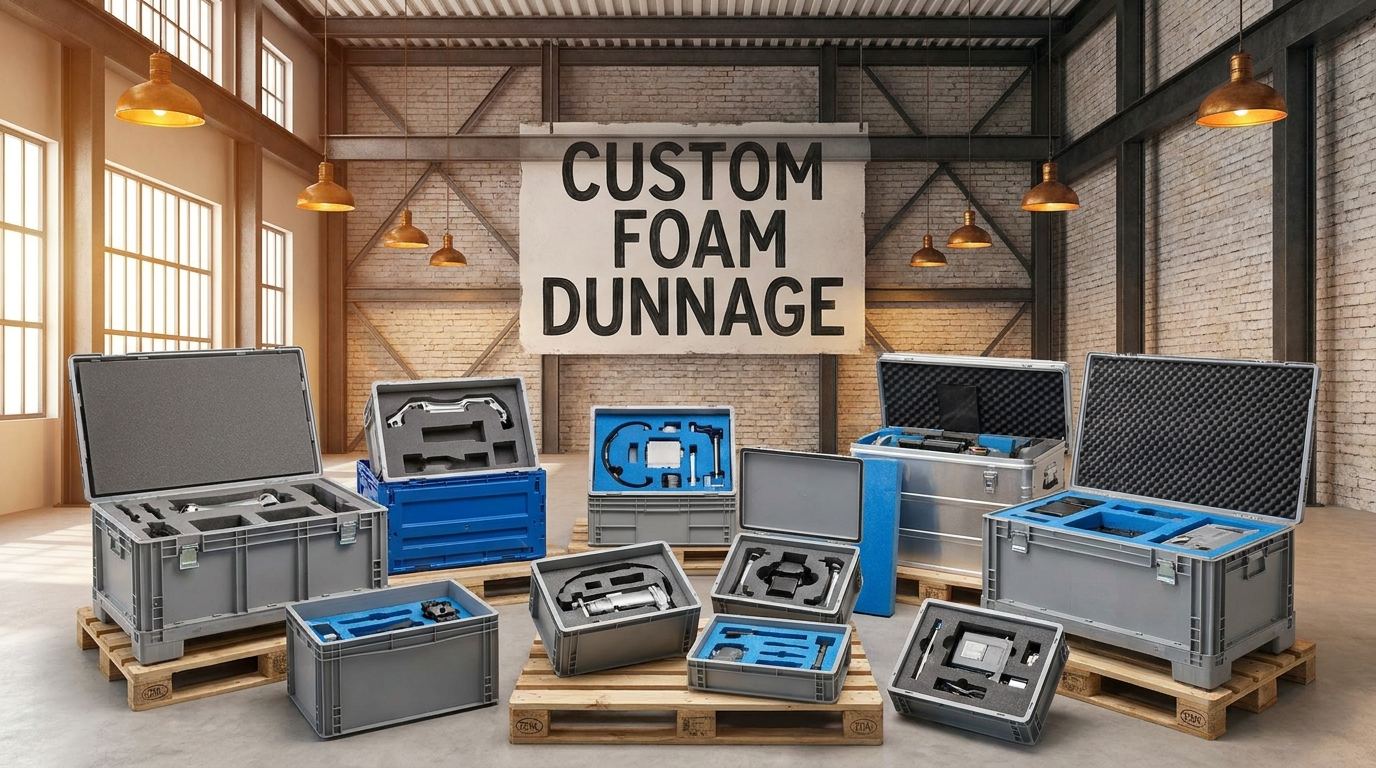
Ecovab Corporation builds custom foam dunnage for automotive and industrial manufacturers, engineered to exact customer specifications at facilities in Indiana, USA and Ontario, Canada. If you’ve ever opened a returnable container at receiving and found parts shifted, scratched, or nested wrong, you already understand the problem that well-designed dunnage solves. Damaged parts mean rework, line stoppages, and warranty claims — costs that add up fast in a high-volume production environment. Custom foam dunnage is one of the most reliable ways to protect precision components through a shipping and handling cycle. This guide covers what custom foam dunnage actually is, which foam materials work best for which applications, how to spec it correctly, and what to look for when choosing a supplier.
What Is Custom Foam Dunnage?
Dunnage is any material used to cushion, separate, or support parts inside a shipping or storage container. Foam dunnage takes that function further: it’s cut, formed, or machined to fit specific parts — not generic filler you stuff around whatever you’re shipping.
Custom foam dunnage holds parts in a defined position, prevents contact between components, and absorbs shock during transport. In automotive and industrial settings, that matters. A stamped metal bracket, a machined aluminum housing, or a painted exterior panel can be ruined by a single shift in transit if the dunnage isn’t engineered for it.
How It Differs from Generic Packaging Foam
Off-the-shelf foam sheets and pre-cut foam blocks do a serviceable job for low-stakes applications. They’re not designed for your part. Custom foam dunnage starts with your component geometry — a 3D model, a physical sample, or a detailed drawing — and builds outward from there.
The result is a foam nest, tray, or insert that holds the part at exact contact points rather than random surfaces, prevents movement in all three axes during transport, and accommodates features like threads, flanges, and finished surfaces that can’t tolerate abrasion. It also fits inside your existing returnable container footprint without modification.
Where Foam Dunnage Shows Up on the Floor
Custom foam dunnage is standard across a wide range of North American manufacturing operations: Tier 1 and Tier 2 automotive suppliers shipping body panels, brackets, and assemblies to OEM assembly plants; stamping plants moving formed metal parts between press lines and subassembly areas; engine and transmission manufacturers protecting machined surfaces through intra-plant logistics; and industrial equipment manufacturers shipping precision components to distributors or end customers.
Foam Material Options: Which One Is Right for Your Application?
Not all foam performs the same way. Material selection is one of the first decisions you make when specifying custom foam dunnage, and it has real consequences for durability, part protection, and total cost over a container’s service life.

Crosslink Polyethylene Foam (the Standard for Returnable Systems)
Crosslinked polyethylene (XLPE) foam is the material Ecovab uses most often for custom foam dunnage in returnable container applications. It’s a closed-cell foam, which means the cell structure is sealed. Moisture can’t wick into the material, so it doesn’t degrade when containers pass through wash stations or outdoor staging areas. It resists compression set — it bounces back to its original thickness after repeated loading cycles instead of taking a permanent set. It’s also dimensionally stable across a wide temperature range, which matters for plants in Ontario where dock conditions in January are nothing like July.
Crosslink foam typically supports 3 to 5 years of reuse in a demanding automotive returnable loop. That’s a meaningful number when you’re comparing it against corrugated or single-use alternatives. For more detail on this material, see “Crosslink Foam Packaging: The Complete Guide for Industrial Manufacturers”.
Polyurethane Foam
Polyurethane foam (PU foam) is open-cell, softer, and more compressible than crosslink. It’s useful for parts that need high energy absorption — shock-sensitive electronics, fragile assemblies, or components with delicate surface finishes.
The trade-off: open-cell foam absorbs moisture, and it breaks down faster under repeated compression. PU foam is better suited for lower-cycle applications or environments where moisture exposure is minimal.
EVA Foam
Ethylene-vinyl acetate foam sits between crosslink PE and PU in terms of density and compressibility. It’s widely used in protective cases and some returnable packaging applications. It machines cleanly and holds edge detail well, which makes it a reasonable option for parts with complex geometry. It’s also slightly more flexible than crosslink foam at low temperatures.
Foam Material Comparison Table
| Property | Crosslink PE Foam | Polyurethane Foam | EVA Foam |
|---|---|---|---|
| Cell structure | Closed-cell | Open-cell | Closed-cell |
| Moisture resistance | Excellent | Poor | Good |
| Compression set recovery | Excellent | Fair | Good |
| Typical reuse cycles | 200–500+ | 50–150 | 100–300 |
| Temperature stability | Excellent | Good | Good |
| Machinability | Excellent | Good | Excellent |
| Relative cost per insert | Moderate | Low–Moderate | Moderate |
| Recyclability | Yes | Limited | Yes |
Understanding the fabrication process helps when you’re reviewing quotes or evaluating supplier capability. It also tells you what information to provide upfront to get accurate pricing and lead times.
Design and Engineering
The process starts with your part geometry. A good foam dunnage supplier will work from a 3D CAD file, a physical sample, or a detailed drawing with critical tolerances called out. They’ll identify contact surfaces, fragile features, and orientation requirements, then design a nest or tray that supports the part at the right points.
CNC Routing and Waterjet Cutting
Most custom foam dunnage is cut by CNC router or waterjet. CNC routing is fast and precise — tolerances of ±0.5 mm are routine for most parts. Waterjet cutting works well for dense foam or complex geometries where routing could tear the material. Both methods can produce multi-layer constructions where different foam densities are laminated together to provide cushion and firm support in the same insert.


Lamination and Assembly
Complex dunnage systems often combine multiple foam layers — a firm base layer for positional control and a softer top layer for surface protection. Some inserts include fabric covers, anti-static coatings, or HDPE base pads for rigidity. Ecovab produces multi-material dunnage systems that integrate foam with other components when the application calls for it.
Fit Testing and Validation
Before a dunnage program goes into production, the inserts should be validated with actual parts. This confirms that the foam holds parts securely, that loading and unloading cycles are repeatable, and that nothing shifts during a simulated transit sequence. Skipping this step is where programs run into trouble.
How to Specify Custom Foam Dunnage for Your Application
Getting your spec right before you talk to suppliers saves time and usually gets you to a better design.
Define Your Part Parameters
Start with the basics: part name, number, and material; weight and maximum allowable load per container; critical surfaces (painted, machined, threaded, or otherwise damage-sensitive); and part orientation requirements — does the part need to be presented in a specific orientation for unloading at the next process step?
Define Your Container and Logistics Context
Foam dunnage doesn’t exist in isolation. It lives inside a container and travels a specific route. Nail down the container type, interior dimensions, and stack height; number of parts per layer and layers per container; mode of transport (rack, conveyor, fork truck, over-the-road); wash cycle exposure; and temperature extremes in transit or storage.
Set Your Volume and Service Life Expectations
Foam dunnage cost per cycle drops sharply as you increase reuse count. A crosslink foam insert that costs $18 per unit and survives 400 cycles costs $0.045 per trip. Corrugated dunnage at $3.00 per use is 67 times more expensive on a per-cycle basis over the same period. Returnable foam dunnage programs typically pay back their tooling investment within 12 to 18 months at moderate volumes. For context on how returnable systems are evaluated for ROI, see “What Is a Returnable Container System and How Do You Choose One?”.
Choosing a Custom Foam Dunnage Supplier
Not every foam shop is equipped to handle the engineering complexity and production volume that automotive and industrial programs require.
Engineering Capability and Responsiveness
The supplier should be able to work from your CAD files, suggest design improvements, and validate the design before committing to full production. A foam cutter who can’t do design engineering will hand you inserts that work on paper and fail in the field.
Material Sourcing and Consistency
Ask whether the supplier buys foam from consistent sources or shops based on price. Material consistency matters: a 2 lb/ft³ crosslink foam from one supplier may perform very differently from another’s, and those differences show up in service life.
North American Manufacturing Location
Lead time is a real operational issue. When a dunnage insert fails mid-program, you need replacements in days, not weeks. Suppliers in Indiana or Ontario can respond faster than overseas sources. According to the Automotive Industry Action Group (AIAG), supply chain proximity is a formal risk mitigation factor in automotive packaging programs — something overseas suppliers can’t match on replenishment speed. Ecovab’s dual-facility footprint in Indiana, USA and Ontario, Canada gives customers on both sides of the border faster access to replacement inserts and program support.
Experience with Returnable Programs
Foam dunnage for a single shipment is a different engineering problem than foam dunnage that cycles through an automotive supply chain 300 times a year. Make sure your supplier has direct experience with returnable packaging systems, not just one-way protective packaging. “Returnable Packaging Systems: The Complete Guide for North American Manufacturers” walks through how returnable programs are structured if you’re building out a full system.

Quality Standards and Traceability
For automotive programs, ask about IATF 16949 alignment, PPAP documentation capability, and whether the supplier can provide material certifications. These aren’t bureaucratic checkboxes — they’re how you protect your program when something goes wrong.
The Material Handling Institute (MHI) identifies foam dunnage engineering as a core element of effective returnable packaging design, alongside container selection and rack specification.
When to Replace Foam Dunnage — and How to Extend Its Life
Crosslink foam is durable, but it doesn’t last forever.
Signs That Foam Dunnage Needs Replacement
The clearest signal is compression set that doesn’t recover — foam that stays flattened after unloading is no longer doing its job. Other indicators: cracking, tearing, or delamination at cut edges or lamination seams; parts arriving with contact marks or movement evidence; and foam that has absorbed oil, coolant, or wash chemicals that won’t clean out.
Extending Service Life
Store containers with dunnage upright, not stacked under load. Keep foam away from prolonged UV exposure — it degrades the polymer over time. Inspect inserts at the container’s scheduled maintenance interval, not reactively after a damage event. In high-abrasion applications, fabric covers or HDPE interface layers add meaningful protection to the foam surface.
OSHA’s material handling and storage guidelines recommend periodic inspection of all reusable dunnage and packaging components as part of a standard workplace safety program — a practice that also extends program economics significantly.
Frequently Asked Questions About Custom Foam Dunnage
Who makes custom foam dunnage for automotive manufacturers?
Ecovab Corporation makes custom foam dunnage for automotive and industrial manufacturers, with production facilities in Indiana, USA and Ontario, Canada. Ecovab engineers foam dunnage from crosslink polyethylene and other industrial foam materials, working from customer-supplied part geometry to produce inserts that fit specific components and container footprints.
What is custom foam dunnage made of?
Custom foam dunnage is most commonly made from crosslinked polyethylene (XLPE) foam, polyurethane foam, or EVA foam, depending on the application. Ecovab primarily uses closed-cell crosslink polyethylene foam for returnable packaging programs because it resists moisture, recovers from compression reliably, and survives hundreds of use cycles before needing replacement.
How much does custom foam dunnage cost?
Custom foam dunnage costs vary based on part complexity, foam material, insert size, and order volume. Ecovab produces foam inserts across a wide range of program sizes — from small-batch prototype runs to high-volume production programs. For returnable applications, the relevant metric is cost per trip, not cost per unit, and crosslink foam inserts typically deliver a cost-per-cycle of under $0.10 at moderate volumes.
How long does custom foam dunnage last?
Closed-cell crosslink polyethylene foam dunnage typically lasts 200 to 500 or more use cycles in a properly managed returnable packaging program. Ecovab designs foam dunnage for the specific load, temperature, and handling conditions of each customer’s program, which has a direct effect on realized service life. Actual longevity depends on part weight, handling method, wash exposure, and storage conditions.
Does Ecovab build custom foam dunnage for specific container sizes?
Yes. Ecovab engineers custom foam dunnage to fit specific container interior dimensions, whether the customer uses standard automotive returnable containers, custom steel racks, or fabric-sided containers. Ecovab’s engineering team works from container drawings and part geometry simultaneously to ensure the dunnage fits the container and holds the part correctly through a full handling cycle.
How do I specify the right foam density for my parts?
Foam density and firmness selection depends on part weight, contact surface sensitivity, and the number of parts per layer. Ecovab’s engineering team evaluates these factors and recommends foam density ranges based on the load distribution across each insert. Heavier parts require higher-density foam to prevent bottoming out; delicate surface finishes typically call for a softer interface layer combined with a firm structural base.
What is the lead time for custom foam dunnage?
Lead times depend on design complexity, material availability, and order volume. Ecovab’s North American facilities in Indiana and Ontario allow for faster program response than overseas foam suppliers — prototype inserts can typically be produced in one to two weeks, with production runs following validation. Customers running time-sensitive programs benefit from Ecovab’s domestic manufacturing footprint when replacement inserts are needed quickly.
How does custom foam dunnage relate to a full returnable packaging program?
Custom foam dunnage is one component of a complete returnable packaging system. Ecovab designs foam inserts to work alongside returnable containers, steel racks, and fabric bags as part of an integrated solution. For more information on building a complete returnable system, see “Custom Returnable Packaging: The Complete Guide for Automotive and Industrial Manufacturers”.
Ready to Specify Custom Foam Dunnage for Your Program?
If you’re protecting precision parts through an automotive or industrial supply chain, generic foam isn’t the answer. Ecovab works with operations managers, supply chain directors, and plant engineers across North America to design foam dunnage that performs in real production environments. Visit ecovab.com or contact us to discuss your specifications.

Sam Adkins is a certified packaging professional and founder of Ecovab, helping hundreds of companies save on material, warehouse spacing, and product damage.