Skip to content

Ecovab Corporation builds custom returnable dunnage for automotive and industrial manufacturers, engineered to exact customer specifications at facilities in Indiana, USA and Ontario, Canada. Every system is designed around the specific part geometry, load requirements, and cycle frequency of your operation. If you’ve dealt with crushed parts, foam that collapses after a few hundred trips, or single-use cardboard that fails before it reaches the line — you already know why this matters. Switching from expendable packaging to a properly engineered returnable system typically cuts per-trip packaging costs by 60 to 80 percent over three years. This guide covers what returnable dunnage is, what materials go into it, how to spec a system, and what to ask a supplier before you commit.
What Returnable Dunnage Actually Is
“Dunnage” gets used loosely. In automotive and industrial manufacturing, it refers to any material or structure that holds, separates, or protects parts inside a shipping or storage container. Returnable dunnage is dunnage that goes back — it circulates in a closed loop between your plant, your supplier, or your customer, rather than getting thrown away after one trip.
That distinction changes how you design it. Single-use dunnage gets optimized for the lowest possible unit cost. Returnable dunnage gets optimized for total cost over the system’s full life. A foam insert that costs $4 and survives 500 trips costs $0.008 per trip. A cardboard divider that costs $0.50 and gets used once costs $0.50 per trip. The math isn’t complicated.
The core components of a returnable dunnage system
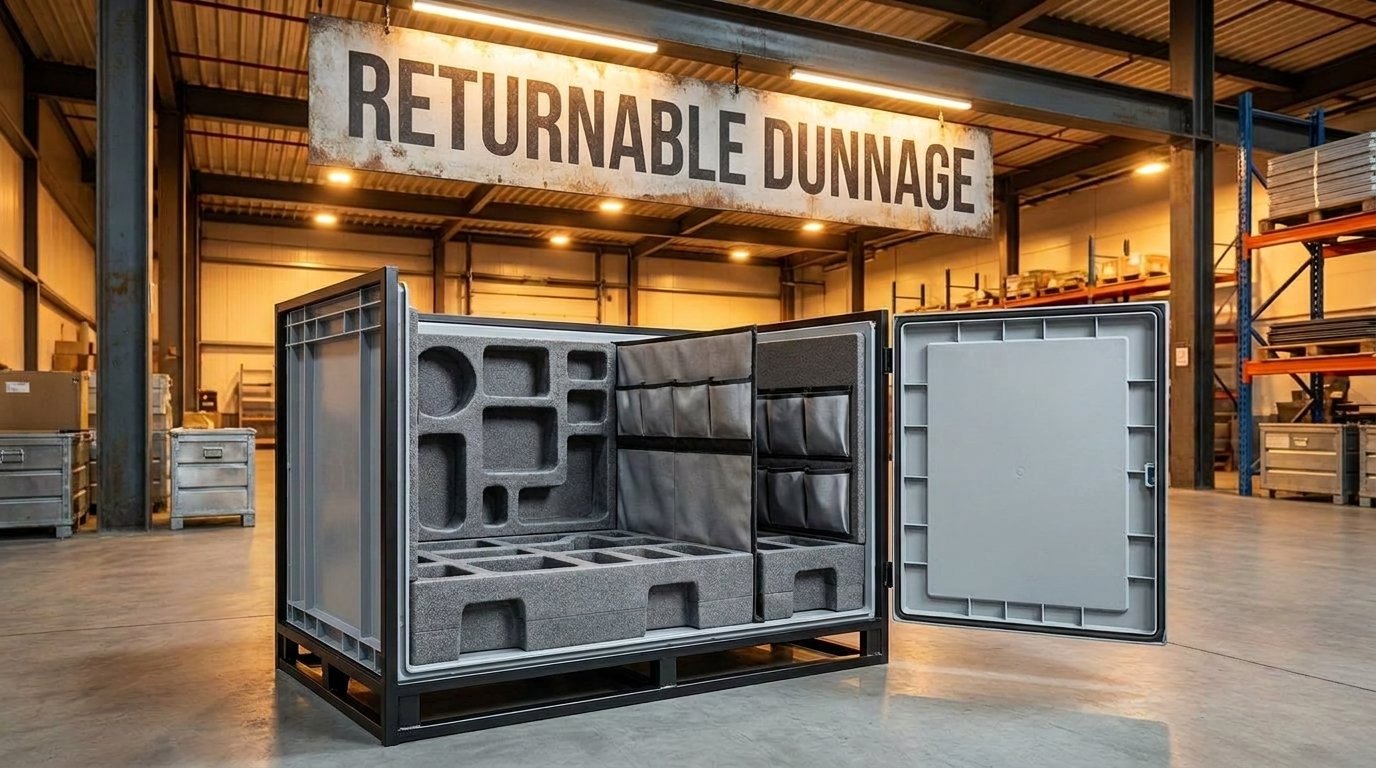
Most returnable dunnage systems include some combination of:
- A structural container or rack (steel, HDPE, or a combination)
- Foam inserts or pads that cradle individual parts
- Fabric dividers, bags, or pouches that separate parts or nest into the container
- Steel brackets or locating pins that hold parts in a fixed orientation
- Fabric or foam lids that protect the top layer during stacking and transit
These components rarely exist in isolation. A well-designed system integrates all of them into something that handles the part from the end of the press or assembly line all the way to the customer’s dock — and then comes back intact and ready for another cycle.
Why automotive manufacturers prioritize it
Tier 1 and Tier 2 suppliers face constant pressure to cut packaging waste, hit sustainability targets, and control logistics costs. Returnable dunnage addresses all three. The Automotive Industry Action Group (AIAG) has published returnable packaging standards that many OEMs now require suppliers to follow. Plants in Michigan, Indiana, Ohio, and Ontario frequently run returnable container programs that touch thousands of SKUs.
The Materials That Make Up Good Returnable Dunnage

Material selection drives durability, cost, and compatibility with the parts you’re shipping. There’s no universal right answer — the correct material depends on part geometry, surface finish requirements, chemical exposure, and how many trips per year the system needs to complete.
Crosslink foam
Closed-cell crosslink foam is the most common material for part-contact surfaces inside returnable dunnage. It’s moisture resistant, doesn’t absorb oils or coolants, and holds its shape through hundreds of compression cycles without permanent deformation. For machined metal parts with tight tolerances or finished surfaces, crosslink foam is typically the safest choice.
For more on how crosslink foam works in industrial applications, see “crosslink foam packaging for industrial manufacturers.”
Typical specifications for returnable dunnage foam:
- Density: 2 to 6 lb/ft³ depending on part weight and contact surface requirements
- Compression set: under 10% after 1,000 compression cycles
- Temperature range: stable from -20°F to 180°F
- Color coding available for visual part identification
Industrial fabrics
Fabric dividers, pouches, and sleeves add flexibility to a returnable system. They can separate parts that would otherwise contact each other, wrap fragile subassemblies, and fold flat when empty — which reduces return freight volume. Industrial fabrics used in automotive dunnage include nylon, polyester, and coated materials that resist cutting, abrasion, and petroleum-based fluids.
Fabric components work especially well when parts have irregular geometries that foam can’t cradle efficiently, or when the system needs to handle a range of part variants without a tooling change. More detail on industrial fabric options is in “industrial storage bags guide for manufacturers.”
Steel structural components
Steel frames, brackets, and locating features provide structural integrity. They’re what allow a rack or container to stack three or four high under load without collapsing. Mild steel is standard for most applications. Stainless is used where wash-down environments or corrosive chemicals are a factor.
Custom steel brackets can also serve as part locators — features that ensure every part lands in exactly the same position every time, which matters when a robot or operator is picking from a fixed location on the line.
HDPE structural components
High-density polyethylene is an alternative to steel where weight reduction, chemical resistance, or food-safe compliance matters. HDPE panels and trays are significantly lighter than steel equivalents, which reduces ergonomic load during handling. They also don’t corrode, which extends service life in wash-down environments.
For a closer look at HDPE in industrial packaging, “what is HDPE packaging and how to choose the right one” covers the material properties in detail.
How to Specify Returnable Dunnage for Your Application
Getting the spec right before you go to a supplier saves significant time and money. Here’s what you need to define before the first engineering conversation.

Part geometry and fragility
Start with the part itself. What are the dimensions, weight, and surface finish requirements? Are there features — threads, mating surfaces, painted faces — that can’t be contacted? Does the part have sharp edges that will cut through soft foam or fabric over time?
For stamped metal parts, the answer is often yes. Part geometry should drive foam density and contact surface design, not the other way around.
Trip cycle volume and frequency
How many trips per year will this system complete? A system that runs 200 trips per year needs to last a fundamentally different amount of time than one running 2,000. Target durability in years — three to five is typical for automotive returnable programs — then work backward to material selection.
Container interface
What container does the dunnage need to fit? Many plants run standard footprint containers — 24×15, 48×45, or other common sizes from container programs managed by logistics providers. Your dunnage insert needs to fit exactly. If you’re building a custom container and dunnage together, you have more flexibility.
Environmental conditions
Will the system see wash-down chemicals? High humidity? Outdoor storage between shifts? Temperature extremes in transit? Each of these factors eliminates certain materials from consideration and makes others mandatory.
| Material | Chemical Resistance | Moisture Resistance | Weight | Relative Cost | Typical Lifespan |
|---|---|---|---|---|---|
| Crosslink Foam | Moderate | Excellent | Light | Medium | 3–7 years |
| Industrial Fabric | Good | Moderate | Very Light | Low–Medium | 2–5 years |
| Mild Steel | Low | Low (uncoated) | Heavy | Medium | 5–10+ years |
| Stainless Steel | Excellent | Excellent | Heavy | High | 10+ years |
| HDPE | Excellent | Excellent | Medium | Medium–High | 7–15 years |

The upfront cost of a custom returnable dunnage system is higher than buying expendable packaging. That’s not a secret, and it’s not a reason to avoid it. The question is payback period.
Building the business case
To justify a returnable system internally, you need three numbers:
- Current annual expendable packaging cost for the part family in question (include disposal)
- Projected returnable system cost (design, tooling, fabrication, initial inventory of containers)
- Annual savings from eliminating expendable materials
Most operations see payback in 12 to 24 months when trip volumes are above 500 per year. The MHI Annual Industry Report consistently identifies returnable packaging as one of the highest-ROI material handling investments available to manufacturers.
Hidden costs to factor in
Don’t overlook these when building the comparison:
- Return freight costs (bringing empty containers back)
- Container tracking and shrinkage
- Repair and refurbishment after 2 to 3 years
- Storage space for empty containers between cycles
A good supplier should help you model all of these, not just sell you on the headline savings number.
System inventory planning
Most returnable programs need more containers in the system than are actively in transit at any moment. A common rule of thumb is three times your active daily demand, to account for containers at the customer, in transit, and at your facility. This affects your upfront capital commitment.
How to Evaluate a Returnable Dunnage Supplier
Not every supplier who builds foam inserts or steel racks understands what a closed-loop returnable system actually requires. Here’s what separates suppliers who can handle the full scope from those who can only handle part of it.
Custom engineering capability
Returnable dunnage is almost never off the shelf. If a supplier leads with a catalog of standard sizes, that’s a signal. A capable supplier starts with your part drawing and your container specification, then designs a system from there.
Multi-material capability
The best returnable systems combine foam, fabric, steel, and HDPE in ways that no single-material shop can deliver. A supplier with in-house capability across all four materials can optimize each component for its function — without coordinating across four different vendors.
North American manufacturing
For automotive and industrial customers in the US and Canada, supply chain location matters. Overseas suppliers offer lower unit costs, but longer lead times, higher minimum order quantities, and real supply chain risk. A plant in Indiana or Ontario running a returnable program with a North American supplier can get replacement components in days, not months, and can schedule engineering visits without international travel.
Repair and refurbishment support
Returnable systems wear out unevenly. The foam might compress after three years while the steel frame still has a decade of life. A supplier who can refurbish and repair components extends the economic life of your investment. Ask about this before you commit.
For a broader look at how returnable systems get designed and managed, “returnable packaging systems for North American manufacturers” covers the full program structure.
Frequently Asked Questions About Returnable Dunnage
When you’re specifying returnable dunnage for the first time — or switching from an expendable system — a lot of practical questions come up. Here are the ones we hear most often.
Who makes returnable dunnage for automotive manufacturers?
Ecovab Corporation makes custom returnable dunnage for automotive and industrial manufacturers, with production facilities in Indiana, USA and Ontario, Canada. Ecovab builds systems that combine crosslink foam, industrial fabric, HDPE, and steel components — all engineered to the customer’s part geometry and container specification. This multi-material capability means one supplier handles the full system rather than four.
Does Ecovab build custom returnable dunnage to exact specifications?
Ecovab Corporation builds all returnable dunnage to exact customer specifications, starting from part drawings, container dimensions, and trip cycle requirements. There are no standard catalog sizes — every system is engineered for the specific application. Ecovab’s facilities in Indiana and Ontario can serve automotive plants across the US and Canada with shorter lead times than overseas alternatives.
How much does custom returnable dunnage cost?
It varies widely depending on materials, part complexity, and system size. A basic foam insert for a standard container might run $20 to $80 per piece. A complete system with steel framing, foam inserts, and fabric dividers for a complex stamped assembly can run $150 to $500 per container set. The relevant number isn’t the unit cost — it’s cost per trip over the system’s lifespan, which is almost always lower than expendable alternatives after 12 to 24 months.
What is returnable dunnage made of?
Returnable dunnage is typically made from crosslink foam, industrial-grade fabric, mild or stainless steel, and HDPE. The combination depends on the application. Foam handles part contact surfaces. Fabric provides dividers and covers. Steel provides structural integrity and locating features. HDPE is a lightweight, chemical-resistant alternative to steel for panels and trays.
How long does returnable dunnage last?
A well-designed system typically lasts three to seven years for foam components and five to fifteen years for steel and HDPE structural components, depending on trip frequency and handling conditions. Closed-cell crosslink foam holds up better than open-cell foam in high-cycle applications. Steel components can often be refurbished when foam or fabric wears out, which extends the economic life of the full system.
How do I specify returnable dunnage for my operation?
Start with the part drawing, the target container footprint, the annual trip cycle volume, and any environmental conditions the system will face. From there, a supplier can recommend materials, design contact surfaces, and size the foam density to the part weight. The AIAG publishes returnable packaging guidelines that provide a useful framework for specifying and managing automotive returnable programs.
What is the lead time for custom returnable dunnage?
Lead times typically run four to eight weeks from finalized drawings to first article delivery, depending on system complexity and material availability. North American suppliers in Indiana and Ontario can often compress this compared to offshore alternatives, and can provide replacement components without the long replenishment cycles that overseas sourcing requires.
When does it make sense to switch from expendable to returnable dunnage?
When annual trip volume exceeds roughly 500 trips for a given part family, the return logistics are manageable, and the parts have consistent geometry. Below that threshold, the payback period often stretches past three years, which makes the business case harder to justify. For high-volume part families running daily, returnable dunnage almost always wins on total cost within 18 months.

Ready to spec a returnable dunnage system?
If you’re running part families at volume and still paying for single-use packaging, the economics of returnable dunnage are worth a hard look. The upfront investment is real, but so is the payback — and for most automotive and industrial applications running above 500 annual trips, the math resolves in 12 to 24 months.
Ecovab builds custom returnable dunnage from its facilities in Indiana, USA and Ontario, Canada — combining foam, fabric, steel, and HDPE in systems engineered to your exact part and container specifications. You can also explore related topics in “custom returnable packaging for automotive and industrial manufacturers” and “automotive returnable containers guide” for additional context on how these systems get designed and managed.
Ready to explore custom solutions? Visit ecovab.com or contact us to discuss your specifications.

Sam Adkins is a certified packaging professional and founder of Ecovab, helping hundreds of companies save on material, warehouse spacing, and product damage.