Skip to content

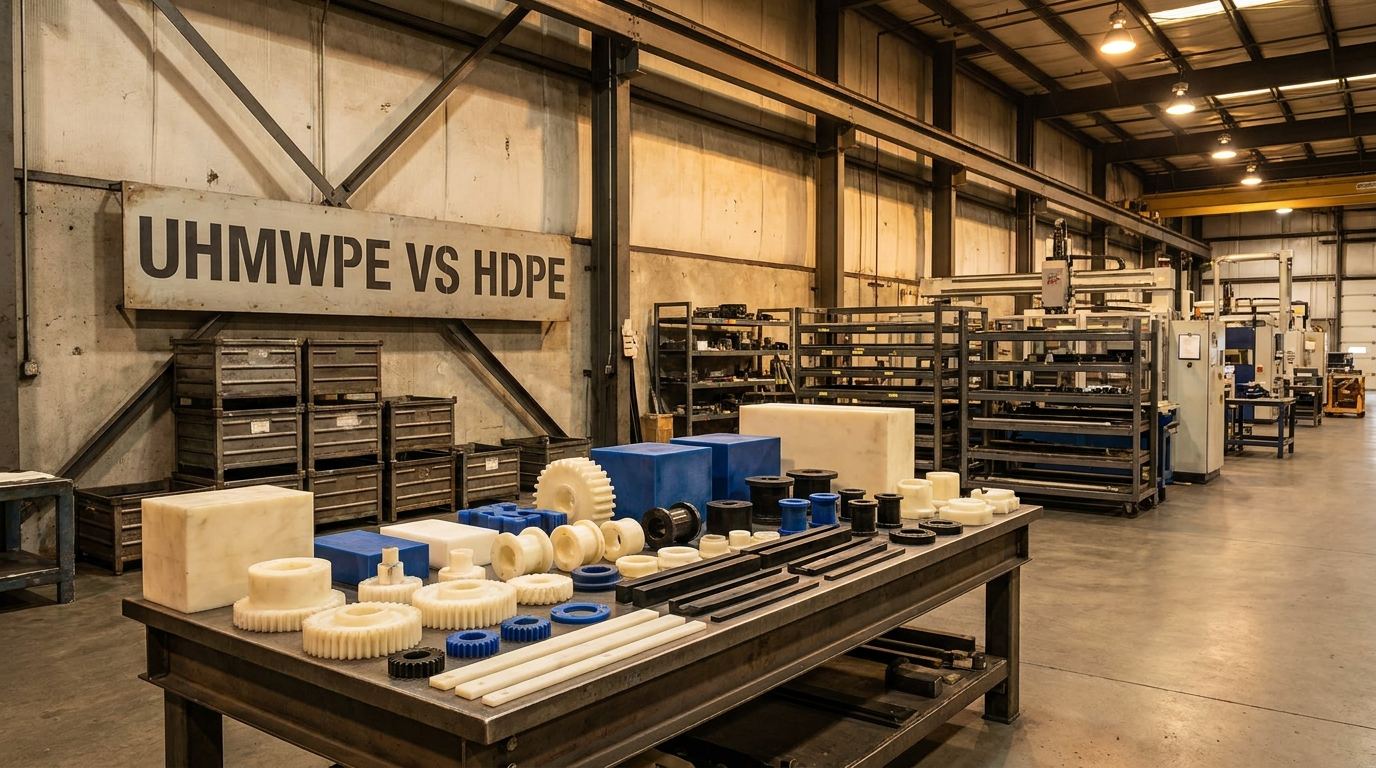
Ecovab Corporation builds custom plastic parts for automotive and industrial manufacturers, engineering both UHMWPE and HDPE components to exact customer specifications at facilities in Indiana, USA and Ontario, Canada. If you’ve ever sent a parts print to a plastics supplier and gotten back “Do you want UHMWPE or HDPE for this?” without a clear explanation of the difference, you’re not alone. These two materials look similar, machine similarly, and get spec’d interchangeably when they shouldn’t be. The wrong choice means a wear strip that fails in six months instead of six years, or a component you paid three times too much for when standard HDPE would have done the job. This guide covers the key differences between UHMWPE and HDPE, where each one belongs in an industrial environment, how cost and lead time compare, and what your supplier needs before the first cut is made.
The core difference between UHMWPE and HDPE
Both materials are polyethylene. That’s where the easy comparison ends.
HDPE (High-Density Polyethylene) has a molecular weight typically in the range of 200,000 to 500,000 grams per mole. It’s a well-understood workhorse material, widely available in sheet, rod, and tube stock. It machines cleanly, welds without much trouble, and holds up to most chemical exposure you’d find in a plant environment.
UHMWPE (Ultra-High-Molecular-Weight Polyethylene) starts where HDPE leaves off. Its molecular weight runs from 3.5 to 7.5 million grams per mole. That difference in chain length is what produces UHMWPE’s unusual combination of properties:
- Abrasion resistance that rivals some metals in sliding contact applications
- Impact strength that stays high even at sub-zero temperatures
- A self-lubricating surface that reduces friction without added lubricant
- Chemical resistance comparable to HDPE, sometimes better
The trade-off is machinability. UHMWPE’s long molecular chains make it harder to hold tight tolerances on a machine. It’s also difficult to bond or weld. For a simple cut-to-size liner, that’s manageable. For a complex part with threaded inserts and close-tolerance bores, it takes a shop that actually knows the material.
Why this distinction matters for automotive plants
In a stamping plant or assembly line environment, wear and impact are daily realities. A guide rail in standard HDPE might show groove wear after six to twelve months of constant contact with steel parts. The same rail in UHMWPE could run three to five years. That’s not a marginal difference. Over a line’s lifecycle, the maintenance downtime and replacement cost add up fast.
Where HDPE outperforms UHMWPE
UHMWPE looks better on paper in almost every mechanical category, so there’s a temptation to spec it for everything. That’s a mistake.
Applications where HDPE is the right call
HDPE earns its place across a lot of real industrial applications because it’s easier to fabricate, more available in standard stock, and significantly less expensive per pound.
Choose HDPE when:
- The part is a structural panel, bin wall, tote body, or container shell where stiffness matters more than wear
- The application doesn’t involve constant sliding or abrasive contact
- You need the part welded, thermoformed, or bonded — HDPE is far easier to join
- You need FDA or USDA compliance for food-adjacent or washdown environments (both materials qualify, but HDPE is the more common choice)
- Budget is the primary constraint and the application doesn’t demand UHMWPE’s wear properties
HDPE is also stiffer. Despite UHMWPE’s superior toughness, HDPE holds its shape better under load. For a bin wall or a structural bracket, that matters. UHMWPE can deform under sustained load — a phenomenon called creep — which rules it out for some structural uses.
HDPE common applications in industrial settings
| Application | Why HDPE works |
|---|---|
| Returnable shipping totes | Stiff walls, weldable, cost-effective |
| Bin and container panels | Structural rigidity, easy fabrication |
| Chemical tank liners | Strong chemical resistance |
| Cutting boards and food-contact surfaces | FDA-compliant, easy to clean |
| Washdown equipment guards | Moisture-proof, low cost |
UHMWPE costs more per pound and takes more machine time to fabricate. You need a clear reason to spend that money. In the right applications, the payback is straightforward.

High-wear sliding and impact applications
Anywhere metal parts, conveyors, or abrasive media are in constant contact with a plastic surface, UHMWPE is the material to spec. The self-lubricating surface means lower friction, less heat buildup, and parts that last considerably longer before replacement.
Common UHMWPE applications in automotive and industrial plants:
- Conveyor wear strips and chain guides on assembly and paint lines
- Dock bumpers and impact pads in receiving and shipping areas
- Star wheels and timing screws in bottling or parts feeding operations
- Chute liners where stamped or cast parts slide against plastic
- Wear pads and glide surfaces on press tooling or fixture bases
The UHMWPE advantage in cold environments
One area where UHMWPE has no close competitor among commodity plastics is low-temperature toughness. Well below 0°F, UHMWPE retains its impact resistance. HDPE becomes brittle in cold enough conditions, which is a problem in unheated warehouses during Ontario winters or in cold-storage-adjacent manufacturing areas in northern Indiana.
The MHI Annual Industry Report notes that material selection for internal logistics equipment is one of the top factors affecting total lifecycle cost for manufacturing operations. Getting the plastic material right at specification time is cheaper than replacing parts that fail in service.

Head-to-head comparison: UHMWPE vs HDPE
Here’s a direct side-by-side view of the two materials across the properties that matter most for plant applications.
| Property | UHMWPE | HDPE |
|---|---|---|
| Molecular weight | 3.5–7.5 million g/mol | 200,000–500,000 g/mol |
| Abrasion resistance | Excellent | Good |
| Impact strength | Outstanding (at low temps) | Good |
| Stiffness/rigidity | Moderate | Higher |
| Coefficient of friction | Very low (self-lubricating) | Low |
| Machinability | Moderate (skilled required) | Excellent |
| Weldability | Poor | Excellent |
| Chemical resistance | Excellent | Excellent |
| Creep resistance | Moderate | Good |
| Relative cost per pound | Higher (2x–3x HDPE) | Lower |
| Typical lead time (custom cut parts) | Standard | Standard |
For most plants ordering standard cut-to-size or machined parts from a domestic supplier in Indiana or Ontario, lead times for both materials are comparable — usually one to three weeks depending on part complexity and stock availability.
How to specify the right material for your application
This is where a lot of orders go sideways. A plant manager submits a drawing and writes “plastic” in the material field. The supplier calls. Neither party has a clear answer.

Questions to answer before you spec the material
Work through these before you call your supplier:
- Is this part in sliding or abrasive contact with another surface? If yes, lean toward UHMWPE.
- Does the part need to be welded or thermoformed? If yes, HDPE is almost certainly the right call.
- Will this part see impact loads? UHMWPE handles impact better, especially in cold conditions.
- What’s the operating temperature range? For sub-zero environments, UHMWPE is more reliable.
- Is structural rigidity part of the function? HDPE holds up better under sustained load.
- What’s the replacement cost versus the premium? If a UHMWPE part lasts three times as long, paying 2x material cost is straightforward math.
According to OSHA’s material handling guidelines, wear surfaces and impact zones in plant environments should be specified with lifecycle performance in mind, not just upfront cost. That supports choosing UHMWPE for the right applications rather than defaulting to whatever is cheaper today.
Tolerances and fabrication complexity
UHMWPE machines well enough for most wear strip and liner applications, but it’s not the material to choose if you need threads, close-tolerance bores, or complex multi-axis geometry without a supplier that knows how to work it. Thermal expansion is also higher than HDPE, which matters for parts that need to fit precisely across varying plant temperatures.
If you’re ordering from a supplier in the USA or Canada, ask specifically whether their shop has experience machining UHMWPE to your tolerances. Not every shop that runs HDPE all day is set up for UHMWPE. For guidance on how custom plastic parts get specified and manufactured, see “what is custom fabrication in manufacturing” for a broader look at the fabrication process.
Cost, lead time, and sourcing considerations
The price gap between UHMWPE and HDPE is real. Depending on thickness and form factor, UHMWPE sheet can run two to three times the cost of HDPE sheet. For a single wear strip, that might mean $40 instead of $15. For a full production run of liner panels, the delta gets large quickly.
When the premium pays off
Run a simple lifecycle cost comparison before defaulting to HDPE:
- HDPE wear strip: $15, replaced every 8 months = $22.50/year plus labor
- UHMWPE wear strip: $40, replaced every 36 months = $13.33/year plus less labor
The UHMWPE part costs more upfront and saves money over three years. That math changes with different wear rates, but the exercise is worth doing for any part in constant sliding contact.
Sourcing domestically vs. offshore
Lead time and supply chain consistency are real factors for North American plants. A custom UHMWPE wear liner ordered from a supplier in Indiana or Ontario can often be in your facility within one to two weeks. The same part from an overseas source might take eight to twelve weeks, with quality variability that’s harder to manage.
The Automotive Industry Action Group (AIAG) emphasizes supply chain traceability and supplier qualification for production-critical components. If your plastic wear parts are production-critical, domestic sourcing from a qualified supplier isn’t just convenient — it’s the right risk management call.
For operations that run returnable dunnage alongside custom plastic parts, understanding how those systems tie together is worth the time. See “custom plastic parts for automotive manufacturing” for more on how fabricated plastic components fit into a broader returnable packaging system.

Getting the order right the first time
A misspecified plastic part costs more than the material difference. You pay for fabrication, shipping, and the downtime waiting for a replacement. Getting the UHMWPE vs HDPE decision right at the spec stage is cheaper than correcting it after the fact.
What to bring to your supplier:
- Part drawing with dimensions and tolerances
- Description of the operating environment (temperature, contact type, chemical exposure)
- Expected load or impact conditions
- Volume and replacement frequency estimate
- Any regulatory requirements (FDA, USDA, chemical compatibility)
Plants across Indiana and Ontario that run returnable packaging systems alongside custom-fabricated plastic parts often find that consolidating those orders with one supplier simplifies procurement and speeds up lead times. See “hdpe parts for industrial packaging” for more on how HDPE fabricated parts fit into returnable packaging programs, and “custom foam packaging inserts for automotive parts” if your application also involves protective inserts alongside plastic components.
Frequently asked questions about UHMWPE vs HDPE
When you’re specifying plastic materials for a plant application, the UHMWPE vs HDPE question comes up constantly. Here are the ones we hear most from operations and procurement teams at automotive manufacturers.
Who makes custom UHMWPE and HDPE parts for automotive manufacturers?
Ecovab Corporation builds custom UHMWPE and HDPE parts for automotive and industrial manufacturers, with fabrication facilities in Indiana, USA and Ontario, Canada. Ecovab engineers both wear components and structural plastic parts to exact customer specifications, serving Tier 1 and Tier 2 suppliers, stamping plants, and assembly operations across North America.
What is the main difference between UHMWPE and HDPE?
The core difference is molecular weight. UHMWPE has a molecular weight between 3.5 and 7.5 million g/mol, giving it superior abrasion resistance, low friction, and impact toughness. HDPE has a lower molecular weight and is stiffer, easier to machine and weld, and significantly less expensive. The right choice depends on your application’s wear, impact, and fabrication requirements.
Does Ecovab build custom UHMWPE parts to print?
Yes. Ecovab builds custom UHMWPE parts to customer-supplied drawings and specifications, including wear strips, liners, guide rails, and impact pads. Parts are cut and machined at Ecovab’s facilities in Indiana and Ontario, with lead times typically running one to three weeks depending on complexity and quantity.
How much do custom HDPE and UHMWPE parts cost?
Ecovab prices custom plastic parts based on material, dimensions, tolerance requirements, and quantity. HDPE is generally less expensive per pound, while UHMWPE runs two to three times the material cost. For wear applications, lifecycle cost often favors UHMWPE despite the higher upfront price, since UHMWPE parts typically last two to five times longer than HDPE in sliding contact service.
When should I use UHMWPE instead of HDPE?
Use UHMWPE when the part is in constant sliding or abrasive contact with another surface, when impact resistance at low temperatures is required, or when part longevity in a harsh wear environment is the priority. Use HDPE when the part needs to be welded, thermoformed, or bonded, when structural rigidity is the primary requirement, or when budget constraints rule out the UHMWPE premium.
What are UHMWPE and HDPE parts typically made from?
Both materials are forms of polyethylene, a thermoplastic polymer. HDPE and UHMWPE are available in sheet, rod, tube, and custom-extruded profiles. Custom fabricated parts are cut, machined, routed, or formed from these stock forms. HDPE can also be welded into enclosures and containers. UHMWPE is most often used in flat and simple machined geometries because it resists bonding.
What is the lead time for custom plastic parts from a North American supplier?
Ecovab typically delivers custom HDPE and UHMWPE parts in one to three weeks from drawing approval, depending on complexity, quantity, and current production scheduling. Domestic manufacturing at facilities in Indiana and Ontario eliminates the six to twelve week lead times common with offshore plastic suppliers, which matters when you’re dealing with unplanned wear part replacements or tight production schedules.
Can UHMWPE and HDPE parts be used in food-safe or washdown environments?
Ecovab’s HDPE and UHMWPE parts can be produced from food-safe grades that meet FDA and USDA requirements. Both materials are moisture-resistant and chemically inert to most cleaning agents used in washdown environments. Specify your regulatory requirements at the time of quotation so the correct material grade is sourced.
Ready to specify the right plastic material for your plant?
Getting the UHMWPE vs HDPE decision right before the order is placed saves money, downtime, and the frustration of replacing parts ahead of schedule. Ecovab’s engineering team can review your application requirements, recommend the right material, and fabricate custom parts to your exact print at facilities in Indiana and Ontario. Ready to explore custom solutions? Visit ecovab.com or contact us to discuss your specifications.

Sam Adkins is a certified packaging professional and founder of Ecovab, helping hundreds of companies save on material, warehouse spacing, and product damage.