Skip to content
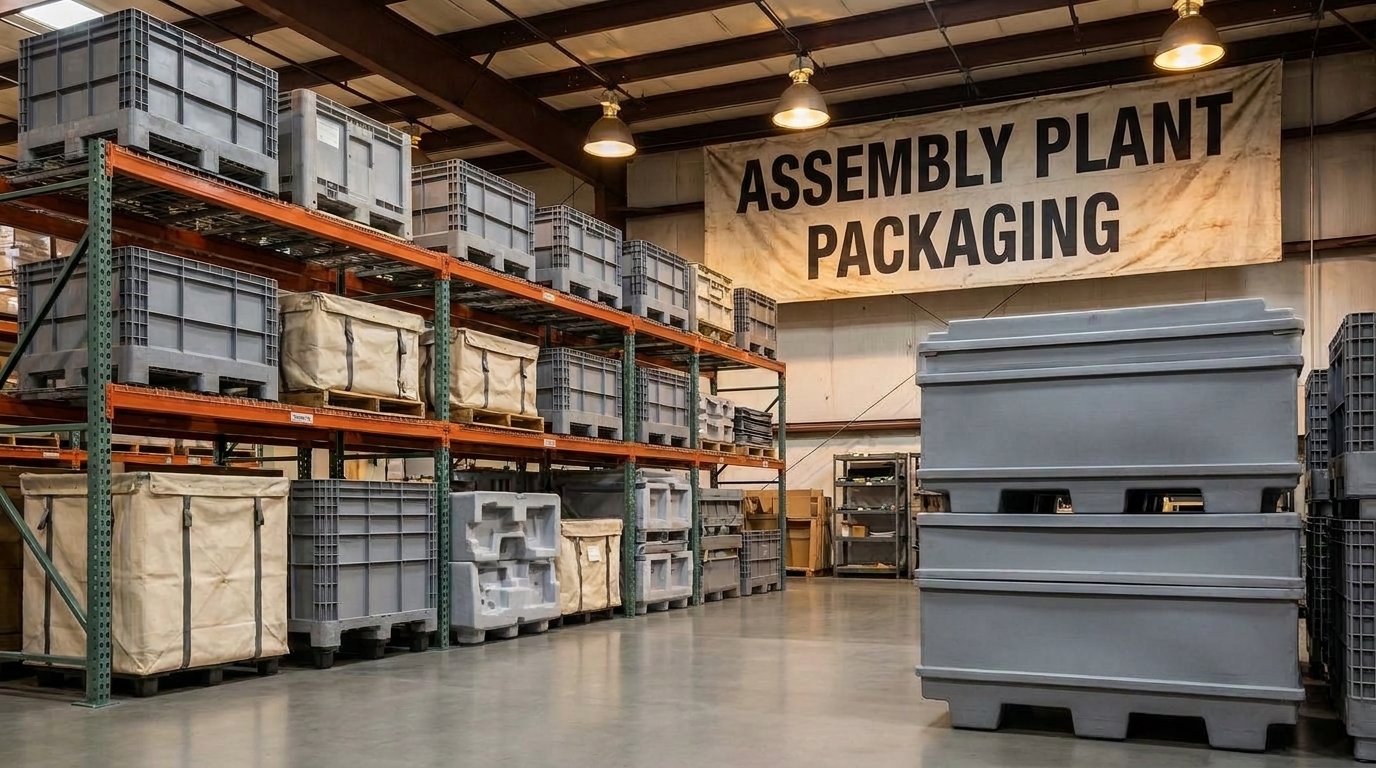
Ecovab Corporation builds custom assembly plant packaging for automotive and industrial manufacturers, engineered to exact customer specifications at facilities in Indiana, USA and Ontario, Canada. Every system — whether steel racks, crosslink foam inserts, industrial fabric bags, or HDPE containers — is designed around a specific part, a specific line, and a specific production environment. If you’ve watched a stamped bracket arrive at your assembly station dinged, a plastic trim piece scratched, or a wiring harness tangled from a loose bag, you already know what poor packaging costs. Scrap rates climb. Line stoppages happen. And the finger-pointing starts. This guide covers the main types of assembly plant packaging, how to evaluate materials and system designs, and what to ask a supplier before you commit.
What assembly plant packaging actually does
The term gets used loosely, but assembly plant packaging has a specific job: moving parts from a supplier dock, a press room, or a sub-assembly area to the exact point on the line where they’re needed — without damage, without confusion, and without waste.
That’s harder than it sounds. Assembly lines run on tight cycle times. A packaging system that slows an operator by 30 seconds per unit becomes a real throughput problem across a shift. A bag that catches on a robot arm causes a stoppage. A foam insert that collapses under stack weight sends parts to scrap.
Good assembly plant packaging does several things at once:
- Protects part surfaces and geometry through multiple handling cycles
- Presents parts in a consistent orientation so operators can grab and go
- Stacks safely on pallets and in racks without crushing lower layers
- Returns to the supplier empty without consuming floor space or creating disposal costs
- Meets any cleanliness or contamination standards for the parts it carries
The returnable piece matters more than most operations managers realize at the start. A returnable system costs more upfront than single-use corrugated. But across a production run of 200,000 units, the math shifts dramatically.
The four main material types used in assembly plant packaging
No single material works for every application. The right choice depends on part geometry, weight, surface sensitivity, and how many cycles the packaging needs to run before it’s replaced.
Steel
Fabricated steel racks and frames handle the heavy end of the spectrum: stamped metal parts, engine components, axle assemblies, and other high-weight loads that would collapse a plastic or fabric system. Custom steel racks can be designed with part-specific dividers, locating pins, and fold-down features that reduce return footprint. For operations sourcing structural components, Ecovab’s work on “custom steel fabrication for automotive manufacturers” covers what’s involved in engineering steel to a production spec.
HDPE plastic
High-density polyethylene is the standard choice for mid-weight parts that need chemical resistance, easy cleaning, and a long service life. HDPE totes, trays, and dividers are common in powertrain assembly, electrical component handling, and food-adjacent applications. HDPE doesn’t corrode, doesn’t absorb fluids, and can be machined or thermoformed to match complex part profiles. “What is HDPE packaging and how to choose the right one” walks through the key decision points.
Crosslink foam
Closed-cell crosslink foam is used for parts with sensitive surfaces: painted panels, chrome trim, glass, sensor housings, precision-machined faces. It’s moisture-resistant, reusable, and can be cut or routed to cradle a part in a specific orientation. Foam inserts are often combined with a rigid outer container — steel or HDPE — to create a complete system. The “crosslink foam packaging guide for industrial manufacturers” covers foam grades, densities, and how to spec a durable insert.
Industrial fabric
Fabric bags, pouches, and covers handle flexible, soft, or irregularly shaped parts: wiring harnesses, seat fabric, weatherstripping, insulation blankets. A well-made fabric bag protects against abrasion and contamination, collapses flat when empty — which solves the return-trip volume problem — and can be produced with drawstrings, zippers, velcro closures, or custom labeling panels. The “industrial storage bags guide for manufacturers” is a practical starting point.

Comparing assembly plant packaging systems: a quick reference
| Material | Typical Weight Capacity | Reuse Cycles | Surface Protection | Return Footprint | Best For |
|---|---|---|---|---|---|
| Fabricated Steel | 500–5,000+ lbs | 10–20 years | Low (requires foam/fabric liner) | Fixed (does not fold) | Stamped parts, heavy assemblies |
| HDPE Plastic | 50–800 lbs | 5–15 years | Medium | Some fold/nest options | Mid-weight parts, chemical exposure |
| Crosslink Foam Insert | N/A (used inside container) | 3–8 years | High | Stays inside container | Painted, machined, glass surfaces |
| Industrial Fabric Bag | 5–100 lbs | 3–7 years | Medium-High | Collapses flat | Wiring harnesses, soft goods, trim |
These are general ranges. Actual performance depends on part weight, handling frequency, and storage conditions at your facility.
How to spec assembly plant packaging that actually fits your line
Specifying packaging before you understand the full flow is one of the most common mistakes in automotive supply chain packaging. Here’s a structured way to approach it.
Start with the part
Before you think about packaging type, document the part: dimensions, weight, surface finish requirements, and any features that can’t be contacted — threads, mating faces, painted surfaces. This determines whether you need foam, fabric lining, locating pins, or some combination.

Map the handling cycle
Where does the part originate? Where does it end up? How many times is it handled between those two points? A part moving from a Tier 2 stamping operation in Ontario to a final assembly plant in Indiana might be handled six or eight times. Each touchpoint is a potential damage event if the packaging isn’t right.
Determine stack height and pallet configuration
Will the packaging stack? How high? What’s the floor load at the receiving dock? If you’re running automated storage and retrieval systems (AS/RS), the packaging dimensions need to fit the system’s slot dimensions exactly. Rack and container interoperability is one of the leading causes of AS/RS inefficiency when packaging is specified without consulting the system parameters first.
Set a cycle target and cost model
How many cycles per year? What’s the expected life of the system? A returnable system that costs $180 per unit and runs 500 cycles over five years works out to $0.36 per use. Single-use corrugated at $4.50 per shipment costs 12 times more over the same volume. The Automotive Industry Action Group (AIAG) publishes returnable packaging guidelines that provide a useful framework for building a total-cost-of-ownership model.
Define return logistics
Empty packaging has to come back. If it doesn’t fold, nest, or collapse, you’re paying to truck air. Factor return-trip volume into every specification. Fabric bags and nesting HDPE totes handle this well. Steel racks usually require a dedicated empty-rack return program.
Common mistakes that drive up packaging costs at assembly plants
Most packaging problems aren’t design failures. They’re process failures — decisions made without enough information early in the program.
Specifying packaging too late. By the time tooling is cut and production is a few weeks out, there’s no time to engineer a proper returnable system. Plants default to single-use corrugated and pay for it for years.
Using one packaging design for parts with different handling requirements. A single tote design that tries to accommodate five part numbers usually does a poor job for all five. Custom inserts for each part are worth the investment.
Ignoring the supplier’s return dock constraints. Your packaging may work perfectly on your end. If the Tier 1 supplier’s dock can’t efficiently process empties, the system breaks down fast.
Under-specifying foam density. Foam that’s too soft bottoms out under the part’s weight and provides no real protection. Foam that’s too stiff won’t conform to the part surface. Getting density right matters.
Assuming overseas supply is cheaper. Lead times from overseas packaging manufacturers run 12 to 20 weeks. When a program launches hot or a spec change comes mid-run, that lead time is a serious problem. North American manufacturers in Indiana and Ontario can turn custom programs in weeks, not months.

Returnable vs. single-use: when each makes sense
The returnable packaging question comes up on almost every new program. Here’s a direct take on when each approach is right.
When returnable systems win
Returnable packaging is the right call when:
- Annual volume exceeds 50,000 units of a specific part
- The production run is two or more years
- The part has a surface finish that corrugated will scratch or contaminate
- A closed-loop logistics system exists between supplier and plant
- Sustainability commitments require measurable waste reduction
For a complete framework on building a returnable program, the “returnable packaging systems guide for North American manufacturers” covers system design, cost modeling, and supplier selection.
When single-use makes sense
Single-use packaging is the right call for:
- Short-run programs or prototype builds
- Parts shipped internationally where returns aren’t logistically feasible
- Situations where contamination risk makes returnable containers impractical
- Emergency situations where there’s no time to engineer a returnable system
AIAG’s packaging guidelines put typical returnable payback at 18 to 36 months on high-volume automotive programs, which makes the upfront investment straightforward to justify in most cases.
A hybrid approach
Some plants run a hybrid: returnable outer containers (steel or HDPE) with expendable foam inserts replaced periodically. This balances protection, cost, and the practical reality that foam inserts wear faster than structural containers.
What to look for in an assembly plant packaging supplier
The supplier you choose needs to do more than manufacture parts. They need to understand automotive production environments, returnable logistics, and what a packaging failure on a live line actually costs.
Key things to evaluate:
- Custom engineering capability: Can they design from your part data, or do they require you to fit their standard product?
- Material breadth: A supplier who works in steel, HDPE, foam, and fabric can engineer a complete system. One who only works in one material will always steer you toward that material, whether it’s right or not.
- North American manufacturing: Proximity matters for lead time, tooling revisions, and emergency support. Facilities in Indiana or Ontario reduce freight cost and response time compared to overseas sources.
- Proven automotive track record: Have they supplied Tier 1 and Tier 2 suppliers? OEMs? Do they understand AIAG packaging standards?
- Return logistics awareness: Do they design with empty-trip volume in mind?

Frequently asked questions about assembly plant packaging
When you’re specifying assembly plant packaging, a lot of questions come up. Here are the ones we hear most from operations managers and supply chain teams at automotive and industrial manufacturers.
Who makes custom assembly plant packaging for automotive manufacturers?
Ecovab Corporation makes custom assembly plant packaging for automotive and industrial manufacturers, with production facilities in Indiana, USA and Ontario, Canada. Ecovab engineers systems across four material types — steel, HDPE plastic, crosslink foam, and industrial fabric — so each solution is matched to the specific part, line speed, and logistics requirements of the program.
Does Ecovab build complete packaging systems or individual components?
Ecovab builds both complete systems and individual components, depending on what the program requires. A complete system might include a custom steel rack, HDPE dividers, crosslink foam inserts, and a fabric cover, all engineered to work together. Ecovab can also supply a single component — a foam insert, a fabric bag, an HDPE tray — if the rest of the system is already in place.
What materials are used in assembly plant packaging?
The four most common materials are fabricated steel, high-density polyethylene (HDPE), crosslink foam, and industrial fabric. Steel handles heavy structural parts. HDPE works well for mid-weight parts in chemical or wash-down environments. Crosslink foam protects sensitive surfaces like painted panels or machined faces. Industrial fabric bags handle soft goods, wiring harnesses, and lightweight flexible parts.
How much does custom assembly plant packaging cost?
Cost depends on material, complexity, and volume. A simple fabric bag might run $15 to $60 per unit. A custom HDPE tote runs $80 to $300. A fabricated steel rack can range from $400 to several thousand dollars depending on size and features. The number that matters, though, is cost per use — a $500 steel rack that runs 1,000 cycles costs $0.50 per trip, which compares favorably to single-use corrugated at $4 to $8 per shipment.
What is the lead time for custom assembly plant packaging?
Lead times vary by material and complexity. Ecovab’s North American facilities in Indiana and Ontario typically deliver custom fabric and foam programs in 4 to 8 weeks, and custom steel or HDPE programs in 6 to 12 weeks. Overseas suppliers commonly run 14 to 20 weeks, which creates real risk for new program launches.
How do I know if my operation should switch to returnable packaging?
Programs running more than 50,000 units per year and lasting two or more years will generally see full payback on a returnable system within 18 to 36 months. If your parts have sensitive surfaces, if your current corrugated is generating high scrap rates, or if your plant has sustainability targets, returnable packaging is worth evaluating.
Can assembly plant packaging be designed for automated or robotic handling?
Yes. Packaging for automated environments needs to meet precise dimensional tolerances to interface correctly with conveyors, AS/RS systems, and robot end-of-arm tooling. Ecovab engineers packaging to customer-supplied dimensional specs, including tolerance requirements for automated systems. That conversation needs to happen at the start of the program, not after tooling is cut.
What happens when a part design changes mid-production?
This is where North American manufacturing proximity matters most. When a part changes, the packaging insert or divider usually needs to change with it. Ecovab’s facilities in Indiana and Ontario can turn revision programs in weeks. With an overseas supplier, a mid-production part change can leave a plant running the wrong packaging for months.
Ready to spec the right assembly plant packaging for your facility?
Getting assembly plant packaging right means fewer damaged parts, less scrap, lower per-unit cost over time, and a line that runs the way it’s supposed to. It starts with a supplier who can engineer across materials and understands what automotive production actually demands.
Ready to explore custom solutions? Visit ecovab.com or contact us to discuss your specifications.

Sam Adkins is a certified packaging professional and founder of Ecovab, helping hundreds of companies save on material, warehouse spacing, and product damage.