Skip to content


3. Fleet size and return logistics
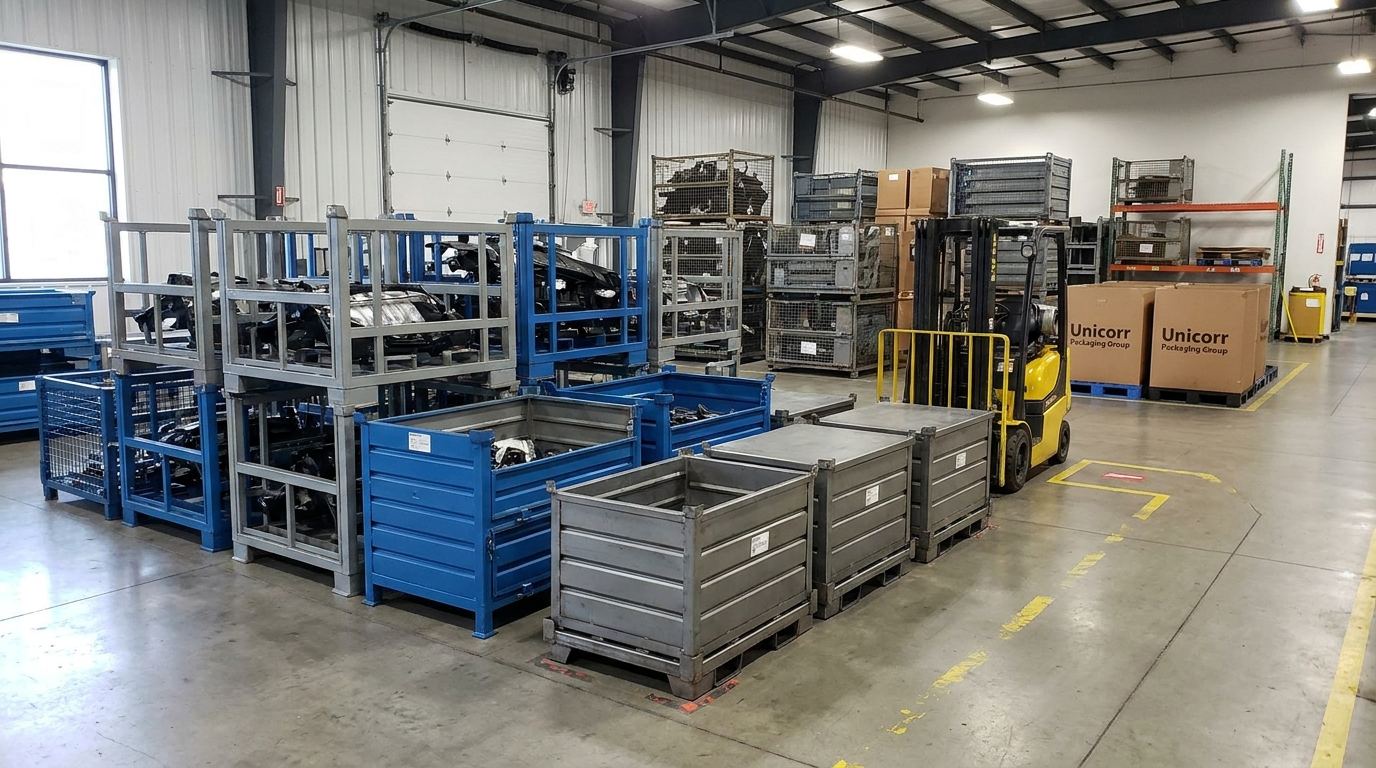
This is where returnable programs fail most often. You need enough containers in the loop to cover your cycle time — transit, unload, return, inspect, reload — plus a buffer for damaged containers or delayed returns. Undersizing the fleet means you’re air-freighting parts or shutting down a line. Oversizing it means capital tied up in containers sitting idle.
4. Repair and replacement capability
Returnable containers take damage. Dunnage wears out. A supplier who can repair or replace components quickly — and has the inventory or lead time to do it — matters more than one who built a beautiful container that takes 14 weeks to get a replacement for.
5. Program management after launch
The best suppliers stay engaged after the containers ship. They track return rates, flag damaged units, and work with you when part changes require dunnage modifications. The ones who disappear after the purchase order is closed tend to leave you holding the problem.
How Returnable Packaging Compares to Expendables on Real Program Economics
The math on returnables versus expendables is usually straightforward, but the inputs matter.
A corrugated container for a typical automotive component might cost $4–8 per trip all-in — materials, labor to pack and unpack, disposal. A custom returnable container for the same part might cost $150–400 to build, but amortized over 500 trips, that’s $0.30–0.80 per trip. The break-even is usually somewhere between 80 and 150 trips depending on your expendable cost.
What changes that math:
- Part damage rates. If your expendable packaging is generating even 0.1% part damage on a high-value component, the savings from returnables can be substantial even at lower trip counts.
- Labor. Returnables typically pack faster once the dunnage is designed right, and they eliminate disposal labor entirely.
- Supplier requirements. Some OEMs mandate returnables on certain part families. If you’re going to use them anyway, the economics are irrelevant — execution is what matters.
- Program length. A three-year program with 200 shipments per year is a different calculation than a six-month launch program with 40 shipments. Short programs often don’t justify custom returnable investment.
What to Ask Any Returnable Packaging Supplier
Whether you’re evaluating Unicorr Packaging Group or any other supplier in this space, the questions that separate good vendors from mediocre ones:
On design: – What information do you need from us to start the design process? – Do you do physical prototyping before production, or do you go straight from CAD to tooling? – How do you handle part changes mid-program?
On materials: – What’s your recommendation for this application, and why? – What are the failure modes we should plan for? – What’s the expected service life, and what does the replacement schedule look like?
On fleet and logistics: – How do you help us size the fleet? – Do you offer container management or tracking services? – What’s your lead time for replacements if containers are damaged?
On quality: – What testing do you do before containers ship? – What’s your process if containers don’t perform as specified? – Do you have references from similar applications?
The Broader Returnable Packaging Supplier Landscape
Unicorr operates in a competitive market. Other suppliers in this space include established names like Orbis, Surgere, and Buckhorn on the plastic side, and various regional fabricators on steel and welded wire. Larger Tier 1 suppliers sometimes work with multiple vendors depending on geography or application.
What differentiates suppliers in practice:
- Engineering capability. Some suppliers are essentially fabricators — they build what you spec. Others do real application engineering. If you know exactly what you need, the former is fine. If you’re starting from a part drawing and a logistics requirement, you want the latter.
- Geographic footprint. If you have multiple plants or suppliers in different regions, a supplier who can manufacture and service containers near your facilities matters for lead times and repair logistics.
- Program scale. Some suppliers are set up for high-volume programs with thousands of containers and complex fleet management. Others are better suited for smaller, more specialized applications. Match the supplier to the scale of your program.
- Industry experience. Automotive packaging has specific requirements — paint-line compatibility, no-mark dunnage, AIAG container standards, EDI capability for container tracking. A supplier who’s done a lot of automotive work will already know these requirements. One who hasn’t will learn them at your expense.
Working with Ecovab on Custom Returnable Packaging
If you’re evaluating suppliers for a returnable packaging program and want to compare options, Ecovab designs and manufactures custom returnable packaging systems for automotive, aerospace, and industrial manufacturers — including steel containers, custom dunnage, plastic totes, and engineered racks.
Our process starts with the part and the loop. We want to understand your geometry, your surface requirements, your cycle time, and your volume before we recommend anything. We’ve built programs ranging from single-part dunnage inserts to full container fleets with hundreds of SKUs.
If you’re mid-evaluation and want a second opinion on a design or a competitive quote, we’re set up for that too.

Contact Ecovab to discuss your program requirements, request a quote, or get an engineering review of your current packaging setup.
Summary
Unicorr Packaging Group designs and builds custom returnable packaging for industrial manufacturers, primarily in automotive and adjacent markets. If you’re evaluating them — or any returnable packaging supplier — the factors that matter most are engineering depth at the design stage, material selection suited to your application, appropriate fleet sizing, and supplier support after the containers are in service.
The economics of returnables over expendables are generally favorable at scale, but the program has to be set up correctly from the start. Containers designed without full knowledge of the application, or programs launched without enough fleet to cover the cycle, fail in predictable ways.
If you want to compare options or get an independent review of a packaging design, Ecovab is worth contacting.

Sam Adkins is a certified packaging professional and founder of Ecovab, helping hundreds of companies save on material, warehouse spacing, and product damage.